How to Export Spices from India — Complete Guide
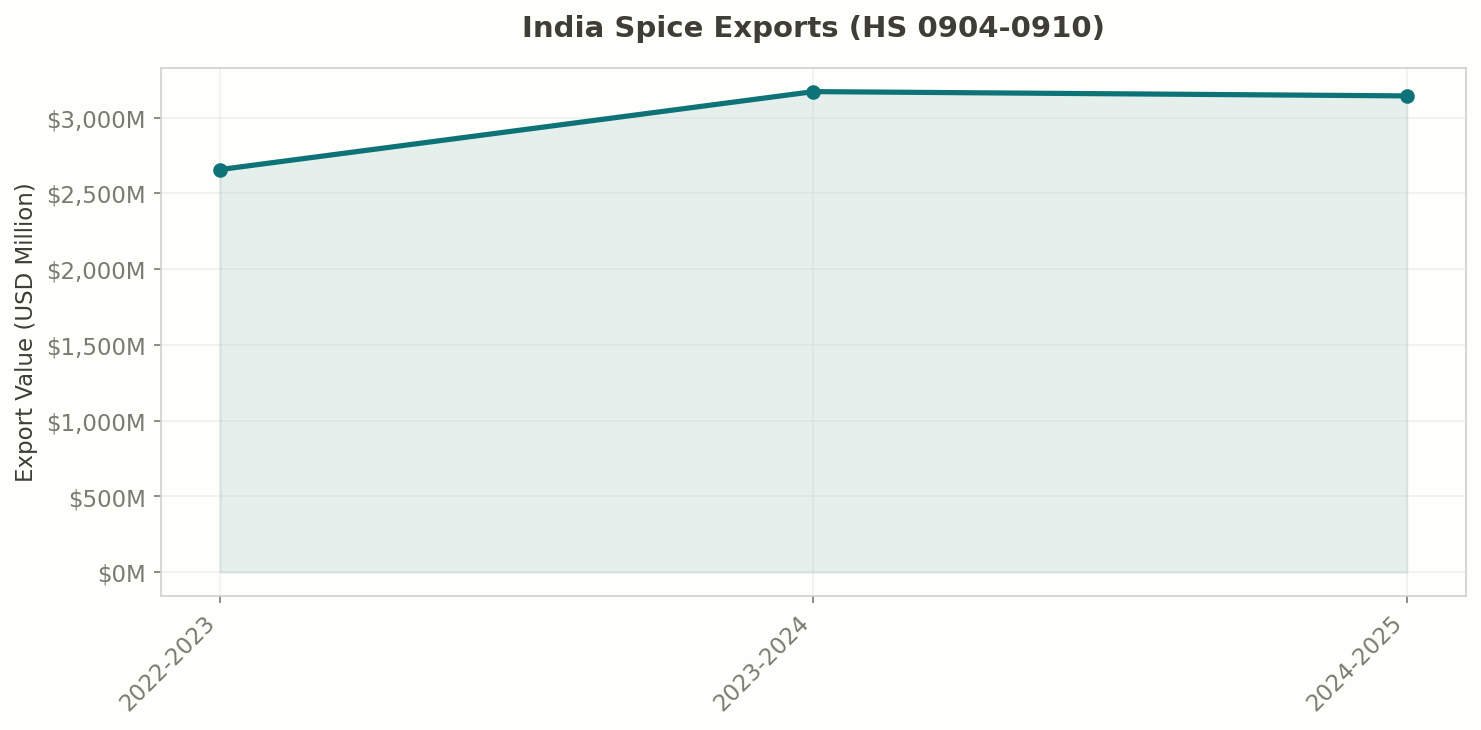
India is the world's largest producer, consumer, and exporter of spices. In 2024-25, India's spice exports reached $3.14 billion, shipping to over 150 countries. For an Indian MSME owner — whether you are a farmer in Kerala, a trader in Rajasthan, or a processor in Gujarat — spices represent one of the highest-margin agricultural export opportunities available.
The spice trade is also one of the most regulated. Between FSSAI food safety requirements, Spices Board registration, phytosanitary certificates, and importing country standards for pesticide residues and aflatoxins, there is a lot to get right. This guide covers the entire process, from identifying your product and market to shipping your first consignment.
India's Spice Export Landscape
India exported $3.14 billion in spices in 2024-25, continuing a strong growth trajectory from $2.66 billion in 2022-23 — a 19% increase over two years. The sector is resilient because spices are essential food ingredients with inelastic demand.
The major spice categories and their export values in 2024-25:
| HS Code | Spice Category | 2024-25 Exports (USD Million) | Share |
|---|---|---|---|
| 0904 | Pepper and chillies | $1,384 | 44.0% |
| 0909 | Cumin, coriander, fennel, anise | $897 | 28.5% |
| 0910 | Ginger, turmeric, saffron, curry | $593 | 18.9% |
| 0908 | Nutmeg, mace, cardamom | $242 | 7.7% |
| 0906 | Cinnamon | $14 | 0.5% |
| 0907 | Cloves | $13 | 0.4% |
Chillies and pepper (HS 0904) dominate, accounting for 44% of all spice exports. Cumin and coriander (HS 0909) are the second largest category at $897 million — India supplies roughly 70% of the world's cumin. Turmeric and ginger (HS 0910) have seen particularly strong growth, driven by global health and wellness trends.
Where Indian Spices Are in Demand
India's spice exports reach over 150 countries, though concentration at the top is significant. Asia is the largest regional buyer, with China being the single biggest destination — primarily for dried chillies used in food processing. The USA and UAE are the next largest individual markets, buying a diverse range of spices. South Asian neighbours, particularly Bangladesh, import large volumes of chillies and turmeric. Southeast Asian markets (Thailand, Malaysia, Indonesia) are important for cumin, pepper, and fennel. European markets (UK, Germany, Netherlands) import turmeric, cumin, and pepper for both food manufacturing and retail.
Want the full country-by-country breakdown? See exact export values, growth rates, tariff rates, and market attractiveness scores for every destination in our detailed data pages. View Spices export data by country →
Step 1 — Get Your IEC and Register with the Spices Board
Before exporting any spice, you need:
Import Export Code (IEC): Mandatory for all exports. Apply at dgft.gov.in — costs Rs 500, issued in 1-3 days. See our detailed IEC guide for the step-by-step process.
Spices Board Registration: The Spices Board of India (under the Ministry of Commerce) is the apex body for spice export promotion and regulation. Register at indianspices.com. Registration is mandatory for exporters of cardamom (large and small) and is strongly recommended for all other spice exports as it provides access to quality testing labs, market intelligence, and export incentives.
FSSAI Licence: Required if you process, package, or manufacture spice products. Apply at fssai.gov.in. Central licence is needed if your turnover exceeds Rs 12 crore or you export.
APEDA Registration: While APEDA's primary focus is on processed food, many spice exporters also register with APEDA for the RCMC certificate needed to claim export incentives under RoDTEP.
Step 2 — Know Your HS Codes
Correct HS code classification is critical for spices because tariff rates and regulations vary significantly by product. Use the HS Code Finder to identify your exact code.
Key 6-digit codes for Indian spice exports:
- 090411 — Pepper, neither crushed nor ground
- 090412 — Pepper, crushed or ground
- 090420 — Chillies (dried capsicum), crushed or ground
- 090910 — Seeds of anise or badian
- 090921 — Coriander seeds, neither crushed nor ground
- 090930 — Cumin seeds
- 090961 — Juniper berries
- 091010 — Ginger
- 091030 — Turmeric (curcuma)
- 091040 — Thyme; bay leaves
- 090830 — Cardamom
The 8-digit Indian Tariff code provides further granularity. Always confirm with your customs broker before shipping — using the wrong code can result in higher duties at the destination or customs holds.
Step 3 — Quality Standards and Testing
Spice quality is where most first-time exporters stumble. International buyers — especially in the EU, USA, and Japan — have strict standards for:
Pesticide Residue Levels (MRLs)
The EU has the strictest Maximum Residue Limits. For example:
- Ethylene oxide: Zero tolerance in the EU (common cause of rejections)
- Chlorpyrifos: MRL of 0.01 mg/kg in the EU
- Many Indian pesticides are not approved for use in the EU at all
Action: Get your consignment tested at a Spices Board-approved laboratory or an NABL-accredited lab before shipping. Major labs include SGS India, Eurofins, and TUV SUD.
Aflatoxin Levels
Aflatoxins are naturally occurring mycotoxins that develop in improperly stored spices:
- EU limit: 5 ppb for aflatoxin B1, 10 ppb total aflatoxins
- USA (FDA): 20 ppb total aflatoxins
- Chillies and turmeric are particularly susceptible
Salmonella and Microbiological Contamination
Many importing countries require microbiological testing. The EU checks for Salmonella in pepper, turmeric, and dried herbs. Sterilisation through steam treatment or irradiation may be required.
Testing Infrastructure and Costs
Pre-shipment lab testing should be done at NABL-accredited laboratories. Key labs include the Spices Board's Quality Evaluation Laboratories in Kochi, Mumbai, Chennai, Delhi, and Guntur, and private labs such as SGS India, Eurofins Analytical Services, TUV SUD South Asia, and Vimta Labs. A comprehensive spice testing panel — covering pesticide residues (multi-residue panel of 200+ pesticides), aflatoxins (B1, B2, G1, G2), Salmonella, E. coli, moisture content, and volatile oil content — costs Rs 8,000-20,000 per sample with a turnaround of 5-7 working days. Ethylene oxide testing alone costs Rs 2,000-4,000 per sample. For regular exporters, establish an annual testing contract with a lab to reduce per-sample costs by 20-30%. Budget Rs 15,000-30,000 per container for quality testing — a fraction of the Rs 5-10 lakh cost of a rejected shipment.
Physical Quality Standards
The Spices Board has set quality standards (ASTA colour values, moisture content, volatile oil content) for each spice. For example:
- Black pepper: minimum 4% volatile oil, maximum 12% moisture
- Turmeric: minimum 3% curcumin content, maximum 10% moisture
- Chilli: ASTA colour value minimum 80 for export grade
Step 4 — Processing and Packaging
Processing Infrastructure
If you're sourcing raw spices from farmers, you'll need processing — cleaning, sorting, grading, grinding (if applicable), and packaging. Options include:
- Own processing unit — requires FSSAI licence and adherence to food safety standards
- Contract processing — use a Spices Board-registered processor. Many operate in Kochi (Kerala), Guntur (Andhra Pradesh), and Jodhpur (Rajasthan)
- Common Facility Centres — the Spices Board operates shared processing facilities for MSME exporters in key spice-producing regions
Packaging Requirements
- Whole spices: PP woven bags (25-50 kg) with food-grade inner liners for bulk. For retail export, vacuum-sealed pouches or stand-up pouches.
- Ground spices: Multi-layer laminates (BOPP/foil/PE) to prevent moisture absorption and flavour loss
- Labelling: Must include product name, HS code, net weight, country of origin, lot/batch number, manufacturing and expiry dates, nutritional information (for retail packs), and allergen declarations where applicable
- EU-specific: All packaging must comply with EU Regulation 1169/2011 on food information. Labelling must be in the official language of the destination country. Allergen declarations for 14 major allergens are mandatory. Nutrition facts must follow the EU format (energy in kJ and kcal, fat, saturates, carbohydrate, sugars, protein, salt per 100g).
- USA-specific: FDA requires a Nutrition Facts panel in the standard US format, ingredient list, net weight in both metric and US customary units, manufacturer/importer name and address, and allergen declarations for the 9 major allergens under FALCPA. Prior notice filing with FDA is mandatory at least 15 days before the shipment arrives.
- Middle East: Arabic and English dual-language labelling is mandatory in GCC countries. Halal certification from an approved body is required for all food imports. Saudi Arabia's SFDA and UAE's ESMA have specific labelling templates that must be followed exactly.
Step 5 — Logistics and Shipping
Primary Export Ports for Spices
- Kochi (Kerala) — India's traditional spice port. Closest to pepper, cardamom, and cinnamon growing regions.
- Tuticorin (Tamil Nadu) — For chillies and turmeric from South India
- Mundra/Kandla (Gujarat) — For cumin, coriander, fennel from Rajasthan/Gujarat
- JNPT/Nhava Sheva (Maharashtra) — General container port with connections to all global destinations
Container Specifications
Spices are typically shipped in 20-foot dry containers. One container holds approximately:
- 16-18 tonnes of whole spices (depending on density)
- 14-16 tonnes of ground spices
- Temperature: ambient for most dried spices. Maintain below 25°C for volatile oil retention.
Fumigation
Most destination countries require methyl bromide fumigation or phosphine treatment. This is done at the port or at approved inland fumigation centres. The fumigation certificate is a mandatory export document.
Freight Costs (Indicative)
- 20-ft container Kochi to EU (Rotterdam/Hamburg): Rs 1,20,000-2,00,000 (transit 16-22 days via Suez)
- 20-ft container Mundra to UAE (Jebel Ali): Rs 40,000-70,000 (transit 4-6 days)
- 20-ft container JNPT to USA East Coast: Rs 1,50,000-2,50,000 (transit 28-35 days)
- 20-ft container Kochi to Japan: Rs 1,00,000-1,60,000 (transit 14-18 days)
- Air freight (for premium saffron, cardamom): Rs 250-400 per kg to USA/EU, Rs 150-250 per kg to Middle East
Always use food-grade container liners and desiccant bags to prevent moisture absorption during transit. Spices are hygroscopic — even 1-2% moisture gain can cause caking, mould growth, and quality rejection at the destination.
Step 6 — Documentation
Complete documentation for a spice export consignment:
- Commercial Invoice
- Packing List
- Bill of Lading
- Certificate of Origin (from Chamber of Commerce or FIEO)
- Phytosanitary Certificate (from Plant Quarantine Division, DPPQS)
- Fumigation Certificate
- Quality/Analysis Certificate (from accredited lab)
- FSSAI licence copy
- Spices Board Registration Certificate (if applicable)
- Health Certificate (required by some countries)
- Shipping Bill (filed via ICEGATE)
For the EU specifically, you may also need an aflatoxin analysis report, pesticide residue analysis, and a Salmonella test report.
Pricing and Margins
Spice export pricing depends heavily on the variety, quality grade, and form (whole vs ground). Indicative FOB prices for 2024-25:
| Spice | FOB Price Range (USD/tonne) |
|---|---|
| Black pepper (MG1 grade) | $4,500 - $6,000 |
| Chilli (whole dried) | $1,500 - $3,000 |
| Turmeric (finger, 3% curcumin) | $1,200 - $2,000 |
| Cumin seeds | $2,500 - $4,000 |
| Coriander seeds | $800 - $1,500 |
| Cardamom (small, 7mm+) | $15,000 - $25,000 |
Margins for processed/ground spices are typically 15-25% higher than whole spices, but require more investment in processing infrastructure and quality control.
Government Support for Spice Exporters
Spices Board schemes:
- Quality improvement programmes — subsidised lab testing (Spices Board labs offer testing at 30-50% lower rates than private labs for registered exporters)
- Export promotion — participation in international food fairs (ANUGA Cologne, Gulfood Dubai, SIAL Paris, Fi Europe, IFE London). The Spices Board sponsors Indian pavilions and reimburses up to 75% of stall rental costs for registered exporters
- Brand promotion — assistance for building export brands, including subsidised packaging design and marketing material development
- Common Facility Centres in Kochi, Guntur, and Jodhpur provide shared processing, cleaning, sorting, and packing infrastructure for MSME spice exporters at subsidised rates
RoDTEP (Remission of Duties and Taxes on Exported Products): Refunds embedded taxes. Specific rates: whole pepper (090411) 3.2%, chillies crushed/ground (090420) 3.5%, cumin seeds (090930) 3.0%, turmeric (091030) 3.2%, coriander seeds (090921) 2.8%. These rates are subject to revision — always check the current DGFT schedule.
Duty Drawback: Additional refund of 1.5-2.5% on customs duties paid on imported packaging materials and processing inputs.
Transport and Marketing Assistance (TMA): Financial support for freight to new markets, especially in Africa and Latin America. Covers Rs 3-7 per kg for sea freight to eligible distant markets.
Export Credit Facilities: Pre-shipment packing credit and post-shipment credit available at concessional interest rates (7-9%) from commercial banks under RBI's export credit guidelines. ECGC provides credit risk insurance at 0.6-1.2% of invoice value.
Common Mistakes to Avoid
Ethylene oxide contamination. This is the number one cause of Indian spice shipment rejections in the EU. Ethylene oxide is used as a sterilisation agent but has zero tolerance in the EU. Use steam sterilisation or irradiation instead.
Not testing before shipping. A lab test costs Rs 5,000-15,000. A rejected container costs Rs 5-10 lakh (product + freight + disposal). Always test.
Ignoring shelf life. Ground spices lose flavour and potency within 6-12 months. Whole spices last 2-3 years if properly stored. Time your shipments accordingly.
Using non-food-grade packaging. Packaging materials must be food-safe. Ink migration from packaging to spices has caused rejections in Japan and the EU.
Not maintaining proper storage conditions. Spices must be stored in cool, dry conditions (below 25 degrees C, relative humidity below 65%) to prevent aflatoxin growth and moisture absorption. Many small exporters store spices in poorly ventilated godowns where humidity spikes during monsoon season. Invest in dehumidifiers and proper ventilation. Raised pallets (minimum 6 inches off the ground) and adequate spacing from walls prevent moisture wicking.
Failing to build long-term buyer relationships. The spice trade is relationship-driven. Attending trade fairs once is not enough. Successful exporters attend the same shows year after year, follow up diligently, send samples within 48 hours of inquiry, and maintain consistent quality across shipments. Join the Spices Board's buyer-seller meet programmes, register on B2B platforms like IndiaMART (Global), Alibaba, and TradeIndia, and contact Indian embassy commercial sections in your target markets for introductions to importers and distributors.
Key Takeaways
- India exported $3.14 billion in spices in 2024-25, with chillies/pepper (44%) and cumin/coriander (28.5%) dominating
- China ($609M), USA ($346M), and UAE ($317M) are the top three markets
- Register with Spices Board, get FSSAI licence, and IEC before your first shipment
- Quality testing is non-negotiable — test for pesticide residues, aflatoxins, and microbiological contamination before every shipment
- EU has the strictest standards (zero tolerance for ethylene oxide) — use steam sterilisation, not chemical treatment
Next Steps
- Identify your spice and HS code using the HS Code Finder — each variety has a specific 6-digit code
- Research your target market with the Market Finder — see which countries are importing your specific spice
- Check country requirements — browse guides for USA, UAE, UK, or Saudi Arabia
- Get pre-shipment quality testing at a Spices Board or NABL-accredited lab
- Calculate your landed cost including duties using the Duty Calculator
The world needs Indian spices. With proper quality control and the right market intelligence, your MSME can capture a share of this $3 billion opportunity.
Ready to start exporting?
Get a detailed market report with country-by-country analysis, pricing insights, and buyer contacts.
Get Market ReportXIMPEX Export Advisory
Need help implementing the strategies discussed in this guide? Our team of export specialists can provide personalized guidance for your business.