Complete Guide to Exporting to the UAE from India
The United Arab Emirates is India's third-largest export destination and the gateway to the entire Middle East, Africa, and Central Asian markets. India exported $22 billion worth of goods to the UAE in 2024-25 — and that number significantly understates the UAE's importance because billions of dollars' worth of Indian goods are re-exported from Dubai to third countries.
For Indian MSME exporters, the UAE offers proximity (5-7 days shipping from Western India), cultural familiarity (3.5 million Indians live in the UAE), established trade infrastructure, and since May 2022, the India-UAE Comprehensive Economic Partnership Agreement (CEPA) that provides zero or reduced tariffs on most Indian goods.
Market Overview — India-UAE Trade
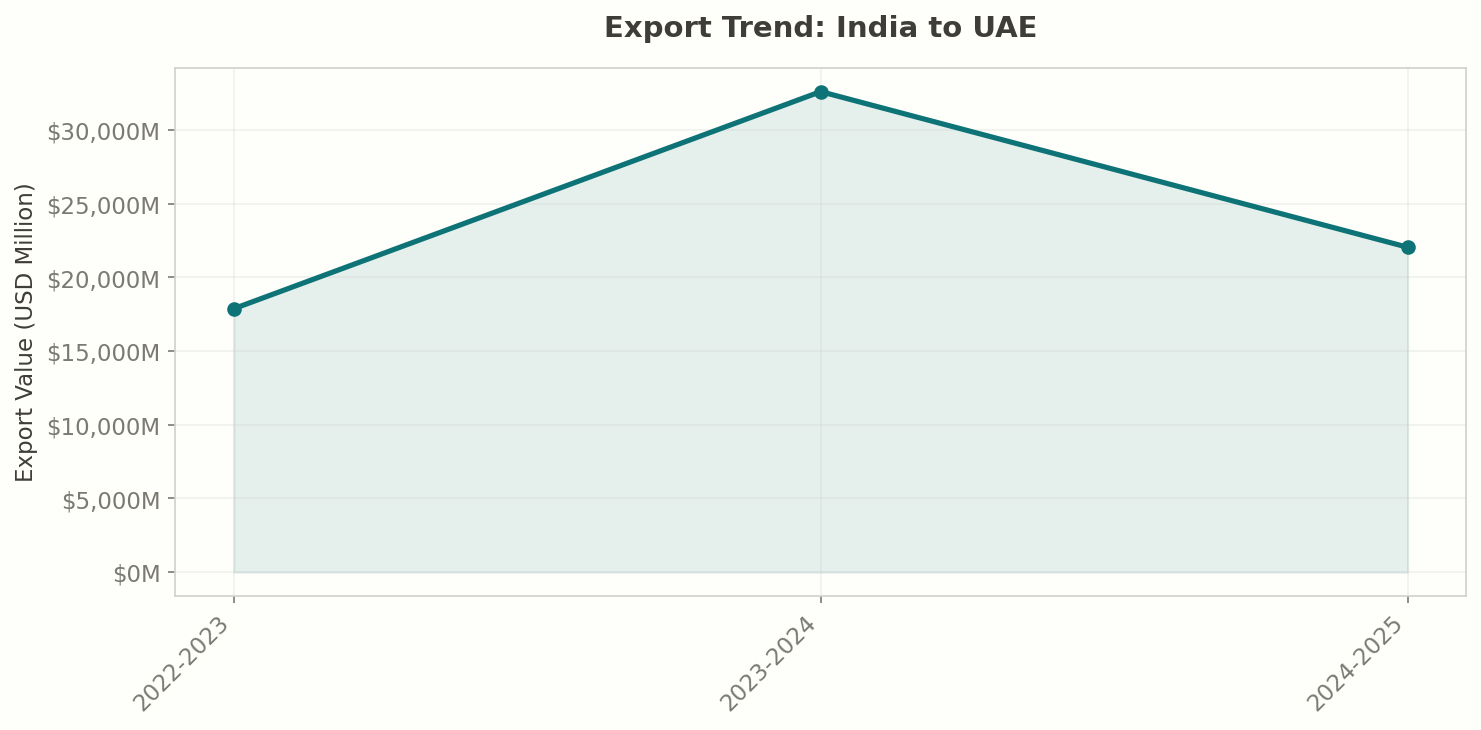
India's exports to the UAE reached $22 billion in 2024-25. The relationship saw a spike to $32.6 billion in 2023-24, partly driven by high petroleum re-export volumes and gems trade. The baseline trend is strongly upward — up from $17.9 billion in 2022-23.
The UAE is not just an end market. Dubai's Jebel Ali Free Zone is the world's largest re-export hub. Roughly 60% of goods entering Dubai are re-exported to destinations across the Middle East, Africa, and the CIS countries. This means your goods shipped to Dubai can end up in markets from Saudi Arabia to Nigeria to Kazakhstan — without you needing separate market access for each.
What India Exports to the UAE
| Rank | HS Chapter | Product Category | Export Value (USD Million) |
|---|---|---|---|
| 1 | 71 | Gems and jewellery | $7,540 |
| 2 | 84 | Machinery | $1,483 |
| 3 | 89 | Ships and boats | $1,048 |
| 4 | 87 | Vehicles and parts | $992 |
| 5 | 73 | Iron and steel articles | $789 |
| 6 | 85 | Electronics | $755 |
| 7 | 72 | Iron and steel | $667 |
| 8 | 61 | Knitted apparel | $636 |
| 9 | 62 | Woven apparel | $549 |
| 10 | 09 | Spices | $537 |
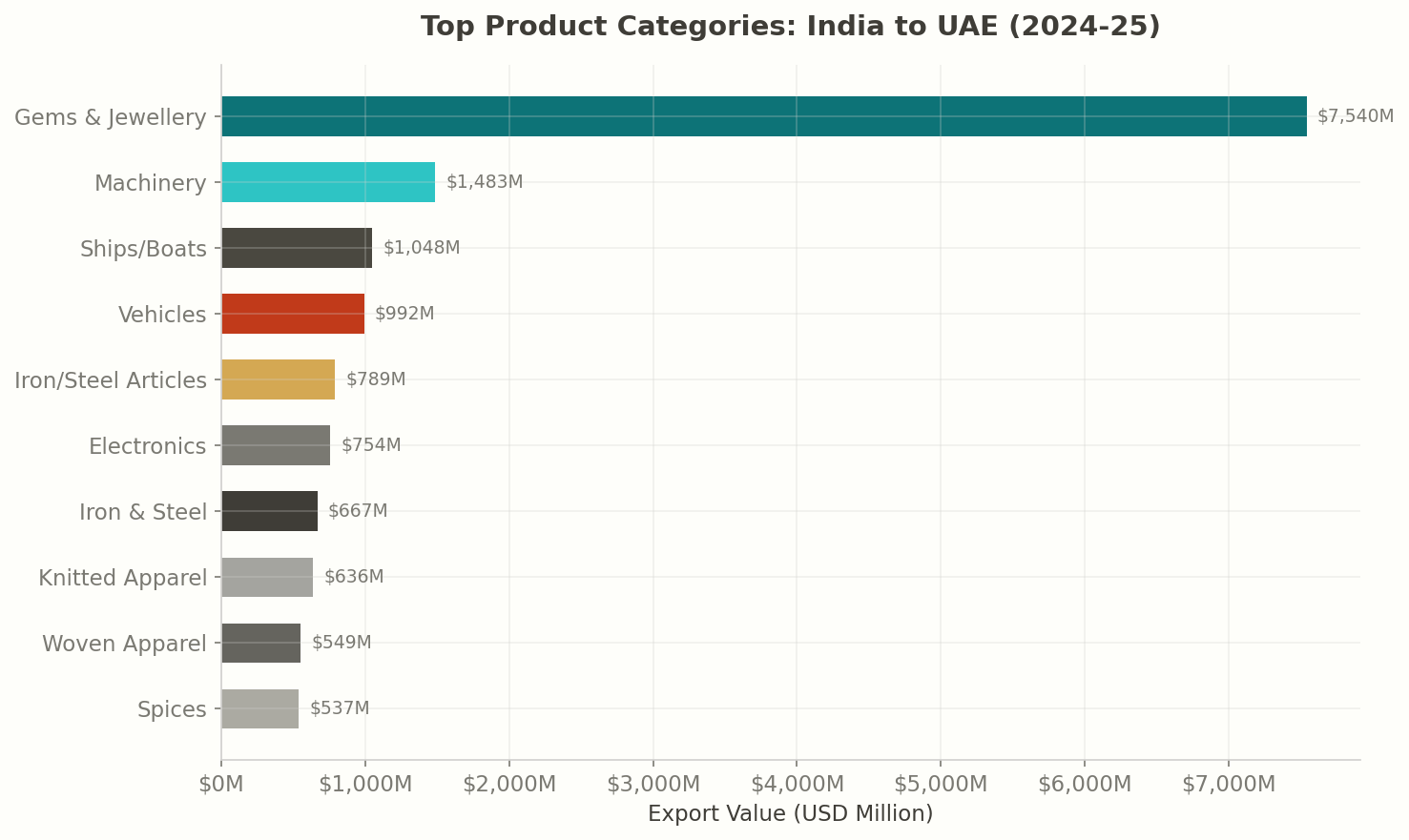
Gems and jewellery dominate at $7.5 billion — Dubai is a global hub for diamond and gold trading. The engineering goods cluster (machinery, vehicles, iron/steel) totals $4.9 billion. Textiles and apparel contribute $1.2 billion, driven by the UAE's large South Asian population and tourism-fuelled retail sector. Spices at $537 million reflect the UAE's position as a food distribution hub for the Middle East.
India-UAE CEPA — The Game Changer
The Comprehensive Economic Partnership Agreement (CEPA), effective since May 1, 2022, is the most significant development in India-UAE trade in decades. Key benefits for Indian exporters:
Zero tariff on 80% of products: The UAE eliminated customs duties on approximately 80% of Indian tariff lines. This means most Indian goods enter the UAE duty-free under CEPA, compared to the standard 5% UAE import duty.
Products covered: Gems, jewellery, textiles, leather, footwear, furniture, sports goods, plastics, electrical machinery, and medical instruments all qualify for zero duty.
How to claim CEPA benefits:
- Obtain a Certificate of Origin (CoO) from the designated Indian issuing authority (DGFT or authorised chambers)
- The CoO must be in the prescribed CEPA format
- Submit it to UAE customs at the time of import
- Products must meet the Rules of Origin — typically 40% local value addition
Products NOT covered (or partially covered):
- Some agricultural products have tariff rate quotas (TRQs) rather than full elimination
- Petroleum products are excluded
- Some processed food items have phased reduction schedules
Key Regulatory Requirements
UAE Customs and Standards
Emirates Authority for Standardization and Metrology (ESMA): Sets technical regulations for products sold in the UAE. Key requirements:
- Halal certification: Mandatory for all meat, poultry, and food products containing animal derivatives. Halal certification must be from a UAE-recognised certification body. In India, Jamiat Ulama-i-Hind and FSSAI-approved halal certifiers are generally accepted.
- ECAS (Emirates Conformity Assessment Scheme): Product registration required for regulated products (electronics, toys, building materials, automotive parts). Applied through the ESMA portal.
SABER/SASO (For Re-Export to Saudi Arabia)
If your goods enter the UAE and are re-exported to Saudi Arabia, they must comply with SASO (Saudi Standards, Metrology and Quality Organisation) requirements. The SABER system requires product certification and conformity assessment before goods can enter Saudi Arabia.
Food Safety Requirements
- Dubai Municipality Food Safety Department: Regulates all food imports into Dubai. Health certificates and lab analysis reports are required.
- Shelf life: UAE requires a minimum remaining shelf life — typically 50% of total shelf life at the time of import. Don't ship products with short remaining shelf life.
- Labelling: Must include product name, ingredients, net weight, manufacturing date, expiry date, country of origin, storage conditions — all in Arabic and English.
Dubai Free Zones — A Strategic Advantage
The UAE has over 40 free zones, each offering specific advantages. Key ones for Indian exporters:
Jebel Ali Free Zone (JAFZA):
- 100% foreign ownership
- Zero corporate tax, zero personal income tax
- Full repatriation of profits and capital
- Ideal for warehousing and re-export operations
Dubai Multi Commodities Centre (DMCC):
- Preferred for gems, jewellery, and precious metals trade
- Over 20,000 member companies
Sharjah Airport Free Zone (SAIF):
- Lower setup costs than Dubai zones
- Good for light manufacturing and distribution
Setting up a UAE entity: Many Indian MSME exporters establish a trading company in a free zone to act as their regional distribution hub. Setup costs range from AED 15,000-50,000 depending on the free zone, with annual renewal fees of AED 10,000-30,000.
Logistics — India to UAE
Shipping Routes
The UAE is one of the closest major markets for Indian exporters:
- Mundra/Kandla to Dubai: 4-5 days
- JNPT to Dubai: 5-7 days
- Chennai to Dubai: 7-9 days
- Air freight (Delhi/Mumbai to Dubai): Same day or next day
Freight Costs (Indicative)
- 20-ft container to Jebel Ali: $800-$1,500
- 40-ft container to Jebel Ali: $1,200-$2,500
- Air freight: $1.5-$3.5 per kg
These are among the lowest freight costs for any major market — a significant competitive advantage for Indian exporters.
Ports of Entry
- Jebel Ali (Dubai) — handles 80% of UAE's containerised cargo
- Sharjah (Port Khalid/Hamriyah) — smaller vessels, lower costs
- Abu Dhabi (Khalifa Port) — growing with industrial zone development
- Ras Al Khaimah — for specific industrial imports
Payment Terms
India-UAE trade benefits from strong banking relationships and established payment channels:
- Letters of Credit: Standard for larger orders. UAE banks (Emirates NBD, Mashreq, FAB) are well-versed in Indian trade.
- T/T (Wire Transfer): Very common for repeat orders. 30% advance, 70% against documents is typical.
- Open Account: For established relationships, 30-60 day terms are common.
- INR settlement: Under the India-UAE trade agreement, bilateral trade can be settled in INR through the rupee-dirham mechanism. This reduces forex costs.
Documentation
- Commercial Invoice (in English; Arabic translation recommended)
- Packing List
- Bill of Lading
- Certificate of Origin — CEPA format for preferential tariffs
- Phytosanitary Certificate (for agricultural products)
- Health Certificate (for food products)
- Halal Certificate (for meat/animal-derived food)
- ECAS registration (for regulated consumer products)
- Shipping Bill (filed via ICEGATE)
- Insurance Certificate
Common Mistakes When Exporting to the UAE
Not using CEPA benefits. Many Indian exporters still ship to the UAE without a CEPA Certificate of Origin, paying the standard 5% duty when they could enter duty-free. This is leaving money on the table.
Ignoring Arabic labelling. Food and consumer products must have Arabic language labelling. Adding Arabic labels after arrival in Dubai is possible but adds cost and delay.
Sending food without halal certification. Any food product containing meat, gelatin, or animal-derived ingredients must be halal-certified. Even some food colourants and additives require halal verification.
Overestimating the consumer market. The UAE has only 10 million residents. Its true value is as a re-export hub — design your distribution strategy accordingly.
Key Takeaways
- India exported $22 billion to the UAE in 2024-25 — gems ($7.5B), machinery ($1.5B), and ships ($1B) lead
- The India-UAE CEPA provides zero duty on 80% of Indian products — claim it with the correct Certificate of Origin
- The UAE is primarily a re-export hub — 60% of Dubai's imports are re-exported to the Middle East, Africa, and CIS
- Halal certification is mandatory for food with animal ingredients; Arabic labelling required for consumer products
- Shipping from Western India takes just 4-7 days at freight costs of $800-$1,500 per container
- Free zones like JAFZA offer 100% ownership and zero tax for setting up a UAE distribution entity
Start Exporting to the UAE
- Check if your product qualifies for CEPA zero duty using the Duty Calculator — most Indian goods now enter duty-free
- Identify your HS code with the HS Code Finder
- Get a CEPA Certificate of Origin from DGFT or your local Chamber of Commerce
- Check product-specific requirements — ECAS registration, halal certification, or food safety approvals
- Research the UAE market with the Market Finder to see which products are in demand
- Consider setting up a free zone entity if you plan to use Dubai as a distribution hub for the region
The UAE is the easiest major international market for Indian exporters — close proximity, cultural familiarity, CEPA benefits, and world-class trade infrastructure. If you're looking for your first export market, this is the one to start with.
Ready to start exporting?
Get a detailed market report with country-by-country analysis, pricing insights, and buyer contacts.
Get Market ReportXIMPEX Export Advisory
Need help implementing the strategies discussed in this guide? Our team of export specialists can provide personalized guidance for your business.