Complete Guide to Exporting to the UK from India
The United Kingdom is India's sixth-largest export destination, with Indian goods worth $10.2 billion reaching the UK in 2024-25. Post-Brexit, the UK has emerged as an independent trade partner with its own tariff schedule, regulatory framework, and — most significantly — an India-UK Free Trade Agreement currently under advanced negotiation that could dramatically boost bilateral trade once signed.
For Indian MSME exporters, the UK offers a mature, high-spending consumer market of 67 million people, strong demand for Indian goods across categories from textiles to pharmaceuticals, and a large Indian diaspora (1.8 million) that creates natural demand for ethnic products, food, and fashion.
Market Overview — India-UK Trade
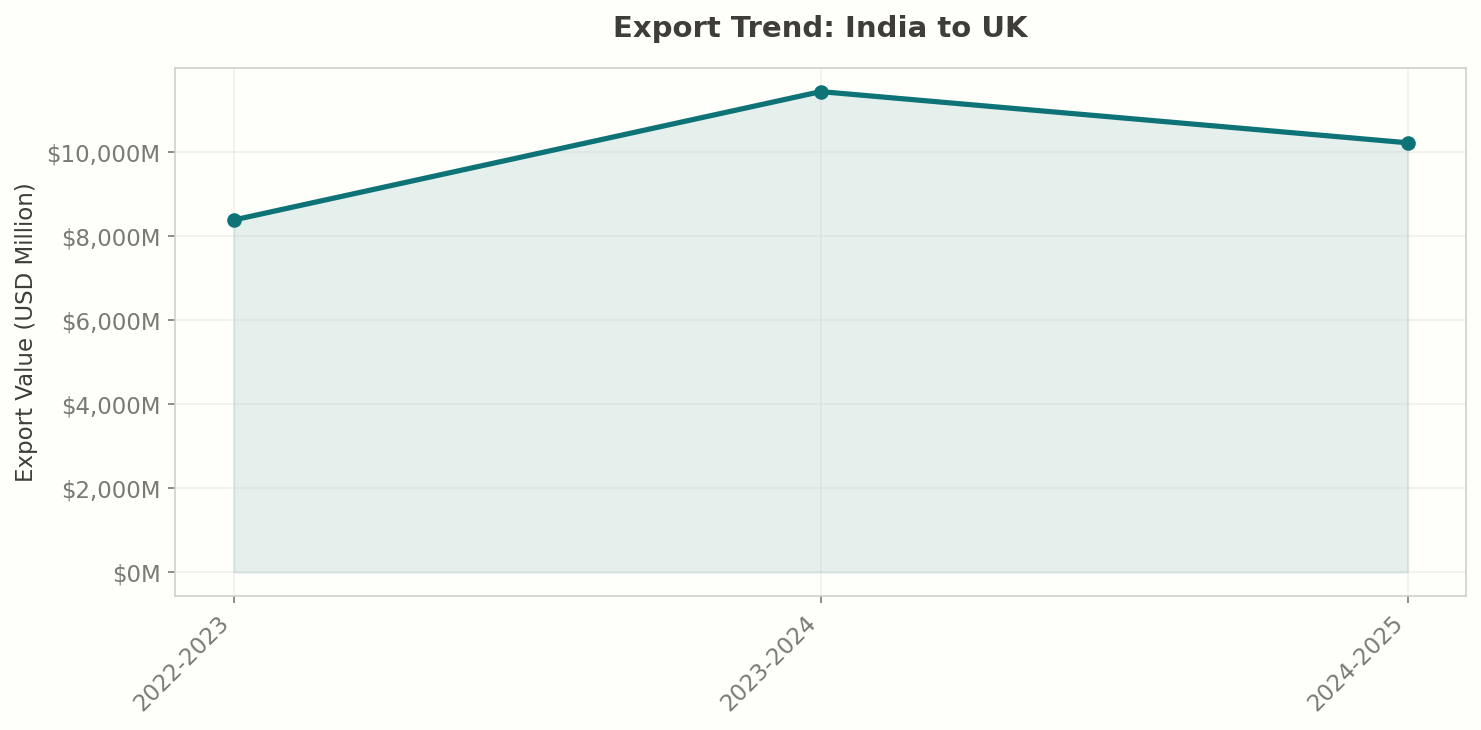
India exported $10.2 billion to the UK in 2024-25, up from $8.4 billion in 2022-23 — a 22% increase over two years. The 2023-24 spike to $11.4 billion reflects growing trade diversification as both countries negotiate closer economic ties.
What India Exports to the UK
| Rank | HS Chapter | Product Category | Export Value (USD Million) |
|---|---|---|---|
| 1 | 84 | Machinery | $1,690 |
| 2 | 71 | Gems and jewellery | $954 |
| 3 | 30 | Pharmaceuticals | $764 |
| 4 | 62 | Woven apparel | $760 |
| 5 | 61 | Knitted apparel | $646 |
| 6 | 72 | Iron and steel | $524 |
| 7 | 85 | Electronics | $428 |
| 8 | 29 | Organic chemicals | $398 |
| 9 | 73 | Iron/steel articles | $307 |
| 10 | 64 | Footwear | $269 |
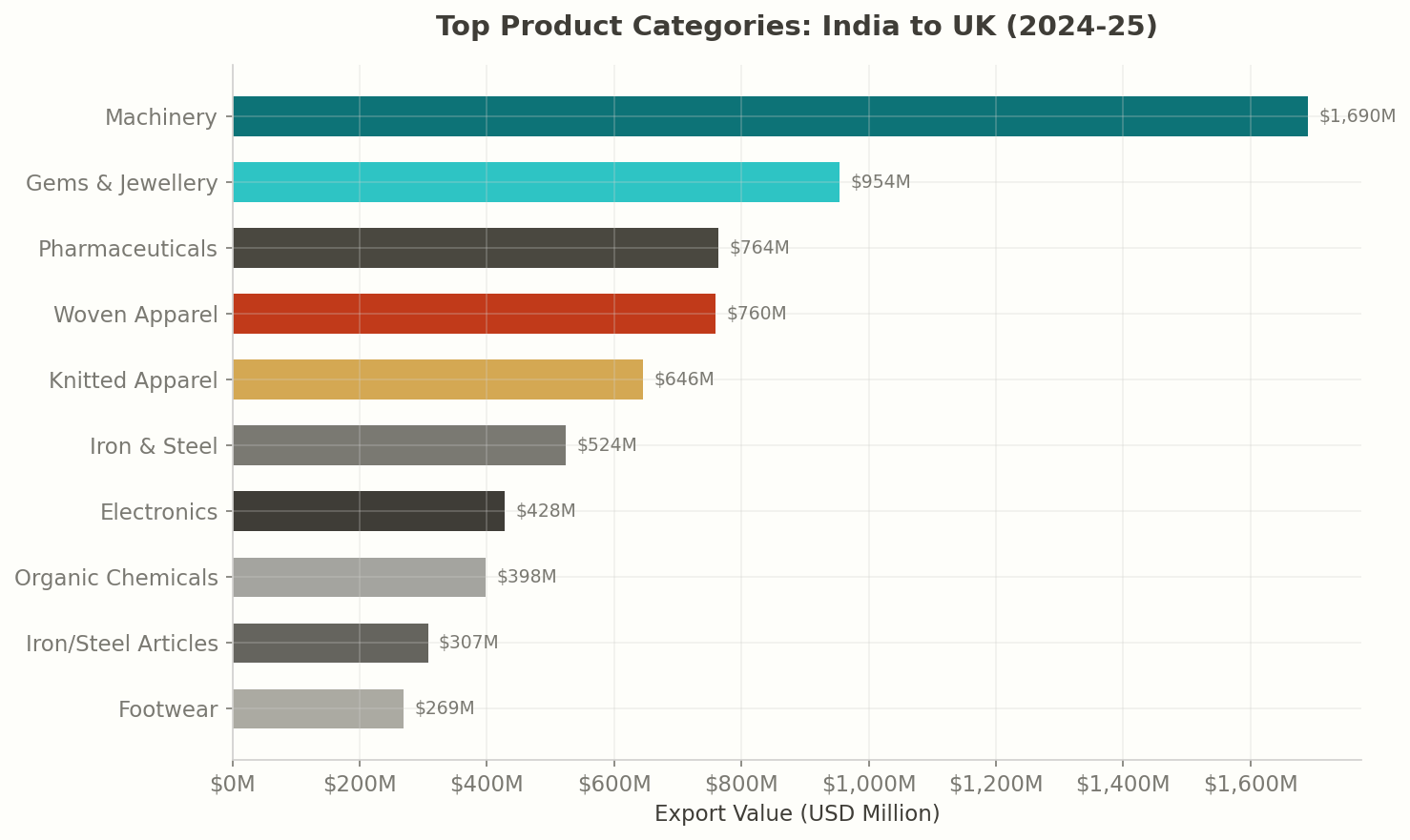
The UK market is notably diversified. Unlike the USA (dominated by pharma and gems), UK imports from India are spread across machinery, gems, pharma, textiles, steel, chemicals, and footwear. This creates opportunities for a wide range of MSME manufacturers. Textiles and apparel combined ($1.4B) and pharmaceuticals ($764M) are consistently strong performers.
Post-Brexit Regulatory Framework
Since January 1, 2021, the UK has operated its own independent regulatory and customs system, separate from the EU. Key changes that affect Indian exporters:
UKCA Marking
The UK Conformity Assessed (UKCA) mark replaced the EU's CE mark for products sold in England, Wales, and Scotland. Products that previously needed CE marking for the EU market now need UKCA marking for the UK market.
Products requiring UKCA:
- Electrical and electronic equipment
- Machinery
- Personal Protective Equipment (PPE)
- Toys
- Medical devices
- Construction products
Northern Ireland exception: Products sold in Northern Ireland still require CE marking under the Northern Ireland Protocol.
Transition period: The UK government has repeatedly extended deadlines for mandatory UKCA marking. As of 2025, CE marking is still accepted for most product categories in Great Britain, but full UKCA transition is expected. Check the latest GOV.UK guidance for your product category.
UK REACH
The UK's independent chemical regulation system, separate from EU REACH. If you export chemicals, dyes, or products containing regulated chemicals (paints, textiles with chemical treatments, plastics), you need UK REACH registration.
Key difference from EU REACH: UK REACH requires separate registration with the UK Health and Safety Executive (HSE), even if you already have EU REACH registration.
Food Standards Agency (FSA)
For food exports, the UK's Food Standards Agency sets safety and labelling requirements:
- Allergen labelling: 14 allergens must be declared (same list as EU)
- Nutrition labelling: Traffic light system (red/amber/green) is voluntary but expected by UK retailers
- Phytosanitary requirements: Import health certificates needed for plant and animal products
- Country of Origin: Mandatory labelling for meat, dairy, fish, honey, olive oil, and fresh produce
Tariff Structure — UK Global Tariff
Post-Brexit, the UK applies its own tariff schedule — the UK Global Tariff (UKGT). In many cases, UK tariffs are slightly lower than EU tariffs.
Indicative UK tariff rates for Indian exports:
| Product Category | UK Tariff Rate |
|---|---|
| Pharmaceuticals (3004) | 0% |
| Cut diamonds (7102) | 0% |
| Cotton T-shirts (6109) | 12% |
| Woven shirts (6205) | 12% |
| Bed linen (6302) | 8-12% |
| Iron/steel articles (7326) | 0-2.5% |
| Organic chemicals (29xx) | 0-6.5% |
| Footwear (6403) | 8% |
| Basmati rice (100630) | 0% |
| Spices (0904-0910) | 0-4% |
India currently trades with the UK under MFN (Most Favoured Nation) tariff rates. India also benefits from the UK's Developing Countries Trading Scheme (DCTS), which provides tariff preferences for certain products.
Use the Duty Calculator to check exact rates for your HS code.
The India-UK FTA — What to Expect
The India-UK Free Trade Agreement has been under negotiation since January 2022. While not yet signed, significant progress has been made. Expected benefits for Indian exporters:
- Tariff elimination: Zero or reduced duties on most Indian goods, including textiles, leather, and processed food — sectors where high MFN tariffs currently limit competitiveness
- Services liberalisation: Easier movement of Indian professionals to the UK
- Mutual recognition of standards: Reduced compliance burden through recognition of Indian testing and certification
- Rules of Origin: Expected 35-40% domestic value addition threshold for preferential tariff access
The FTA, once signed, would be transformative for Indian textile and apparel exporters, who currently face 12% duties while competitors like Bangladesh enjoy duty-free access under the DCTS.
Logistics — India to UK
Shipping Routes and Transit Times
- JNPT to Felixstowe/Southampton: 18-22 days (via Suez Canal)
- Mundra to London Gateway: 18-21 days
- Chennai to UK ports: 20-25 days
- Air freight (Delhi/Mumbai to London): 8-10 hours, next-day delivery for express
Major UK Ports
- Felixstowe — UK's busiest container port, handles 40% of containerised trade
- Southampton — Second largest, strong for retail goods
- London Gateway — Newer port near London, growing rapidly
- Liverpool — For goods destined for Northern England and Scotland
Freight Costs (Indicative)
- 20-ft container to Felixstowe: $1,500-$3,000
- 40-ft container to UK ports: $2,500-$5,000
- Air freight: $3-$5.50 per kg
Customs Procedures Post-Brexit
Since Brexit, goods entering the UK require full customs declarations — even those previously transiting through EU ports. Key requirements:
- EORI number: Your UK buyer needs a UK Economic Operators Registration and Identification (EORI) number
- Customs declaration: Full declaration through the Customs Declaration Service (CDS)
- Health certificates: Required for food and animal products at the UK border
Payment Terms
- Open Account (30-60 days): Most common for established relationships. UK buyers are generally reliable payers.
- Letters of Credit: For first-time or large orders. UK banks (HSBC, Barclays, Standard Chartered) are familiar with India trade.
- T/T Wire Transfer: Common for SME-to-SME trade. 30-50% advance is typical.
- Currency: GBP or USD. GBP is preferred by UK buyers. Hedge your exposure if quoting in GBP.
Documentation
- Commercial Invoice
- Packing List
- Bill of Lading
- Certificate of Origin (DCTS format for preferential tariff)
- Phytosanitary Certificate (for agricultural products)
- Health Certificate (for food/animal products)
- UKCA Declaration of Conformity (for regulated products)
- Shipping Bill (via ICEGATE)
- Insurance Certificate
The Indian Diaspora Advantage
The UK's 1.8 million-strong Indian diaspora creates a natural market for:
- Ethnic food products: Spices, ready-to-eat meals, snacks, sweets (sold in supermarkets and ethnic grocery stores)
- Textiles: Ethnic wear, saris, kurtas (sold through diaspora retailers)
- Ayurvedic and herbal products: Growing demand driven by wellness trends
The diaspora channel often provides an easier entry point for first-time exporters than mainstream UK retail, which requires significant scale and compliance investment.
Common Mistakes When Exporting to the UK
Assuming EU compliance covers the UK. Post-Brexit, the UK has separate regulations. CE marking, EU REACH registration, and EU food safety approvals may not be sufficient for the UK market.
Not claiming DCTS preferences. Many Indian exporters pay full MFN tariffs when they could benefit from reduced rates under the UK's Developing Countries Trading Scheme. Check eligibility and get the correct Certificate of Origin.
Ignoring VAT. UK VAT is 20% on most goods and is charged at import. This is the buyer's cost, but factor it into your pricing discussions — your CIF price plus 20% VAT and duty is what the buyer actually pays.
Underestimating UK quality expectations. UK retail buyers (Marks & Spencer, ASDA, Tesco) have exacting quality and social compliance standards. Factory audits, SEDEX membership, and Oeko-Tex certification are table stakes.
Key Takeaways
- India exported $10.2 billion to the UK in 2024-25, led by machinery ($1.7B), gems ($954M), and pharma ($764M)
- Post-Brexit UK has its own regulatory framework: UKCA marking, UK REACH, FSA food rules
- India benefits from the UK's DCTS preferential tariff scheme — claim it with the correct Certificate of Origin
- India-UK FTA negotiations are advanced — once signed, expect zero duty on most Indian goods
- The 1.8 million Indian diaspora creates a natural entry channel for ethnic food, textiles, and wellness products
- UK retail quality standards are among the highest globally — invest in compliance before approaching major buyers
Start Exporting to the UK
- Check tariff rates and DCTS eligibility using the Duty Calculator
- Identify your HS code with the HS Code Finder
- Review UK regulatory requirements for your product category on GOV.UK
- Explore the UK market for your products with the Market Finder
- Connect with UK buyers through trade shows like the India-UK Trade Council events, Source India, and the London Textile Fair
- Consider the diaspora channel as your entry point if you're new to international trade
India and the UK are building a deeper trade partnership. With the FTA on the horizon, now is the time to establish your presence in this $10 billion market.
Ready to start exporting?
Get a detailed market report with country-by-country analysis, pricing insights, and buyer contacts.
Get Market ReportXIMPEX Export Advisory
Need help implementing the strategies discussed in this guide? Our team of export specialists can provide personalized guidance for your business.