Complete Guide to Exporting to the USA from India
The United States is India's largest export destination, absorbing $62.3 billion worth of Indian goods in 2024-25. For Indian MSME exporters, the USA represents the world's biggest consumer market — 330 million people with high purchasing power and an insatiable appetite for manufactured goods, pharmaceuticals, textiles, gems, seafood, and agricultural products.
But the US market is also one of the most regulated. Between FDA requirements for food and drugs, CPSC standards for consumer products, customs duties that lack preferential treatment (India has no FTA with the USA), and stringent labelling laws, exporting to America requires careful preparation. This guide covers the market opportunity, top product categories, regulatory requirements, logistics, and payment practices.
Market Overview — India-USA Trade
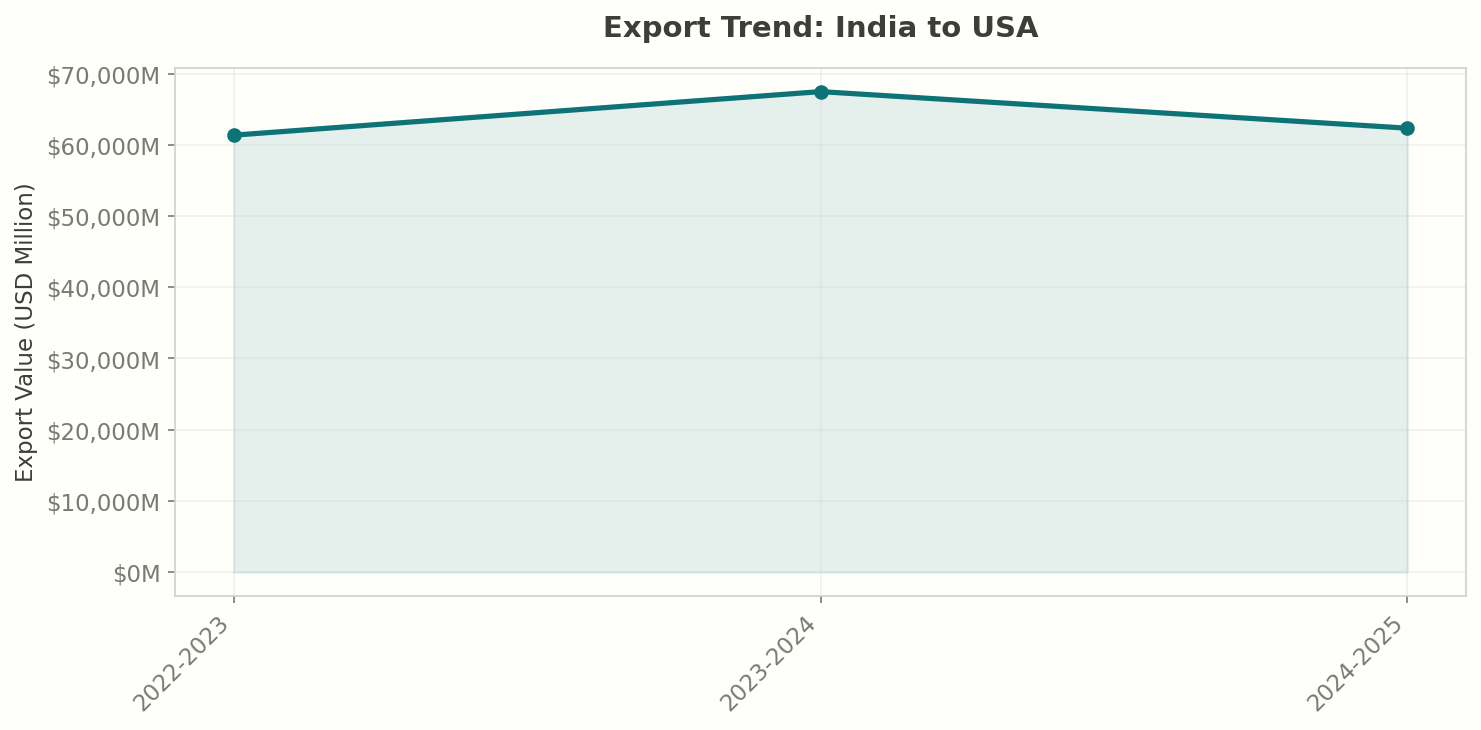
India's goods exports to the USA totalled $62.3 billion in 2024-25, down from $67.5 billion in 2023-24. Despite the dip, the USA has remained India's top export partner for over a decade. The trade relationship is dominated by high-value manufactured goods.
What India Exports to the USA
The top product categories exported from India to the USA in 2024-25:
| Rank | HS Chapter | Product Category | Export Value (USD Million) |
|---|---|---|---|
| 1 | 30 | Pharmaceuticals | $9,693 |
| 2 | 71 | Gems and jewellery | $9,216 |
| 3 | 84 | Machinery | $5,892 |
| 4 | 85 | Electronics | $3,439 |
| 5 | 73 | Iron and steel articles | $2,721 |
| 6 | 62 | Woven apparel | $2,632 |
| 7 | 61 | Knitted apparel | $2,632 |
| 8 | 63 | Home textiles | $2,594 |
| 9 | 87 | Vehicles and parts | $2,158 |
| 10 | 03 | Seafood | $2,018 |
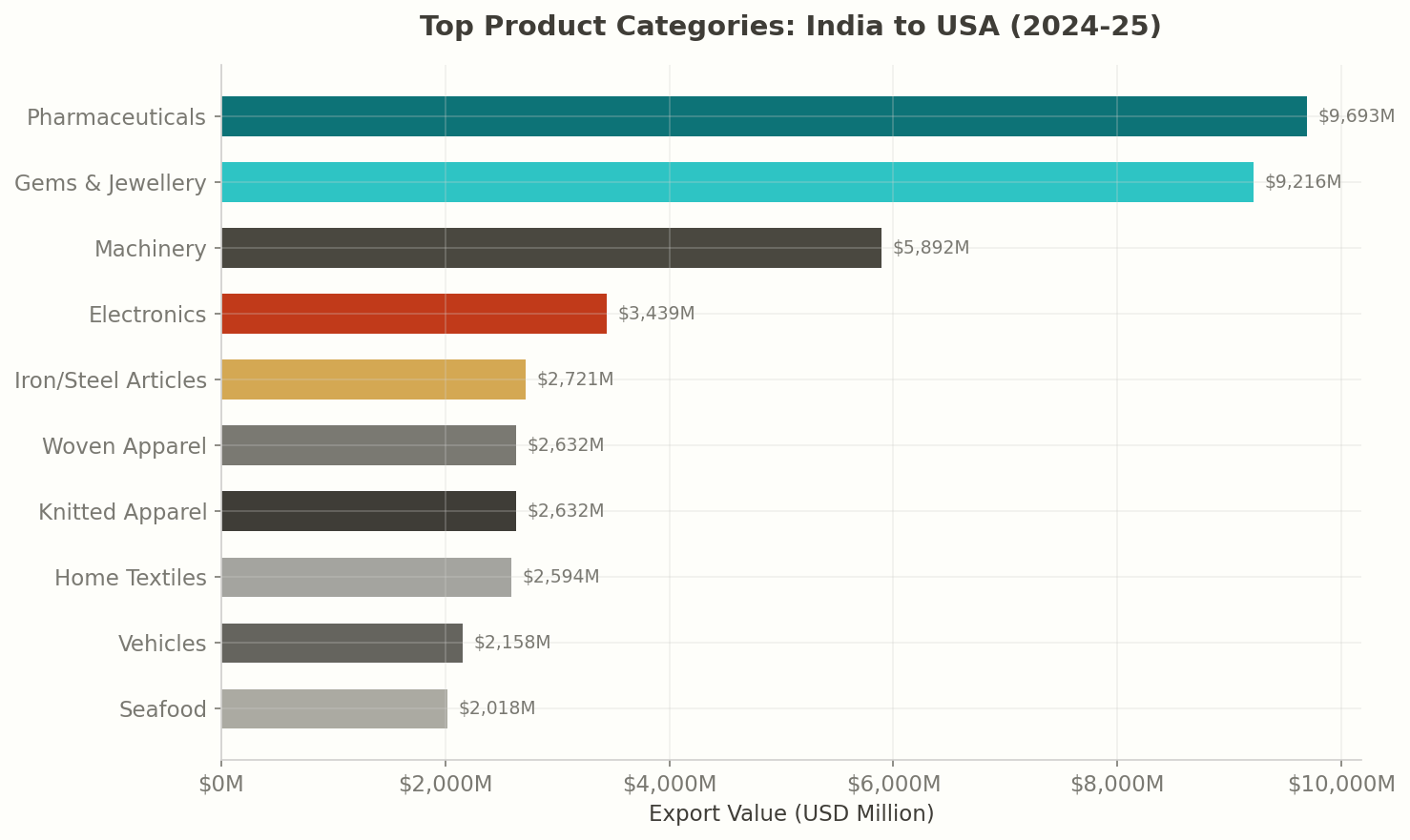
Pharmaceuticals ($9.7B) and gems/jewellery ($9.2B) dominate, together accounting for 30% of all exports to the USA. The textiles cluster (apparel + home textiles) contributes $7.9 billion. Machinery and electronics reflect India's growing role as a manufacturing hub.
Regulatory Requirements — Key US Agencies
FDA (Food and Drug Administration)
If you're exporting food, beverages, dietary supplements, pharmaceuticals, medical devices, or cosmetics, you must comply with FDA regulations.
Food exports (including spices, seafood, tea, processed food):
- Prior Notice Filing: Every food shipment to the US must have a prior notice filed with the FDA at least 15 days before arrival (for ocean freight) or 4 hours for air freight. Filed through the FDA's Prior Notice System Interface (PNSI).
- Facility Registration: Your manufacturing/processing facility must be registered with the FDA. Registration is free, done through the FDA Unified Registration and Listing System (FURLS). Must be renewed biennially.
- FSMA (Food Safety Modernization Act): Requires a Foreign Supplier Verification Program (FSVP) — your US importer must verify that your food meets US safety standards.
- Labelling: Nutrition Facts panel, ingredient list, allergen declarations, country of origin. All in English.
Pharmaceutical exports:
- Products must have FDA approval (ANDA for generics, NDA for new drugs)
- Manufacturing facility must pass FDA inspection and have a valid Establishment Identification Number (FEI)
- Current Good Manufacturing Practice (cGMP) compliance is mandatory
CPSC (Consumer Product Safety Commission)
For consumer products — textiles, toys, electronics, household goods:
- CPSIA compliance for children's products (lead, phthalates testing)
- Flammability standards for textiles (16 CFR 1610/1611)
- General Certificate of Conformity (GCC) required for non-children's consumer products
- Children's Product Certificate (CPC) required for products designed for children under 12
CBP (Customs and Border Protection)
- ISF (Importer Security Filing): The US importer must file an ISF ("10+2") at least 24 hours before goods are loaded at the foreign port
- Country of Origin marking: All products must be marked with "Made in India" in English, legible and permanent
- Anti-dumping duties: May apply to specific products. Check the International Trade Commission database for current AD/CVD orders against India
Tariff Structure
The USA applies MFN (Most Favoured Nation) tariff rates to Indian goods. India does not benefit from the GSP (Generalized System of Preferences) — the USA terminated India's GSP benefits in June 2019. There is no India-USA Free Trade Agreement.
Indicative tariff rates:
| Product Category | US Tariff Rate |
|---|---|
| Pharmaceuticals (3004) | 0% (most formulations) |
| Cut diamonds (7102) | 0% |
| Cotton yarn (5205) | 5-10% |
| Knitted T-shirts (6109) | 16.5-32% |
| Woven shirts (6205) | 14.9-19.7% |
| Bed linen (6302) | 6.2-12% |
| Shrimp (0306) | 0% |
| Auto parts (8708) | 0-6% |
| Iron/steel articles (7326) | 0-5.5% |
| Spices (0904-0910) | 0-5% |
Textiles and apparel face the highest tariffs (often 15-32%), which is a significant competitive disadvantage compared to countries with preferential access (Vietnam, Bangladesh via AGOA/EBA). However, India's scale, quality, and product diversity still make it competitive.
Use the Duty Calculator to check the exact tariff rate for your HS code.
Logistics — Getting Your Goods to America
Shipping Routes and Transit Times
- West Coast (LA/Long Beach): 22-28 days from JNPT, 25-30 days from Chennai
- East Coast (New York/New Jersey, Savannah): 28-35 days from JNPT, 24-30 days via Suez Canal
- Gulf Coast (Houston): 30-35 days from Western India
Major Indian Ports for USA-Bound Cargo
- JNPT/Nhava Sheva — primary port for most US-bound cargo
- Mundra — growing alternative with competitive rates
- Chennai/Tuticorin — for South Indian manufacturers
- Kolkata — for Eastern India exporters
Freight Costs (Indicative, 2024-25)
- 20-ft container to US West Coast: $2,500-$4,000
- 40-ft container to US East Coast: $4,000-$6,500
- Air freight (perishables, pharma): $3-$6 per kg
Incoterms
Most India-USA trade is conducted on FOB (Free on Board) terms, where the US buyer arranges and pays for ocean freight. For smaller/newer exporters, CIF or DDP terms may be requested. Understand the cost implications before agreeing.
Payment Terms and Trade Finance
Common Payment Methods
- Letters of Credit (LC): Standard for first-time relationships. Irrevocable LC from a US bank provides strong payment security.
- Documents against Payment (D/P): Buyer pays when presented with shipping documents. Moderate risk.
- Open Account: Most common for established relationships. Payment in 30-60-90 days after shipment. Higher risk — use ECGC insurance.
- Wire Transfer (T/T): Advance payment (30-50% upfront, balance against documents) common for SME orders.
Currency
All US trade is in USD. Indian exporters benefit from rupee depreciation against the dollar but should hedge large contracts (Rs 5 crore+) using forward contracts through their AD bank.
ECGC Insurance
The Export Credit Guarantee Corporation provides insurance against buyer default. Particularly recommended for open account terms to US buyers. Premium is 0.5-1.5% of the insured value.
Key Compliance Documents
- Commercial Invoice (must match the purchase order exactly)
- Packing List
- Bill of Lading (ocean) or Airway Bill
- Certificate of Origin
- ISF filing confirmation (importer's responsibility, but coordinate)
- FDA Prior Notice confirmation (for food/drug/cosmetic/device)
- Product-specific test reports (CPSIA, flammability, etc.)
- Shipping Bill (filed via ICEGATE)
- Insurance Certificate (if CIF)
State-Level Considerations
The USA is not one market — it is 50 state markets with different dynamics:
- California: Prop 65 requires warnings for products containing chemicals on California's list. This affects almost everything from food to textiles to electronics.
- New York/New Jersey: Major entry port for East Coast distribution
- Texas: Growing import hub, especially for industrial goods
- Florida: Gateway to Latin American re-exports
Common Mistakes When Exporting to the USA
Not filing FDA Prior Notice. Your container will be detained at port if Prior Notice is not filed correctly. It's the importer's legal obligation, but as the supplier, ensure it's done.
Ignoring California Prop 65. If your product contains any substance on California's list (which includes over 900 chemicals), it needs a Prop 65 warning label. Many Indian exporters discover this after their goods are in a US warehouse.
Underestimating customs clearance time. US customs can hold shipments for inspection, especially first-time shippers. Budget 3-7 days for clearance beyond arrival.
Not having a US-based importer of record. Every import into the USA needs a licensed customs broker and an importer of record (the US buyer or their agent). Clarify this before shipping.
Key Takeaways
- The USA is India's largest export market at $62.3 billion in 2024-25
- Pharma ($9.7B), gems ($9.2B), and textiles ($7.9B) are the top categories
- FDA compliance is mandatory for food, drugs, cosmetics, and medical devices
- CPSC/CPSIA compliance is required for consumer products, especially children's items
- No FTA exists — full MFN tariffs apply. Textiles face 15-32% duties.
- FOB is the standard Incoterm; LCs are recommended for first-time buyers
- California Prop 65 and state-specific rules add compliance layers
Start Exporting to the USA
- Identify your HS code with the HS Code Finder and check the US tariff rate using the Duty Calculator
- Check product-specific regulations — FDA for food/pharma, CPSC for consumer goods
- Find a US customs broker who can handle ISF filing and customs clearance
- Ensure your labelling meets US requirements (English language, country of origin, product-specific mandates)
- Use the Market Finder to see exactly which products India is shipping to the USA and identify opportunities
- Get ECGC insurance if your buyer requests open account terms
The USA is not an easy market, but it is the most rewarding one. Indian exports to America have grown consistently over the past decade, and with proper compliance and quality, your MSME can claim a share of this $62 billion trade.
Ready to start exporting?
Get a detailed market report with country-by-country analysis, pricing insights, and buyer contacts.
Get Market ReportXIMPEX Export Advisory
Need help implementing the strategies discussed in this guide? Our team of export specialists can provide personalized guidance for your business.