How to Export to Australia from India — Complete Guide
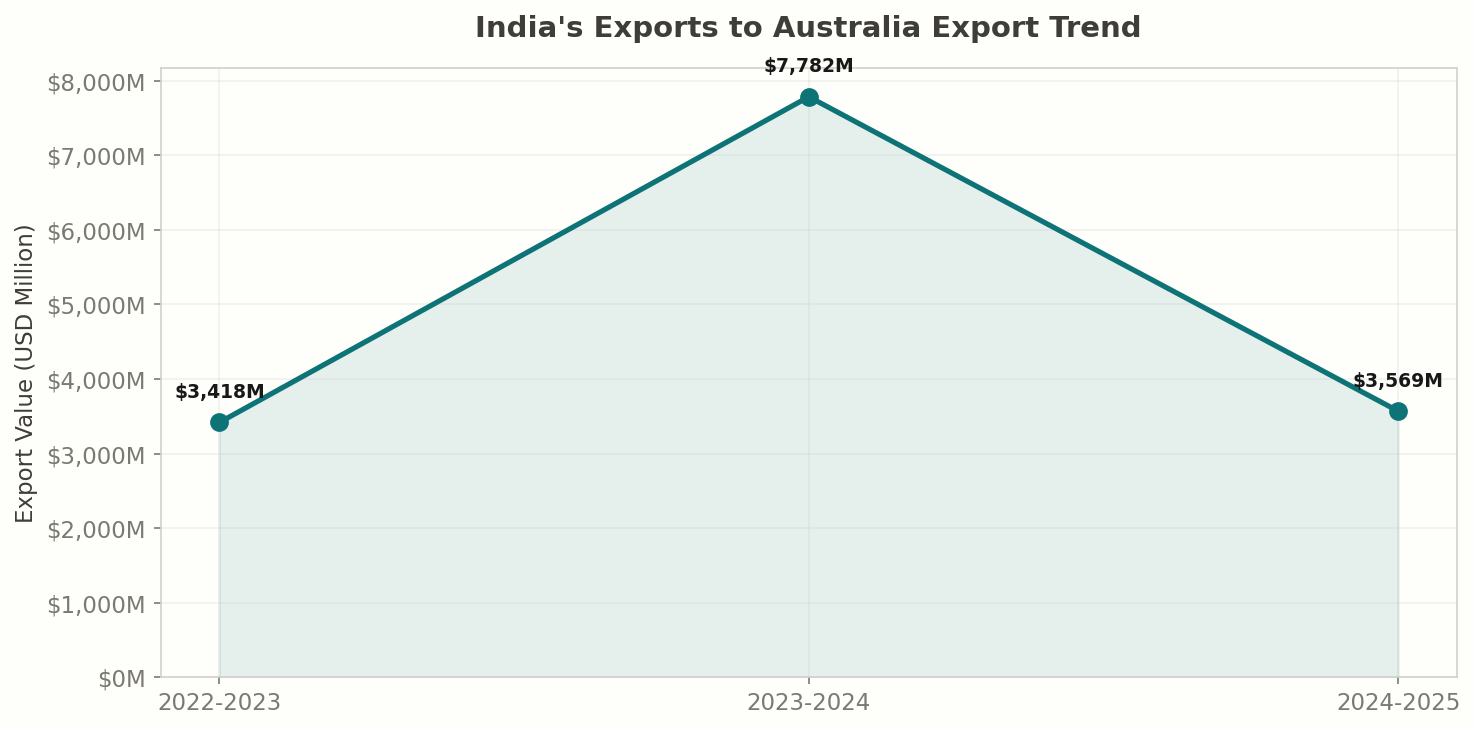
Australia is one of India's most promising and fast-growing export destinations. Bilateral trade in goods reached $3,569.42 million in 2024-25, following a remarkable spike to $7,782 million in 2023-24 driven by surges in commodity and pharmaceutical shipments. More importantly, the Australia-India Economic Cooperation and Trade Agreement (AI-ECTA), which entered into force in December 2022, has fundamentally changed the trade equation — giving Indian exporters preferential or zero-duty access to a wealthy, English-speaking market of 26 million consumers with one of the world's highest per-capita incomes.
For Indian MSME exporters, Australia offers a compelling combination: strong demand for pharmaceuticals, gems, textiles, machinery, and food products; a transparent regulatory environment; reliable payment culture; and a growing Indian diaspora of over 900,000 that creates natural demand for ethnic goods. The AI-ECTA makes this market more accessible than ever before.
India–Australia Trade Overview
India's goods exports to Australia totalled $3,569.42 million in 2024-25, a correction from the $7,782 million recorded in 2023-24 — a year that saw exceptional volumes in refined petroleum, gems, and pharmaceutical categories. Before the spike, exports stood at approximately $4,800 million in 2022-23. The underlying trend is one of steady growth, supported by the AI-ECTA's tariff reductions that are being phased in over five to ten years.
The trade relationship is evolving. Historically dominated by India's import of Australian coal, LNG, and gold, the export side is diversifying rapidly. India now ships a broad basket of manufactured goods, pharmaceuticals, auto parts, and processed food to Australia — product categories where the AI-ECTA is progressively eliminating duties.
What India Exports to Australia
The top product categories exported from India to Australia in 2024-25:
| Rank | HS Chapter | Product Category | Export Value (USD Million) |
|---|---|---|---|
| 1 | 30 | Pharmaceuticals | $427.8 |
| 2 | 71 | Gems and jewellery | $304.7 |
| 3 | 84 | Machinery | $290.0 |
| 4 | 87 | Vehicles and parts | $240.4 |
| 5 | 85 | Electrical equipment | $206.6 |
| 6 | 63 | Textile articles | $176.6 |
| 7 | 62 | Woven apparel | $173.4 |
| 8 | 61 | Knitted apparel | $172.3 |
| 9 | 73 | Steel articles | $138.3 |
| 10 | 38 | Chemical products | $90.8 |
| 11 | 40 | Rubber and articles | $88.6 |
| 12 | 21 | Food preparations | $84.1 |
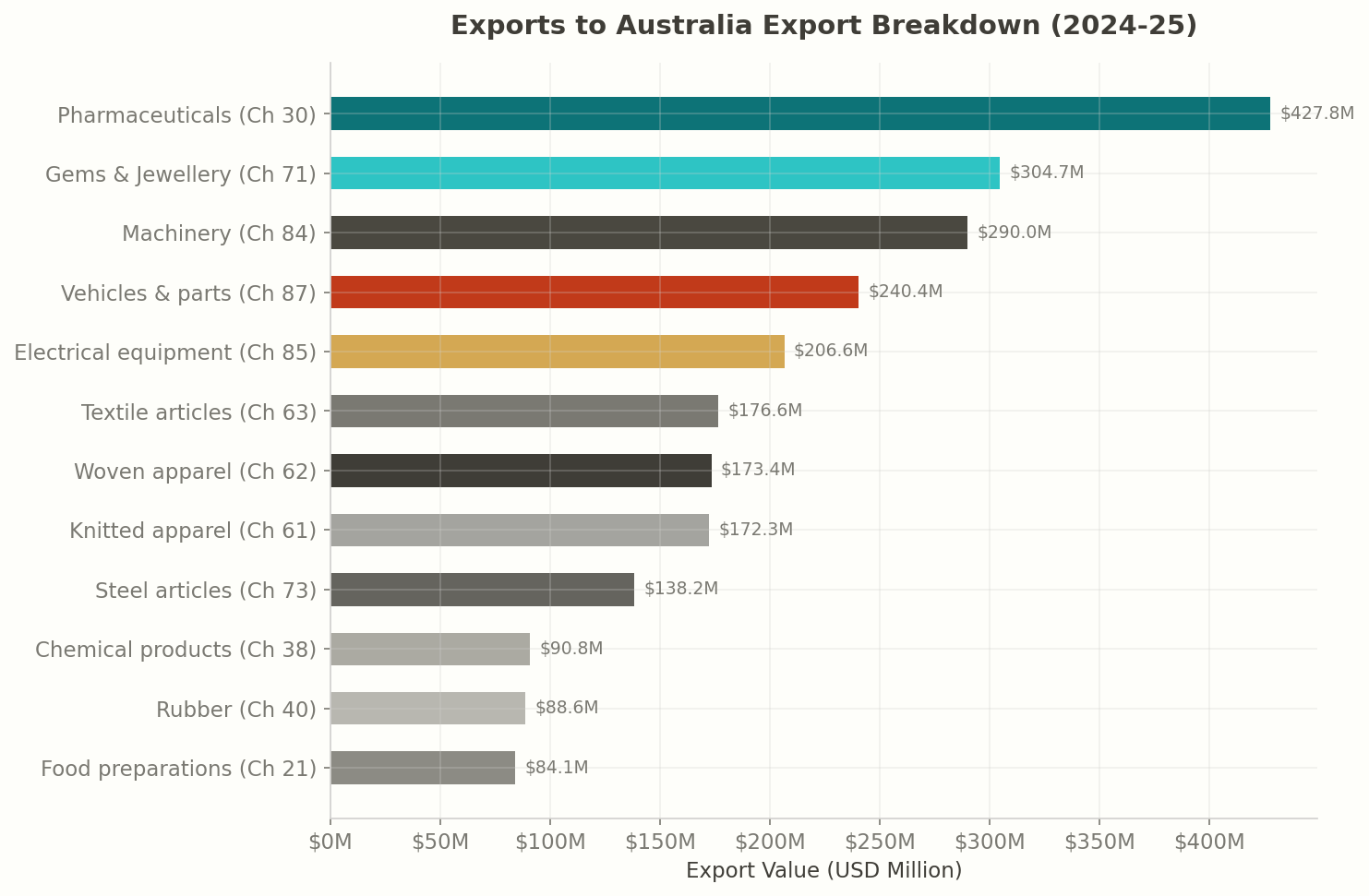
Pharmaceuticals lead at $427.8 million, reflecting Australia's reliance on generic medicines — an area where Indian manufacturers are globally competitive. The textiles cluster (apparel and textile articles combined) contributes over $522 million. Machinery and vehicles together account for $530 million, driven by India's growing role as a supplier of auto components, industrial equipment, and electrical machinery to Australian industries. Food preparations at $84.1 million represent a growing segment fuelled by the Indian diaspora and increasing mainstream demand for Indian cuisine.
Regulatory and Customs Framework
Australia has one of the world's strictest biosecurity and import regulatory regimes. Understanding the key agencies and their requirements is essential before shipping goods.
Australian Border Force (ABF)
The ABF is the primary customs authority. All goods entering Australia must be declared through the Integrated Cargo System (ICS). Your Australian importer or their customs broker handles the import declaration, but as the exporter, you must ensure your documentation is accurate and complete.
Key requirements:
- Tariff classification must match the Australian Harmonized Tariff Schedule
- Country of origin must be declared (critical for AI-ECTA preferential tariff claims)
- Goods value must be stated in Australian dollars (AUD) for duty calculation
- Anti-dumping measures may apply to specific product categories — check the Anti-Dumping Commission database
Department of Agriculture, Fisheries and Forestry (DAFF)
Australia's biosecurity regime is among the strictest in the world. The Biosecurity Import Conditions system (BICON) governs what can and cannot enter Australia.
Products subject to BICON assessment:
- All food and agricultural products
- Wooden packaging (must be ISPM 15 compliant — heat treated and marked)
- Plant-based products (cotton, jute, spices, tea)
- Animal products (leather, wool, silk — may require treatment certificates)
Practical impact: Even non-food goods shipped in wooden crates or pallets must comply with biosecurity rules. Fumigation certificates and treatment declarations are routinely required. Failure to comply results in goods being held at port, fumigated at your cost, or destroyed.
Therapeutic Goods Administration (TGA)
If you are exporting pharmaceuticals, medical devices, or health supplements to Australia, TGA registration is mandatory.
For pharmaceuticals:
- Products must be listed on the Australian Register of Therapeutic Goods (ARTG)
- Manufacturing facilities must meet PIC/S (Pharmaceutical Inspection Co-operation Scheme) GMP standards
- India's CDSCO GMP certification is recognised under certain conditions, but TGA may conduct independent audits
For medical devices:
- Must be included in the ARTG
- Conformity assessment through TGA or a recognised EU Notified Body
Australian Competition and Consumer Commission (ACCC)
The ACCC enforces consumer protection laws. Products sold in Australia must meet mandatory safety standards. Key areas:
- Product safety standards for consumer goods including electrical appliances, toys, furniture, and clothing
- Country of origin labelling for food products — Australia has strict rules about "Made in," "Product of," and "Grown in" claims
- Misleading conduct provisions — marketing claims must be substantiated
Key Standards and Certifications
Australian/New Zealand Standards (AS/NZS)
Australia and New Zealand share a joint standards system. Products sold in Australia must comply with applicable AS/NZS standards.
Electrical products: Must meet AS/NZS 3820 (essential safety) and carry appropriate approval marks. Australian plug and voltage standards (230V/50Hz, Type I plug) differ from Indian standards — product adaptation is required.
Building and construction materials: Must meet the National Construction Code (NCC) requirements. BCA (Building Code of Australia) compliance is mandatory.
Food contact materials: Must comply with Food Standards Australia New Zealand (FSANZ) standards. Migration testing for packaging materials may be required.
HACCP and Food Safety
For food exports, HACCP (Hazard Analysis and Critical Control Points) certification is effectively mandatory. Australian importers and retailers will require:
- HACCP-certified manufacturing facility
- Traceability systems (batch-level tracking from raw material to finished product)
- Allergen management plans compliant with FSANZ requirements (Australia has 10 mandatory allergen declarations, including lupin and molluscs — not required in India)
Organic Certification
Australia recognises organic certification from approved certifying bodies. For Indian organic exports, certification from bodies accredited under India's NPOP (National Programme for Organic Production) is accepted, but verify with your Australian buyer that the specific certifier is recognised.
Tariff Structure and Trade Agreements
AI-ECTA — The Australia-India Economic Cooperation and Trade Agreement
Signed in April 2022 and effective from December 29, 2022, the AI-ECTA is a landmark agreement that has dramatically improved market access for Indian exporters.
Key provisions:
- Zero duty on 96.4% of Australian tariff lines for Indian goods (covering approximately 98.3% of India's export value to Australia)
- Immediate elimination of the 5% duty on textiles, apparel, leather, footwear, gems, and jewellery
- Phased reduction on remaining sensitive products over 5-10 years
- Rules of Origin: Product-specific rules apply. Generally, 35-40% qualifying value content (QVC) or change in tariff classification (CTC) is required.
How to claim AI-ECTA preferential tariffs:
- Verify your product's HS code qualifies under AI-ECTA tariff schedules
- Ensure your product meets the applicable Rule of Origin
- Obtain a Certificate of Origin in the prescribed AI-ECTA format from DGFT or an authorised chamber of commerce
- Your Australian importer presents the CoO to Australian customs at the time of import
Products benefiting most from AI-ECTA:
- Textiles and apparel (previously 5% duty, now zero)
- Gems and jewellery (duty eliminated)
- Steel and iron articles (duty reduced or eliminated)
- Leather goods and footwear (duty eliminated)
Use the Duty Calculator to check the current AI-ECTA preferential rate for your HS code.
Indicative Tariff Rates Under AI-ECTA
| Product Category | AI-ECTA Rate | MFN Rate |
|---|---|---|
| Pharmaceuticals (3004) | 0% | 0-5% |
| Gems and jewellery (7103) | 0% | 0-5% |
| Machinery (84xx) | 0% | 0-5% |
| Vehicles and auto parts (8708) | 0% | 0-5% |
| Electrical equipment (85xx) | 0% | 0-5% |
| Woven apparel (62xx) | 0% | 5% |
| Knitted apparel (61xx) | 0% | 5% |
| Textile articles (63xx) | 0% | 5% |
| Steel articles (73xx) | 0% | 0-5% |
| Rubber articles (40xx) | 0% | 0-5% |
| Food preparations (21xx) | 0-5% | 0-5% |
Australia's MFN tariff rates were already moderate (0-5% for most industrial goods), so the AI-ECTA's impact is most significant for textiles, apparel, and agricultural products where the 5% saving on thin margins can be the difference between winning and losing an order against competitors from countries without preferential access.
Logistics and Shipping
Shipping Routes and Transit Times
- JNPT/Nhava Sheva to Sydney/Melbourne: 18-24 days
- Mundra to Fremantle (Perth): 14-18 days
- Chennai to Melbourne: 16-20 days
- Kolkata to Sydney: 20-26 days
- Air freight (Delhi/Mumbai to Sydney): 10-14 hours direct or via Singapore
Major Australian Ports
- Melbourne — Australia's busiest container port, handles approximately 36% of the nation's containerised trade. Primary gateway for Victoria, Tasmania, and South Australia.
- Sydney (Port Botany) — Second largest, serves New South Wales and the Australian Capital Territory. Strong for consumer goods and food.
- Brisbane — Gateway to Queensland, growing in importance for agricultural and mining sector imports.
- Fremantle (Perth) — Primary port for Western Australia. Closest major Australian port to India, significantly shorter transit times from Western Indian ports.
- Adelaide — Smaller but relevant for South Australian markets and automotive components.
Freight Costs (Indicative)
- 20-ft container to Melbourne/Sydney: $1,800-$3,500
- 40-ft container to Australian ports: $3,000-$5,500
- Air freight: $3.50-$6.00 per kg
- LCL (less than container load): $80-$120 per cubic metre
Quarantine and Biosecurity at Port
Australian biosecurity inspection at port is rigorous. Containers may be selected for physical inspection, X-ray, or fumigation. Typical biosecurity processing adds 2-5 business days to clearance. To minimise delays:
- Ensure all wooden packaging is ISPM 15 treated and stamped
- Declare all organic materials (cotton, jute, leather, plant-based products)
- Include pest-free area certificates for relevant agricultural products
- Clean containers thoroughly — soil residue or insect contamination triggers mandatory treatment
Documentation Requirements
- Commercial Invoice (in English, with AUD value declaration)
- Packing List (with detailed weight and dimension information)
- Bill of Lading or Airway Bill
- Certificate of Origin — AI-ECTA format for preferential tariff claims
- Phytosanitary Certificate (for plant and agricultural products, issued by India's Plant Quarantine authority)
- Health Certificate (for food products, issued by EIC/FSSAI)
- Fumigation/Treatment Certificate (for wooden packaging, ISPM 15 compliance)
- TGA approval documentation (for pharmaceuticals and medical devices)
- Shipping Bill (filed via ICEGATE)
- Insurance Certificate (if CIF terms)
- Manufacturer's Declaration of Conformity (for regulated consumer products)
- HACCP certification (for food manufacturing facilities)
Payment and Banking
Australia has a reliable and transparent payment culture. Default rates are low, and Australian businesses generally honour payment commitments.
Common Payment Methods
- Open Account (30-60 days): The most common payment method for established relationships. Australian buyers prefer this and are generally reliable payers. Consider ECGC insurance for added security.
- Letters of Credit: Used for first-time transactions or high-value orders. Australian banks (Commonwealth Bank, ANZ, Westpac, NAB) are well-versed in trade finance.
- T/T Wire Transfer: Common for SME-to-SME trade. 30% advance with balance against shipping documents is typical for new relationships.
- Documentary Collection (D/P): Moderate risk option — buyer pays upon presentation of shipping documents through the banking channel.
Currency
Trade is typically denominated in USD or AUD. Australian buyers often prefer AUD pricing. If quoting in AUD, hedge your currency exposure — the AUD/INR rate can be volatile. Forward contracts through your AD (Authorised Dealer) bank are recommended for orders above Rs 25 lakh.
ECGC Insurance
While Australian payment reliability is strong, ECGC (Export Credit Guarantee Corporation) insurance is still advisable, particularly for open account terms with new buyers. ECGC premiums for Australia are among the lowest for any market, reflecting the country's low sovereign and commercial risk. Cover is available for both single buyer policies and whole turnover policies.
Indian Diaspora Advantage
Australia's Indian diaspora — over 900,000 strong and one of the fastest-growing communities — creates a natural market for ethnic food products, spices, ready-to-eat meals, textiles, ethnic wear, and Ayurvedic products. Indian grocery stores, restaurants, and online retailers across Sydney, Melbourne, Brisbane, and Perth import directly from India. This channel offers a lower-barrier entry point for MSMEs that may not yet have the scale or certifications required by major Australian supermarket chains like Woolworths and Coles.
Common Mistakes
Ignoring biosecurity requirements. Australia's quarantine regime is non-negotiable. Contaminated shipments are fumigated (at the exporter's or importer's cost), returned, or destroyed. Wooden packing that is not ISPM 15 compliant will trigger automatic fumigation charges of AUD 500-2,000 per container.
Not claiming AI-ECTA preferences. The AI-ECTA eliminated tariffs on most Indian goods, yet many exporters still ship without a CEPA-format Certificate of Origin. On a $100,000 textile shipment, that is $5,000 in unnecessary duty.
Assuming Indian electrical standards work in Australia. Australia uses 230V/50Hz with Type I plugs. Indian-standard electrical products (Type D plugs, different safety marks) cannot be sold in Australia without modification and certification to AS/NZS standards.
Underestimating labelling requirements for food. Australia requires specific allergen declarations (including lupin, which is not a declared allergen in India), country of origin labelling in prescribed formats, and nutritional information panels that differ from Indian FSSAI formats. Get labelling right before shipping — relabelling in Australia is expensive.
Sending perishables without understanding cold chain requirements. Australian food safety standards require unbroken cold chain documentation. Temperature loggers in containers, cold chain declarations, and specific storage instructions are mandatory for perishable goods.
Key Takeaways
- India exported $3,569.42 million to Australia in 2024-25, led by pharmaceuticals ($427.8M), gems ($304.7M), and machinery ($290.0M)
- The AI-ECTA (effective December 2022) provides zero duty on 96.4% of Australian tariff lines — claim it with the correct Certificate of Origin
- Australia has one of the world's strictest biosecurity regimes — ISPM 15 wooden packaging compliance, fumigation certificates, and BICON clearance are mandatory
- TGA registration is required for pharmaceuticals and medical devices; HACCP certification is essential for food exports
- The Australian market is small (26 million people) but wealthy, with high per-unit-value demand for quality goods
- AI-ECTA has made Australia significantly more competitive as a destination for Indian textiles, gems, leather, and steel
- Payment culture is reliable — open account terms are common and default rates are low
Next Steps
- Check your AI-ECTA tariff rate using the Duty Calculator — most Indian goods now enter Australia at zero duty
- Identify your correct HS code with the HS Code Finder and verify it against Australia's tariff schedule
- Check BICON for your product's biosecurity import conditions at the Australian Department of Agriculture website
- Explore the Australian market with the Market Finder to identify demand for your product category
- Obtain AI-ECTA Certificate of Origin from DGFT or your local authorised chamber of commerce
- Ensure product compliance — TGA for pharma, AS/NZS for electrical goods, FSANZ for food, HACCP for food manufacturing
- Connect with Australian buyers through trade events like the Australia India Business Council forums, Austrade trade missions, and the India Business Summit
Australia is a high-value, low-risk market that rewards quality and compliance. With the AI-ECTA removing tariff barriers, the opportunity for Indian MSME exporters has never been better. The key is getting your regulatory and biosecurity compliance right from the start — once that foundation is in place, Australia offers a stable, profitable, and long-term trading relationship.
Ready to start exporting?
Get a detailed market report with country-by-country analysis, pricing insights, and buyer contacts.
Get Market ReportXIMPEX Export Advisory
Need help implementing the strategies discussed in this guide? Our team of export specialists can provide personalized guidance for your business.