How to Export to France from India — Complete Guide
France is the European Union's second-largest economy and one of India's most important trading partners in Western Europe. India exported $4,997.87 million in goods to France in 2024-25, a diverse basket spanning machinery, pharmaceuticals, electrical equipment, apparel, gems, organic chemicals, precision instruments, and leather goods. France is not just a market — it is a gateway. As a founding EU member, goods cleared through French customs circulate freely across the entire European Single Market of 450 million consumers. For Indian MSMEs with ambitions in Europe, France is one of the strongest entry points.
France is the world's seventh-largest economy, with 68 million consumers who are discerning, brand-conscious, and willing to pay premium prices for quality. The French market is particularly receptive to Indian products in textiles, leather goods, pharmaceuticals, and precision engineering — categories where India offers compelling combinations of craftsmanship, cost competitiveness, and technical capability. With a growing Indian diaspora and increasing French consumer interest in Indian products, the market opportunity is substantial and expanding.
India–France Trade Overview
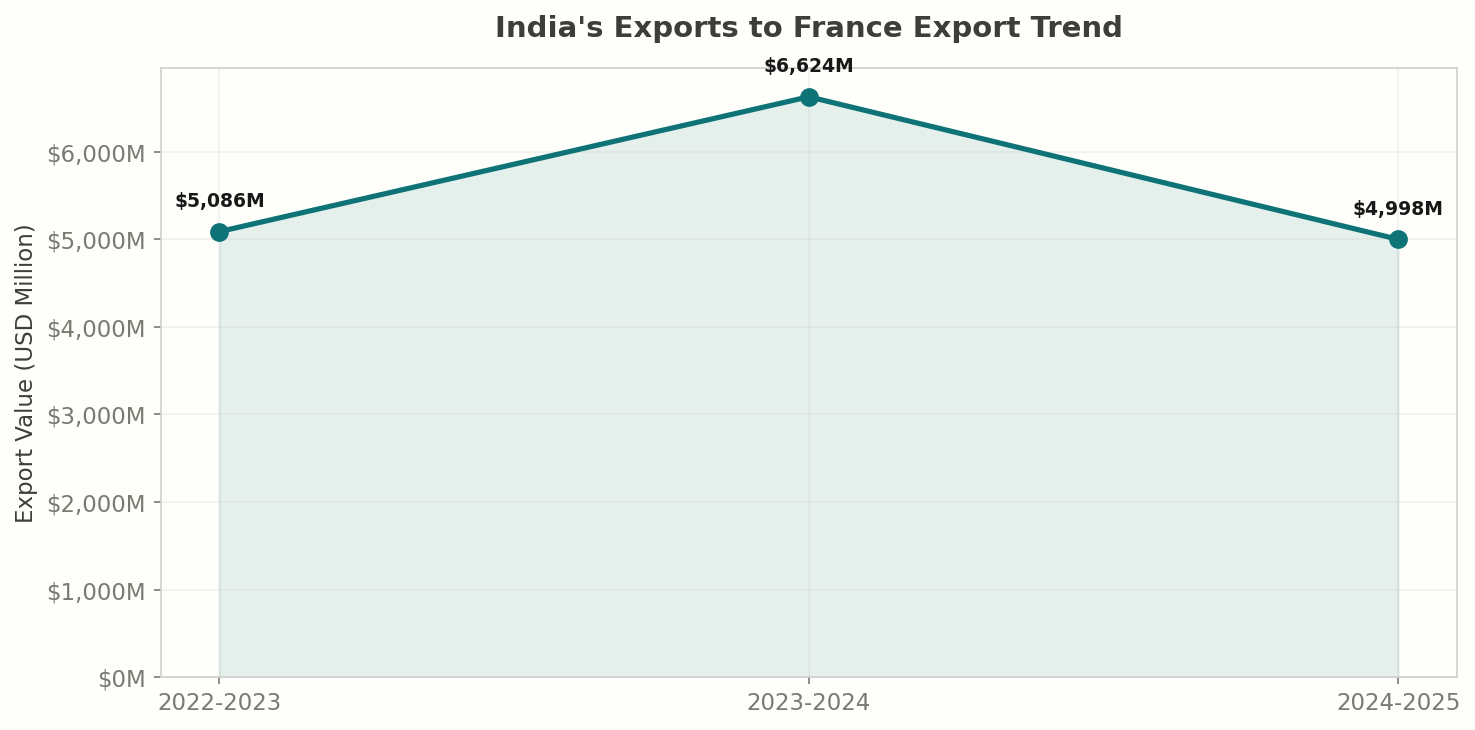
India's goods exports to France totalled $4,997.87 million in 2024-25, down from a peak of $6,624.35 million in 2023-24 but still well above the $5,086.15 million recorded in 2022-23. The 2023-24 spike reflected strong demand for Indian electrical equipment, machinery, and pharmaceuticals driven by European supply chain diversification away from China. The 2024-25 normalisation brings trade closer to the underlying growth trend, which remains positive over a five-year horizon.
India and France enjoy a strategic partnership that extends well beyond trade into defence, space, nuclear energy, and technology. France has been a consistent advocate for stronger India-EU economic ties, and the ongoing India-EU Free Trade Agreement (FTA) negotiations — if successfully concluded — would transform the tariff landscape for Indian goods entering France and the broader EU market. Currently, Indian goods enter France under EU MFN tariffs or the EU's Generalised Scheme of Preferences (GSP), which provides reduced or zero tariffs for many Indian product categories.
What India Exports to France
The top product categories exported from India to France in 2024-25:
| Rank | HS Chapter | Product Category | Export Value (USD Million) |
|---|---|---|---|
| 1 | 84 | Machinery | $588.62 |
| 2 | 30 | Pharmaceuticals | $560.27 |
| 3 | 85 | Electrical equipment | $524.20 |
| 4 | 62 | Woven apparel | $347.13 |
| 5 | 71 | Gems and jewellery | $323.70 |
| 6 | 29 | Organic chemicals | $320.80 |
| 7 | 61 | Knitted apparel | $249.49 |
| 8 | 90 | Instruments | $217.69 |
| 9 | 87 | Vehicles and parts | $207.50 |
| 10 | 63 | Textile articles | $166.78 |
| 11 | 42 | Leather goods | $164.01 |
| 12 | 40 | Rubber | $146.86 |
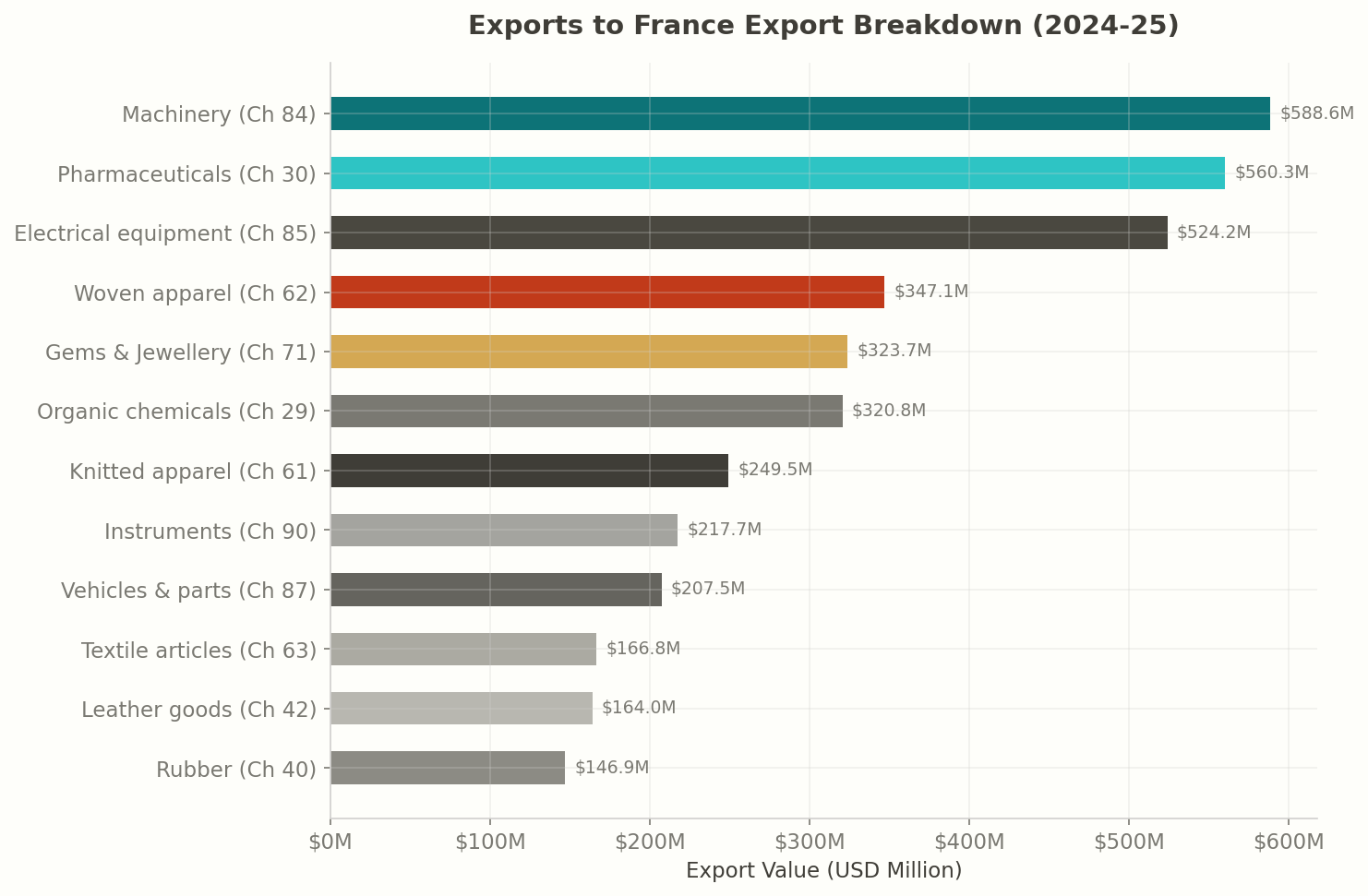
Machinery leads at $588.62 million, reflecting India's growing position as a supplier of industrial equipment and components to French manufacturing. Pharmaceuticals at $560.27 million underscores France's role as one of the largest pharmaceutical markets in Europe — India supplies substantial quantities of generic drugs, active pharmaceutical ingredients (APIs), and finished dosage forms to the French healthcare system.
Electrical equipment at $524.20 million is a standout category, positioning France as one of the top European destinations for Indian electronics and electrical components. The combined apparel categories — woven ($347.13M), knitted ($249.49M), and textile articles ($166.78M) — total $763.40 million, making textiles and apparel collectively the largest export category. France's fashion industry, haute couture houses, and mass-market retailers all source from India.
The leather goods story at $164.01 million is particularly interesting. France is the global capital of luxury leather goods (Hermes, Louis Vuitton, Chanel), and Indian tanneries and leather goods manufacturers supply raw and semi-finished leather, leather components, and finished products into French luxury and mid-market supply chains. Gems and jewellery at $323.70 million serves both the luxury market and France's fashion jewellery industry. Instruments at $217.69 million reflects India's growing medical device and precision engineering capabilities.
Regulatory and Customs Framework
As an EU member state, France applies EU-wide customs regulations, product safety directives, and market surveillance rules. Goods cleared through French customs can circulate freely within the entire EU Single Market. This means that meeting French (EU) regulatory requirements gives you access not just to France's 68 million consumers, but to the EU's 450 million.
Direction Generale des Douanes et Droits Indirects (DGDDI)
DGDDI is France's customs administration:
- Import declaration is filed electronically through the DELTA system — France's customs clearance platform integrated with the EU's TARIC (Tariff Integrated Regulation) database
- Customs valuation: Based on CIF (Cost, Insurance, Freight) value, in accordance with EU customs valuation rules
- EORI number: Your French importer must have a valid Economic Operators Registration and Identification (EORI) number to import goods into the EU. This is mandatory.
- Single Administrative Document (SAD): The standard EU customs declaration form, filed electronically
- Pre-arrival declarations: EU customs regulations require advance cargo information (Entry Summary Declaration) to be filed before goods arrive at EU borders
- Risk-based inspection: French customs uses EU-wide risk profiling. First-time shipments and high-risk product categories receive closer examination.
Direction Generale de la Concurrence, de la Consommation et de la Repression des Fraudes (DGCCRF)
DGCCRF is France's consumer protection and market surveillance authority:
- Conducts market surveillance checks on consumer products already on the market
- Enforces EU product safety directives (General Product Safety Directive, sector-specific directives)
- Monitors labelling compliance, including French-language requirements
- Can order product recalls and impose penalties for non-compliance
EU Food Safety Regulations
Food imports into France are governed by EU food safety regulations:
- European Food Safety Authority (EFSA) sets safety standards for the entire EU
- EU Maximum Residue Limits (MRLs) for pesticides are harmonised across all member states — check the EU MRL database, not French national MRLs
- HACCP compliance is expected for all food manufacturers exporting to the EU
- Food labelling: Must comply with EU Regulation 1169/2011 (Food Information to Consumers). In France, labels must be in French — this is a legal requirement under the Toubon Law (Loi Toubon), which mandates French language on all consumer product information.
- EU organic certification: To market products as organic in France/EU, you need certification under EU organic regulations. India's NPOP organic standard has an equivalence agreement with the EU organic standard, simplifying certification for Indian organic exporters.
ANSM (Agence Nationale de Securite du Medicament)
ANSM regulates pharmaceuticals and medical devices in France:
- Pharmaceuticals must receive EU Marketing Authorisation (centralised through EMA or decentralised/mutual recognition through ANSM)
- Manufacturing facilities must comply with EU GMP standards. EU/French authorities conduct GMP inspections of Indian pharmaceutical plants.
- Medical devices: Now governed by the EU Medical Device Regulation (MDR 2017/745), which replaced the previous directive in 2021. MDR requirements are substantially more stringent — Indian medical device exporters must ensure full MDR compliance.
Key Standards and Certifications
CE Marking
The CE mark is the passport to the European Single Market. It indicates that a product complies with all applicable EU health, safety, and environmental requirements. CE marking is mandatory for:
- Machinery (Machinery Directive 2006/42/EC)
- Electrical and electronic equipment (Low Voltage Directive 2014/35/EU)
- Medical devices (MDR 2017/745)
- Personal protective equipment (PPE Regulation 2016/425)
- Construction products (Construction Products Regulation 305/2011)
- Toys (Toy Safety Directive 2009/48/EC)
- Radio equipment (Radio Equipment Directive 2014/53/EU)
Indian exporters must conduct conformity assessment (self-certification for some categories, third-party Notified Body assessment for others), prepare technical documentation, draft a Declaration of Conformity, and affix the CE mark before placing products on the EU market. Shipping without CE marking where required will result in customs detention and refusal of entry.
REACH (Registration, Evaluation, Authorisation and Restriction of Chemicals)
REACH is the EU's comprehensive chemical regulation. It applies to:
- All chemical substances manufactured in or imported into the EU in quantities exceeding 1 tonne per year
- Chemical products, mixtures, and articles containing substances of very high concern (SVHCs)
- Indian exporters of organic chemicals, dyes, paints, plastics, rubber, and textiles must ensure REACH compliance
Practical implications for Indian exporters:
- Your EU/French importer is the REACH registrant (importers bear registration responsibility)
- You must provide your importer with Safety Data Sheets (SDS) and information on chemical composition
- Certain restricted substances (Annex XVII) are banned or limited in concentration — verify that your products comply
- SVHCs on the Candidate List require notification to ECHA (European Chemicals Agency) if present above 0.1% w/w
RoHS (Restriction of Hazardous Substances)
RoHS Directive 2011/65/EU restricts hazardous substances in electrical and electronic equipment:
- Lead, mercury, cadmium, hexavalent chromium, PBBs, and PBDEs are restricted to specified maximum concentrations
- Applies to all electrical and electronic equipment sold in the EU
- Indian exporters of electrical equipment ($524.20M to France) must ensure RoHS compliance and maintain documentation
French Language Requirements
France enforces strict French-language requirements for all consumer products under the Loi Toubon:
- Product names, descriptions, instructions for use, safety warnings, and warranty information must be in French
- Packaging, labels, inserts, and accompanying documentation must be in French
- Technical documentation for professional products should ideally be available in French, though English is accepted in many B2B contexts
- Marketing materials, catalogues, and product literature for the French market should be in French
This is not merely a recommendation — it is a legal requirement, and DGCCRF actively enforces it. Products with only English-language labelling will face market surveillance action.
Tariff Structure and Trade Agreements
EU Common External Tariff
As an EU member, France applies the EU Common External Tariff. Indian goods may benefit from:
- EU GSP (Generalised Scheme of Preferences): Provides reduced or zero tariffs for developing countries including India. However, India has been graduated from GSP for many product categories where it is considered competitive — check product-specific eligibility.
- MFN rates: EU's standard WTO tariff rates apply where GSP is not available.
Indicative tariff rates for key Indian export categories:
| Product Category | GSP/Applied Rate | MFN Rate |
|---|---|---|
| Machinery (84xx) | 0-3% | 0-6% |
| Pharmaceuticals (30xx) | 0% | 0-6.5% |
| Electrical equipment (85xx) | 0-3.5% | 0-14% |
| Woven apparel (62xx) | 9.6% | 12% |
| Gems and jewellery (71xx) | 0% | 0-4% |
| Organic chemicals (29xx) | 0-3.5% | 0-6.5% |
| Knitted apparel (61xx) | 9.6% | 12% |
| Instruments (90xx) | 0% | 0-6.7% |
| Vehicles and parts (87xx) | 0-4% | 0-22% |
| Leather goods (42xx) | 3-5% | 3-9.7% |
| Rubber (40xx) | 0-3% | 0-6.5% |
India-EU FTA negotiations: India and the EU have been negotiating a Free Trade Agreement since 2007. An eventual agreement would significantly reduce tariffs on Indian textiles, apparel, leather goods, and agricultural products — categories that currently face the highest EU tariffs. Indian exporters in these sectors should monitor negotiation progress closely.
Use the Duty Calculator to check the exact applicable rate for your HS code.
Logistics and Shipping
Shipping Routes and Transit Times
- JNPT/Nhava Sheva to Le Havre: 18-22 days
- JNPT to Marseille: 14-18 days (shorter Suez Canal route)
- Mundra to Le Havre: 18-22 days
- Mundra to Fos-sur-Mer: 14-16 days
- Chennai to Le Havre: 20-24 days
- Air freight (Delhi/Mumbai to Paris CDG): 8-9 hours direct
Major French Ports
- Le Havre — France's largest container port and the primary gateway for Northern France and the Paris region. Handles approximately 50% of France's container traffic. Excellent road and rail connections to Paris (200 km) and the industrial centres of northern France.
- Marseille/Fos-sur-Mer — France's second-largest port complex, located on the Mediterranean coast. The primary gateway for Southern France and offers shorter transit times from India via the Suez Canal. Fos-sur-Mer is the deep-water container terminal adjacent to Marseille.
- Dunkirk — Northern France port, strong for bulk cargo, steel, and industrial materials. Growing container volumes.
- Rouen — River port on the Seine, serving the Paris metropolitan area. Primarily for bulk cargo and grain exports.
Freight Costs (Indicative)
- 20-ft container to Le Havre: $1,800-$3,500
- 40-ft container to Le Havre: $3,000-$6,000
- 20-ft container to Marseille: $1,500-$3,000
- Air freight to Paris CDG: $3.50-$6.50 per kg
- Inland transport from Le Havre to Paris: $400-$800 per container
French Customs Clearance
- Standard clearance: 1-2 business days for compliant shipments
- DELTA system: France's electronic customs clearance platform processes declarations efficiently
- EU transit: Goods cleared through French customs can be moved freely to any EU member state without further customs formalities
- Food inspections: DGCCRF and DGAL (Direction Generale de l'Alimentation) may inspect food shipments. First-time food exports should allow 3-5 additional business days.
- CE mark verification: Customs officials may verify CE marking documentation for regulated products at the border
Documentation Requirements
- Commercial Invoice (in English or French, with full product description, HS codes, and values)
- Packing List (with weights, dimensions, and detailed carton-level information)
- Bill of Lading or Airway Bill
- Certificate of Origin (Form A for GSP claims, or standard non-preferential CoO)
- Single Administrative Document (SAD) — completed by the French customs broker
- CE Declaration of Conformity and technical file (for CE-marked products)
- REACH compliance documentation and Safety Data Sheets (for chemical products)
- French-language labels and product information (mandatory for consumer products)
- Phytosanitary Certificate (for plant and agricultural products)
- Health Certificate (for food and seafood, issued by EIC/FSSAI/MPEDA)
- EU GMP compliance documentation (for pharmaceutical products)
- EUR.1 movement certificate (if applicable for EU preferential arrangements)
- Shipping Bill (filed via ICEGATE)
- Insurance Certificate
Payment and Banking
Common Payment Methods
- T/T Wire Transfer: Standard for established trade relationships. French businesses generally pay within agreed terms, though payment cycles in France can be longer than in Northern Europe — 45-60 day payment terms are standard, and 90 days is not uncommon in certain industries.
- Letters of Credit: Used for first-time transactions and high-value orders. French banks are among the largest and most reliable in the eurozone.
- Open Account (30-90 days): Common for ongoing relationships. French payment legislation (Loi de Modernisation de l'Economie) caps inter-business payment terms at 60 days from invoice date (or 45 days from month-end), which provides a legal framework benefiting suppliers.
- SEPA Credit Transfer: Within the EU, payments are processed through the SEPA (Single Euro Payments Area) system, enabling fast and low-cost EUR transfers.
Currency
Trade is denominated in EUR or USD. For goods invoiced in Euros, Indian exporters should hedge their EUR/INR exposure through forward contracts, as the EUR/INR rate can fluctuate significantly.
Key French Banks
- BNP Paribas — France's largest bank and one of the world's largest. Extensive trade finance operations globally, including India.
- Societe Generale — Major French bank with strong corporate and investment banking capabilities
- Credit Agricole — France's largest retail bank and a significant trade finance provider
- Credit Mutuel — Large cooperative bank with strong regional presence
- BPCE (Banque Populaire / Caisse d'Epargne) — Major banking group with extensive domestic network
French Business Culture
French business culture has distinct characteristics that Indian exporters should understand:
- Formality: French business interactions are more formal than Anglo-Saxon norms. Use titles (Monsieur, Madame), maintain formal address until invited to use first names, and dress professionally.
- Relationship orientation: Like Indian business culture, French commerce values personal relationships. Face-to-face meetings in France are important, particularly for initial business development. Phone calls and video conferences are acceptable for ongoing communication, but initial trust is built in person.
- French language: While many French business professionals speak English, conducting at least some communication in French — even basic greetings and pleasantries — is valued and respected. Product documentation, labels, and marketing materials must be in French.
- Lunch culture: Business lunches are common and can extend to 90 minutes — they are relationship-building, not formalities.
- August vacation: Much of French business slows significantly in August. Avoid scheduling important meetings or expecting quick decisions during this period.
Common Mistakes
Not CE marking products where required. CE marking is mandatory for a wide range of product categories sold in the EU. Indian exporters of machinery, electrical equipment, medical devices, and consumer products frequently underestimate the CE marking process — assuming it is a simple label when it actually requires conformity assessment, technical documentation, and formal declaration. Products without proper CE marking will be refused entry at French customs or seized during market surveillance. Begin the CE marking process well before your planned shipment date.
Ignoring REACH chemical compliance. REACH applies to virtually every product containing chemical substances — not just chemical products themselves. Textiles, leather goods, plastics, rubber, and electronics all contain chemical substances subject to REACH restrictions. Indian exporters of dyes, paints, organic chemicals, and rubber must provide their EU importers with complete chemical composition data and Safety Data Sheets. Failure to comply with REACH can result in product seizure, fines, and exclusion from the EU market.
Underestimating French-language documentation requirements. The Loi Toubon mandates French-language labelling and product information for all consumer products. Indian exporters frequently assume English-only labelling is acceptable — it is not. Products with only English labels will face enforcement action from DGCCRF. Invest in professional French translations of all consumer-facing product information before shipment.
Applying for GSP benefits without checking graduation. India has been graduated from the EU GSP for many product categories where it is considered competitive. Assuming GSP rates apply without verifying product-specific eligibility can lead to under-payment of duties and subsequent customs assessments. Check the EU GSP regulation and TARIC database for your specific HS code.
Treating the French market as identical to other EU markets. While EU regulations are harmonised, market preferences, distribution channels, and business cultures vary significantly between EU member states. French consumers have distinct preferences — particularly in food, fashion, and luxury goods. Product positioning, marketing, and packaging that works in Germany or the UK may not resonate in France. Research the French market specifically, not just the EU market generically.
Ignoring the August slowdown. Planning product launches, expecting contract negotiations, or scheduling critical shipments during August is a common mistake. French business operates on a different rhythm in summer. Plan your French market activities around this calendar reality.
Key Takeaways
- India exported $4,997.87 million to France in 2024-25, led by machinery ($588.62M), pharmaceuticals ($560.27M), electrical equipment ($524.20M), and a combined $763.40M in textiles and apparel
- CE marking is mandatory for machinery, electrical equipment, medical devices, and many consumer products — non-compliance results in customs refusal or market seizure
- REACH compliance is required for all products containing chemical substances — provide your EU importer with complete chemical composition data
- French-language labelling is legally required for all consumer products under the Loi Toubon — prepare French labels before shipment
- EU GSP provides tariff preferences for some Indian products, but check product-specific graduation status
- France is a gateway to the entire EU Single Market — goods cleared through French customs circulate freely across 27 EU member states
- French business culture values formality, relationships, and the French language — invest in personal meetings and French-language communication
- Shipping to Marseille via Suez is 4-6 days faster than to Le Havre for Indian exporters
Next Steps
- Identify your HS code with the HS Code Finder and check the EU tariff rate using the Duty Calculator
- Determine CE marking requirements for your product category and begin the conformity assessment process
- Verify REACH and RoHS compliance for chemical substances in your products
- Prepare French-language labels and product documentation with professional translations
- Explore French market demand with the Market Finder
- Connect with French importers and distributors — Business France (France's trade promotion agency) has offices in India and organises buyer-seller meets and trade missions
- Attend France-focused trade fairs — major events include SIAL Paris (food), Premiere Vision (textiles/fashion), Maison et Objet (home/design), and JEC World (composites)
- Consider France as your EU gateway — once you have established French market presence, expand to neighbouring EU markets with the same CE-marked, EU-compliant products
- Explore other export markets to build a diversified international presence
France is a sophisticated, high-value market that rewards quality, regulatory compliance, and cultural sensitivity. Strong demand across Indian core export categories, combined with gateway access to the EU Single Market, makes France one of the most strategically important European destinations for Indian exporters. MSMEs that invest in CE marking, REACH compliance, French-language documentation, and relationship building will find France to be a profitable and enduring export market.
Ready to start exporting?
Get a detailed market report with country-by-country analysis, pricing insights, and buyer contacts.
Get Market ReportXIMPEX Export Advisory
Need help implementing the strategies discussed in this guide? Our team of export specialists can provide personalized guidance for your business.