How to Export to Canada from India — Complete Guide
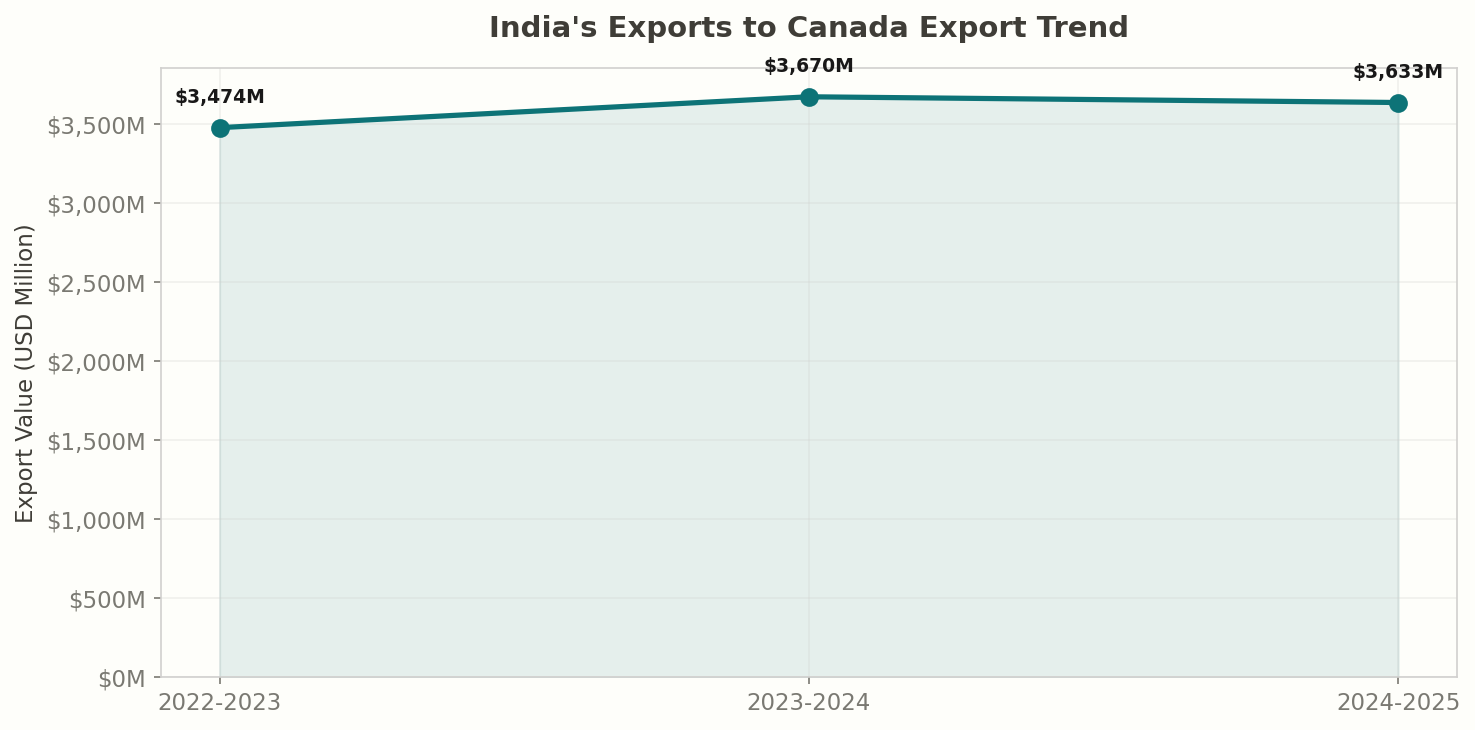
Canada is a stable, high-income export market with deep cultural ties to India. India exported $3,633.38 million in goods to Canada in 2024-25, maintaining a remarkably consistent trade trajectory — up from $3,474.42 million in 2022-23 and $3,669.55 million in 2023-24. Unlike many export destinations where trade volumes fluctuate sharply with commodity cycles, India-Canada trade is characterised by steady, diversified flows across pharmaceuticals, machinery, steel, gems, seafood, textiles, and rice. This diversification makes Canada a resilient market for Indian exporters.
Canada is the world's ninth-largest economy, with 40 million consumers who enjoy one of the highest standards of living globally. More importantly for Indian exporters, Canada is home to over two million people of Indian origin — the largest Indian diaspora in any Western country relative to population. This community drives substantial demand for Indian food products, textiles, spices, and consumer goods, creating a natural market entry point that few other countries offer. For Indian MSMEs, Canada combines the accessibility of a diaspora-driven market with the premium pricing of a G7 economy.
India–Canada Trade Overview
India's goods exports to Canada totalled $3,633.38 million in 2024-25, essentially flat compared to $3,669.55 million in 2023-24 and up modestly from $3,474.42 million in 2022-23. This stability is a defining feature of the India-Canada trade relationship: no single commodity dominates to the point where price swings cause dramatic year-to-year variation. The top twelve export categories span pharmaceuticals, machinery, metals, gems, seafood, textiles, and cereals — a remarkably balanced portfolio.
India and Canada do not currently have a free trade agreement, though negotiations for a Comprehensive Economic Partnership Agreement (CEPA) have been ongoing since 2010. In the meantime, trade operates under WTO Most Favoured Nation (MFN) tariff rates, with Canada's General Preferential Tariff (GPT) providing reduced rates for certain products from developing countries including India. The eventual conclusion of an India-Canada CEPA would significantly enhance market access — making it important for Indian exporters to understand the current tariff landscape and plan for future preferential access.
What India Exports to Canada
The top product categories exported from India to Canada in 2024-25:
| Rank | HS Chapter | Product Category | Export Value (USD Million) |
|---|---|---|---|
| 1 | 30 | Pharmaceuticals | $535.99 |
| 2 | 84 | Machinery | $264.78 |
| 3 | 73 | Steel articles | $236.98 |
| 4 | 71 | Gems and jewellery | $200.83 |
| 5 | 29 | Organic chemicals | $190.13 |
| 6 | 03 | Seafood | $143.38 |
| 7 | 63 | Textile articles | $142.66 |
| 8 | 61 | Knitted apparel | $124.24 |
| 9 | 87 | Vehicles and parts | $119.52 |
| 10 | 62 | Woven apparel | $116.13 |
| 11 | 10 | Cereals and rice | $108.09 |
| 12 | 72 | Iron and steel | $101.93 |
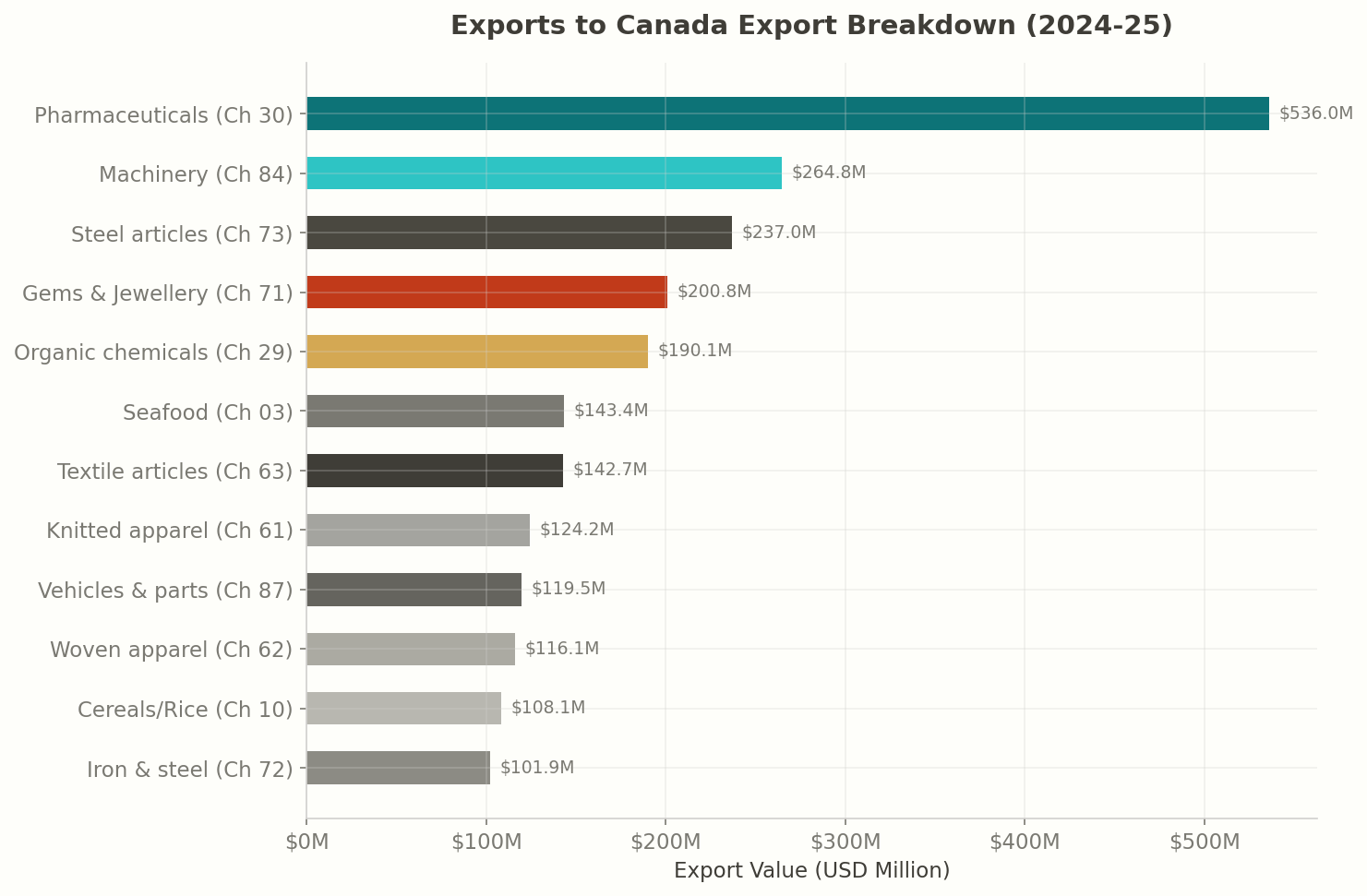
Pharmaceuticals lead at $535.99 million — India is one of the world's largest generic drug manufacturers, and Canada's universal healthcare system is a major consumer of affordable generics. Canadian pharmacies stock significant quantities of Indian-manufactured generic medications, and this category has shown consistent growth as Canadian healthcare costs drive demand for cost-effective alternatives.
Machinery ($264.78M) and steel articles ($236.98M) reflect India's industrial export capabilities. Gems and jewellery at $200.83 million benefits from the large Indian diaspora in Canada — gold jewellery demand from the Indian-Canadian community is a significant driver. Organic chemicals ($190.13M) supply Canada's pharmaceutical and chemical industries.
The textiles and apparel story is noteworthy: combined exports across textile articles ($142.66M), knitted apparel ($124.24M), and woven apparel ($116.13M) total $383.03 million — making textiles and apparel collectively the second-largest category. The Indian diaspora and Canada's multicultural retail environment drive demand for Indian fabrics, garments, and home textiles.
Seafood at $143.38 million and cereals/rice at $108.09 million highlight Canada's appetite for Indian food products. Basmati rice, shrimp, and frozen fish are particularly strong categories, supported by both diaspora demand and mainstream Canadian consumer interest in international cuisines.
Regulatory and Customs Framework
Canada has a well-established, transparent regulatory system. Regulations are published, consistently enforced, and — unlike some markets — generally predictable. The key challenge for Indian exporters is navigating the interplay between federal and provincial regulations, which can differ significantly.
Canada Border Services Agency (CBSA)
CBSA is Canada's primary border and customs agency. All imports into Canada are processed through CBSA:
- Import declaration is filed electronically through the CBSA's Customs Commercial System
- Customs valuation: Based on transaction value (FOB or CIF depending on the terms), consistent with WTO valuation principles
- Business Number (BN): Your Canadian importer must have a CBSA import/export account linked to their Business Number
- Advance Commercial Information (ACI): Marine shipments require advance electronic data submission before arrival at a Canadian port — typically 24 hours before loading at the port of origin
- Risk-based examination: CBSA uses intelligence-driven targeting. First-time trade lanes and high-risk product categories receive more scrutiny. Compliant trade partners benefit from reduced inspection rates over time.
- Trusted Trader programs: CBSA's Partners in Protection (PIP) and Customs Self-Assessment (CSA) programs offer expedited clearance for qualified importers
Canadian Food Inspection Agency (CFIA)
CFIA regulates all food imports into Canada:
- Safe Food for Canadians Regulations (SFCR): Since 2019, all food importers must hold a Safe Food for Canadians (SFC) licence. Your Canadian importer is responsible for obtaining this licence.
- Preventive Control Plans (PCP): Canadian importers must have documented preventive controls for food safety hazards
- Maximum Residue Limits (MRLs): Canada maintains its own MRL database for pesticide residues — distinct from Codex or Indian standards. Indian agricultural exporters must test against Canadian MRLs specifically.
- Bilingual labelling: All food products sold in Canada must be labelled in both English and French. This is a federal requirement under the Consumer Packaging and Labelling Act — not optional, not regional, and applies to all consumer food products regardless of which province they are sold in.
- Nutritional information: The Canadian Nutrition Facts table format differs from American, European, and Indian formats. Use the CFIA-specified format.
Health Canada
Health Canada regulates pharmaceuticals, medical devices, natural health products, and cosmetics:
- Pharmaceuticals: All drugs must receive a Drug Identification Number (DIN) before sale in Canada. Manufacturing facilities must comply with Canadian GMP standards. Health Canada conducts facility inspections — including inspections of Indian manufacturing plants.
- Medical devices: Classified into four risk categories (Class I-IV). Require a Medical Device Licence. Class III and IV devices require pre-market review.
- Natural Health Products (NHP): Products like Ayurvedic medicines, herbal supplements, and traditional remedies are regulated as NHPs and require a Natural Product Number (NPN) before sale. This is particularly relevant for Indian exporters of traditional medicine and herbal products.
- Cosmetics: Must be notified to Health Canada via the Cosmetic Notification Form. Ingredient restrictions follow the Canadian Cosmetic Ingredient Hotlist.
CSA Group and Product Safety
The CSA Group (formerly Canadian Standards Association) is Canada's primary standards development organisation:
- CSA certification: Required for electrical and electronic products sold in Canada. CSA testing covers safety, electromagnetic compatibility, and energy efficiency.
- cUL mark: Products certified by Underwriters Laboratories for the Canadian market also bear the cUL mark, which is accepted as equivalent to CSA certification for most product categories.
- SCC accreditation: The Standards Council of Canada (SCC) accredits testing laboratories and certification bodies. Ensure your testing is conducted at an SCC-accredited facility.
Key Standards and Certifications
Bilingual Labelling — The Non-Negotiable Requirement
Canada's bilingual (English and French) labelling requirement is the single most frequently overlooked regulation by Indian exporters. Under the Consumer Packaging and Labelling Act and the Official Languages Act:
- All consumer products sold in Canada must have labels in both English and French
- This applies to product names, ingredient lists, directions for use, safety warnings, net quantity declarations, and dealer information
- The requirement is federal and applies uniformly across all provinces — not just Quebec
- Non-compliant products will be detained at the border or recalled from store shelves
For Indian exporters, this means preparing bilingual packaging and labels before shipment. Working with a Canadian distributor or customs broker who can provide French translation and label compliance review is strongly recommended.
Cold Weather Packaging
Canada's extreme winter climate (temperatures reaching -30 to -40 degrees Celsius in many regions) requires special attention to packaging:
- Liquid products must be packaged to withstand freezing during transit and warehouse storage
- Perishable goods require cold chain management adapted to Canadian conditions
- Fragile goods (glass, ceramics) need packaging that accounts for thermal stress from temperature variations
- Adhesives and labels must maintain integrity in sub-zero temperatures
Provincial vs. Federal Regulations
Canada's federal system means some regulations vary by province — provincial sales taxes differ, alcohol and cannabis regulations are provincial, and environmental/packaging regulations may have provincial variations. For goods exports, federal regulations (CBSA, CFIA, Health Canada, CSA) are the primary concern. But your Canadian distributor's province of operation may affect distribution logistics and cost structures.
Tariff Structure and Trade Agreements
Current Tariff Framework
In the absence of a bilateral FTA, Indian goods enter Canada under:
- MFN rates: Canada's standard tariff rates for WTO members. Generally moderate — Canada's average applied MFN tariff is approximately 4-5% for industrial goods and higher for agricultural products.
- General Preferential Tariff (GPT): Canada's unilateral preference programme for developing countries, providing reduced or zero tariff rates on eligible products. India qualifies for GPT treatment on many product categories, though coverage has been narrowed in recent years.
Indicative tariff rates for key Indian export categories:
| Product Category | GPT/Applied Rate | MFN Rate |
|---|---|---|
| Pharmaceuticals (30xx) | 0% | 0-8% |
| Machinery (84xx) | 0-5% | 0-9.5% |
| Steel articles (73xx) | 0-6% | 0-8% |
| Gems and jewellery (71xx) | 0% | 0-6.5% |
| Organic chemicals (29xx) | 0% | 0-6.5% |
| Seafood (03xx) | 0-5% | 0-11% |
| Knitted apparel (61xx) | 12-18% | 16-18% |
| Woven apparel (62xx) | 12-18% | 16-18% |
| Cereals/rice (10xx) | 0% | 0-5% |
| Iron and steel (72xx) | 0% | 0-7% |
Key observations:
- Pharmaceuticals and chemicals generally enter at zero or low duty
- Textiles and apparel face the highest tariffs (12-18%), making a future CEPA particularly valuable for this sector
- Seafood and agricultural products enjoy moderate tariff preferences
Use the Duty Calculator to check the exact applicable rate for your HS code.
India-Canada CEPA Negotiations
India and Canada have been negotiating a CEPA since 2010. While progress has been intermittent, the agreement — if concluded — would provide significant tariff reductions, particularly for textiles, apparel, agricultural products, and processed foods where current tariffs are highest. Indian exporters should monitor these negotiations and be prepared to take advantage of preferential rates once the agreement enters into force.
Logistics and Shipping
Shipping Routes and Transit Times
- JNPT/Nhava Sheva to Vancouver: 28-35 days (via Pacific route)
- JNPT to Montreal: 25-30 days (via Suez Canal and Atlantic)
- Mundra to Vancouver: 26-32 days
- Chennai to Vancouver: 25-32 days
- Air freight (Delhi/Mumbai to Toronto): 14-16 hours (one stop or direct)
Major Canadian Ports and Gateways
- Vancouver — Canada's largest port by tonnage and the primary gateway for Asian imports. Located on the Pacific coast, it serves Western Canada and acts as a transit point for goods moving inland to Ontario and Quebec by rail. Most Indian shipments via the Pacific route arrive here.
- Montreal — Canada's second-largest container port. Located on the St. Lawrence River, it serves Quebec, Ontario, and Eastern Canada. For Indian shipments via the Suez Canal and Atlantic route, Montreal can be faster than routing through Vancouver and railing across the continent.
- Toronto (inland) — Not a seaport, but Canada's largest distribution hub. The Greater Toronto Area is home to over 6 million people and is the economic centre of Canada. Goods arriving at Montreal or Vancouver are typically railed or trucked to Toronto-area distribution centres.
- Halifax — Atlantic port serving the Maritime provinces. Growing as a container port and offers shorter Atlantic transit times than Montreal.
- Prince Rupert — Northern Pacific port in British Columbia. Offers faster rail connections to the Canadian prairies and central Canada than Vancouver, with shorter vessel transit from Asia.
Freight Costs (Indicative)
- 20-ft container to Vancouver: $2,500-$4,500
- 40-ft container to Vancouver: $4,000-$7,000
- 20-ft container to Montreal: $2,000-$4,000
- Air freight to Toronto: $4.50-$7.50 per kg
- Inland rail (Vancouver to Toronto): $2,500-$4,000 per container
Canada's vast geography means inland freight costs can be significant. A container arriving in Vancouver and destined for Toronto adds substantial rail or truck costs. Factor inland logistics into your landed cost calculation.
Canadian Customs Clearance
- Standard clearance: 1-3 business days for routine shipments
- ACI compliance: Advance Commercial Information must be transmitted electronically before the vessel arrives — failure to comply results in delays
- CFIA inspection: Food imports may be held for CFIA sampling and testing. First-time food shipments from India should allow 5-7 additional business days for inspection.
- Anti-dumping duties: Canada maintains anti-dumping measures on certain steel products. Verify whether your steel product is subject to anti-dumping duty before shipment.
Documentation Requirements
- Commercial Invoice (in English, with complete product description, HS codes, values, and terms of sale)
- Packing List (with weights, dimensions, and carton-level detail)
- Bill of Lading or Airway Bill
- Certificate of Origin (Form A for GPT claims, or standard non-preferential CoO)
- Canada Customs Coding Form (B3) — typically completed by the Canadian customs broker
- Bilingual labels (English and French) — must be prepared and affixed before or at time of import
- CFIA import licence and documentation (for food, plant, and animal products)
- Phytosanitary Certificate (for plant and agricultural products)
- Health Certificate (for seafood and animal products, issued by EIC/FSSAI/MPEDA)
- Drug Establishment Licence (DEL) documentation and DIN (for pharmaceutical products)
- CSA/cUL certification (for electrical and electronic products)
- Shipping Bill (filed via ICEGATE)
- Insurance Certificate
Payment and Banking
Common Payment Methods
- T/T Wire Transfer: The most common payment method. Canadian businesses are reliable payers with strong credit cultures. Payment terms of 30-60 days against documents are standard for established relationships.
- Letters of Credit: Used for first-time transactions and high-value orders. Canada's banking system is exceptionally stable — Canadian banks are among the best-capitalised in the world, and LC confirmations from Canadian banks are highly reliable.
- Open Account (30-60 days): Common for ongoing relationships. Canadian payment culture is dependable — commercial default rates are low.
- Export credit insurance: Export Development Canada (EDC) provides trade credit insurance that Canadian importers can access, providing additional security for Indian exporters.
Currency
Trade is denominated in USD or CAD (Canadian Dollar). Most India-Canada trade settles in USD, particularly for commodities and industrial goods. The CAD/USD rate fluctuates with oil prices (Canada is a major oil producer), so exporters invoicing in CAD should monitor energy markets and consider hedging for large contracts.
Key Canadian Banks
- TD Bank (Toronto-Dominion) — Canada's largest bank by assets
- Royal Bank of Canada (RBC) — Largest by market capitalisation, extensive international trade finance operations
- Scotiabank (Bank of Nova Scotia) — Strong international presence, particularly in emerging markets. Has operations in India.
- Bank of Montreal (BMO) — Strong in commercial banking and trade finance
- CIBC (Canadian Imperial Bank of Commerce) — Major domestic commercial bank
Canada's banking system is considered one of the most stable in the world — no major Canadian bank failed during the 2008 global financial crisis. LC and payment risk from Canadian banks is minimal.
The Diaspora Market Advantage
Canada's Indian diaspora (over 2 million people, concentrated in the Greater Toronto Area, Vancouver, Calgary, and Edmonton) creates unique market opportunities: direct consumer demand for Indian food, spices, textiles, jewellery, and home goods; established distribution networks through Indian grocery stores and retailers in major Canadian cities; and seasonal demand spikes around Diwali, wedding season, and Baisakhi. Indian exporters can leverage this diaspora as a low-risk market entry strategy, then expand into mainstream Canadian retail channels.
Common Mistakes
Ignoring French-language labelling. This is the most common and most costly mistake Indian exporters make when entering Canada. All consumer products must be labelled in both English and French — this is federal law, not a Quebec-specific requirement. Products arriving without French labels will be detained at the border, returned, or require expensive relabelling in Canada. The cost of preparing bilingual labels before shipment is trivial compared to the cost of border delays or rejected shipments.
Underestimating cold weather packaging requirements. Indian exporters frequently ship products in packaging designed for tropical or temperate climates. Canadian winters are severe, and products — especially liquids, glass containers, adhesive-label goods, and perishables — must be packaged to withstand sub-zero temperatures during transit, port handling, and warehouse storage. Test your packaging under simulated cold conditions before shipping to Canada.
Not understanding provincial vs. federal regulatory differences. While customs and import regulations are federal, some product regulations, tax structures, and distribution requirements vary by province. Working with a Canadian distributor who understands provincial nuances — particularly if you are distributing across multiple provinces — is essential.
Shipping pharmaceuticals without proper Health Canada documentation. India is a major generic drug supplier to Canada, but Health Canada's regulatory requirements are rigorous. Drug Identification Numbers (DINs), facility GMP compliance, and proper drug labelling (bilingual, with Canadian Drug Facts format) must all be in place before shipment. Pharmaceutical shipments without proper documentation will be refused entry.
Overlooking anti-dumping duties on steel products. Canada maintains anti-dumping and countervailing duty measures on certain steel products from specific countries. Indian steel exporters must verify whether their products are subject to these measures before committing to sales. CBSA publishes a complete list of products under anti-dumping review or order.
Assuming the diaspora market is the entire market. While the Indian diaspora provides an excellent market entry point, limiting yourself to diaspora-focused distribution channels caps your growth potential. Canada's mainstream retail, foodservice, and industrial markets are far larger. Use the diaspora market as a beachhead, then expand into mainstream channels.
Key Takeaways
- India exported $3,633.38 million to Canada in 2024-25 — a stable, diversified trade relationship led by pharmaceuticals ($535.99M), machinery ($264.78M), and steel articles ($236.98M)
- Bilingual (English + French) labelling is mandatory for all consumer products — this is federal law and the most commonly violated requirement by Indian exporters
- Canada does not have an FTA with India; goods enter under MFN or GPT rates. An eventual India-Canada CEPA would significantly reduce tariffs, especially on textiles and apparel
- The Indian diaspora (2M+ people) creates strong natural demand for Indian food, textiles, jewellery, and consumer goods
- Cold weather packaging is essential — products and packaging must withstand Canadian winter conditions
- Health Canada regulations for pharmaceuticals, medical devices, and natural health products are rigorous — ensure DIN, GMP, and NPN compliance
- CSA or cUL certification is required for electrical and electronic products
- CFIA regulates food imports with bilingual labelling, Canadian MRLs, and the SFC licensing system
- Canadian banking is exceptionally stable — payment risk is minimal, and LC reliability is among the best in the world
Next Steps
- Identify your HS code with the HS Code Finder and check Canada's applicable tariff rate using the Duty Calculator
- Prepare bilingual (English and French) labels for all consumer products — engage a professional translator for regulatory-compliant French translations
- Verify product-specific certifications — Health Canada for pharma/medical devices/NHPs, CFIA for food, CSA for electrical products
- Test food and agricultural products against Canadian MRLs for pesticide residues
- Explore Canadian market demand with the Market Finder
- Connect with the Indian diaspora distribution network — Indian-Canadian trade associations, grocery chains, and importers in Toronto and Vancouver
- Engage a Canadian customs broker who understands CBSA procedures and bilingual labelling requirements
- Attend Canada-focused trade events — the Canadian High Commission in India organises trade missions and business matching events
- Explore other export markets to diversify your international customer base
Canada is a market that rewards reliability, regulatory compliance, and patience. The absence of a bilateral FTA means tariff preferences are limited, but the market's stability, high consumer spending power, and the built-in advantage of a large Indian diaspora make it one of the most accessible Western markets for Indian MSMEs. Exporters who invest in bilingual labelling, cold-weather packaging, and proper regulatory documentation will find Canada to be a steady, profitable, and growing export destination.
Ready to start exporting?
Get a detailed market report with country-by-country analysis, pricing insights, and buyer contacts.
Get Market ReportXIMPEX Export Advisory
Need help implementing the strategies discussed in this guide? Our team of export specialists can provide personalized guidance for your business.