How to Export to Italy from India — Complete Guide
Italy is India's largest export destination in Southern Europe and one of the most important trade partners in the European Union. India exported $5,718.79 million in goods to Italy in 2024-25, with iron and steel alone accounting for over $1 billion — a reflection of Italy's massive steel processing and manufacturing base. Beyond metals, the India-Italy trade relationship spans machinery, chemicals, spices, electrical equipment, vehicles, apparel, gems, seafood, and rubber, creating a broad and resilient export portfolio.
Italy is the world's eighth-largest economy and the EU's third-largest, home to 59 million consumers. The country is a global leader in manufacturing — particularly in fashion, automotive, machinery, food processing, and construction materials. Italy's manufacturing sector is dominated by family-owned SMEs with decades of expertise. For Indian exporters, this SME-heavy structure creates a different dynamic: Italian buyers are often owner-operators who make fast decisions, value personal relationships, and expect flexibility from suppliers.
India–Italy Trade Overview
India's goods exports to Italy totalled $5,718.79 million in 2024-25, down from $7,880.19 million in 2023-24 but still significantly above the $6,315.05 million recorded in 2022-23. The 2023-24 peak was driven by exceptional demand for Indian iron and steel, as Italian steelmakers increased imports amid European energy cost pressures and supply chain realignment. The 2024-25 figure represents a normalisation but confirms India's position as a major supplier to Italian industry.
India and Italy do not have a bilateral trade agreement — trade operates under the EU Common External Tariff framework, with Indian goods benefiting from the EU's Generalised Scheme of Preferences (GSP) where eligible. The ongoing India-EU FTA negotiations are particularly relevant for Italy, given the complementary nature of the two economies: India supplies raw materials and semi-finished goods that Italian industry transforms into high-value finished products.

What India Exports to Italy
The top product categories exported from India to Italy in 2024-25:
| Rank | HS Chapter | Product Category | Export Value (USD Million) |
|---|---|---|---|
| 1 | 72 | Iron and steel | $1,034.38 |
| 2 | 84 | Machinery | $546.53 |
| 3 | 29 | Organic chemicals | $374.42 |
| 4 | 09 | Spices | $334.32 |
| 5 | 85 | Electrical equipment | $317.90 |
| 6 | 87 | Vehicles and parts | $315.93 |
| 7 | 73 | Steel articles | $236.62 |
| 8 | 61 | Knitted apparel | $197.61 |
| 9 | 71 | Gems and jewellery | $189.85 |
| 10 | 03 | Seafood | $163.19 |
| 11 | 62 | Woven apparel | $154.83 |
| 12 | 40 | Rubber | $142.02 |
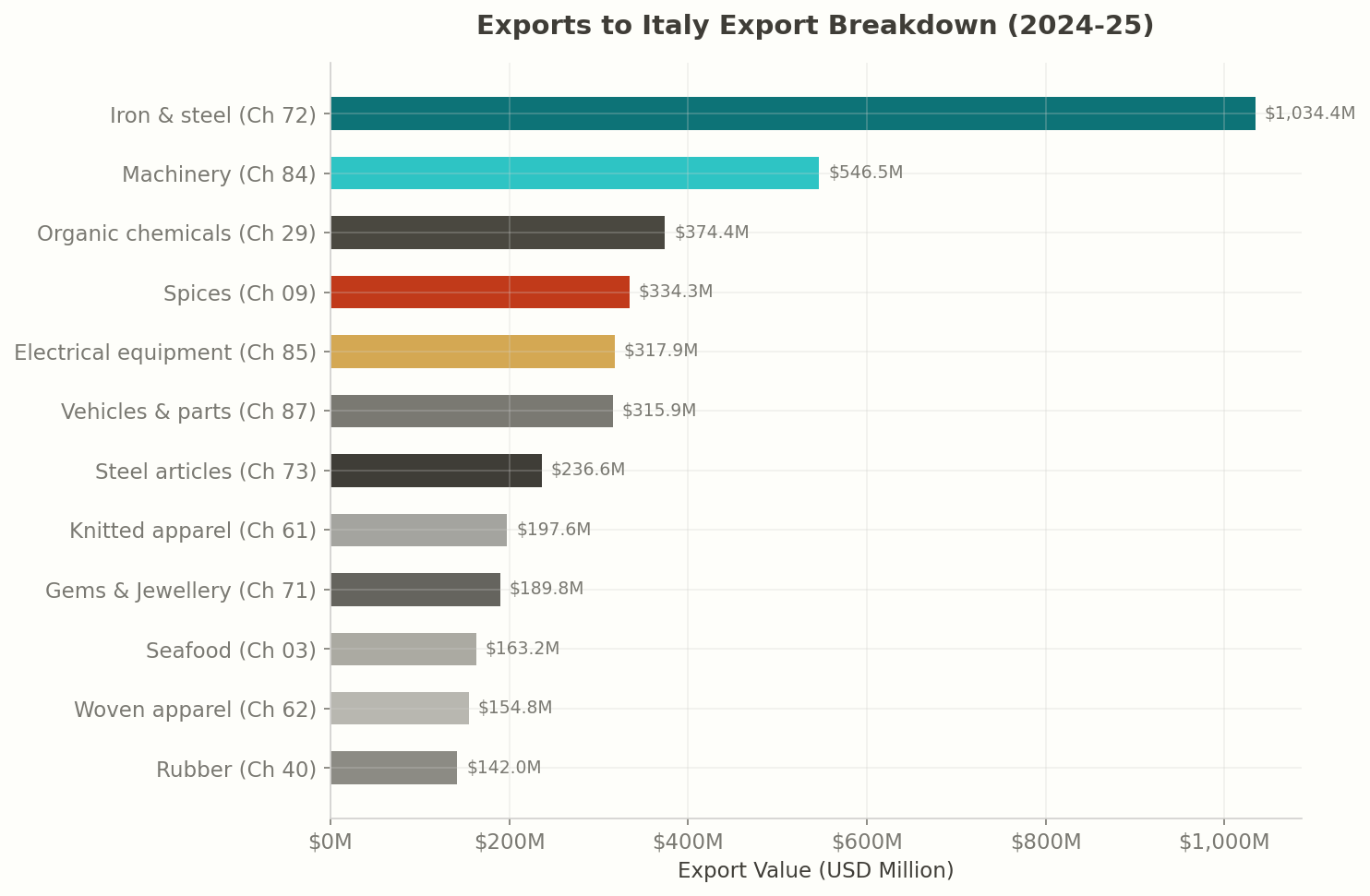
Iron and steel dominate at $1,034.38 million — making Italy one of India's largest steel export destinations globally. Italy is one of Europe's biggest steel consumers, with major steelmakers and steel processors scattered across the northern industrial belt (Lombardy, Veneto, Emilia-Romagna). Indian semi-finished steel, hot-rolled coils, cold-rolled sheets, and ferro-alloys feed into Italian manufacturing of automobiles, machinery, construction materials, and consumer goods. Steel articles at $236.62 million further reinforces this metals story — combined iron, steel, and steel articles total $1,271 million, representing over 22% of India's total exports to Italy.
Machinery at $546.53 million and electrical equipment at $317.90 million reflect India's growing integration into Italian industrial supply chains. Vehicles and parts at $315.93 million includes auto components supplying Italy's automotive sector — home to Fiat (Stellantis), Ferrari, Lamborghini, Maserati, and a vast network of Tier 1 and Tier 2 auto parts manufacturers.
Spices at $334.32 million is a standout category that reflects Italy's culinary culture. Italian cuisine relies heavily on pepper, chilli, turmeric, cumin, and other spices — and India is the world's largest spice producer and exporter. The Italian food industry, from restaurants to packaged food manufacturers, consumes significant quantities of Indian spices. Seafood at $163.19 million supplies Italy's substantial seafood consumption market.
The textiles and apparel categories — knitted apparel ($197.61M), woven apparel ($154.83M), and rubber ($142.02M) — serve Italy's fashion and manufacturing industries. Italy is the EU's largest fashion producer, and Indian textile mills and garment factories supply fabric, yarn, finished garments, and leather to Italian fashion houses and mid-market brands.
Regulatory and Customs Framework
As an EU member state, Italy applies EU-wide customs regulations, product safety directives, and market access rules. The regulatory framework is identical to other EU countries, but Italian enforcement and business practices have their own characteristics.
Agenzia delle Dogane e dei Monopoli (ADM)
The Agenzia delle Dogane e dei Monopoli is Italy's customs and monopoly agency:
- Import declaration is filed electronically through the AIDA (Automazione Integrata Dogane Accise) system — Italy's customs clearance platform
- Customs valuation: Based on CIF value, in accordance with EU Customs Code
- EORI number: Your Italian importer must hold a valid Economic Operators Registration and Identification (EORI) number. This is mandatory for all import transactions within the EU.
- Single Administrative Document (SAD): Standard EU customs declaration, filed electronically
- Entry Summary Declaration (ENS): Must be submitted before goods arrive at the EU border — typically 24 hours before loading at the port of origin for maritime cargo
- Risk-based inspection: Italian customs uses EU-wide risk profiling systems. Italy's customs clearance has improved significantly in recent years with digitalisation, though processing times can still be longer than Northern European ports.
Italian Market Surveillance
Italy enforces EU product safety through several agencies:
- Ministry of Economic Development (MISE): Oversees industrial product safety and CE marking compliance
- NAS (Nuclei Antisofisticazioni e Sanita): The Carabinieri's specialised food safety and health fraud unit. NAS conducts rigorous inspections of food imports and domestic food operations — they are known for thoroughness and can impose severe penalties.
- ISS (Istituto Superiore di Sanita): Italy's national public health institute, involved in food safety assessment and pharmaceutical regulation
- AIFA (Agenzia Italiana del Farmaco): Italy's pharmaceutical regulatory agency, responsible for drug authorisation, pricing, and reimbursement decisions
EU Product Safety Framework (Applied in Italy)
All EU product safety regulations apply uniformly in Italy:
- CE marking: Mandatory for all product categories covered by EU directives (machinery, electrical equipment, medical devices, PPE, construction products, toys, etc.)
- REACH: Chemical regulation applies to all products containing chemical substances
- RoHS: Restriction of hazardous substances in electrical and electronic equipment
- EU food safety regulations: Harmonised MRLs for pesticides, food additive regulations, allergen labelling, and traceability requirements
Key Standards and Certifications
CE Marking (Applied in Italy)
CE marking requirements in Italy are identical to the rest of the EU. Key product categories requiring CE marking include machinery (Directive 2006/42/EC), electrical equipment (LVD 2014/35/EU), medical devices (MDR 2017/745), construction products (CPR 305/2011), and automotive components. Indian exporters must complete conformity assessment, maintain technical documentation, issue a Declaration of Conformity, and affix the CE mark before goods enter the EU market. For machinery and electrical equipment — India's second and fifth-largest export categories to Italy — CE marking is non-negotiable.
REACH and RoHS Compliance
REACH is particularly relevant for India-Italy trade given the large volumes of organic chemicals ($374.42M) and rubber ($142.02M). Organic chemicals must be accompanied by Safety Data Sheets; your Italian importer handles REACH registration but you must provide complete chemical composition data. SVHCs on the ECHA Candidate List require notification if present above 0.1% w/w. RoHS applies to all electrical and electronic equipment.
Italian Food Safety and Spice Exports
Italy's food safety standards are enforced with particular rigour, reflecting the country's deep culinary culture:
- EU harmonised MRLs for pesticide residues apply — but Italian authorities (NAS) are known for stringent enforcement and frequent testing
- Aflatoxin limits are critical for Indian spice exports. The EU sets strict maximum levels for aflatoxins in spices (particularly chilli, paprika, nutmeg, ginger, and turmeric). Indian spice exporters must test for aflatoxin B1 and total aflatoxins before shipment — EU rejection rates for Indian spices due to aflatoxin contamination have been historically significant.
- Sudan dyes: The EU has imposed mandatory testing for Sudan dyes (I, II, III, IV) in chilli and chilli products from India. Each shipment must be accompanied by an analytical report and a health certificate.
- Traceability: EU food law requires full traceability from producer to consumer. Maintain detailed records of your supply chain.
- Italian labelling: Food labels must comply with EU Regulation 1169/2011 and must be in Italian for products sold to Italian consumers
Italian Business Culture
Italian business culture has distinctive characteristics:
- Relationship-driven: Italians prefer to do business with people they know and trust personally. Personal introductions, trade fair meetings, and face-to-face visits are far more effective than cold emails.
- Regional differences: Northern Italy (Milan, Turin, Bologna) is highly industrialised and efficiency-oriented. Southern Italy (Naples, Bari, Palermo) has a different pace — more relationship-intensive and flexible on timelines. Understand your buyer's region.
- Family businesses (Imprese Familiari): Decision-making is often concentrated in the owner or family patriarch. Decisions can be fast, but trust must be established first.
- Design and aesthetics: Products, packaging, and correspondence are expected to demonstrate attention to aesthetics — reflecting Italy's deep design heritage.
- Flexibility: Italian businesses expect flexibility on quantities, specifications, and delivery schedules. Rigidity that works in German or Japanese relationships can be counterproductive in Italy.
Tariff Structure and Trade Agreements
EU Common External Tariff (Applied in Italy)
Italy applies the EU Common External Tariff. Indian goods may benefit from:
- EU GSP: Reduced or zero tariff rates for eligible products from developing countries including India. However, India has been graduated from GSP for many product categories — verify product-specific eligibility.
- MFN rates: Standard EU tariff rates for WTO members where GSP is not available.
Indicative tariff rates for key Indian export categories:
| Product Category | GSP/Applied Rate | MFN Rate |
|---|---|---|
| Iron and steel (72xx) | 0% | 0-7% |
| Machinery (84xx) | 0-3% | 0-6% |
| Organic chemicals (29xx) | 0-3.5% | 0-6.5% |
| Spices (09xx) | 0% | 0-12.5% |
| Electrical equipment (85xx) | 0-3.5% | 0-14% |
| Vehicles and parts (87xx) | 0-4% | 0-22% |
| Steel articles (73xx) | 0-3% | 0-6% |
| Knitted apparel (61xx) | 9.6% | 12% |
| Gems and jewellery (71xx) | 0% | 0-4% |
| Seafood (03xx) | 0-4% | 0-23% |
| Woven apparel (62xx) | 9.6% | 12% |
| Rubber (40xx) | 0-3% | 0-6.5% |
Key observations:
- Iron and steel — India's largest category — enters at 0% under GSP for most tariff lines
- Spices enter at 0% under GSP, supporting the $334.32M export flow
- Textiles and apparel face the highest tariffs (9.6-12%), making this the sector most impacted by the absence of an FTA
- Seafood tariffs vary widely depending on species and processing level
Use the Duty Calculator to check the exact applicable rate for your HS code.
EU Steel Safeguard Measures
The EU maintains safeguard measures on certain steel products, implemented through a tariff rate quota (TRQ) system:
- Steel imports exceeding the quota are subject to an additional 25% safeguard tariff
- India has country-specific and residual quotas for different steel product categories
- Indian steel exporters must monitor quota utilisation levels — once a quota is exhausted, the 25% additional tariff applies to remaining shipments in that period
- The safeguard measures are reviewed periodically and have been extended multiple times since their initial implementation in 2018
Given that iron and steel represent $1,034.38 million of India's exports to Italy, understanding and managing safeguard quota availability is critical for Indian steel exporters.
Logistics and Shipping
Shipping Routes and Transit Times
- JNPT/Nhava Sheva to Genoa: 14-18 days via Suez Canal
- Mundra to Genoa: 14-16 days
- JNPT to La Spezia: 15-19 days
- JNPT to Naples: 13-17 days
- Chennai to Trieste: 16-20 days
- Air freight (Delhi/Mumbai to Milan Malpensa or Rome Fiumicino): 8-10 hours direct
Major Italian Ports
- Genoa — Italy's largest port and the primary gateway for Northern Italian industry. Genoa serves Lombardy (Milan), Piedmont (Turin), and Emilia-Romagna (Bologna) — the heart of Italian manufacturing. For Indian exporters of steel, machinery, and auto components destined for Northern Italian factories, Genoa is the natural port of entry.
- La Spezia — Container port adjacent to Genoa, handling significant volumes of containerised cargo. Well-connected to the northern industrial belt.
- Gioia Tauro — Italy's largest transhipment hub in Calabria. Primarily hub-and-spoke redistribution, less relevant for direct import.
- Naples — Serves Southern Italy and Campania. Growing container volumes.
- Trieste — Primary port for the Adriatic region and a gateway to Central Europe (Austria, Hungary, Czech Republic). Strong for bulk cargo.
- Livorno — Tuscan port, significant for automotive imports/exports.
Freight Costs (Indicative)
- 20-ft container to Genoa: $1,500-$3,000
- 40-ft container to Genoa: $2,500-$5,500
- 20-ft container to Naples: $1,400-$2,800
- Air freight to Milan: $3.50-$6.50 per kg
- Inland transport (Genoa to Milan): $300-$600 per container
Italy's geography means that port-to-factory distances are generally shorter than in larger countries — Genoa to Milan is approximately 150 km, and most Northern Italian industrial centres are within 300 km of either Genoa or La Spezia.
Italian Customs Clearance
- Standard clearance: 1-3 business days. Italian customs has improved significantly with the AIDA electronic system, though clearance times can still be somewhat longer than Northern European ports.
- Pre-arrival processing: Entry Summary Declarations must be filed 24 hours before loading for maritime cargo
- Food inspections: Italian food safety authorities conduct rigorous inspections, particularly for spices and seafood from India. Allow 3-7 additional business days for first-time food shipments pending laboratory analysis for aflatoxins, pesticide residues, and Sudan dyes.
- Steel safeguard quota verification: Customs will verify quota availability for steel products subject to EU safeguard measures
Documentation Requirements
- Commercial Invoice (in English or Italian, with full product description, HS codes, unit prices, and total value)
- Packing List (with exact weights, dimensions, and carton-level detail)
- Bill of Lading or Airway Bill
- Certificate of Origin (Form A for GSP claims, or standard non-preferential CoO)
- Single Administrative Document (SAD) — completed by the Italian customs broker (spedizioniere doganale)
- CE Declaration of Conformity and technical file (for CE-marked products)
- REACH compliance documentation and Safety Data Sheets (for chemical products and articles containing regulated substances)
- Phytosanitary Certificate (for plant and agricultural products)
- Health Certificate (for food and seafood, issued by EIC/FSSAI/MPEDA)
- Aflatoxin and Sudan dye test reports (mandatory for spice exports to the EU)
- Italian-language labels (for consumer products sold to Italian consumers)
- EU GMP compliance documentation (for pharmaceutical products)
- Shipping Bill (filed via ICEGATE)
- Insurance Certificate
Payment and Banking
Common Payment Methods
- T/T Wire Transfer: Standard for established relationships. Italian payment cycles are longer than Northern Europe — 60-90 day terms are common, and delays beyond agreed terms are not unusual with smaller companies. Factor this into cash flow planning.
- Letters of Credit: Strongly recommended for first-time transactions. Italian banks issue reliable LCs.
- Open Account (60-90 days): Common for ongoing relationships, but secure ECGC export credit insurance to mitigate delayed payment risk.
- Documentary Collection (D/P): Used for medium-value transactions.
Currency
Trade is denominated in EUR or USD. Most India-Italy industrial goods trade (steel, chemicals, machinery) settles in USD, while consumer goods and food products are often invoiced in EUR. Hedge EUR/INR exposure for Euro-denominated contracts.
Key Italian Banks
- UniCredit — Italy's largest bank and one of Europe's largest. Extensive trade finance operations, including dedicated India desk.
- Intesa Sanpaolo — Italy's second-largest bank. Strong in corporate banking and trade finance.
- Mediobanca — Major investment bank, important for large-value transactions
- Banco BPM — Significant commercial bank serving Northern Italian SMEs
- BPER Banca — Regional bank with growing national presence
Italian SME Procurement Patterns
Italian SMEs often prefer buying directly from manufacturers rather than through trading companies. Expect small initial trial orders (a few tonnes of steel, a few hundred garment pieces) that grow steadily if quality and delivery meet expectations. Italian manufacturers frequently need customised raw materials and components for their own bespoke products — be prepared for non-standard specifications. Payment terms are negotiated aggressively; start with LC terms and gradually move to open account as trust is established.
Common Mistakes
Ignoring regional business differences between North and South Italy. Northern Italy (Lombardy, Veneto, Emilia-Romagna) and Southern Italy (Campania, Puglia, Sicily) have different business cultures and economic dynamics. Northern buyers are efficiency-oriented and process-driven; Southern buyers emphasise personal relationships and flexibility. An approach that works in Milan may not work in Naples. Research your buyer's region and adapt.
Not understanding Italian SME procurement patterns. Italy's industrial base is SME-dominated. Indian exporters accustomed to large corporations may be surprised by informal decision-making, small order quantities, and the personalised nature of Italian purchasing. Be flexible on minimum orders and responsive to custom specifications.
Failing to meet EU product safety standards (CE marking, REACH, RoHS). The regulatory requirements are identical to the rest of the EU but enforcement in Italy has increased significantly in recent years. Italian market surveillance authorities (MISE, NAS) conduct regular inspections and can impose fines, product seizures, and market bans. Ensure full CE marking compliance for machinery and electrical equipment, REACH compliance for chemicals and chemical-containing products, and RoHS compliance for electronics.
Underestimating aflatoxin and Sudan dye testing for spice exports. Italy is one of India's largest spice export destinations, but the EU's strict aflatoxin limits and mandatory Sudan dye testing for Indian chilli and chilli products have caused significant shipment rejections. Every spice shipment to Italy must be accompanied by accredited laboratory test reports for aflatoxins and Sudan dyes. Test before shipment — not after your goods are detained at Genoa port.
Not monitoring EU steel safeguard quotas. With over $1 billion in iron and steel exports to Italy, Indian steel exporters must closely track EU safeguard quota utilisation. Shipping steel after your country-specific quota is exhausted means facing a 25% additional tariff — potentially wiping out your entire margin. Monitor quota levels through the European Commission's safeguard quota database and time your shipments accordingly.
Expecting Northern European payment discipline. Italian payment cycles tend to be longer than in Germany or Scandinavia. Budget for 60-90 day cycles and consider ECGC export credit insurance. Use Letters of Credit for initial transactions with new Italian buyers.
Key Takeaways
- India exported $5,718.79 million to Italy in 2024-25, led by iron and steel ($1,034.38M), machinery ($546.53M), organic chemicals ($374.42M), and spices ($334.32M)
- Combined iron, steel, and steel articles total $1,271 million — monitor EU steel safeguard quotas to avoid the 25% additional tariff
- CE marking is mandatory for machinery, electrical equipment, and many other product categories — non-compliance results in market exclusion
- Spice exports require aflatoxin and Sudan dye test reports — EU rejection rates for non-compliant Indian spices are significant
- Italy's manufacturing sector is SME-dominated — expect small initial orders, personalised relationships, and flexible specifications
- Regional differences between North and South Italy affect business culture, procurement patterns, and communication style
- Italian payment cycles are longer than Northern European norms — use LCs for initial transactions and consider export credit insurance
- Italy is a gateway to the EU Single Market — goods cleared through Italian customs circulate freely across 27 EU member states
- REACH compliance is critical for organic chemicals ($374.42M) and rubber ($142.02M) exports
Next Steps
- Identify your HS code with the HS Code Finder and check the EU tariff rate using the Duty Calculator
- Verify CE marking requirements for your product category, especially for machinery and electrical equipment
- Test spices for aflatoxins and Sudan dyes at an accredited laboratory before shipment
- Monitor EU steel safeguard quota utilisation if you export iron, steel, or steel articles
- Explore Italian market demand with the Market Finder
- Attend Italian trade fairs — major events include CIBUS (food, Parma), EICMA (motorcycles, Milan), EMO (machine tools, Milan), and Vinitaly (Verona). The Italian Trade Agency (ICE) organises trade missions and buyer-seller meets for Indian exporters.
- Connect with Italian importers and customs brokers (spedizionieri doganali) who understand Italian market nuances
- Plan face-to-face visits — Italian business culture demands personal relationships. Budget for at least one visit to Italy before expecting significant order volumes.
- Explore other export markets to build a diversified European and global export portfolio
Italy rewards quality, relationship investment, and cultural adaptability. Over $1 billion in steel exports alone demonstrates the industrial complementarity between the two economies. Indian MSMEs that navigate EU regulatory requirements, build personal trust with Italian buyers, and adapt to regional business cultures will find one of Europe's most rewarding export partnerships.
Ready to start exporting?
Get a detailed market report with country-by-country analysis, pricing insights, and buyer contacts.
Get Market ReportXIMPEX Export Advisory
Need help implementing the strategies discussed in this guide? Our team of export specialists can provide personalized guidance for your business.