How to Export to Bangladesh from India — Complete Guide
Bangladesh is India's largest neighbour market and the eighth-largest destination for Indian exports worldwide. India exported $8,745.64 million in goods to Bangladesh in 2024-25 — a correction from the $10,963.18 million peak in 2023-24, but still reflecting the enormous depth and breadth of this bilateral trade relationship. The two countries share a 4,096-kilometre land border, the fifth-longest in the world, and this geographical proximity has created one of the most active cross-border trade corridors in South Asia.
For Indian MSME exporters, Bangladesh offers something rare: a massive, accessible, and growing market right next door. Bangladesh's garment industry — the second-largest in the world after China — depends heavily on Indian raw cotton, yarn, and fabric. Beyond textiles, Bangladesh imports Indian vehicles, machinery, cereals, spices, chemicals, and a wide range of agricultural products. The South Asian Free Trade Area (SAFTA) provides preferential tariff access, and the extensive network of land border crossings means you can deliver goods overland in days rather than weeks. However, the market has its own complexities — particularly around payment mechanisms, port congestion, and regulatory procedures — that every exporter must understand before shipping.
India–Bangladesh Trade Overview
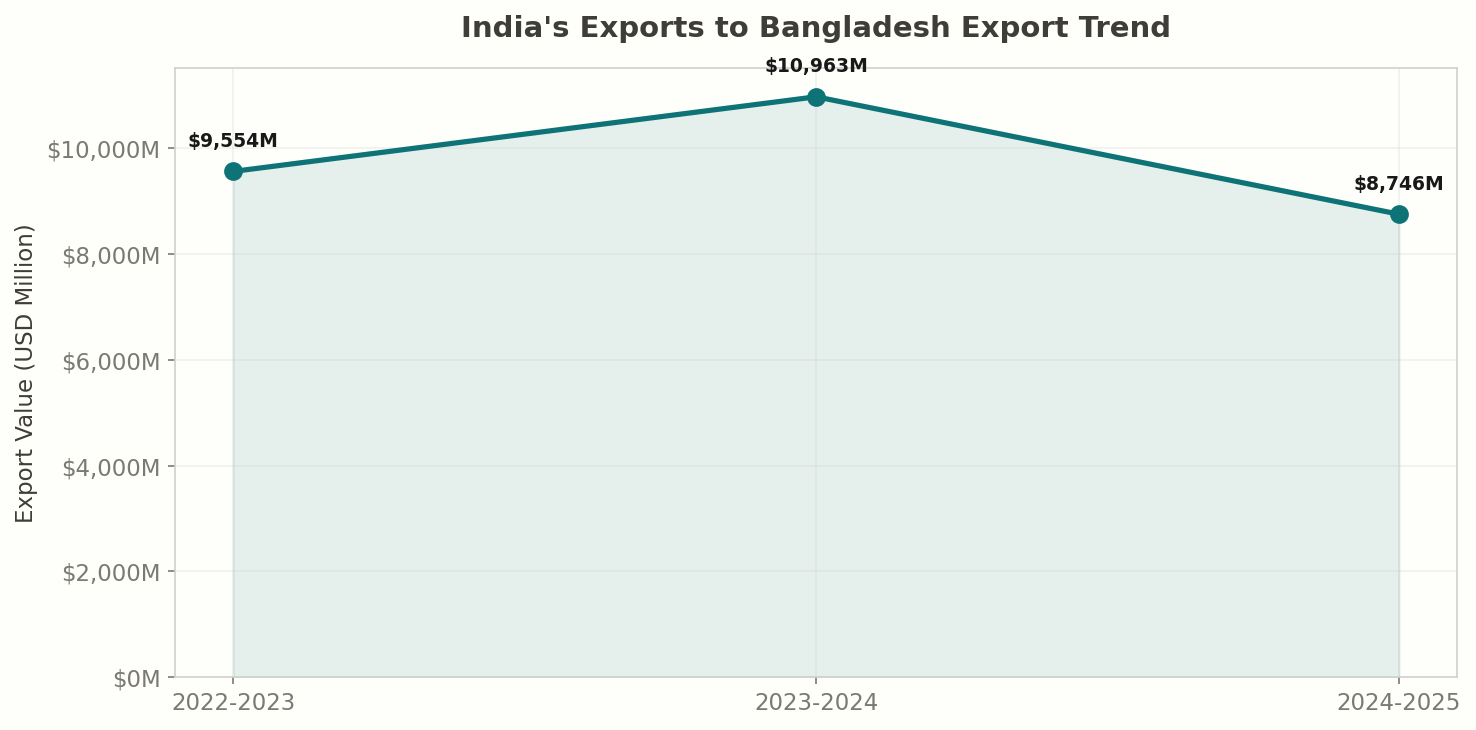
India's goods exports to Bangladesh totalled $8,745.64 million in 2024-25, down from $10,963.18 million in 2023-24 and $9,554.07 million in 2022-23. The dip in 2024-25 reflects Bangladesh's tightening of import controls amid foreign exchange reserve pressures rather than any fundamental weakening of trade ties. The underlying demand remains strong — Bangladesh is industrialising rapidly, urbanising fast, and its 170 million consumers represent a market that India is uniquely positioned to serve.
The SAFTA framework, which has been in force since 2006, grants Indian goods preferential access to the Bangladeshi market, with Bangladesh — as a Least Developed Country (LDC) member — offering deeper concessions under the agreement. In addition, the bilateral trade relationship benefits from multiple land border crossing points, a growing network of border haats (local markets), and ongoing discussions around an Indian rupee settlement mechanism that could reduce dependence on USD-denominated trade.
Cotton and textiles alone account for nearly a quarter of India's exports to Bangladesh, underscoring the structural interdependence between India's cotton-growing belt and Bangladesh's garment export powerhouse. This is not a trade relationship driven by cyclical demand — it is a structural partnership embedded in industrial supply chains.
What India Exports to Bangladesh
The top product categories exported from India to Bangladesh in 2024-25:
| Rank | HS Chapter | Product Category | Export Value (USD Million) |
|---|---|---|---|
| 1 | 52 | Cotton | $2,157.52 |
| 2 | 27 | Mineral fuels | $1,074.95 |
| 3 | 87 | Vehicles and parts | $690.08 |
| 4 | 07 | Vegetables | $429.33 |
| 5 | 84 | Machinery | $408.30 |
| 6 | 10 | Cereals/Rice | $378.42 |
| 7 | 23 | Animal feed/residues | $320.75 |
| 8 | 09 | Spices | $316.57 |
| 9 | 29 | Organic chemicals | $275.02 |
| 10 | 32 | Dyes/Paints | $255.58 |
| 11 | 72 | Iron and steel | $219.91 |
| 12 | 39 | Plastics | $188.48 |
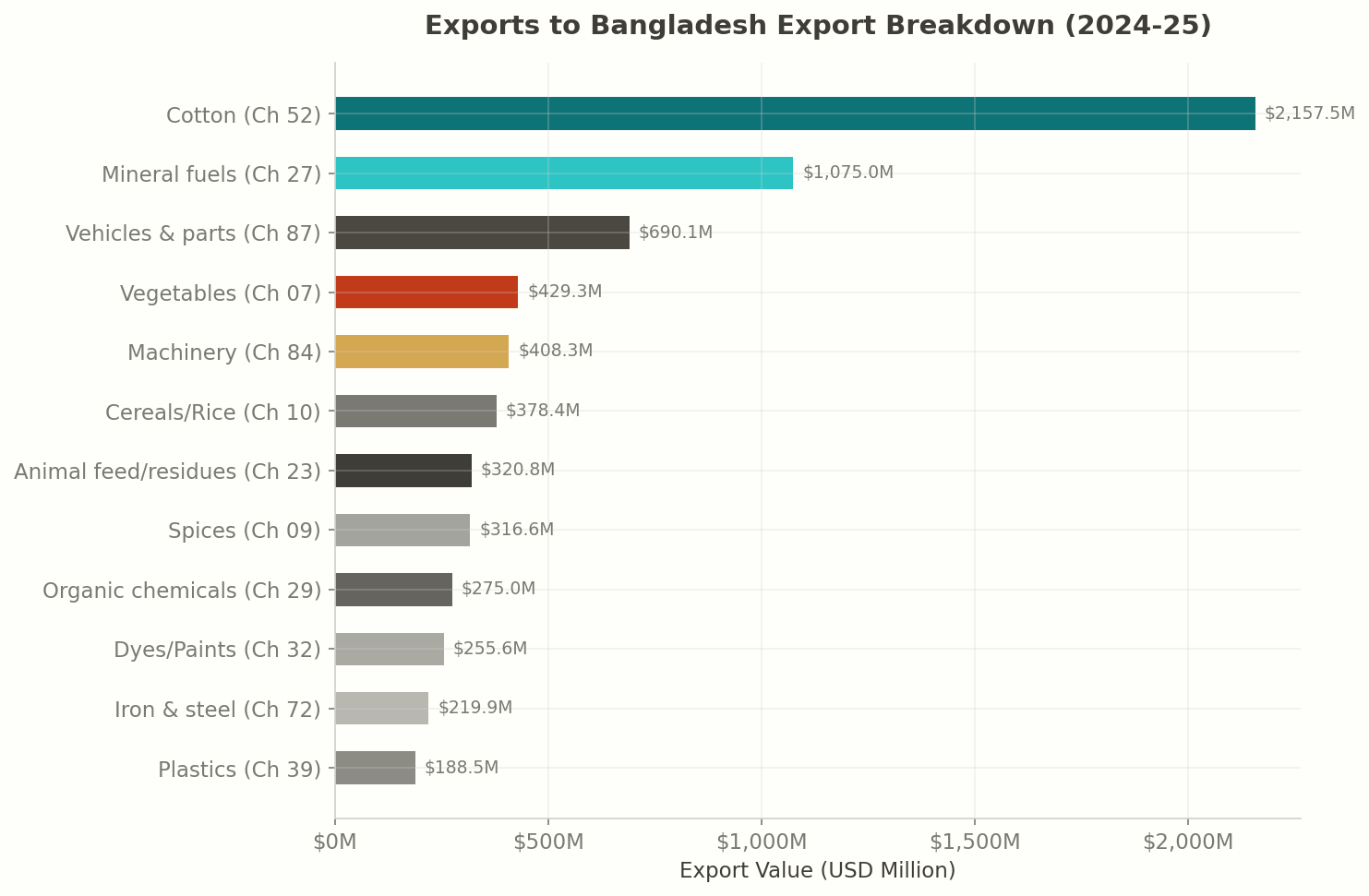
Cotton dominates at $2,157.52 million — a figure that reflects Bangladesh's position as the world's second-largest garment exporter. Bangladeshi factories import raw cotton, cotton yarn, and woven cotton fabric from India as primary inputs for their ready-made garment (RMG) industry, which itself exports over $40 billion annually. For Indian cotton ginners, spinners, and weavers, Bangladesh is not just a customer — it is the single largest export market for Indian cotton products globally.
Mineral fuels at $1,074.95 million includes petroleum products, LPG, and other energy commodities that Bangladesh imports to meet its growing industrial and domestic energy needs. Vehicles and parts ($690.08M) reflects the dominance of Indian automotive brands — Tata, Mahindra, Bajaj, and TVS — in the Bangladeshi market, along with a growing auto components trade. Agricultural products form a significant cluster: vegetables ($429.33M), cereals and rice ($378.42M), animal feed ($320.75M), and spices ($316.57M) together account for over $1.4 billion, driven by both dietary overlap and Bangladesh's food security import needs.
Dyes and paints ($255.58M) serve Bangladesh's garment dyeing and finishing industry, while organic chemicals ($275.02M) and plastics ($188.48M) support Bangladesh's broader industrialisation. Iron and steel ($219.91M) feeds the construction boom in Dhaka and other rapidly growing cities.
Regulatory and Customs Framework
Bangladesh's regulatory environment has modernised significantly in recent years, but it remains more complex and less predictable than mature markets. Understanding the key agencies and their requirements is essential for smooth trade.
National Board of Revenue (NBR)
The NBR is Bangladesh's primary customs and tax authority. All imports into Bangladesh are processed through NBR's customs wing, which operates the ASYCUDA World automated customs system.
- Import declaration must be filed electronically through the ASYCUDA system by a licensed customs clearing agent (C&F agent) in Bangladesh
- Customs valuation is based on the WTO Transaction Value method, but NBR frequently applies reference pricing (pre-determined minimum values) for common goods. If your invoice price is below the NBR reference price, the higher reference value will be used for duty calculation
- Pre-Shipment Inspection (PSI): Bangladesh requires PSI for certain categories of imports. Check whether your product category falls under the PSI requirement before shipping
- Advance Income Tax (AIT): Bangladesh imposes AIT at the point of import — typically 3-5% of the assessed value, payable by the importer. This effectively increases the landed cost of goods and should be factored into your pricing
Bangladesh Standards and Testing Institution (BSTI)
BSTI is the national standards body responsible for product quality and safety certification.
- Mandatory BSTI certification is required for approximately 180 product categories, including food items, electrical appliances, construction materials, and consumer goods
- Products requiring BSTI certification must be tested and approved before they can be sold in Bangladesh
- BSTI standards are largely based on ISO standards, but specific Bangladeshi requirements may differ. Verify the applicable BDS (Bangladesh Standards) for your product
- For food products, BSTI works in conjunction with the Bangladesh Food Safety Authority (BFSA), which was established in 2015 and is gradually expanding its regulatory oversight
Import Policy Order
Bangladesh's Import Policy Order (IPO), issued every few years by the Ministry of Commerce, defines which goods can be freely imported, which require specific permissions, and which are restricted or banned.
- Freely importable goods can be imported without specific permission, subject to standard customs and regulatory requirements
- Restricted goods require prior permission from the relevant ministry or authority
- Banned goods include items prohibited on religious, health, safety, or environmental grounds
- The IPO changes periodically — always verify the current status of your product before shipping. Your Bangladeshi buyer's C&F agent should confirm this as part of the import process.
Key Standards and Certifications
BSTI Product Certification
For products falling under the mandatory certification list, BSTI certification involves factory inspection, product testing, and ongoing surveillance. The process typically takes 2-4 months and requires:
- Application with product samples and technical documentation
- Laboratory testing at BSTI-designated labs
- Factory inspection (for manufacturing quality systems)
- Annual renewal and periodic surveillance
Halal Certification
Bangladesh is a Muslim-majority country. While halal certification is not legally mandatory for all food imports, it is strongly expected by Bangladeshi consumers and retailers for meat, processed food, and food ingredients. Indian exporters of food products should obtain halal certification from a recognised Indian halal certification body.
Phytosanitary and Health Requirements
Agricultural products require phytosanitary certificates from India's Plant Quarantine authority. For processed food products, compliance with BFSA and BSTI requirements is necessary. Spice exports should comply with Bangladesh's maximum residue limit (MRL) requirements for pesticides and aflatoxin levels.
Tariff Structure and Trade Agreements
SAFTA (South Asian Free Trade Area)
SAFTA, operational since 2006, is the primary trade agreement governing India-Bangladesh tariff preferences.
Key provisions:
- Bangladesh, as an LDC member of SAFTA, offers preferential tariff concessions to Indian goods under the Sensitive List framework
- India has granted duty-free, quota-free (DFQF) access to Bangladeshi LDC goods, and Bangladesh reciprocates with reduced tariffs on Indian products not on its Sensitive List
- Bangladesh maintains a Sensitive List of products excluded from SAFTA preferences — this list includes several items where Bangladesh seeks to protect domestic industry
- Rules of Origin: Generally 30% domestic value addition for LDC members, 40% for non-LDC members (India). Change in Tariff Heading (CTH) at the 4-digit level is the standard criterion
Current tariff landscape (indicative):
| Product Category | SAFTA Preferential Rate | MFN Rate |
|---|---|---|
| Cotton yarn (5205) | 5-10% | 10-25% |
| Mineral fuels (27xx) | Varies | 5-25% |
| Vehicles (8703/8704) | On Sensitive List | 25-100% |
| Machinery (84xx) | 0-5% | 5-25% |
| Spices (09xx) | 5-12% | 15-25% |
| Organic chemicals (29xx) | 0-5% | 5-15% |
| Dyes and paints (32xx) | 0-5% | 10-25% |
How to claim SAFTA preferences:
- Verify your product is not on Bangladesh's SAFTA Sensitive List
- Ensure compliance with the SAFTA Rules of Origin criteria
- Obtain a SAFTA Certificate of Origin from DGFT or an authorised chamber of commerce
- Your Bangladeshi importer presents the CoO to NBR Customs at import clearance
Use the Duty Calculator to check the applicable SAFTA rate for your HS code.
Logistics and Shipping
Land Border Trade
The India-Bangladesh land border is the backbone of bilateral trade. Over 60% of India-Bangladesh trade by volume moves overland through designated Land Customs Stations (LCS) and Integrated Check Posts (ICP).
Key border crossings:
- Petrapole-Benapole (West Bengal): India's largest land port by trade volume. Handles the bulk of India-Bangladesh overland trade. Road connectivity is well-established, though congestion during peak periods is common.
- Agartala-Akhaura (Tripura): Growing in importance, particularly after the opening of the Agartala-Akhaura rail link. Serves as the gateway for trade to and from northeastern India.
- Dawki-Tamabil (Meghalaya): Smaller but significant for trade from northeastern India, particularly stone, coal, and agricultural products.
- Hili-Hili (West Bengal): Active for agricultural commodities, particularly rice and wheat.
- Fulbari-Banglabandha (West Bengal): Important for the northern corridor connecting India's Siliguri corridor to northern Bangladesh.
Land border trade procedures:
- Goods must be accompanied by a Customs Declaration at the Indian LCS
- Export documentation (Shipping Bill) is filed through ICEGATE
- On the Bangladesh side, the importer's C&F agent files the import declaration through ASYCUDA
- Transit time from border to Dhaka: typically 1-2 days from Petrapole, 1 day from Akhaura
Sea Routes
For high-volume or bulk shipments, sea routes remain important:
- Kolkata/Haldia to Chittagong: 5-7 days
- JNPT to Chittagong: 10-14 days
- Mundra to Chittagong: 12-16 days
- Chennai to Chittagong: 8-12 days
Chittagong Port Congestion
Chittagong handles approximately 90% of Bangladesh's seaborne trade, and congestion is a persistent challenge. Container dwell times at Chittagong can extend to 15-20 days during peak periods, compared to 3-5 days at efficient ports. This congestion adds to landed costs through detention and demurrage charges. Indian exporters should:
- Factor in potential delays when quoting delivery timelines
- Consider the Payra Port and Mongla Port as alternatives for certain cargo types
- Use land routes where feasible to bypass Chittagong congestion entirely
- Coordinate closely with the Bangladeshi buyer on vessel scheduling to minimise port holding time
Freight Costs (Indicative)
- Truck from Kolkata to Petrapole border: INR 15,000-25,000
- 20-ft container Kolkata to Chittagong (sea): $800-$1,500
- 40-ft container JNPT to Chittagong: $1,500-$3,000
- Overland trucking from Petrapole to Dhaka (via Bangladeshi transporter): BDT 25,000-40,000
Documentation Requirements
- Commercial Invoice (in triplicate, with accurate descriptions matching the HS classification)
- Packing List (detailed weights, carton counts, and descriptions)
- Bill of Lading (for sea) or Truck Receipt/Lorry Receipt (for land border trade)
- Certificate of Origin — SAFTA format for preferential tariff claims
- Letter of Credit (mandatory for most imports above $5,000 — see Payment section)
- Phytosanitary Certificate (for agricultural and plant products)
- Health Certificate (for food products, issued by EIC/FSSAI)
- BSTI compliance documentation (for products under mandatory certification)
- Pre-Shipment Inspection certificate (if applicable to your product category)
- Shipping Bill (filed via ICEGATE at the Indian end)
- Insurance Certificate
- Pro-forma Invoice (required by Bangladeshi banks for LC opening)
Payment and Banking
Payment terms in India-Bangladesh trade require careful attention. Bangladesh has specific regulatory requirements around import payments that differ significantly from most other markets.
Letter of Credit — The Critical Requirement
Bangladesh Bank (the central bank) mandates that most imports above $5,000 must be settled through irrevocable Letters of Credit (LC). This is not a preference — it is a regulatory requirement.
Key LC considerations:
- LC opening: The Bangladeshi importer opens the LC through a Bangladeshi commercial bank (Sonali Bank, Agrani Bank, Islami Bank Bangladesh, Dutch-Bangla Bank, or private banks). The LC is confirmed or advised through an Indian bank.
- LC discrepancy risk: Bangladeshi banks are strict about LC documentation compliance. Even minor discrepancies — a misspelled word, a weight difference of a few kilograms, a date inconsistency — can result in the LC being dishonoured or payment being delayed. Indian exporters must ensure documents are letter-perfect.
- LC amendment costs: If documents have discrepancies, amendments cost $50-$150 per instance and add 2-4 weeks to the payment cycle. Multiple discrepancies can make a shipment commercially unviable.
Foreign Exchange Concerns
Bangladesh has periodically faced foreign exchange reserve pressures, which can affect import payment timelines:
- During forex-tight periods, Bangladeshi banks may delay LC opening or impose additional margin requirements on importers
- Payment delays of 30-60 days beyond the LC terms have occurred during particularly constrained periods
- Indian exporters should monitor Bangladesh's forex reserve situation and adjust credit terms accordingly
- Consider export credit insurance from ECGC (Export Credit Guarantee Corporation) to mitigate payment risk
Indian Rupee Settlement Mechanism
India and Bangladesh have been developing a bilateral rupee settlement mechanism to reduce dependence on USD for trade payments. Under this mechanism:
- Bangladeshi importers can pay in Indian rupees through designated banking channels
- This reduces forex conversion costs and exposure to USD volatility for both parties
- The mechanism is still in early stages of implementation, but it is expected to grow as bilateral trade infrastructure matures
Currency
Most India-Bangladesh trade is denominated in USD. However, the INR settlement mechanism is gaining traction for smaller transactions. Bangladesh's currency, the Taka (BDT), is not freely convertible, so direct BDT invoicing by Indian exporters is not standard practice.
Common Mistakes
Ignoring the LC requirement. Bangladesh mandates LCs for most imports above $5,000. Indian exporters accustomed to T/T (wire transfer) payments in other markets sometimes discover this requirement only after the order is placed, causing delays and frustration. Confirm the payment mechanism before accepting the order and ensure your bank is experienced with Bangladesh LCs.
LC documentation discrepancies. Bangladeshi banks reject documents at a higher rate than most other markets. A single misspelling, an invoice amount that differs from the LC by even one dollar, or a shipping date outside the LC validity period will result in discrepancy charges and payment delays. Prepare LC documents with the same precision you would apply to Japanese documentation standards.
Not understanding border trade procedures. Land border trade between India and Bangladesh has specific procedural requirements — customs hours, vehicle registration, transshipment rules, and documentation formats — that differ from port-based trade. Exporters who treat Petrapole like JNPT will encounter confusion and delays. Engage a clearing agent experienced in land border trade.
Underestimating Chittagong port delays. Chittagong port congestion can add 10-15 days to your delivery timeline and $500-$1,500 in detention and demurrage charges per container. If your Bangladeshi buyer promises "fast clearance," verify independently. Consider land routes or alternative ports where practical.
Not using SAFTA Certificate of Origin. Many Indian exporters ship to Bangladesh without obtaining the SAFTA CoO, causing their buyer to pay full MFN duty rates. On a $100,000 cotton yarn shipment, the difference between the SAFTA preferential rate and the MFN rate could be $5,000-$15,000 in additional duty. Always obtain and provide the SAFTA CoO.
Assuming uniform regulations. Bangladesh's import regulations — particularly regarding restricted items, reference pricing, and PSI requirements — change more frequently than in mature markets. What was freely importable last year may require a permit this year. Always verify current regulations before each shipment through your buyer's C&F agent and the NBR website.
Key Takeaways
- India exported $8,745.64 million to Bangladesh in 2024-25, led by cotton ($2,157.52M), mineral fuels ($1,074.95M), and vehicles ($690.08M)
- Cotton trade alone exceeds $2.1 billion, driven by Bangladesh's massive garment industry demand for Indian raw cotton, yarn, and fabric
- SAFTA provides preferential tariff access — always obtain and provide the SAFTA Certificate of Origin to reduce your buyer's duty costs
- Land border trade through Petrapole-Benapole, Agartala-Akhaura, and other crossings handles the majority of bilateral trade volume
- Bangladesh mandates Letters of Credit for most imports above $5,000 — prepare documents with zero discrepancies to avoid payment delays
- Chittagong port congestion is a persistent challenge — factor in potential delays of 10-15 days and consider land routes as an alternative
- Foreign exchange reserve pressures in Bangladesh can affect import payment timelines — consider ECGC insurance for risk mitigation
- The Indian rupee settlement mechanism is a developing channel that may reduce forex dependencies over time
Next Steps
- Identify your HS code with the HS Code Finder and check Bangladesh's SAFTA tariff rate using the Duty Calculator
- Verify import status — confirm your product is not on Bangladesh's SAFTA Sensitive List and is freely importable under the current Import Policy Order
- Confirm BSTI requirements — check whether your product category requires mandatory BSTI certification before it can be sold in Bangladesh
- Assess logistics options — evaluate land border routes versus sea routes based on your shipment volume, origin location, and delivery timeline
- Set up LC-compliant banking — ensure your AD (Authorised Dealer) bank is experienced with Bangladesh LCs and can advise on documentation compliance
- Explore Bangladesh market demand with the Market Finder
- Engage a Bangladesh-experienced clearing agent — for land border trade, work with a C&F agent who operates at your chosen border crossing
- Explore other export markets to diversify beyond the Bangladesh corridor
Bangladesh is India's most natural export market — geographically adjacent, culturally familiar, and structurally dependent on Indian inputs for its largest export industry. The SAFTA framework has reduced tariff barriers, and the extensive land border network provides logistics options that no other market can match. However, the LC-driven payment system, port congestion challenges, and evolving regulatory environment require Indian exporters to approach this market with careful preparation and reliable local partners. For MSMEs willing to invest in understanding Bangladesh's specific requirements, the rewards are substantial — a $8.7 billion market that is accessible, scalable, and right next door.
Ready to start exporting?
Get a detailed market report with country-by-country analysis, pricing insights, and buyer contacts.
Get Market ReportXIMPEX Export Advisory
Need help implementing the strategies discussed in this guide? Our team of export specialists can provide personalized guidance for your business.