How to Export to Brazil from India — Complete Guide
Brazil is Latin America's largest economy, the world's seventh most populous country with 215 million consumers, and one of India's most important trade partners in the Southern Hemisphere. India exported $5,080.96 million in goods to Brazil in 2024-25, driven by a massive $1.16 billion in chemical products — largely agrochemicals feeding Brazil's enormous agricultural sector — along with vehicles, machinery, and organic chemicals. Brazil's economy is built on agriculture, mining, and manufacturing, and its import needs align closely with India's export strengths in chemicals, pharmaceuticals, machinery, and auto components.
For Indian MSME exporters, Brazil offers enormous market potential but comes with significant complexity. Brazil has some of the highest tariffs in the world, a notoriously intricate tax system that locals call "Custo Brasil" (the cost of doing business in Brazil), and regulatory agencies with long approval timelines. The country is a founding member of Mercosur — the South American customs union — which imposes a Common External Tariff (CET) that can push the effective cost of imported goods well above their FOB value. Success in Brazil requires patience, a willingness to navigate bureaucratic complexity, and partnerships with experienced local importers and customs brokers. The rewards, however, are substantial: a massive consumer market, a diversified industrial base, and a growing appetite for the products India does best.
India-Brazil Trade Overview
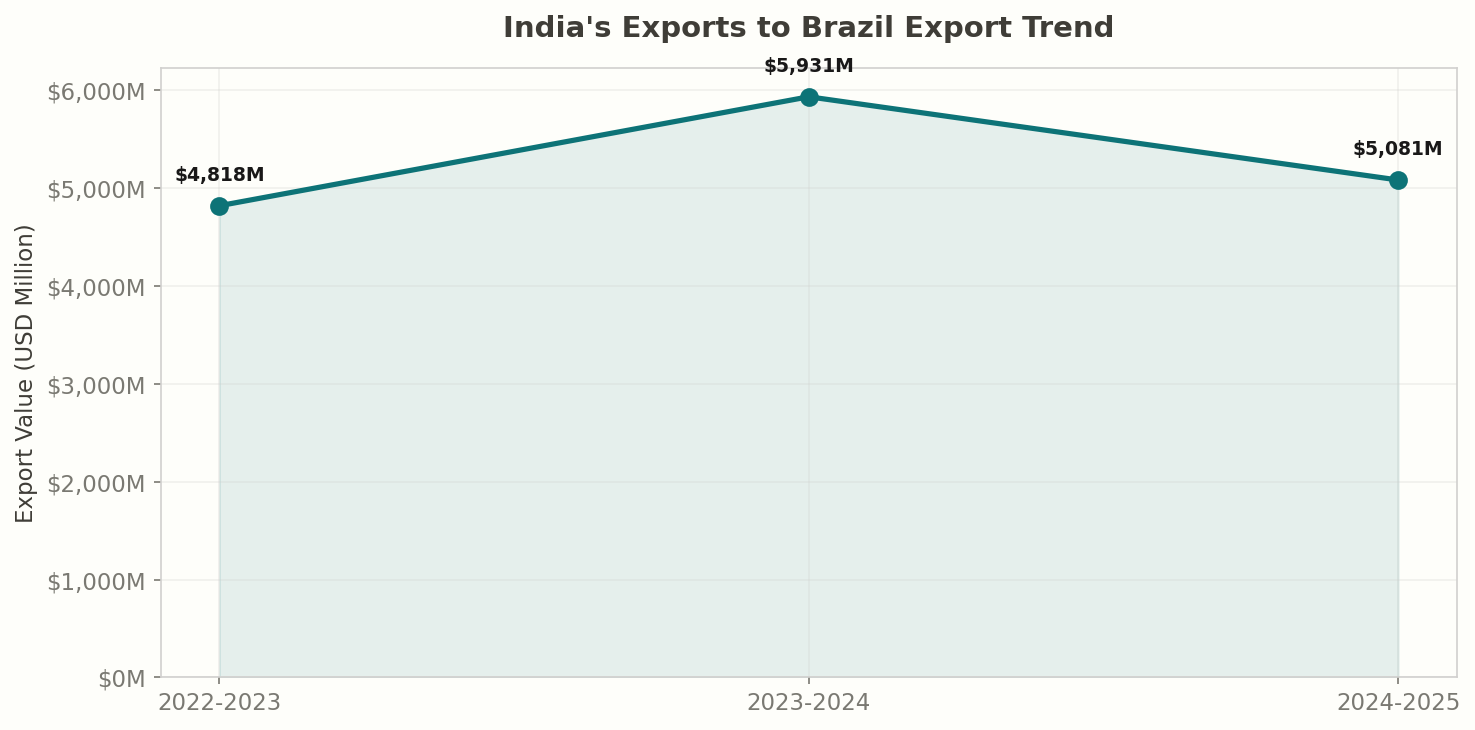
India's goods exports to Brazil totalled $5,080.96 million in 2024-25, following $5,930.90 million in 2023-24 and $4,818.24 million in 2022-23. The trade relationship has grown steadily over the past decade, underpinned by complementary economic structures: Brazil needs chemicals, pharmaceuticals, and manufactured goods; India needs raw materials, soybeans, and crude oil that Brazil supplies. This complementarity has driven bilateral trade even in the absence of a comprehensive free trade agreement between the two countries.
India and Brazil cooperate through BRICS and IBSA, and there have been discussions about an India-Mercosur Preferential Trade Agreement, but progress has been slow. Currently, trade is conducted largely on MFN terms, which means Brazilian tariffs apply in full — and they are steep. Despite this, the sheer size of Brazil's market and the strength of demand for Indian chemicals and pharmaceuticals have driven exports above $5 billion.
Brazil's membership in Mercosur (alongside Argentina, Uruguay, and Paraguay) means that tariff policy is coordinated at the bloc level through the Common External Tariff (CET). The CET averages around 11% but varies widely — industrial inputs face lower duties, while finished goods, consumer electronics, and vehicles face tariffs of 20-35%.
What India Exports to Brazil
The top product categories exported from India to Brazil in 2024-25:
| Rank | HS Chapter | Product Category | Export Value (USD Million) |
|---|---|---|---|
| 1 | 38 | Chemical products | $1,159.88 |
| 2 | 87 | Vehicles and parts | $666.75 |
| 3 | 84 | Machinery | $599.62 |
| 4 | 29 | Organic chemicals | $499.59 |
| 5 | 30 | Pharmaceuticals | $408.96 |
| 6 | 85 | Electrical equipment | $190.62 |
| 7 | 40 | Rubber | $190.00 |
| 8 | 72 | Iron and steel | $142.07 |
| 9 | 54 | Man-made filaments | $141.44 |
| 10 | 76 | Aluminium | $121.23 |
| 11 | 90 | Instruments | $88.85 |
| 12 | 32 | Dyes and paints | $88.20 |
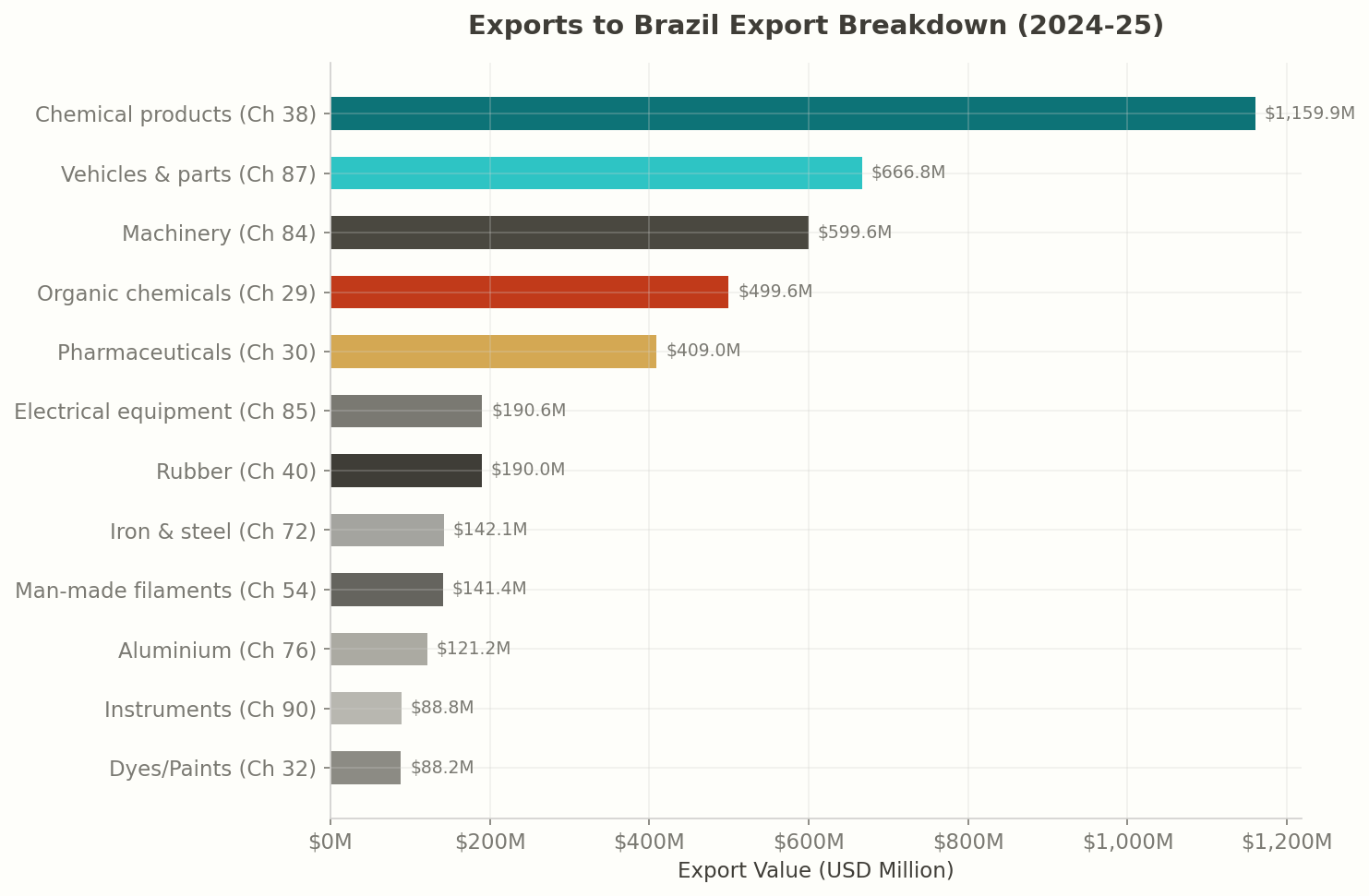
Chemical products dominate at $1,159.88 million — nearly 23% of all Indian exports to Brazil. This figure reflects Brazil's position as one of the world's largest agricultural producers. Brazil's agribusiness sector — soybeans, corn, coffee, sugarcane, cattle — consumes vast quantities of agrochemicals (pesticides, herbicides, fungicides), and India is one of the world's leading producers of generic agrochemical formulations. Indian companies like UPL, PI Industries, and Rallis India have built significant positions in the Brazilian agrochemical market.
Vehicles and parts at $666.75 million encompass auto components, two-wheeler parts, and some finished vehicles. Indian auto component suppliers serve both Brazilian vehicle manufacturers and the aftermarket. Machinery ($599.62M) spans industrial machinery, agricultural equipment, and processing machinery for Brazil's food and mining industries.
Organic chemicals ($499.59M) and pharmaceuticals ($408.96M) round out the top five. India supplies pharmaceutical intermediates and finished generic formulations, though ANVISA registration is a significant barrier for new products. Rubber ($190.00M) is driven by tyre-related exports, and man-made filaments ($141.44M) serve Brazil's textile industry.
Regulatory and Customs Framework
Brazil's regulatory environment is comprehensive, multi-layered, and — by global standards — exceptionally complex. Multiple federal agencies are involved in import clearance, and the interaction between customs duties, federal taxes, state taxes, and agency-specific registrations creates a compliance burden that is unique in its complexity.
Receita Federal (Brazilian Federal Revenue Service)
The Receita Federal is Brazil's customs authority, responsible for tariff collection, import clearance, and trade compliance. Key requirements:
- Import licence: Most products require an import licence, which can be automatic (processed within 10 days) or non-automatic (may take 60+ days for controlled products). The SISCOMEX system handles licence applications
- Customs declaration: Filed electronically through SISCOMEX by the Brazilian importer or their licensed customs broker (despachante aduaneiro)
- Customs valuation: Based on CIF value, to which multiple layers of taxes are applied
- Customs channels: Green (automatic release), Yellow (document review), Red (physical inspection), Grey (special investigation). First-time shipments from new suppliers are more likely to face Yellow or Red channel processing
- Post-clearance audit: Receita Federal conducts audits for up to five years after import
Brazil's Tax System on Imports
This is where Brazil's complexity becomes most apparent. Imported goods are subject to a cascade of taxes, each calculated on a different base:
- II (Imposto de Importacao): Import duty — the Mercosur CET rate. Ranges from 0-35% depending on the product
- IPI (Imposto sobre Produtos Industrializados): Federal excise tax on manufactured goods. Ranges from 0-30%, applied on (CIF + II)
- PIS (Programa de Integracao Social): Federal social contribution. Typically 2.1% on imports, applied on CIF
- COFINS (Contribuicao para Financiamento da Seguridade Social): Federal social security contribution. Typically 9.65% on imports, applied on CIF
- ICMS (Imposto sobre Circulacao de Mercadorias e Servicos): State-level value-added tax. Varies by state, typically 17-25%, calculated on a grossed-up base that includes all federal taxes
The cumulative effect is significant. A product with a 14% import duty (II) can face a total tax incidence of 50-70% when all layers are applied. This is the "Custo Brasil" that makes Brazil one of the most expensive markets for imported goods. Work closely with your Brazilian buyer to understand the full landed cost.
ANVISA (Agencia Nacional de Vigilancia Sanitaria)
ANVISA is Brazil's health regulatory agency, responsible for pharmaceuticals, medical devices, cosmetics, food products, and sanitising agents:
- Pharmaceutical registration: Notoriously lengthy — expect 2-3 years for a new drug registration, and 12-18 months even for generic products with established bioequivalence data. ANVISA requires extensive documentation including stability studies, bioequivalence data, and GMP certificates
- GMP inspections: ANVISA conducts on-site GMP inspections of foreign manufacturing facilities. Indian pharmaceutical manufacturers exporting to Brazil must be prepared for ANVISA inspections
- Medical devices: Registration required before import. Classification-dependent timelines, but generally 12-24 months
- Food products: Require ANVISA registration or notification depending on the product category. Food additives, dietary supplements, and novel foods face longer approval timelines
INMETRO (Instituto Nacional de Metrologia, Qualidade e Tecnologia)
INMETRO is Brazil's standards and conformity assessment body. Mandatory INMETRO certification is required for a wide range of product categories:
- Electrical and electronic products: Plugs, cables, appliances, lighting, batteries, and similar products require INMETRO certification before import
- Personal protective equipment (PPE): Helmets, safety glasses, gloves, and other PPE must carry INMETRO certification
- Automotive components: Tyres, child restraints, and certain auto parts are regulated
- Toys: All toys sold in Brazil require INMETRO certification
- Construction materials: Portland cement, steel bars, and other construction products
INMETRO certification requires testing at an accredited laboratory and ongoing factory audits. The process takes 3-6 months — products without certification will be stopped at customs.
MAPA (Ministerio da Agricultura, Pecuaria e Abastecimento)
MAPA regulates agricultural imports:
- Phytosanitary certificates required for all plant-origin products
- Animal health certificates for animal-origin products
- Pesticide MRLs enforced at the border — Brazil has its own MRL database maintained by ANVISA
Key Standards and Certifications
ABNT Standards
ABNT (Associacao Brasileira de Normas Tecnicas) is Brazil's national standards body. ABNT standards (NBR standards) are used as the reference for INMETRO certification and product compliance:
- NBR standards for electrical safety, packaging, labelling, and product performance
- Labelling requirements: All product labels must be in Portuguese. Weight, dimensions, ingredients, and usage instructions must be provided in Portuguese. This applies to both the product label and any packaging text
- Voltage compatibility: Brazil uses both 127V and 220V depending on the region. Electrical products must be clearly labelled for the appropriate voltage
Anti-Dumping and Trade Remedies
Brazil is one of the most active users of anti-dumping measures globally. Indian exporters should be aware:
- Brazil's trade remedy authority (DECOM, under the Ministry of Economy) actively investigates and imposes anti-dumping duties on imported products
- Indian products frequently subject to Brazilian anti-dumping duties include steel products, chemicals, textiles, and tyres
- Anti-dumping duties can add 20-100%+ to the standard import duty, making the product commercially unviable
- Before entering a product category, check whether anti-dumping duties are in force on Indian-origin goods. Your Brazilian importer or customs broker can confirm this
Tariff Structure and Trade Agreements
Mercosur Common External Tariff (CET)
Brazil's import duties are largely determined by the Mercosur CET. Key rates for Indian export categories:
| Product Category | CET Rate (Indicative) | Notes |
|---|---|---|
| Chemical products (38xx) | 0-14% | Lower rates for inputs not produced locally |
| Vehicles (8703) | 35% | One of the highest auto tariffs globally |
| Machinery (84xx) | 0-14% | Ex-tarifario mechanism allows temporary duty reduction for machinery not produced in Brazil |
| Organic chemicals (29xx) | 0-14% | Varies by specific product |
| Pharmaceuticals (3004) | 0-6% | Relatively low duty, but ANVISA is the real barrier |
| Electrical equipment (85xx) | 0-20% | Higher rates for consumer electronics |
| Rubber (40xx) | 10-16% | Subject to anti-dumping duties on certain products |
| Iron and steel (72xx) | 10-14% | Anti-dumping duties may apply |
| Man-made filaments (54xx) | 16-18% | Textiles face higher protection |
Ex-Tarifario Mechanism
Brazil offers a valuable mechanism called "ex-tarifario" (tariff exception) that allows temporary reduction of import duties to 0-2% for capital goods and IT/telecom equipment that are not manufactured in Brazil. If your Brazilian buyer is importing machinery or equipment not available from Brazilian manufacturers, they can apply for an ex-tarifario to reduce the CET rate. This process is managed by the Ministry of Economy and can take 2-4 months to approve.
Manaus Free Trade Zone
The Manaus Free Trade Zone in the Amazon region offers significant tax incentives for products manufactured or assembled there, particularly electronics and motorcycles. Indian companies exporting components for assembly in Manaus can benefit from reduced import duties and exemption from IPI.
Use the Duty Calculator to check the exact tariff rate for your specific HS code.
Logistics and Shipping
Shipping Routes and Transit Times
- JNPT/Nhava Sheva to Santos: 25-30 days
- Mumbai to Paranagua: 25-30 days
- Mundra to Santos: 24-28 days
- Chennai to Santos: 28-32 days
- Air freight (Mumbai/Delhi to Sao Paulo/Guarulhos): 18-24 hours (with one stop, typically via Middle East or Europe)
Major Brazilian Ports
- Santos — Latin America's largest port, located in Sao Paulo state. Handles approximately 30% of Brazil's total trade. Primary port for general cargo, chemicals, and industrial goods. Well-connected to Sao Paulo, Brazil's economic capital.
- Paranagua — Major port in Parana state, primarily known for agricultural exports but increasingly handling imports. Important for products destined for southern Brazil.
- Rio de Janeiro — Serves the Rio de Janeiro metropolitan area and surrounding industrial zones.
- Itajai/Navegantes — Important container port in Santa Catarina state, serving southern Brazil's manufacturing sector.
- Manaus — Inland port on the Amazon River, critical for the Manaus Free Trade Zone.
Freight Costs (Indicative)
- 20-ft container to Santos: $2,000-$4,000
- 40-ft container to Brazilian ports: $3,500-$6,500
- Air freight: $5.00-$8.50 per kg (Brazil air freight rates are among the highest in Latin America)
- Container dwell times at Brazilian ports can be 5-15 days due to customs inspection and documentation processing — factor this into your logistics planning
Customs Clearance Timelines
Brazilian customs clearance is slower than most developed markets:
- Green channel: 1-3 days (automatic release — available for low-risk, established importers)
- Yellow channel: 5-10 days (document review)
- Red channel: 10-20 days (physical inspection)
- First-time shipments from a new supplier origin are more likely to be directed to Red channel
- Demurrage and container detention charges can accumulate quickly during extended clearance — work with an experienced despachante aduaneiro (customs broker) to minimise delays
Documentation Requirements
- Commercial Invoice (in English and Portuguese, with detailed product descriptions, HS code classifications, and Incoterms)
- Packing List (detailed weights and dimensions)
- Bill of Lading or Airway Bill
- Certificate of Origin (issued by DGFT or authorised chamber of commerce — essential to demonstrate origin and avoid anti-dumping duties applicable to other countries)
- INMETRO certification documentation (for regulated products — mandatory)
- ANVISA registration or import authorisation (for pharmaceuticals, medical devices, food products, and cosmetics)
- Phytosanitary Certificate (for agricultural and plant products)
- Fumigation Certificate (for wooden packaging — ISPM-15 compliance)
- Import Licence (LI — Licenca de Importacao, obtained by your Brazilian importer via SISCOMEX)
- Proforma Invoice (required for the Brazilian importer's import licence application)
- Shipping Bill (filed via ICEGATE)
- Insurance Certificate
- Technical documentation and test reports as required by INMETRO or ANVISA
All product labels and documentation must include Portuguese-language translations. Brazilian customs will reject shipments where required label information is not in Portuguese.
Payment and Banking
Common Payment Methods
- Letters of Credit: Strongly recommended for first-time transactions and medium-to-large orders. Brazilian banks (Banco do Brasil, Itau Unibanco, Bradesco, Santander Brasil) are reputable LC issuers, though LC charges in Brazil tend to be higher than in Asia or Europe.
- T/T Wire Transfer: Used for established relationships. Advance payment of 30-50% with balance against documents is common. Full advance payment is difficult to negotiate with Brazilian buyers due to the high cost of working capital in Brazil (interest rates are among the highest in the world).
- Documentary Collection (D/P, D/A): Commonly used in India-Brazil trade. D/P provides reasonable security; D/A (documents against acceptance) should be used cautiously with new buyers.
- ECGC cover: Recommended. Brazil is rated as a moderate-risk market, and ECGC cover provides protection against both commercial default and country risks including currency transfer restrictions.
Currency
The Brazilian Real (BRL) is volatile, subject to swings driven by commodity prices, domestic politics, fiscal policy, and US Federal Reserve actions. Always price your exports in USD. Brazilian importers are accustomed to USD pricing in international trade and manage their own BRL/USD exposure. Do not accept BRL-denominated contracts unless you have access to sophisticated hedging instruments.
Brazilian Business Culture
- Relationship-driven: Brazilian business culture emphasises personal relationships. Face-to-face meetings are important, and business is often conducted over extended meals. Building rapport before discussing commercial terms is expected
- Flexibility with time: While punctuality is appreciated, Brazilian business culture is more relaxed about schedules than Japan or Germany. Meetings may start late and run long
- Bureaucratic patience: Brazilians themselves acknowledge the complexity of their regulatory and tax system. Be patient and rely on local expertise to navigate it
- Portuguese language: English proficiency in Brazilian business is improving but remains uneven. Working with Portuguese-speaking staff or translators significantly improves communication
Common Mistakes
Underestimating Brazil's tax complexity. The cascading tax system (II + IPI + PIS + COFINS + ICMS) can push the total tax incidence on imports to 50-70% of CIF value. Exporters who price their products without understanding the full landed cost in Brazil will either lose deals (because the buyer calculates a much higher shelf price than expected) or will be surprised when their product is uncompetitive. Work with your Brazilian importer to model the complete tax cascade before quoting.
Not budgeting for ANVISA registration timelines. If you are exporting pharmaceuticals, medical devices, or cosmetics to Brazil, ANVISA registration is mandatory and takes 2-3 years. Indian pharmaceutical companies that treat Brazil as a quick market entry opportunity are invariably disappointed. Budget for the time, cost, and complexity of ANVISA registration — including the possibility of an on-site GMP inspection at your Indian manufacturing facility by ANVISA inspectors.
Ignoring anti-dumping duties. Brazil is one of the world's most active users of anti-dumping measures, and Indian products are frequent targets. Steel, chemicals, textiles, and rubber products of Indian origin have been subject to Brazilian anti-dumping investigations and duties. An anti-dumping duty of 30-100% on top of the already-high CET rate can make your product completely uncompetitive overnight. Before entering any product category in Brazil, check for existing or pending anti-dumping measures on Indian-origin goods.
Not understanding the Mercosur CET. The Common External Tariff is not a single rate — it varies by product at the 8-digit tariff line level, and exceptions are common. Brazil has unilaterally reduced the CET on some product lines and temporarily increased it on others. The ex-tarifario mechanism offers duty reductions on capital goods not produced in Brazil. Navigating the CET requires product-specific research, not assumptions based on average tariff rates.
Skipping INMETRO certification. Products requiring INMETRO certification will be stopped at customs without it. The certification process takes months. Starting exports without confirming INMETRO requirements results in containers sitting at Brazilian ports — a costly mistake.
Neglecting Portuguese-language requirements. All product labels, user manuals, and documentation must be in Portuguese. This is a legal requirement. Shipments with English-only labels will face customs delays and may be rejected by Brazilian consumer protection authorities (PROCON).
Key Takeaways
- India exported $5,080.96 million to Brazil in 2024-25, led by chemical products ($1,159.88M), vehicles and parts ($666.75M), machinery ($599.62M), and organic chemicals ($499.59M)
- Brazil has some of the highest import tariffs in the world — the Mercosur CET plus cascading federal and state taxes can push total tax incidence to 50-70% of CIF value
- Chemical products, particularly agrochemicals, drive the trade relationship — Brazil's massive agricultural sector creates sustained demand
- ANVISA pharmaceutical registration takes 2-3 years — begin the process well before you plan to ship
- INMETRO certification is mandatory for electrical products, toys, PPE, and many other categories — obtain certification before shipment
- Anti-dumping duties are a significant risk — check for existing measures on Indian-origin products before entering a category
- Always price in USD due to BRL volatility; all labels and documentation must be in Portuguese
- The ex-tarifario mechanism can reduce duties to 0-2% for capital goods not manufactured in Brazil
Next Steps
- Identify your HS code with the HS Code Finder and check Brazil's Mercosur CET rate using the Duty Calculator
- Model the full landed cost including II, IPI, PIS, COFINS, and ICMS — work with your Brazilian importer or a customs broker to get accurate calculations
- Check for anti-dumping duties on Indian-origin products in your category before committing to the market
- Begin ANVISA registration if exporting pharmaceuticals, medical devices, or cosmetics — this process takes 2-3 years
- Obtain INMETRO certification if your product category requires it — begin the testing and audit process early
- Explore Brazilian market demand with the Market Finder and identify specific product opportunities
- Engage a Brazilian customs broker (despachante aduaneiro) with experience in your product category
- Prepare Portuguese-language labels and documentation for all products
- Explore the ex-tarifario mechanism if exporting capital goods or IT equipment not manufactured in Brazil
- Consider the Manaus Free Trade Zone if exporting components for assembly in Brazil's electronics or two-wheeler sectors
- Explore other export markets in Latin America and globally to build a diversified export portfolio
Brazil is not a market for the faint-hearted. The tariffs are high, the tax system is complex, and the timelines are long. But the market is enormous — 215 million consumers, the world's largest agricultural sector, and a growing middle class. Indian exporters who invest the time to understand Brazil's regulatory landscape and build relationships with reliable local partners will find a market with genuine scale. The $5 billion bilateral trade figure demonstrates that Indian companies have already cracked the code — the opportunity is real for MSMEs willing to do the same.
Ready to start exporting?
Get a detailed market report with country-by-country analysis, pricing insights, and buyer contacts.
Get Market ReportXIMPEX Export Advisory
Need help implementing the strategies discussed in this guide? Our team of export specialists can provide personalized guidance for your business.