How to Export to China from India — Complete Guide
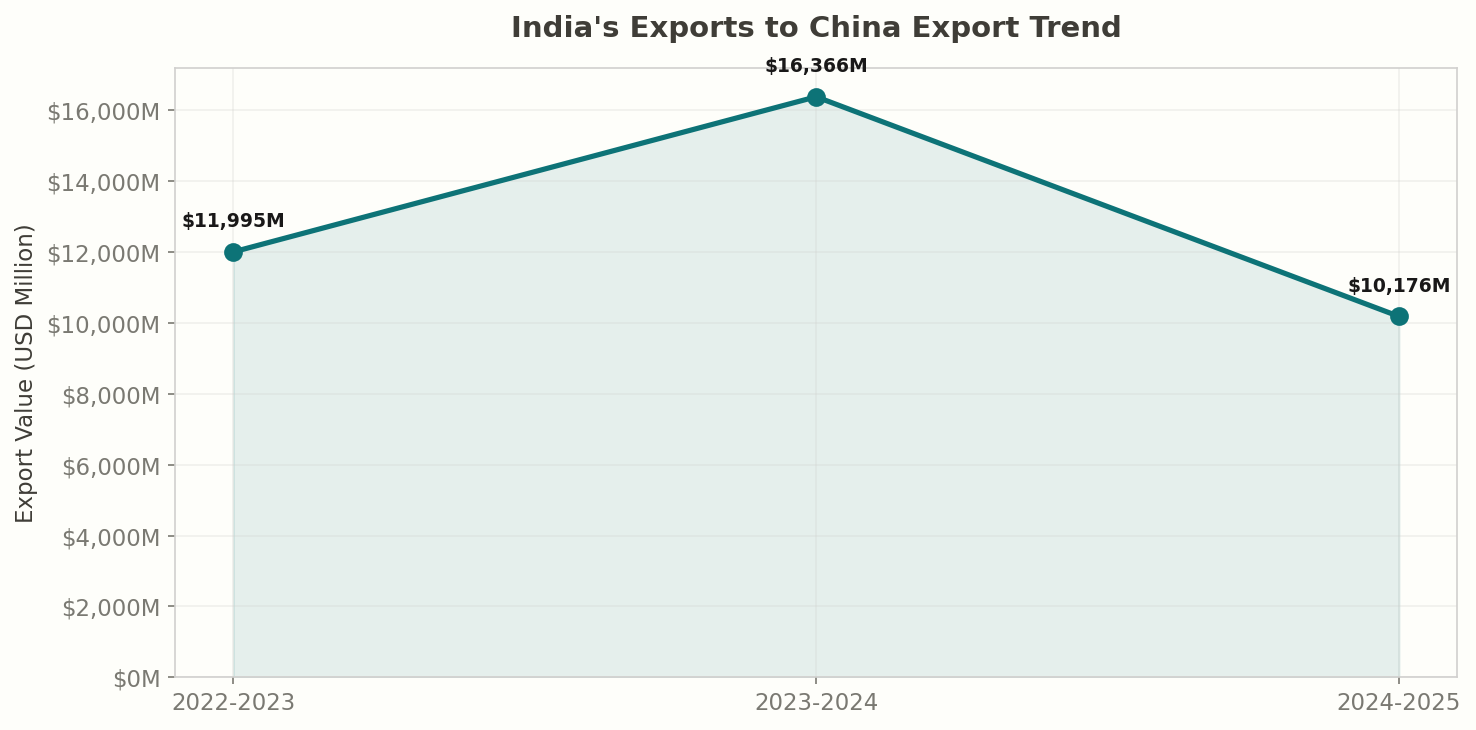
China is India's second-largest trading partner and one of the most complex export markets in the world. India exported $10,175.60 million worth of goods to China in 2024-25, down from a peak of $16,366 million in 2023-24 — a decline driven by softening commodity prices, reduced iron ore demand, and ongoing non-tariff barriers that constrain Indian market access. Despite the decline, $10 billion in annual exports makes China a market that no serious Indian exporter can ignore.
For Indian MSME exporters, China presents a paradox: enormous demand for raw materials, seafood, spices, and select manufactured goods, but a regulatory environment that is opaque, slow-moving, and frequently shaped by political considerations. This guide covers the market opportunity, regulatory requirements, tariff structure, logistics, and the practical challenges of doing business with Chinese buyers.
India–China Trade Overview
India's goods exports to China totalled $10,175.60 million in 2024-25, a significant correction from the $16,366 million recorded in 2023-24. The 2023-24 peak reflected elevated commodity prices — particularly iron ore and copper — that have since moderated. Looking at the longer trend, exports have grown from approximately $8,700 million in 2022-23, indicating a stable baseline that fluctuates with global commodity cycles.
The trade relationship is heavily imbalanced. India's imports from China exceed $100 billion annually, creating a massive trade deficit. India's exports to China are dominated by primary commodities and raw materials — ores, chemicals, seafood, and agricultural products — while India imports manufactured goods, electronics, and machinery from China. This structural imbalance shapes the political context of bilateral trade.
What India Exports to China
The top product categories exported from India to China in 2024-25:
| Rank | HS Chapter | Product Category | Export Value (USD Million) |
|---|---|---|---|
| 1 | 26 | Ores, slag, and ash | $1,943.0 |
| 2 | 29 | Organic chemicals | $1,017.8 |
| 3 | 84 | Machinery | $970.4 |
| 4 | 03 | Seafood | $836.5 |
| 5 | 25 | Salt, sulphur, stone, cement | $785.7 |
| 6 | 09 | Spices | $643.5 |
| 7 | 74 | Copper and articles | $364.4 |
| 8 | 85 | Electrical equipment | $359.7 |
| 9 | 15 | Fats and oils | $356.3 |
| 10 | 39 | Plastics | $250.1 |
| 11 | 72 | Iron and steel | $233.3 |
| 12 | 52 | Cotton | $226.6 |
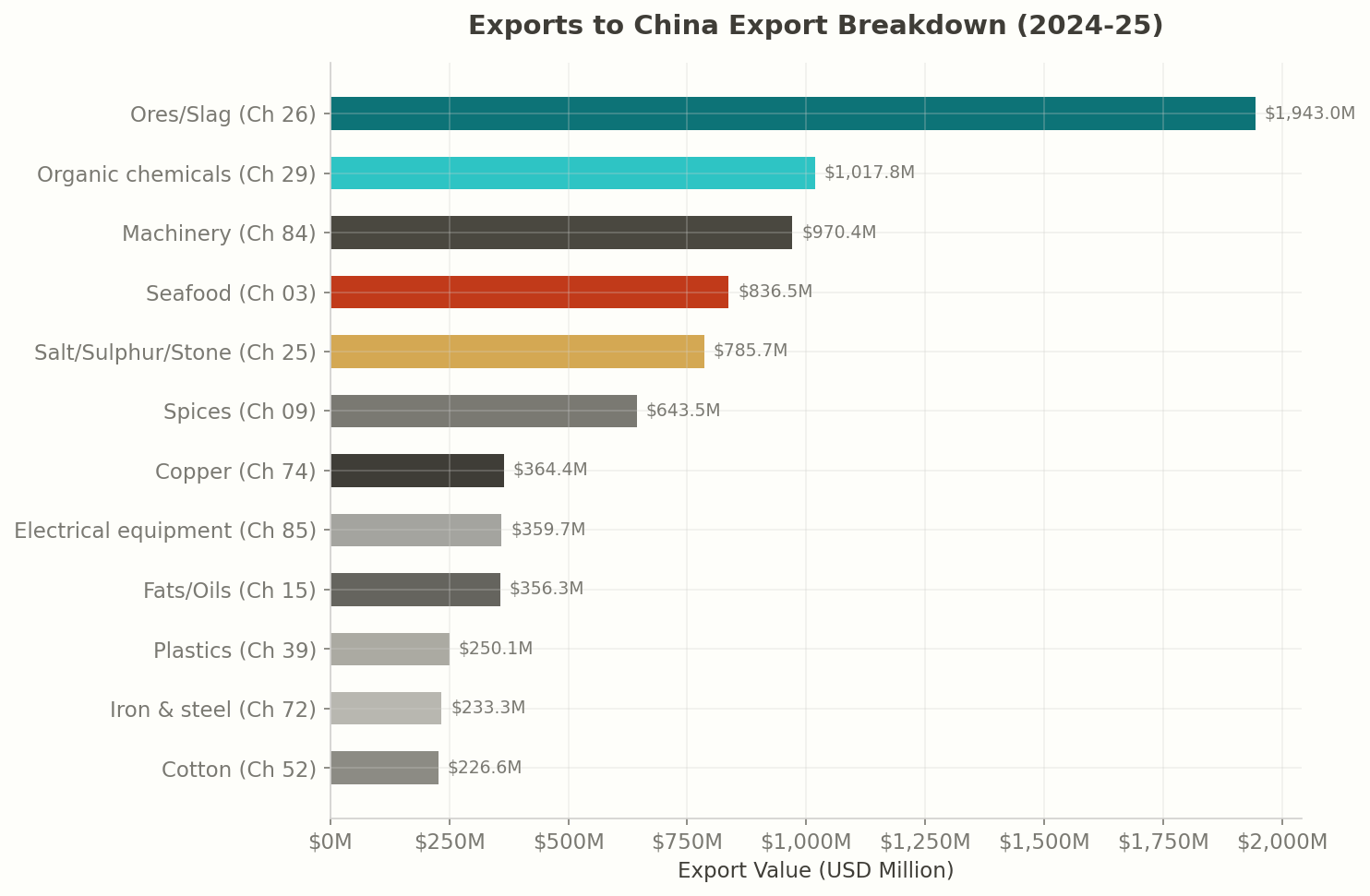
The export basket to China is fundamentally different from India's exports to Western markets. Ores and slag ($1,943M) dominate — primarily iron ore — reflecting China's insatiable demand for steelmaking raw materials. Organic chemicals ($1,017.8M) include intermediates for China's pharmaceutical and chemical industries. Seafood ($836.5M) is a standout category, with Indian shrimp and fish commanding strong demand in the Chinese market. Spices at $643.5M highlight China's position as a major buyer of Indian capsicum, cumin, and other spice products. Cotton ($226.6M) feeds China's textile manufacturing sector.
The opportunity for Indian MSME exporters lies in the value-added segments — seafood, spices, chemicals, and select manufactured goods — rather than bulk commodities that are dominated by large mining and trading companies.
Regulatory and Customs Framework
China's import regulatory system is centralised but complex, with multiple agencies involved in different product categories.
General Administration of Customs of China (GACC)
GACC is the primary customs authority, responsible for import clearance, tariff collection, and border enforcement. Since 2018, GACC has absorbed the functions of the former AQSIQ (Administration of Quality Supervision, Inspection and Quarantine), consolidating inspection and quarantine powers.
Key GACC requirements:
- All food exporters must register with GACC — China's Decree 248 (effective January 2022) requires overseas food production facilities to be registered in the GACC system before products can be exported to China
- Registration is valid for five years and must be renewed
- For high-risk food products (meat, seafood, dairy), registration requires recommendation by India's competent authority (EIC/FSSAI)
- For lower-risk products (spices, processed foods), manufacturers can self-register through the GACC online portal
China Compulsory Certification (CCC)
The CCC mark (also known as 3C certification) is mandatory for a wide range of products sold in China:
Products requiring CCC:
- Electrical and electronic equipment
- Automotive parts and accessories
- Toys
- Safety glass
- IT and telecommunications equipment
- Fire safety products
- Medical devices (certain categories)
CCC process:
- Application to the China Quality Certification Centre (CQC) or designated certification body
- Product testing at an accredited Chinese laboratory
- Factory audit by Chinese inspectors
- Timeline: 3-6 months for initial certification
- Cost: RMB 20,000-100,000 depending on product complexity
For Indian exporters of machinery and electrical equipment to China, CCC certification is a non-negotiable market access requirement.
Food Safety — GB Standards
China uses its own national food safety standards — the GB (Guobiao) standard system. Key standards affecting Indian food exports:
- GB 2760: Food additive standards — permitted additives and maximum levels differ significantly from Indian FSSAI standards
- GB 7718: General food labelling requirements — all food labels must be in Chinese
- GB 28050: Nutrition labelling — mandatory nutritional information panel
- GB 2762: Maximum levels for contaminants in food
- Pesticide MRLs: China has its own maximum residue limits that may differ from Codex Alimentarius or Indian standards
Practical impact: Indian spice exporters must ensure their products meet Chinese pesticide MRL standards, which can be stricter than Indian or even EU standards for certain substances. Independent testing at a CNAS-accredited laboratory before shipment is strongly recommended.
CFDA/NMPA Registration
The National Medical Products Administration (NMPA, formerly CFDA) regulates pharmaceuticals, medical devices, and cosmetics. For Indian pharmaceutical exporters:
- Products must be registered with NMPA
- Clinical trial data from China may be required (though mutual recognition agreements are expanding)
- Registration timeline: 12-36 months for pharmaceutical products
- Chinese regulatory requirements are increasingly aligned with ICH standards, but significant differences remain
Key Standards and Certifications
China National Standards (GB)
GB standards are mandatory for products sold in China. There are over 36,000 GB standards covering virtually every product category. Key categories for Indian exporters:
- GB/T for industrial products: Machinery, tools, equipment
- GB for food safety: Contaminants, additives, labelling
- GB for consumer products: Safety, performance, labelling
ISO and International Standards
China recognises ISO standards in many areas, but Chinese GB standards often have additional or different requirements. Do not assume that ISO certification alone guarantees compliance with Chinese standards.
Labelling Requirements
All products sold in China must be labelled in Simplified Chinese. Requirements include:
- Product name, manufacturer name and address
- Country of origin
- Net content/weight
- Production date and shelf life (for food)
- Chinese distributor or importer details
- GB standard number (for regulated products)
Tariff Structure and Trade Agreements
MFN Tariff Rates
India-China trade operates under WTO MFN tariff rates. China's average applied tariff is approximately 7.5% overall, but rates vary significantly by product:
| Product Category | China MFN Tariff Rate |
|---|---|
| Iron ore (2601) | 0% |
| Organic chemicals (29xx) | 5.5-6.5% |
| Seafood/shrimp (0306) | 5-14% |
| Spices (0904-0910) | 8-20% |
| Cotton (5201) | 1% (in-quota), 40% (out-of-quota) |
| Machinery (84xx) | 0-10% |
| Electrical equipment (85xx) | 0-10% |
| Plastics (39xx) | 6.5-10% |
| Copper (7403) | 0-2% |
| Fats and oils (15xx) | 5-20% |
RCEP Implications
Both India and China are in the Asia-Pacific region, but India opted out of the Regional Comprehensive Economic Partnership (RCEP) in 2019. This means Indian goods do not benefit from the tariff reductions that RCEP members (including ASEAN, Japan, South Korea, Australia, and New Zealand) enjoy when exporting to China. Indian goods face higher tariffs than competitors from RCEP member countries in several categories.
Impact for Indian exporters: In product categories where RCEP members compete with India — such as seafood, agricultural products, and certain manufactured goods — Indian exports face a 5-15% tariff disadvantage. This must be offset through competitive pricing, quality, or unique product characteristics.
APTA (Asia-Pacific Trade Agreement)
India and China are both members of the Asia-Pacific Trade Agreement, which provides limited tariff preferences on approximately 4,000 product lines. The margin of preference is typically 20-50% of the MFN rate. Check whether your product qualifies under APTA — many Indian exporters are unaware of this option.
Use the Duty Calculator to check exact tariff rates for your HS code.
Logistics and Shipping
Shipping Routes and Transit Times
- JNPT/Nhava Sheva to Shanghai: 16-20 days
- Mundra to Ningbo: 14-18 days
- Chennai to Guangzhou: 12-16 days
- Kolkata to Shanghai: 14-18 days
- Vishakhapatnam to Qingdao: 12-16 days
- Air freight (Delhi/Mumbai to Shanghai/Guangzhou): 6-8 hours direct
Major Chinese Ports
- Shanghai — World's busiest container port, primary gateway for East China and the Yangtze River Delta economic zone. Handles over 47 million TEUs annually.
- Ningbo-Zhoushan — Second busiest, serves Zhejiang province's massive manufacturing base.
- Guangzhou/Nansha — Gateway to the Pearl River Delta (Guangdong province), China's manufacturing heartland.
- Shenzhen/Yantian — Major port for South China, strong for electronics and consumer goods.
- Qingdao — Key port for North China, handles significant iron ore and agricultural imports.
- Tianjin — Serves Beijing and Northern China. Important for industrial raw materials.
Freight Costs (Indicative)
- 20-ft container to Shanghai: $1,200-$2,500
- 40-ft container to Chinese ports: $2,000-$4,500
- Air freight: $3.00-$5.50 per kg
- Bulk cargo (ores): Rates vary significantly with Baltic Dry Index
Chinese Customs Clearance
Chinese customs clearance is generally efficient at major ports but can be unpredictable:
- Standard clearance: 1-3 business days
- First-time shipments or new product categories: 5-10 business days (may trigger inspection)
- Food and agricultural products: Additional inspection by GACC quarantine officers, potentially adding 3-7 days
- Products requiring CCC certification: Clearance will be refused without valid certification
Documentation Requirements
- Commercial Invoice (in English; Chinese translation recommended for food products)
- Packing List (detailed, with HS codes for each line item)
- Bill of Lading or Airway Bill
- Certificate of Origin — APTA format if claiming preferential tariff
- Phytosanitary Certificate (for plant and agricultural products)
- Health Certificate (for food and seafood products, issued by EIC)
- GACC Registration Number (for food exporters, Decree 248 compliance)
- CCC Certificate (for products requiring China Compulsory Certification)
- Chinese Language Labels (for food and consumer products — can be affixed in bonded warehouse)
- Shipping Bill (filed via ICEGATE)
- Insurance Certificate
- Inspection Certificate (pre-shipment inspection by CCIC or designated agency, if required)
Payment and Banking
Payment practices in China differ significantly from Western markets. Understanding Chinese business culture around payments is critical.
Letters of Credit — Essential for New Relationships
For first-time transactions with Chinese buyers, an irrevocable Letter of Credit is strongly recommended. Chinese payment culture can be unpredictable, and legal recourse for payment disputes is difficult and expensive.
- Confirmed LC: For high-value shipments, insist on confirmation by a reputable international bank (HSBC, Standard Chartered) rather than relying solely on the Chinese buyer's bank
- LC terms: Chinese buyers typically request 60-90 day LCs. Negotiate carefully — longer terms increase your financing cost
RMB Settlement
China actively promotes settlement in Renminbi (RMB/CNY). Some Chinese buyers may request RMB-denominated invoicing. Indian banks (SBI, Bank of Baroda, ICICI) have RMB correspondent banking arrangements, but RMB settlement adds currency risk. Unless you have specific reasons to accept RMB, denominate contracts in USD.
T/T Wire Transfer
For established relationships, T/T payments with 30% advance and 70% against documents are common. However, Chinese buyers frequently push for 100% open account terms — resist this unless you have significant transaction history and trust.
Payment Risk Considerations
- ECGC insurance is strongly recommended for all China shipments on open account terms
- Chinese courts are difficult to access for foreign creditors. Prevention (secure payment terms) is far more effective than cure (legal action)
- Use the Indian Embassy's trade wing in Beijing for disputes — they can sometimes facilitate resolution
- Chinese buyers in certain industries (particularly small trading companies) have higher default rates than buyers in developed markets
Common Mistakes
Not registering with GACC for food exports. Since Decree 248 took effect in January 2022, all overseas food manufacturing facilities must be registered with GACC. Shipments from unregistered facilities will be refused entry. Registration takes 2-4 months — plan ahead.
Ignoring non-tariff barriers (NTBs). China uses technical standards, inspection requirements, and administrative delays as de facto trade barriers. Products that comply with international standards may still be rejected for failing to meet GB standards. Test against Chinese standards specifically, not just ISO or Indian standards.
Accepting unfavourable payment terms. Chinese buyers are skilled negotiators and will push for maximum payment flexibility. Open account terms with new Chinese buyers carry significant risk. Start with LCs and graduate to open account only after establishing a track record.
Neglecting language barriers. Business communication in China is primarily in Mandarin. English proficiency among Chinese buyers and customs officials varies widely. Invest in a bilingual agent or interpreter for negotiations, contracts, and documentation. All contracts should be bilingual (English and Chinese), with the Chinese version as the governing language for Chinese courts.
Underestimating political and regulatory risk. India-China trade is periodically affected by geopolitical tensions. Import restrictions, enhanced inspections, and regulatory delays can be imposed with little warning. Diversify your export markets — do not become overly dependent on China as a sole buyer.
Assuming RCEP benefits apply. India is not a member of RCEP. Indian goods do not receive RCEP preferential tariff rates in China. Check APTA as an alternative for limited preferential access.
Key Takeaways
- India exported $10,175.60 million to China in 2024-25, dominated by ores ($1,943M), chemicals ($1,017.8M), and machinery ($970.4M)
- GACC registration (Decree 248) is mandatory for all food exporters — plan 2-4 months for registration
- CCC certification is required for electrical, electronic, and automotive products — budget 3-6 months and RMB 20,000-100,000
- China uses GB standards that differ from international standards — test against Chinese-specific requirements
- India is not part of RCEP, creating a tariff disadvantage versus ASEAN and other competitors. Check APTA for limited preferences.
- Letters of Credit are essential for new buyer relationships. Payment risk in China is higher than in Western markets.
- Language barriers are real — use bilingual agents and bilingual contracts
- Non-tariff barriers can be unpredictable. Maintain diversified export markets.
Next Steps
- Identify your HS code with the HS Code Finder and check China's tariff rate using the Duty Calculator
- Register with GACC if you are exporting food, seafood, or agricultural products — this is mandatory under Decree 248
- Check CCC requirements if your product is electrical, electronic, or automotive
- Test your product against GB standards — do not rely on ISO or Indian certifications alone
- Explore Chinese market demand with the Market Finder
- Engage a bilingual trade agent in China who can navigate customs, negotiate with buyers, and manage regulatory processes
- Secure ECGC insurance before shipping on any terms other than confirmed Letter of Credit
- Explore export opportunities to other Asian markets to diversify your buyer base
China is a massive and growing market for Indian goods, but it is not an easy one. The regulatory complexity, language barriers, payment risks, and political unpredictability require Indian exporters to be better prepared than for almost any other market. The rewards are commensurate — $10 billion in annual trade means significant opportunity for exporters who invest in understanding how China works. Start with secure payment terms, invest in Chinese regulatory compliance, and build relationships patiently. China rewards persistence and penalises shortcuts.
Ready to start exporting?
Get a detailed market report with country-by-country analysis, pricing insights, and buyer contacts.
Get Market ReportXIMPEX Export Advisory
Need help implementing the strategies discussed in this guide? Our team of export specialists can provide personalized guidance for your business.