How to Export to Germany from India — Complete Guide
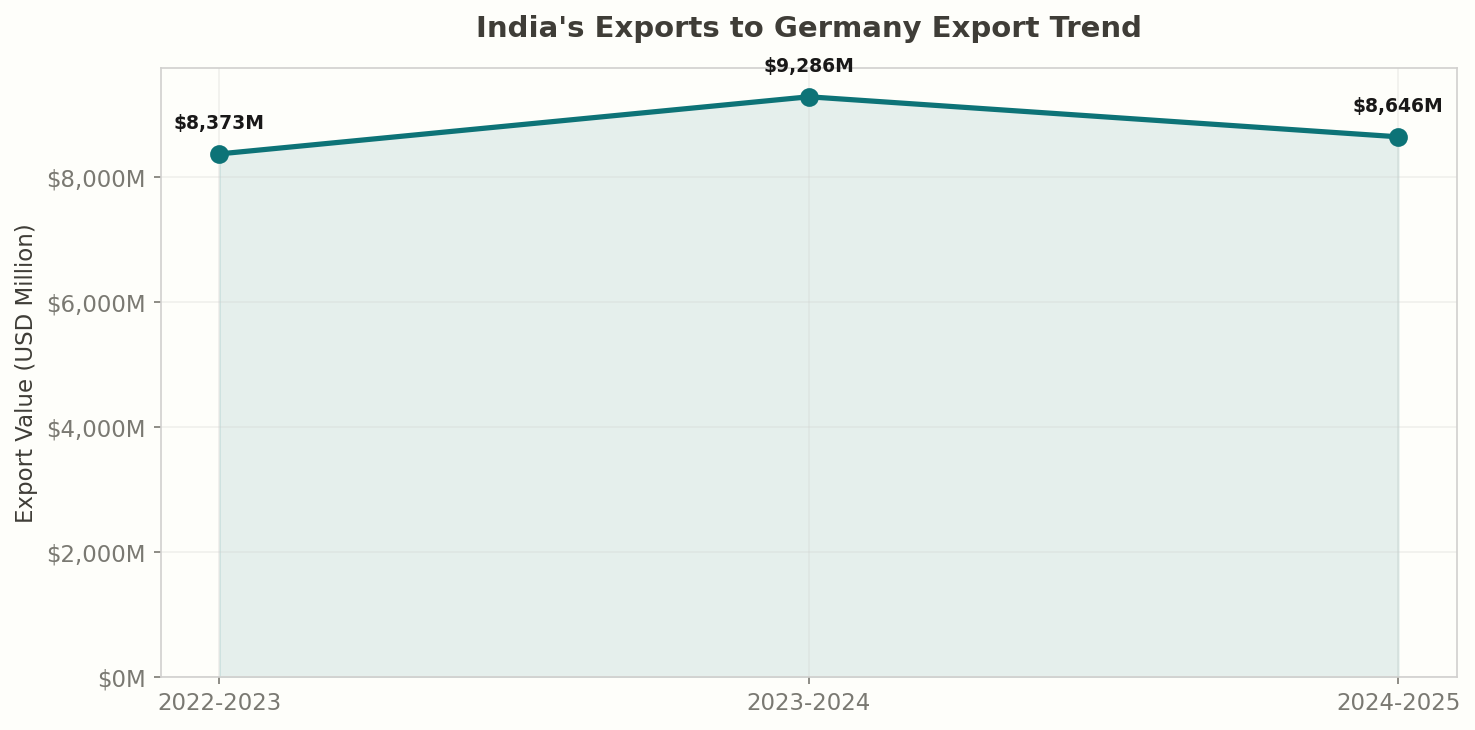
Germany is India's largest trading partner in the European Union and one of the most important export destinations globally. India exported $8.65 billion worth of goods to Germany in 2024-25, up from $8.37 billion in 2022-23. For Indian MSME exporters, Germany offers the EU's largest economy — 84 million people with Europe's highest purchasing power — and access to a market that prizes engineering quality, reliability, and long-term supplier relationships.
But Germany is also one of the most demanding markets in the world. Between stringent EU-wide regulations (REACH, CE marking, food safety), Germany's own technical standards (DIN, TUV certification), and the cultural expectation that everything works perfectly the first time, exporting to Germany requires thorough preparation. This guide covers the trade opportunity, regulatory requirements, logistics, and practical tips for Indian exporters entering the German market.
India–Germany Trade Overview
India's goods exports to Germany totalled $8,645.85 million in 2024-25, continuing a steady upward trend from $8,373 million in 2022-23. Germany consistently ranks among India's top 10 export destinations and is the gateway for Indian goods into the broader EU single market of 450 million consumers.
The trade relationship is underpinned by strong industrial complementarity. Germany needs intermediate goods, chemicals, textiles, and components that Indian manufacturers can supply competitively. Indian exports to Germany span a wide range of sectors — from high-value machinery and automotive parts to traditional strengths like textiles, leather goods, and spices.
Germany is also India's largest source of foreign direct investment from Europe, and many German multinationals — including Bosch, Siemens, Volkswagen, and BASF — source extensively from India. This creates a natural pipeline for Indian MSME exporters who can integrate into established German supply chains. The Indian diaspora in Germany, numbering around 200,000, also facilitates business connections and cultural understanding between the two economies.
Bilateral trade between India and Germany is supported by institutional frameworks including the Indo-German Chamber of Commerce (headquartered in Mumbai with offices in major Indian cities) and Germany Trade and Invest (GTAI), the federal government's trade and investment promotion agency. Both organisations actively support Indian exporters seeking to enter the German market.
What India Exports to Germany
The top product categories exported from India to Germany in 2024-25:
| Rank | HS Chapter | Product Category | Export Value (USD Million) |
|---|---|---|---|
| 1 | 84 | Machinery | $1,252.6 |
| 2 | 85 | Electrical equipment | $987.9 |
| 3 | 29 | Organic chemicals | $511.7 |
| 4 | 87 | Vehicles and parts | $511.1 |
| 5 | 61 | Knitted apparel | $479.3 |
| 6 | 73 | Iron and steel articles | $420.2 |
| 7 | 30 | Pharmaceuticals | $401.1 |
| 8 | 62 | Woven apparel | $355.8 |
| 9 | 90 | Instruments | $353.7 |
| 10 | 64 | Footwear | $298.4 |
| 11 | 40 | Rubber articles | $276.4 |
| 12 | 09 | Spices | $261.6 |
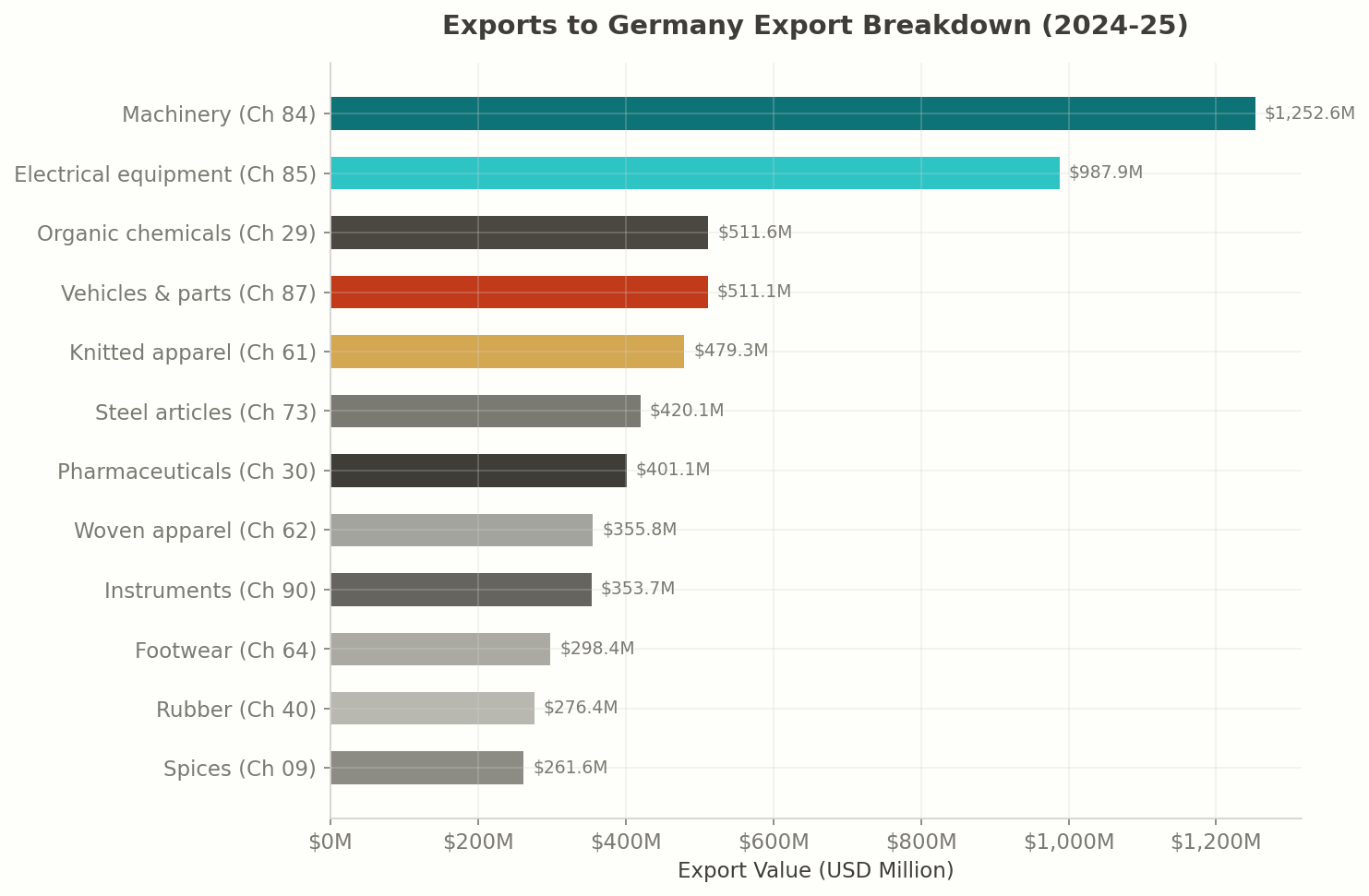
Machinery ($1.25B) and electrical equipment ($988M) together account for over 25% of Indian exports to Germany, reflecting India's growing role as a manufacturer of industrial components, auto parts, and electronic assemblies. The chemicals and automotive cluster (organic chemicals, vehicles and parts) contributes over $1 billion. Textiles and apparel combined ($835M) remain a traditional stronghold. Pharmaceuticals ($401M) reflect India's position as a generic drug supplier to European healthcare systems.
Regulatory and Customs Framework
Germany is part of the European Union, so all EU-wide regulations apply. However, Germany also has its own national regulatory bodies and enforcement mechanisms that add a further layer of compliance.
EU-Wide Regulations
CE Marking: The Conformite Europeenne mark is mandatory for a wide range of products sold anywhere in the EU, including Germany. Product categories requiring CE marking include machinery, electrical equipment, medical devices, toys, personal protective equipment, construction products, and pressure equipment. CE marking demonstrates that your product meets the essential requirements of applicable EU directives. You must prepare a Declaration of Conformity and maintain a Technical File for each CE-marked product.
EU REACH Regulation: Registration, Evaluation, Authorisation and Restriction of Chemicals. If you export chemicals, dyes, pigments, or products containing regulated substances (textiles with chemical treatments, paints, adhesives, plastics with additives), your products must comply with REACH. Only an EU-based entity can register substances — Indian exporters typically appoint an Only Representative (OR) in the EU who handles REACH registration on their behalf.
RoHS Directive: Restriction of Hazardous Substances in electrical and electronic equipment. Limits lead, mercury, cadmium, hexavalent chromium, and other hazardous substances to specified maximum concentration values. Applies to all electrical and electronic products entering the EU market.
German-Specific Requirements
German Customs (Zoll): Germany's customs authority (Zollverwaltung) enforces EU customs regulations with characteristic thoroughness. Import declarations must be filed electronically through the ATLAS system. Your German importer handles customs clearance, but product documentation must be complete and accurate.
TUV Certification: While not always legally mandatory, TUV (Technischer Uberwachungsverein) certification is often a de facto market requirement in Germany. German buyers — especially in industrial, automotive, and engineering sectors — expect TUV-certified products. TUV SUD and TUV Rheinland are the two major certification bodies, and both have offices in India.
DIN Standards: Deutsches Institut fur Normung publishes thousands of technical standards. While EU-harmonised standards (EN standards) are the legal baseline, many German buyers specify DIN standards for engineering components. If your buyer references a DIN standard, ensure your product meets it exactly.
Key Standards and Certifications
For food products:
- EU food safety regulations (Regulation EC 178/2002)
- German Food and Feed Code (LFGB)
- Maximum Residue Limits (MRLs) for pesticides — EU MRLs are among the strictest in the world
- Organic certification (EU organic logo, plus German Bio-Siegel if selling as organic)
- Allergen labelling in German language
For textiles and apparel:
- Oeko-Tex Standard 100 — tests for harmful substances in textiles. Nearly a prerequisite for the German retail market
- GOTS (Global Organic Textile Standard) — for organic textile claims
- Social compliance audits — German buyers increasingly require BSCI (Business Social Compliance Initiative) or SA8000 certification
For machinery and industrial goods:
- CE marking with full technical documentation
- Machine Directive 2006/42/EC compliance
- ISO 9001 quality management certification (expected by virtually all German industrial buyers)
- Product liability insurance — German law holds importers and manufacturers jointly liable
For pharmaceuticals:
- EU GMP (Good Manufacturing Practice) certification
- Marketing authorisation from BfArM (Federal Institute for Drugs and Medical Devices) or through the EU centralised procedure
- German Pharmacopoeia (DAB) standards
Tariff Structure and Trade Agreements
Germany, as an EU member, applies the EU Common Customs Tariff (CCT) to all imports from non-EU countries. India currently exports to Germany under MFN (Most Favoured Nation) rates, with partial benefits from the EU Generalised Scheme of Preferences (GSP).
EU GSP for India: India benefits from the EU's standard GSP scheme, which provides tariff reductions (not elimination) on approximately 66% of tariff lines. Key sectors that benefit include textiles, leather, and certain industrial goods. However, India does not qualify for GSP+ (the enhanced scheme with deeper cuts) because India is classified as an upper-middle-income country by the World Bank.
India-EU FTA Negotiations: India and the EU have been negotiating a Broad-Based Trade and Investment Agreement (BTIA) intermittently since 2007. Negotiations were relaunched in June 2022 with renewed momentum. When concluded, this FTA would significantly reduce tariffs on Indian goods entering the EU market, including Germany. Textiles, leather, footwear, and agricultural products would benefit most.
Indicative EU tariff rates for Indian exports:
| Product Category | EU Tariff Rate (MFN) | GSP Rate |
|---|---|---|
| Machinery (8471) | 0% | 0% |
| Auto parts (8708) | 3-4.5% | 2.7-3.5% |
| Knitted T-shirts (6109) | 12% | 9.6% |
| Woven shirts (6205) | 12% | 9.6% |
| Organic chemicals (2933) | 0-6.5% | 0-5.5% |
| Pharmaceuticals (3004) | 0% | 0% |
| Footwear (6403) | 8% | 4.5% |
| Spices (0904-0910) | 0-12.5% | 0-10% |
| Iron/steel articles (7326) | 0-2.7% | 0-2.2% |
| Instruments (9018) | 0% | 0% |
Use the Duty Calculator to check the exact tariff rate for your HS code.
Logistics and Shipping
Shipping Routes and Transit Times
- JNPT/Nhava Sheva to Hamburg: 20-25 days via Suez Canal
- Mundra to Bremerhaven: 20-24 days
- Chennai to Hamburg: 22-28 days
- Air freight (Delhi/Mumbai to Frankfurt): 8-10 hours direct
Major German Ports
- Hamburg — Germany's largest port and third-largest in Europe. Primary entry point for Indian goods. Handles over 8 million TEUs annually.
- Bremerhaven — Second-largest German port, strong for automotive imports and break-bulk cargo.
- Wilhelmshaven (JadeWeserPort) — Deep-water port for large container vessels, growing as an alternative to Hamburg.
Air Cargo
Frankfurt Airport is Europe's largest air cargo hub and the primary entry point for high-value, time-sensitive Indian exports (pharmaceuticals, instruments, gems, perishable food). Munich, Dusseldorf, and Cologne also handle significant air freight volumes.
Freight Costs (Indicative, 2024-25)
- 20-ft container to Hamburg: $1,800-$3,500
- 40-ft container to Hamburg/Bremen: $3,000-$5,500
- Air freight: $3-$6 per kg
Incoterms
India-Germany trade commonly uses FOB (Free on Board) or CIF terms. For machinery and industrial goods, German buyers often prefer FOB, arranging their own freight through established German logistics providers. For consumer goods and textiles, CIF is more common. Discuss Incoterms early in negotiations — German buyers are precise about cost allocation and will expect your quote to reflect the agreed Incoterm exactly.
Logistics Providers
Germany's logistics infrastructure is world-class. DHL (headquartered in Bonn), DB Schenker (the logistics arm of Deutsche Bahn), and Kuehne+Nagel all have extensive India operations and can handle end-to-end logistics from factory gate to German warehouse. For LCL (less than container load) shipments — common for MSME exporters — these providers offer consolidated services from Indian ports to German destinations. Their India offices can also assist with customs documentation and compliance requirements.
Documentation Requirements
- Commercial Invoice (in English; German translation may be requested by some buyers)
- Packing List with detailed weight and dimension information
- Bill of Lading (ocean) or Airway Bill
- EUR.1 Movement Certificate or GSP Form A (for preferential tariff under EU GSP)
- Certificate of Origin
- CE Declaration of Conformity (for products requiring CE marking)
- Phytosanitary Certificate (for agricultural/plant products)
- Health Certificate (for food products of animal origin)
- REACH compliance documentation (for chemicals and products with regulated substances)
- Shipping Bill (filed via ICEGATE)
- Insurance Certificate (if CIF terms)
- Test reports and quality certificates as specified by the buyer
Payment and Banking
Payment Methods
- Letters of Credit (LC): Standard for first-time relationships with German buyers. German banks (Deutsche Bank, Commerzbank, DZ Bank) are experienced in trade finance with India.
- Open Account (30-60 days): The most common payment method for established relationships. German companies are reliable payers with strong payment discipline — default rates are very low.
- Documents against Payment (D/P): Moderate-risk option for building new relationships.
- Wire Transfer (T/T): Used for smaller orders or when established trust exists. 30% advance, balance against shipping documents is a common structure.
Currency
Most India-Germany trade is denominated in EUR or USD. German buyers typically prefer EUR. If quoting in EUR, hedge your currency risk — the EUR/INR rate can fluctuate significantly. Use forward contracts through your Authorised Dealer (AD) bank for orders above Rs 25 lakh.
German Payment Culture
German businesses value punctuality in all things, including payments. Late payment is rare. However, German buyers also negotiate hard on price and expect long-term pricing stability. Do not quote prices you cannot sustain — German buyers plan procurement months or years in advance and will not appreciate price revisions mid-contract.
Common Mistakes
Underestimating EU regulatory complexity. The EU has some of the world's most stringent product regulations. REACH compliance alone can take 6-12 months and cost several thousand euros. Start the compliance process early — do not assume you can sort out regulations after shipping.
Ignoring German language requirements. Product labels, user manuals, and safety information must be in German for consumer products. Technical documentation for industrial goods should also be in German or at minimum English (which most German engineers read). Never ship consumer products with labels only in English.
Not claiming GSP preferences. Many Indian exporters pay full MFN duty when they could benefit from GSP reductions. Ensure your Certificate of Origin is in the correct GSP format and that your product meets the Rules of Origin criteria.
Treating Germany like one market. Germany has regional economic centres: Munich (automotive, technology), Stuttgart (automotive, machinery), Frankfurt (finance, logistics), Hamburg (trade, media), North Rhine-Westphalia (heavy industry, chemicals). Target the right region for your product category.
Skipping trade fairs. Germany hosts the world's most important industry trade fairs — Hannover Messe (industrial technology), Anuga (food), Medica (medical devices), Ambiente (consumer goods), ISPO (sports). These events are where German buyers find new suppliers. Attending with well-prepared samples and documentation is the most effective market entry strategy.
Key Takeaways
- India exported $8.65 billion to Germany in 2024-25 — machinery ($1.25B), electrical equipment ($988M), and chemicals ($512M) lead
- Germany is the gateway to the EU single market of 450 million consumers
- EU regulations apply: CE marking, REACH, RoHS are mandatory; TUV certification is a de facto market requirement
- India benefits from EU GSP tariff preferences — claim them with the correct Certificate of Origin
- India-EU FTA negotiations are ongoing — once concluded, expect significantly reduced tariffs
- German buyers value quality, precision, and reliability above price — invest in certifications and consistent quality
- Trade fairs (Hannover Messe, Anuga, Medica) are the primary channel for finding German buyers
Next Steps
- Identify your HS code with the HS Code Finder and check the EU tariff rate using the Duty Calculator
- Verify CE marking and REACH requirements for your product category before approaching German buyers
- Get TUV or equivalent certification if you're targeting industrial or engineering sectors
- Register for a relevant German trade fair — this is the most effective way to connect with German buyers
- Use the Market Finder to identify which products India is currently shipping to Germany and spot opportunities
- Ensure your labelling and documentation is in German for consumer products and at minimum English for industrial goods
Germany rewards preparation. Indian exporters who invest in quality certification, regulatory compliance, and relationship-building can build long-term, high-value partnerships with German companies. The $8.65 billion trade relationship is growing, and with the India-EU FTA on the horizon, the opportunity will only expand.
For related information, explore our HS code directory to find the exact tariff classification for your products, or browse country export guides for other major markets.
Ready to start exporting?
Get a detailed market report with country-by-country analysis, pricing insights, and buyer contacts.
Get Market ReportXIMPEX Export Advisory
Need help implementing the strategies discussed in this guide? Our team of export specialists can provide personalized guidance for your business.