How to Export to Japan from India — Complete Guide
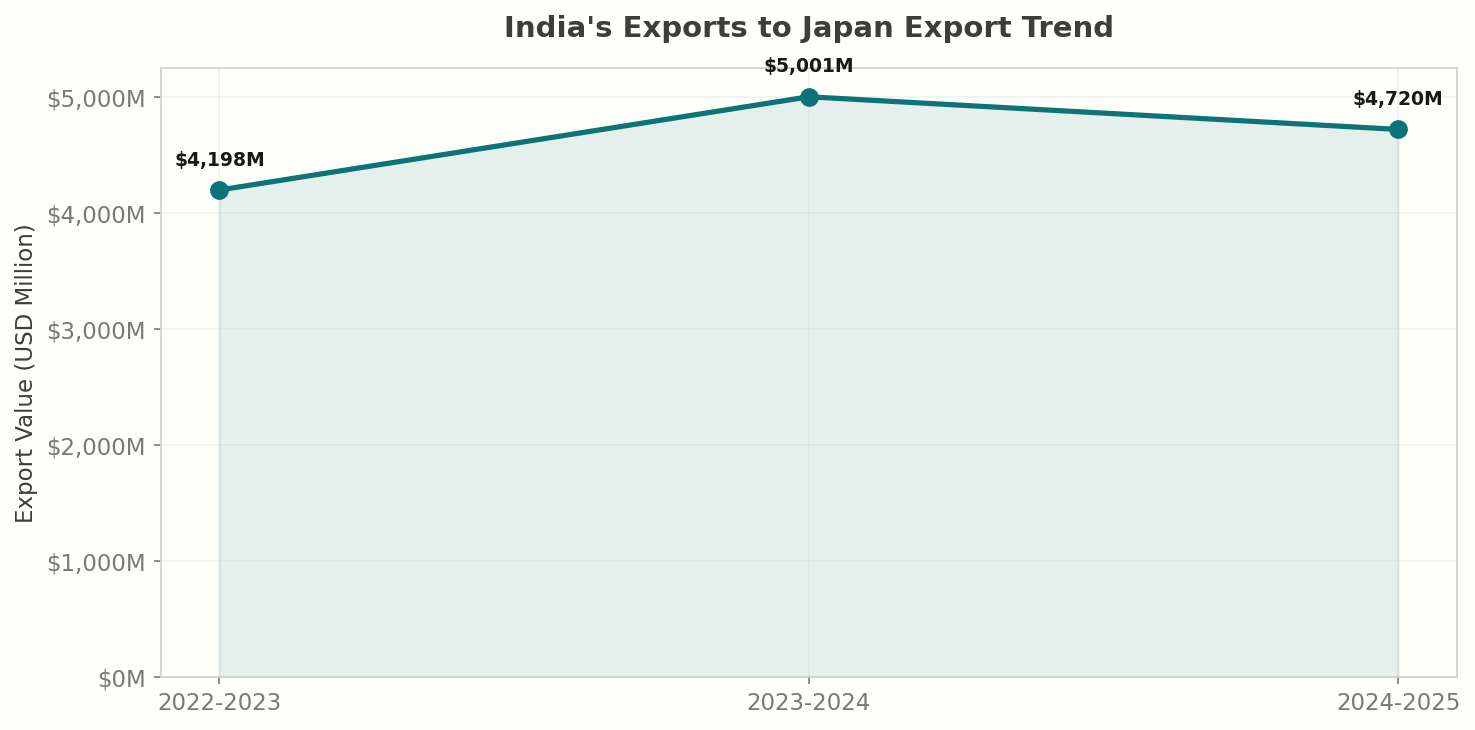
Japan is one of India's most valuable and stable export partners. India exported $4,719.63 million in goods to Japan in 2024-25, up from $4,198 million in 2022-23 — a steady growth trajectory underpinned by the India-Japan Comprehensive Economic Partnership Agreement (CEPA), which has been in force since 2011 and eliminates tariffs on approximately 90% of tariff lines. Japan is the world's fourth-largest economy, with 125 million consumers who are among the most quality-conscious on the planet.
For Indian MSME exporters, Japan represents the ultimate quality test. Japanese buyers demand zero-defect products, meticulous packaging, on-time delivery, and long-term relationship commitment. The standards are exacting, but the rewards are substantial: Japanese business relationships are deep, loyal, and often span decades. Once you establish yourself as a reliable supplier, Japanese buyers rarely switch — even for a lower price.
India–Japan Trade Overview
India's goods exports to Japan totalled $4,719.63 million in 2024-25, continuing a gradual upward trend from $4,198 million in 2022-23. Unlike the volatile swings seen in India's trade with some other Asian markets, the Japan trade relationship is characterised by stability and predictability — reflecting the mature nature of the India-Japan CEPA and the preference of Japanese businesses for long-term, steady supply arrangements.
The India-Japan CEPA, signed in 2011, has been instrumental in this growth. Tariff elimination on approximately 90% of lines has opened Japanese markets to Indian vehicles, machinery, chemicals, seafood, and agricultural products at preferential or zero rates. Japan is also one of India's largest sources of foreign direct investment, and the economic partnership extends well beyond trade into infrastructure, technology transfer, and defence.
What India Exports to Japan
The top product categories exported from India to Japan in 2024-25:
| Rank | HS Chapter | Product Category | Export Value (USD Million) |
|---|---|---|---|
| 1 | 87 | Vehicles and parts | $996.5 |
| 2 | 84 | Machinery | $507.8 |
| 3 | 38 | Chemical products | $466.4 |
| 4 | 29 | Organic chemicals | $406.4 |
| 5 | 03 | Seafood | $296.3 |
| 6 | 71 | Gems and jewellery | $226.9 |
| 7 | 72 | Iron and steel | $204.0 |
| 8 | 85 | Electrical equipment | $199.0 |
| 9 | 62 | Woven apparel | $154.6 |
| 10 | 30 | Pharmaceuticals | $93.9 |
| 11 | 39 | Plastics | $87.5 |
| 12 | 28 | Inorganic chemicals | $80.3 |
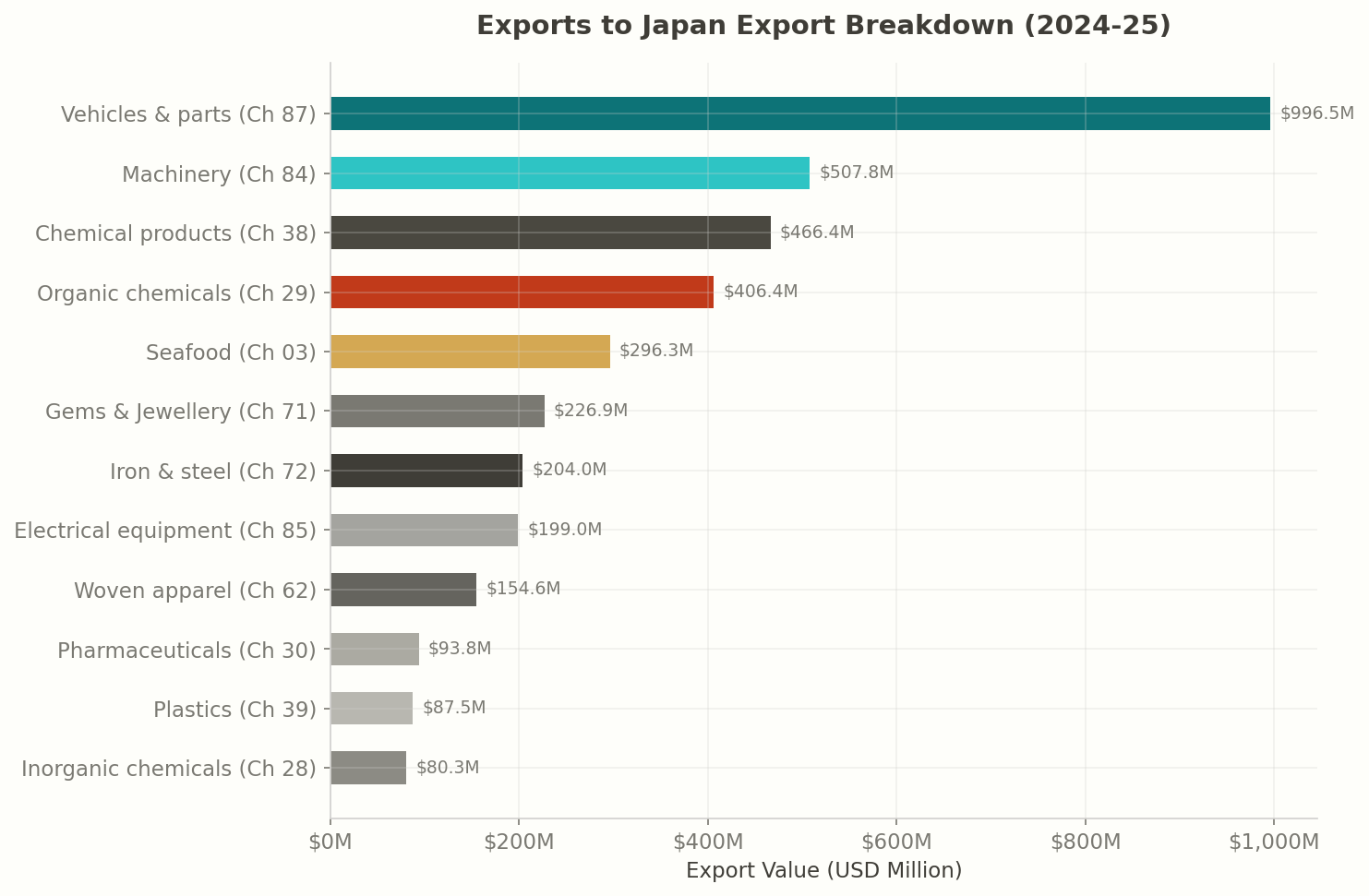
Vehicles and parts dominate at $996.5 million — a reflection of the deep integration between Indian and Japanese automotive industries. Suzuki, Toyota, and Honda manufacture extensively in India, and a significant portion of auto component exports to Japan are intra-company transfers within these supply chains. Machinery ($507.8M) and chemicals ($872.8M combined across Chapters 29 and 38) form the next tier. Seafood at $296.3 million positions Japan as one of India's top buyers of shrimp and fish. Apparel at $154.6 million is modest but growing, driven by Japanese fast-fashion brands sourcing from India as a China+1 alternative.
The auto components story is particularly relevant for Indian MSMEs. Japanese OEMs are actively diversifying their supply chains away from China, and India is a primary beneficiary. If you manufacture auto components and can meet Japanese quality standards, the opportunity is substantial.
Regulatory and Customs Framework
Japan's regulatory environment is transparent, rules-based, and exacting. The standards are high but clearly defined — unlike some markets where requirements are opaque, Japan publishes detailed regulations that exporters can study and prepare for.
Japan Customs
Japan Customs is the primary border agency. All imports are classified under the Japanese tariff schedule (based on the Harmonized System). Key requirements:
- Import declaration must be filed by the Japanese importer or their licensed customs broker
- Pre-arrival examination system: Japan Customs offers advance filing for faster clearance
- Customs valuation: Based on CIF (Cost, Insurance, Freight) value — duty is calculated on the CIF price, not FOB
- Post-clearance audit: Japan Customs conducts risk-based audits. Maintain accurate records for at least five years.
Ministry of Health, Labour and Welfare (MHLW)
MHLW regulates food safety, pharmaceuticals, and medical devices.
Food imports:
- All food imports must comply with the Food Sanitation Act
- Imported food is inspected at the port of entry by quarantine stations under MHLW
- Monitoring inspections: Random sampling and testing of food shipments. If violations are found, the product may be subject to mandatory inspection for subsequent shipments
- Positive List system for pesticides: Japan operates a Positive List system with a default maximum residue limit (MRL) of 0.01 ppm for any pesticide not explicitly listed. This is one of the strictest pesticide regimes in the world. Indian agricultural and food exporters must test their products against Japan's specific MRL list — not Codex or Indian standards.
Pharmaceuticals and medical devices:
- Regulated by the Pharmaceuticals and Medical Devices Agency (PMDA)
- Products must be registered and approved before sale in Japan
- Manufacturing facilities must comply with Japanese GMP standards
- Japanese regulatory approval can take 12-24 months for pharmaceuticals
Ministry of Economy, Trade and Industry (METI)
METI oversees industrial product standards and safety requirements:
- PSE mark: Mandatory for electrical products and appliances sold in Japan. Covers approximately 450 product categories including household appliances, lighting, and power tools.
- SG mark: Safety mark for consumer products — voluntary but widely expected by Japanese retailers and consumers. Covers products like helmets, baby products, and sporting goods.
- S-JET mark: For electrical products — an alternative conformity assessment path to the PSE mark
Plant Protection and Animal Quarantine
- Plant Protection Station: Inspects all plant and agricultural imports. Phytosanitary certificates from India's Plant Quarantine authority are required.
- Animal Quarantine Service: Inspects animal products including seafood, leather, and animal-derived materials.
Key Standards and Certifications
Japanese Industrial Standards (JIS)
JIS standards are Japan's national standards, developed by the Japanese Industrial Standards Committee (JISC). While not always legally mandatory, JIS compliance is effectively required for commercial success in Japan:
- JIS marking on products signals quality and compliance to Japanese buyers
- Japanese companies overwhelmingly prefer JIS-compliant products and materials
- For construction materials, automotive components, and industrial goods, JIS compliance is a de facto market requirement
Japanese Agricultural Standards (JAS)
JAS standards govern food and agricultural product quality:
- Organic JAS: Required for products marketed as organic in Japan. India's NPOP organic certification is not automatically recognised — a JAS-registered certification body must verify compliance.
- JAS grades for quality classification of agricultural products
- Specific JAS for production methods (e.g., free-range, special cultivation)
Quality Culture — Zero-Defect Mentality
Japan's quality expectations go beyond formal standards. The Japanese business culture demands:
- Zero-defect quality: Acceptable Quality Levels (AQLs) that Western buyers consider adequate (e.g., AQL 2.5) are often unacceptable in Japan. Japanese buyers may expect AQL 0.65 or lower.
- Packaging excellence: Product packaging in Japan is an art form. Dented boxes, loose packing, or damaged labels are grounds for rejection — not just the product inside, but the packaging itself.
- Delivery precision: Delivery windows are strict. Being early can be as problematic as being late — Japanese supply chains are calibrated for just-in-time delivery.
- Documentation accuracy: Every detail in every document must be correct. Small errors that would be overlooked in other markets (a misspelled address, a weight discrepancy of a few grams) will be flagged by Japanese buyers.
Indian exporters who succeed in Japan invest significantly in quality management systems, often implementing Toyota Production System (TPS) or similar methodologies in their own facilities.
Tariff Structure and Trade Agreements
India-Japan CEPA
The Comprehensive Economic Partnership Agreement between India and Japan, effective since August 2011, is one of India's most comprehensive trade agreements.
Key provisions:
- Tariff elimination on approximately 90% of Japanese tariff lines for Indian goods — phased over 10-15 years from 2011, with most eliminations now complete
- Immediate zero duty on industrial goods including most machinery, chemicals, and auto components
- Phased reduction for sensitive products including textiles, agricultural goods, and certain food products
- Rules of Origin: Generally 35-40% qualifying value content (QVC) or change in tariff classification (CTC)
Current CEPA preferential tariff rates (indicative):
| Product Category | CEPA Rate | MFN Rate |
|---|---|---|
| Auto parts (8708) | 0% | 0-5% |
| Machinery (84xx) | 0% | 0-5% |
| Organic chemicals (29xx) | 0% | 3-5.5% |
| Chemical products (38xx) | 0% | 3-6.5% |
| Seafood/shrimp (0306) | 1-3.5% | 3.5-10% |
| Iron and steel (72xx) | 0% | 0-5% |
| Woven apparel (62xx) | 5-8% | 8-12.8% |
| Gems (7103) | 0% | 0-5.4% |
| Pharmaceuticals (3004) | 0% | 0-5.4% |
| Cotton textiles (52xx) | 3-5% | 5-10% |
How to claim CEPA preferences:
- Verify your product qualifies under the CEPA tariff schedule
- Ensure compliance with the applicable Rule of Origin (product-specific rules may apply)
- Obtain a Certificate of Origin in the prescribed CEPA format from DGFT or an authorised chamber
- Your Japanese importer presents the CoO to Japan Customs at import
Use the Duty Calculator to check the exact CEPA rate for your HS code.
Logistics and Shipping
Shipping Routes and Transit Times
- JNPT/Nhava Sheva to Yokohama/Tokyo: 18-24 days
- Mundra to Kobe: 16-22 days
- Chennai to Yokohama: 14-20 days
- Vishakhapatnam to Tokyo: 16-22 days
- Air freight (Delhi/Mumbai to Tokyo/Osaka): 8-10 hours direct
Major Japanese Ports
- Tokyo/Yokohama — Japan's largest port complex, serving the Greater Tokyo metropolitan area (38 million people). Primary gateway for consumer goods, food, and general cargo.
- Kobe — Major port in the Kansai region (Osaka-Kobe-Kyoto). Strong for industrial goods, chemicals, and machinery.
- Osaka — Serves Japan's second-largest urban area. Growing container volumes.
- Nagoya — Japan's automotive capital. Primary port for auto-related imports and exports. If you supply auto components, Nagoya is your likely port of entry.
- Hakata (Fukuoka) — Gateway to Kyushu, Japan's southern island.
Freight Costs (Indicative)
- 20-ft container to Yokohama/Tokyo: $1,500-$3,000
- 40-ft container to Japanese ports: $2,500-$5,000
- Air freight: $4.00-$7.00 per kg (Japan air freight rates tend to be higher than other Asian destinations)
- Reefer container (for seafood/perishables): Premium of 30-50% over standard container rates
Japanese Customs Clearance
Japan Customs is efficient and predictable:
- Standard clearance: 1-2 business days for compliant shipments
- Pre-arrival clearance: Available through the NACCS (Nippon Automated Cargo and Port Consolidated System) — declarations can be processed before the vessel arrives
- First-time shipments: May undergo more detailed examination. Provide complete, accurate documentation to avoid delays.
- Food inspections: MHLW quarantine inspection at port for food products. If your product history is clean, inspections are typically sampling-based and fast. If previous violations exist, mandatory inspection on every shipment.
Documentation Requirements
- Commercial Invoice (accurate to the last detail — Japanese customs and buyers scrutinise invoices closely)
- Packing List (with exact weights, dimensions, and item counts per carton)
- Bill of Lading or Airway Bill
- Certificate of Origin — CEPA format for preferential tariff claims
- Phytosanitary Certificate (for plant and agricultural products)
- Health Certificate (for food and seafood, issued by EIC/FSSAI/MPEDA)
- Inspection Certificate (pre-shipment quality inspection report, often required by Japanese buyers)
- Product test reports (pesticide residue analysis for food, safety testing for consumer products)
- JIS or PSE/SG compliance documentation (for regulated industrial and consumer products)
- Shipping Bill (filed via ICEGATE)
- Insurance Certificate
- PMDA registration documentation (for pharmaceuticals and medical devices)
Payment and Banking
Japan has one of the most reliable payment cultures in the world. Japanese businesses take payment obligations seriously, and default rates are exceptionally low.
Common Payment Methods
- T/T Wire Transfer: The most common payment method in India-Japan trade. For established relationships, 100% payment against documents or within 30 days of shipment is standard. Japanese buyers are reliable — once trust is established, open account terms work well.
- Letters of Credit: Used primarily for first-time transactions or very large orders. Japanese banks (MUFG, Sumitomo Mitsui, Mizuho) are among the world's largest and most reliable LC issuers.
- Open Account (30-60 days): Common for ongoing supply relationships. Japanese buyers almost never default on payments — Japan has one of the lowest commercial payment default rates globally.
- Documentary Collection (D/P): Occasionally used. Lower cost than LC but provides less security.
Currency
Trade is denominated in USD or JPY. Japanese buyers often prefer JPY pricing. The JPY/INR rate has been relatively stable in recent years, but large contracts should be hedged through forward contracts with your AD bank.
Trading Houses (Sogo Shosha)
Japan's general trading companies — Mitsubishi Corporation, Mitsui, Itochu, Sumitomo Corporation, and Marubeni — play a unique role in Japanese trade. These sogo shosha act as intermediaries, importers, distributors, and financiers.
Why this matters for Indian exporters:
- Trading houses can provide market access, buyer introductions, and trade finance that would take years to develop independently
- They handle import procedures, customs clearance, and distribution within Japan
- Working through a sogo shosha adds a layer of cost (their margin) but significantly reduces market entry risk
- For MSMEs without Japan experience, approaching a trading house as your first point of contact is often the most practical strategy
Keiretsu Supply Chain Culture
Japanese industry is organised around keiretsu — networks of companies with interlocking business relationships. Major manufacturers (Toyota, Sony, Panasonic) have established supplier networks built on decades of trust.
Implications for Indian exporters:
- Breaking into a keiretsu supply chain takes time — often 2-3 years of relationship building, sample testing, and small trial orders before significant volumes
- Once accepted, you become part of a long-term relationship with predictable volumes
- Japanese buyers will invest in your capability (training, technical assistance, quality systems) — they view suppliers as partners, not vendors
- Price is important but secondary to quality, reliability, and relationship
Common Mistakes
Treating Japan like any other Asian market. Japan's business culture, quality standards, and communication norms are unique. Exporters who apply a generic Asian market strategy will struggle. Invest time in understanding Japanese business etiquette — exchanging business cards (meishi), communication style (indirect, consensus-based), and the importance of face-to-face meetings.
Failing the Positive List pesticide test. Japan's default MRL of 0.01 ppm for unlisted pesticides is far stricter than most countries. Indian spice and agricultural exporters have had shipments rejected for pesticide residues that would pass in the EU or USA. Test against Japan's specific Positive List before shipping — not against Indian or Codex standards.
Submitting imperfect documentation. A weight discrepancy of 50 grams between the invoice and packing list, a transposed digit in an HS code, or a spelling error in the consignee address — these are issues that Japanese buyers and customs officials will flag. Japanese standards for documentation accuracy are the highest in the world. Triple-check every document.
Expecting quick decisions. Japanese business decision-making follows a consensus process called nemawashi (building agreement among all stakeholders). Purchase decisions, especially with new suppliers, take months. Sending a quotation and expecting a response in a week is unrealistic. Be patient, follow up politely, and provide additional information when requested.
Ignoring packaging quality. In Japan, packaging is part of the product. A high-quality product in a damaged, stained, or poorly printed box will be rejected or attract complaints. Invest in packaging that meets Japanese standards — clean, precise, well-designed, and protective.
Not claiming CEPA preferences. The India-Japan CEPA eliminates duties on most industrial goods and reduces them significantly on food and textiles. Shipping without a CEPA Certificate of Origin means paying unnecessary MFN tariffs. On a $500,000 auto parts shipment, even a 3% saving is $15,000.
Key Takeaways
- India exported $4,719.63 million to Japan in 2024-25, led by vehicles/parts ($996.5M), machinery ($507.8M), and chemicals ($872.8M combined)
- The India-Japan CEPA provides zero or reduced duty on approximately 90% of tariff lines — claim preferences with the correct Certificate of Origin
- Japan's quality expectations are the highest in the world — zero-defect mentality, perfect packaging, and precise documentation are non-negotiable
- The Positive List pesticide system (0.01 ppm default MRL) is extremely strict — test agricultural and food products against Japan-specific MRLs
- PSE mark is mandatory for electrical products; JIS compliance is effectively required for industrial goods
- Japanese payment reliability is excellent — default rates are among the lowest globally
- Trading houses (sogo shosha) offer the most practical market entry path for MSMEs new to Japan
- Relationship building takes 2-3 years — be patient, invest in face-to-face meetings, and demonstrate long-term commitment
Next Steps
- Identify your HS code with the HS Code Finder and check Japan's CEPA tariff rate using the Duty Calculator
- Check product-specific regulations — MHLW for food, PMDA for pharma/medical devices, METI for industrial/electrical products
- Test your product against Japanese standards — Positive List MRLs for food, JIS for industrial goods, PSE for electrical products
- Explore Japanese market demand with the Market Finder
- Connect with a trading house (sogo shosha) or Japanese trade intermediary as your market entry partner
- Attend Japan-focused trade events — JETRO (Japan External Trade Organisation) organises regular trade fairs and business matching events for Indian exporters
- Invest in relationship building — visit Japan, meet buyers face-to-face, and demonstrate your commitment to quality and long-term partnership
- Explore other Asian export markets to build a diversified export portfolio
Japan is not a market for exporters seeking quick wins. It is a market for businesses that value quality, precision, and long-term relationships. The India-Japan CEPA has removed the tariff barriers; what remains is the quality barrier — and that is entirely within your control. Indian MSMEs that invest in Japanese-level quality systems, patient relationship building, and meticulous attention to detail will find Japan to be one of the most rewarding and stable export markets in the world.
Ready to start exporting?
Get a detailed market report with country-by-country analysis, pricing insights, and buyer contacts.
Get Market ReportXIMPEX Export Advisory
Need help implementing the strategies discussed in this guide? Our team of export specialists can provide personalized guidance for your business.