How to Export to Kenya from India — Complete Guide
Kenya is East Africa's largest and most dynamic economy, a regional trade hub serving not just its own 55 million consumers but functioning as the commercial gateway to the broader East African Community (EAC) bloc of seven nations with a combined population exceeding 300 million. India exported $1,899.23 million in goods to Kenya in 2024-25, led by pharmaceuticals ($308.15M), machinery ($264.01M), and cereals/rice ($162.04M) — products that serve Kenya's healthcare, industrialisation, and food security needs. The India-Kenya trade relationship is underpinned by centuries of historical connection, a vibrant Indian diaspora in Kenya, and deepening economic cooperation.
For Indian MSME exporters, Kenya represents a high-potential market with comparatively lower entry barriers than more regulated destinations like Brazil or Japan. The market is growing, the regulatory framework is becoming more transparent, and Kenya's strategic investments in port infrastructure (Mombasa) and the Standard Gauge Railway (SGR) from Mombasa to Nairobi are improving logistics across the region. However, Kenya also presents challenges: payment collection risks are higher than in developed markets, the Pre-Export Verification of Conformity (PVoC) requirement catches many first-time exporters off guard, and understanding the EAC tariff structure is essential for competitive pricing. This guide covers everything an Indian exporter needs to know to succeed in the Kenyan market.
India-Kenya Trade Overview
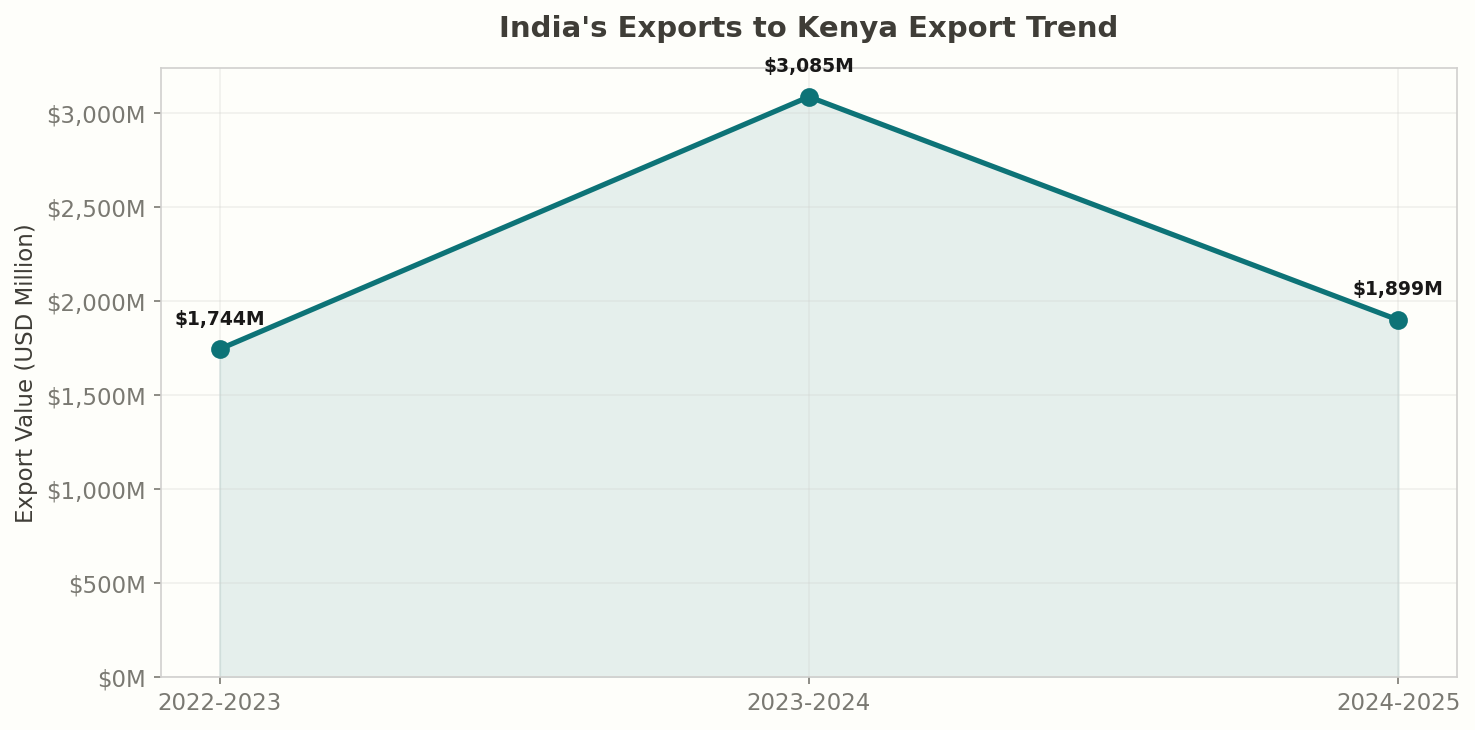
India's goods exports to Kenya totalled $1,899.23 million in 2024-25, following an exceptional $3,085.15 million in 2023-24 (driven by elevated commodity and pharmaceutical shipments) and $1,744.31 million in 2022-23. The 2024-25 figure, while lower than the 2023-24 peak, represents an approximately 9% increase over the 2022-23 baseline — reflecting genuine underlying growth in the trade relationship.
India is consistently among Kenya's top three import sources, alongside China and the UAE. The relationship is deeply rooted: Indian traders have been active along the East African coast for centuries, and the Indian-origin community in Kenya — estimated at 80,000-100,000 people — plays a significant role in business, manufacturing, and professional sectors. This diaspora connection provides Indian exporters with cultural familiarity and business networks that few other exporting nations enjoy.
Kenya's membership in the East African Community (EAC) is a critical strategic factor. The EAC — comprising Kenya, Tanzania, Uganda, Rwanda, Burundi, the DRC, and South Sudan — operates a customs union with a Common External Tariff (CET). Kenya's port of Mombasa serves as the primary entry point for goods destined not only for Kenya but also for Uganda, Rwanda, South Sudan, and eastern DRC. For Indian exporters, selling to Kenya often means selling to the broader East African region. The AfCFTA adds another dimension — as tariff liberalisation progresses, Kenya's position as East Africa's most connected economy makes it a natural hub for accessing the wider African market.
What India Exports to Kenya
The top product categories exported from India to Kenya in 2024-25:
| Rank | HS Chapter | Product Category | Export Value (USD Million) |
|---|---|---|---|
| 1 | 30 | Pharmaceuticals | $308.15 |
| 2 | 84 | Machinery | $264.01 |
| 3 | 10 | Cereals and rice | $162.04 |
| 4 | 87 | Vehicles and parts | $93.96 |
| 5 | 39 | Plastics | $91.77 |
| 6 | 85 | Electrical equipment | $77.28 |
| 7 | 38 | Chemical products | $67.97 |
| 8 | 48 | Paper | $60.77 |
| 9 | 29 | Organic chemicals | $55.64 |
| 10 | 72 | Iron and steel | $42.28 |
| 11 | 40 | Rubber | $40.03 |
| 12 | 76 | Aluminium | $39.29 |
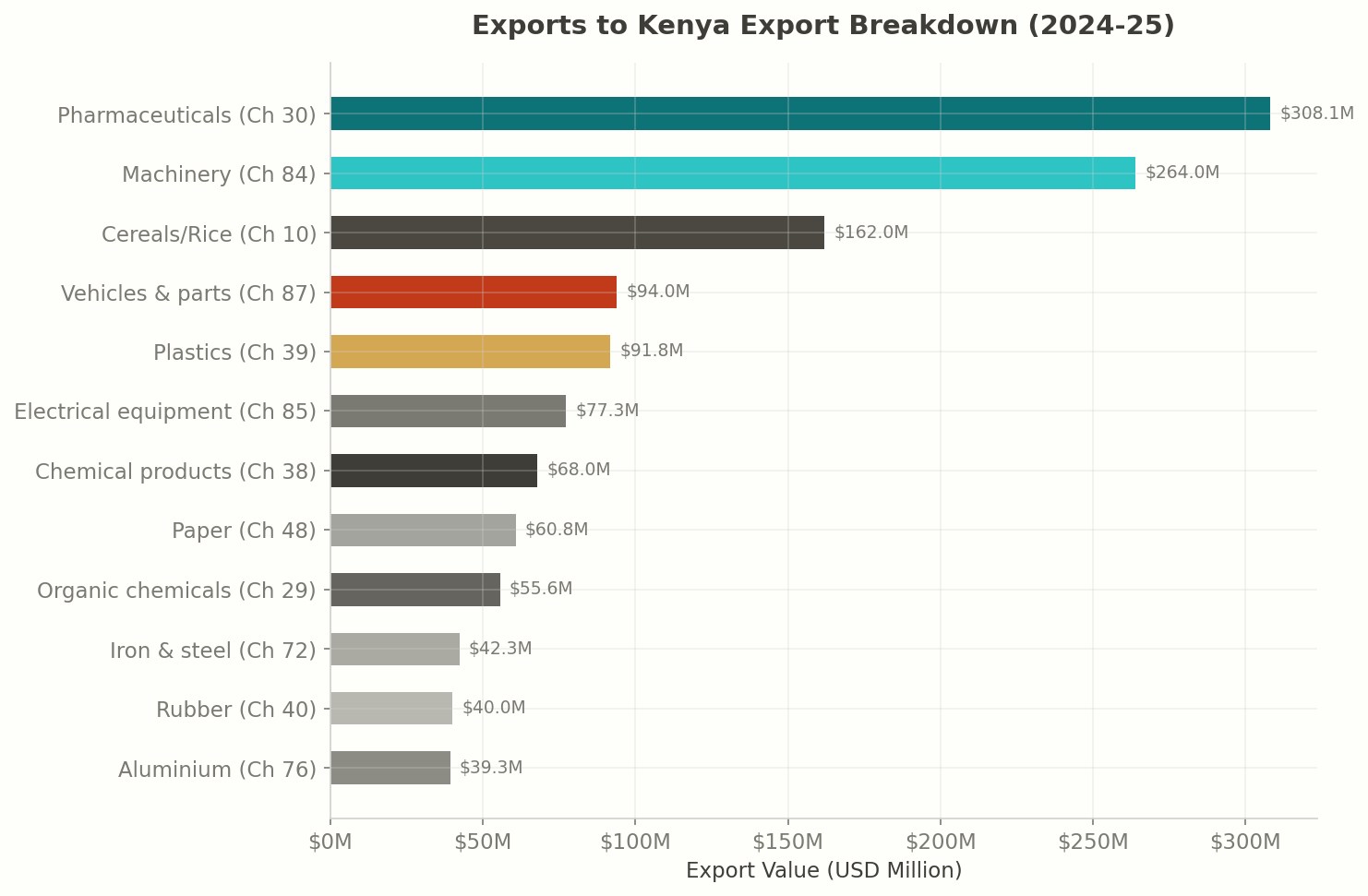
Pharmaceuticals dominate at $308.15 million — over 16% of India's total exports to Kenya. India supplies the vast majority of Kenya's generic medicines, including essential drugs for malaria, HIV/AIDS, and tuberculosis. Indian pharmaceutical companies like Cipla, Aurobindo, Strides, and Ajanta Pharma have built strong distribution networks, and Indian-made generics are trusted by Kenyan healthcare providers. This position was built through competitive pricing, reliable supply, and WHO prequalification compliance.
Machinery at $264.01 million reflects Kenya's industrialisation and infrastructure development — demand spans textile machinery, food processing equipment, construction machinery, pumps, and generators. Cereals and rice at $162.04 million serve Kenya's food needs, with rice being a staple and India a major supplier alongside Pakistan and Tanzania.
Vehicles and parts ($93.96M) include motorcycles — hugely popular for transport across Kenya — auto components, and commercial vehicles. Plastics ($91.77M) and paper ($60.77M) serve Kenya's packaging sector, while iron and steel ($42.28M) feeds construction activity in Nairobi and other growing cities.
Regulatory and Customs Framework
Kenya's regulatory environment has improved significantly over the past decade, with the introduction of electronic systems, clearer procedures, and alignment with international standards. However, compliance requirements — particularly the PVoC — must be understood and addressed before shipment.
Kenya Revenue Authority (KRA) — Customs Division
KRA Customs is the primary border agency responsible for import clearance, tariff assessment, and revenue collection. Key requirements:
- Import declaration: Filed electronically through the KRA iCMS (Integrated Customs Management System) by the Kenyan importer or their licensed customs agent
- Customs valuation: Based on CIF value (Cost, Insurance, Freight). Kenya follows the WTO Customs Valuation Agreement
- Tariff classification: Kenya uses the EAC Common External Tariff schedule, based on the Harmonized System. Tariff rates are set at the EAC level
- Import Declaration Form (IDF): Must be obtained by the Kenyan importer before shipment. The IDF is processed through KRA's online system and is a prerequisite for customs clearance
- Post-clearance audit: KRA conducts risk-based audits. Records must be maintained for at least five years
Pre-Export Verification of Conformity (PVoC)
PVoC is the single most important compliance requirement for Indian exporters to understand. Kenya operates a mandatory pre-shipment inspection programme:
- All goods exported to Kenya (with limited exceptions for raw materials and personal effects) must undergo PVoC inspection in India before shipment
- Inspection agencies: KEBS has appointed international agencies (Bureau Veritas, SGS, Intertek) to conduct PVoC inspections at the point of origin
- Certificate of Conformity (CoC): Issued after successful inspection. Without a CoC, goods will be held at Mombasa and subjected to destination inspection at significantly higher cost and delay
- Timeline: Allow 5-15 days for PVoC inspection and CoC issuance
This is the most common compliance failure for first-time exporters to Kenya. Shipping without a CoC results in port delays, higher destination inspection fees, and potential rejection. Always arrange PVoC inspection before shipment.
Kenya Bureau of Standards (KEBS)
KEBS is the national standards body responsible for product quality, safety, and conformity assessment:
- Kenya Standards (KS): National standards for a wide range of products including food, electrical goods, construction materials, and chemicals
- Diamond Mark of Quality: KEBS quality certification mark, voluntary but widely recognised in the Kenyan market
- Import Standards Mark (ISM): For imported products that meet relevant Kenya Standards
- Standardisation Mark (SM): For locally manufactured products meeting Kenya Standards
Pharmacy and Poisons Board (PPB)
PPB regulates pharmaceuticals, medical devices, and health products in Kenya:
- All pharmaceutical products must be registered with PPB before they can be marketed or distributed in Kenya
- Registration timelines are typically 6-18 months for generic products with WHO prequalification or stringent regulatory authority approval (SRA)
- Manufacturing facilities must comply with WHO GMP standards — PPB conducts GMP inspections of foreign manufacturing sites
- Indian pharmaceutical companies with WHO prequalification enjoy a faster registration pathway
- Medical devices also require PPB registration, with classification-dependent timelines
Other Regulatory Bodies
- Kenya Plant Health Inspectorate Service (KEPHIS): Regulates plant health, seeds, and agricultural inputs. Phytosanitary certificates required for plant-based products
- Department of Veterinary Services: Issues import permits for animal-origin goods
- NEMA (National Environment Management Authority): Environmental compliance for chemicals and certain industrial goods
Key Standards and Certifications
Kenya Standards (KS)
Kenya Standards cover a broad range of products. Key standards relevant for Indian exporters:
- KS EAS (East African Standards): Many Kenya Standards are harmonised with EAC-wide standards. Products meeting KS EAS standards are accepted across the EAC bloc
- Food safety standards: Aligned with Codex Alimentarius, with some Kenya-specific requirements for labelling and composition
- Electrical product standards: Based on IEC standards, with Kenya-specific adaptations. Kenya uses the British-style Type G plug (three-pin rectangular) at 240V/50Hz
- Construction materials: Standards for cement, steel bars, roofing materials, and other building products
Labelling Requirements
- Product labels must include: product name, country of origin, manufacturer name and address, net weight/volume, ingredients (for food), manufacturing and expiry dates, and batch number
- Language: English and/or Kiswahili. English is widely used in commercial contexts and is generally sufficient for most product categories
- Metric system: All measurements must be in metric units
WHO Prequalification (Pharmaceuticals)
For pharmaceutical exports, WHO prequalification is the gold standard in Kenya:
- WHO-prequalified products enjoy faster PPB registration and are eligible for procurement by international health agencies (UNICEF, Global Fund, PEPFAR) operating in Kenya
- PPB also recognises approvals from stringent regulatory authorities (US FDA, EMA, UK MHRA) as a basis for expedited registration
Tariff Structure and Trade Agreements
EAC Common External Tariff (CET)
Kenya's import tariffs are determined by the EAC CET, which uses a three-band structure:
| Band | Rate | Product Types |
|---|---|---|
| Raw materials | 0% | Unprocessed materials, capital goods, certain agricultural inputs |
| Semi-finished goods | 10% | Intermediate products, industrial inputs |
| Finished goods | 25% | Consumer goods, finished manufactured products |
In addition to the three-band CET, some products attract higher "sensitive item" rates of 35%, 40%, or even 50-100% — typically for products that compete with local manufacturing (sugar, dairy, textiles, cement).
Indicative tariff rates for key Indian export categories:
| Product Category | EAC CET Rate | Notes |
|---|---|---|
| Pharmaceuticals (3004) | 0% | Essential medicines are duty-free |
| Machinery (84xx) | 0% | Capital goods and industrial machinery |
| Rice (1006) | 35-75% | Sensitive item — higher protection for domestic producers |
| Vehicles (8703) | 25% | Plus excise duty based on engine capacity |
| Plastics (39xx) | 10-25% | Depends on stage of processing |
| Electrical equipment (85xx) | 10-25% | Lower for inputs, higher for finished goods |
| Paper (48xx) | 10-25% | Varies by product type |
| Iron and steel (72xx) | 0-25% | Lower for inputs, higher for finished products |
Additional Levies
Beyond the CET, imports attract additional levies: Import Declaration Fee (3.5% of CIF), Railway Development Levy (2% of CIF), VAT at 16% on most goods, and excise duty on specific products including vehicles and plastics.
Trade Preferences
- India-EAC trade: No comprehensive preferential trade agreement currently exists. Exports are subject to MFN CET rates
- Duty remission schemes: Kenya operates duty remission programmes for manufacturers importing raw materials. If your Kenyan buyer is a manufacturer, they may import your products at reduced or zero duty under these schemes
Use the Duty Calculator to check the exact tariff rate for your specific HS code.
Logistics and Shipping
Shipping Routes and Transit Times
- JNPT/Nhava Sheva to Mombasa: 10-14 days
- Mumbai to Mombasa: 10-14 days
- Mundra to Mombasa: 10-14 days
- Chennai to Mombasa: 8-12 days
- Air freight (Mumbai/Delhi to Nairobi/JKIA): 5-7 hours (direct flights available on Kenya Airways and Air India)
Port of Mombasa
Mombasa is Kenya's sole major seaport and the principal gateway for the entire East African region:
- Regional gateway: Mombasa serves not only Kenya but also Uganda, Rwanda, South Sudan, and eastern DRC. Approximately 30% of cargo is transit cargo for landlocked countries
- Standard Gauge Railway (SGR): The Mombasa-Nairobi SGR, completed in 2017, provides a fast rail connection (approximately 4.5 hours for cargo), significantly reducing inland transit times and costs
- Port efficiency: Mombasa has improved significantly but congestion still occurs during peak periods. Average container dwell time is 4-6 days
- Inland Container Depots (ICDs): Nairobi ICD allows customs clearance inland, reducing port congestion
Freight Costs (Indicative)
- 20-ft container to Mombasa: $800-$1,800
- 40-ft container to Mombasa: $1,500-$3,200
- Air freight: $2.50-$5.00 per kg
- SGR freight from Mombasa to Nairobi: approximately $500-$800 per TEU (competitive with road transport)
- Road transport from Mombasa to Nairobi: approximately $800-$1,200 per container
Transit Cargo to Landlocked Countries
If your ultimate buyer is in Uganda, Rwanda, or South Sudan, goods will transit through Mombasa:
- Transit procedures: Kenya Customs operates a transit system for goods destined for neighbouring countries. Goods are sealed at Mombasa and released at the destination country's border post
- Northern Corridor: The road and rail route from Mombasa through Nairobi to Uganda, Rwanda, and beyond. Transit times: Mombasa to Kampala approximately 3-5 days by road; Mombasa to Kigali approximately 5-7 days
- Electronic Cargo Tracking System (ECTS): Kenya uses ECTS for monitoring transit cargo, improving security and reducing transit times
Documentation Requirements
- Commercial Invoice (with detailed product descriptions, HS codes, and CIF values)
- Packing List (detailed weights and dimensions per package)
- Bill of Lading or Airway Bill
- Certificate of Origin (issued by DGFT or authorised chamber of commerce)
- PVoC Certificate of Conformity (CoC) — mandatory, must be obtained before shipment through an authorised inspection agency in India
- Import Declaration Form (IDF) — obtained by your Kenyan importer through KRA
- Phytosanitary Certificate (for plant and agricultural products, issued by India's Plant Quarantine authority)
- Health Certificate (for food products, issued by EIC/FSSAI)
- PPB import permit (for pharmaceuticals and medical devices)
- KEPHIS import permit (for agricultural inputs, seeds, and plant products)
- Fumigation Certificate (for wooden packaging — ISPM-15 compliance)
- Shipping Bill (filed via ICEGATE)
- Insurance Certificate
- Product test reports as required under PVoC
Payment and Banking
Common Payment Methods
- Letters of Credit: Strongly recommended for new buyer relationships. Kenyan banks (KCB, Equity Bank, Standard Chartered Kenya) are established LC issuers. For first-time buyers, insist on a confirmed, irrevocable LC.
- T/T Wire Transfer with advance payment: For new buyers, request 30-50% advance with the balance against shipping documents. Full advance payment is achievable with smaller buyers who lack LC facilities.
- Documentary Collection (D/P): Used for established relationships. D/P provides moderate security — the buyer must pay before receiving documents. Avoid D/A (documents against acceptance) with new or unverified Kenyan buyers.
- ECGC cover: Strongly recommended. Kenya is rated as a medium-to-high risk market. ECGC provides credit insurance against buyer default and country risk including currency transfer restrictions.
Payment Collection Risks
Payment collection in Kenya requires more vigilance than in developed markets:
- Delayed payments are common, particularly from smaller buyers. Payment terms of 30 days may stretch to 60-90 days in practice
- Foreign exchange availability: Periods of dollar shortage can delay remittances. Confirmed LCs mitigate this risk
- Credit checks: Conduct due diligence through commercial credit agencies or Indian trade bodies with East African networks (FIEO, EEPC India)
- Start small: Begin with smaller orders and short payment terms for new buyers. Extend credit only after establishing a payment track record
Currency
The Kenya Shilling (KES) has depreciated gradually against the USD over the past decade. Always price your exports in USD. Kenyan importers expect USD pricing and manage their own KES/USD exposure. Avoid KES-denominated contracts.
Business Culture and the Indian Diaspora
Kenya has one of the strongest Indian diaspora communities in Africa, and this connection is a significant asset for Indian exporters:
- Historical trade links: Indian traders have been active on the East African coast for over 500 years. The Gujarati, Punjabi, and Ismaili communities are deeply embedded in Kenya's business landscape
- Business networks: The Indian diaspora controls significant portions of Kenya's manufacturing, distribution, and retail sectors. Leveraging diaspora networks for introductions and market intelligence is a practical strategy
- Relationship-based commerce: Kenyan business culture values personal relationships. Visiting Nairobi and meeting buyers face-to-face significantly improves your chances of securing business
- Growing middle class: Kenya's urban middle class is expanding, driving demand for consumer goods, pharmaceuticals, and processed food — categories where Indian exporters are competitive
- English language: Kenya is an English-speaking business environment, eliminating the language barrier that Indian exporters face in markets like Brazil or Japan
Common Mistakes
Not getting PVoC before shipment. This is the single most common and costly mistake for first-time exporters to Kenya. The PVoC Certificate of Conformity must be obtained in India before shipment. Arriving at Mombasa without a CoC triggers destination inspection — significantly more expensive, 2-4 weeks additional delay, and potential rejection. Always arrange PVoC inspection through an authorised agency (Bureau Veritas, SGS, Intertek) at least two weeks before your planned shipment date.
Ignoring EAC tariff bands. Kenya's tariff follows the EAC CET three-band system (0%, 10%, 25%) plus sensitive item rates. Exporters who assume a flat duty rate or use the wrong HS code face unexpected charges and customs disputes. Verify the applicable rate at the 8-digit HS code level.
Underestimating payment collection challenges. New buyer relationships carry meaningful default and delay risk. Exporters who ship on open account or D/A terms to unknown Kenyan buyers take unnecessary risk. Start with confirmed LCs or advance payment, obtain ECGC cover, and extend credit only after building a track record.
Not registering pharmaceutical products with PPB before marketing. PPB registration must be completed before pharmaceutical products can be released for sale in Kenya. Unregistered products will be held by customs and may be destroyed. Begin the PPB registration process 6-18 months before your planned market entry.
Overlooking the transit cargo opportunity. Kenya is not just a market — it is a gateway. Indian exporters focused solely on the Kenyan market miss the opportunity to serve Uganda, Rwanda, South Sudan, and eastern DRC through Mombasa. Understanding the Northern Corridor transit procedures allows you to serve a market of 300+ million people through a single port of entry.
Using inappropriate packaging for tropical conditions. Kenya's coastal climate is hot and humid. Products not packaged for tropical conditions may deteriorate during transit and storage. Steel products must be protected against rust, pharmaceuticals must maintain cold chain integrity, and food products must be sealed against moisture and pests.
Key Takeaways
- India exported $1,899.23 million to Kenya in 2024-25, led by pharmaceuticals ($308.15M), machinery ($264.01M), and cereals/rice ($162.04M)
- Kenya is the gateway to the EAC bloc (7 nations, 300+ million people) — Mombasa port serves the entire East African region
- PVoC (Pre-Export Verification of Conformity) is mandatory — obtain the Certificate of Conformity in India before shipment
- Indian pharmaceuticals dominate Kenya's generic medicine market — WHO prequalification accelerates PPB registration
- EAC CET follows a three-band structure: 0% (raw materials), 10% (semi-finished), 25% (finished goods) — plus higher rates for sensitive items
- Payment collection risk is real — use confirmed LCs for new buyers and obtain ECGC credit insurance
- The Indian diaspora in Kenya provides valuable business networks and cultural bridges
- The Mombasa-Nairobi SGR has improved logistics, reducing transit times from the port to the capital
- Always price in USD — the KES has a long-term depreciation trend against the dollar
- Begin PPB registration 6-18 months before planned pharmaceutical market entry
Next Steps
- Identify your HS code with the HS Code Finder and check Kenya's EAC CET rate using the Duty Calculator
- Arrange PVoC inspection through an authorised agency in India (Bureau Veritas, SGS, Intertek) before shipment — this is mandatory
- Register with PPB if exporting pharmaceuticals or medical devices — begin the process early, particularly if you have WHO prequalification
- Conduct buyer due diligence — use commercial credit agencies, FIEO, or diaspora business networks to verify your Kenyan buyer's creditworthiness
- Obtain ECGC cover for credit risk protection — essential for the Kenyan market
- Explore Kenyan market demand with the Market Finder and identify product-specific opportunities
- Leverage the Indian diaspora in Kenya for introductions, market intelligence, and distribution partnerships
- Consider the transit cargo opportunity — explore serving Uganda, Rwanda, and other landlocked EAC countries through Mombasa
- Engage a Kenyan customs agent experienced with KRA procedures and PVoC requirements
- Explore other export markets across Africa and globally to build a diversified export portfolio
Kenya offers Indian MSME exporters a compelling combination of market potential, strategic location, and cultural familiarity. The Indian diaspora connection, English-language business environment, and Kenya's role as East Africa's commercial hub make it one of the most accessible African markets for Indian companies. Get the basics right — PVoC compliance before shipment, payment security for new buyers, and PPB registration for pharmaceuticals — and Kenya will prove to be a rewarding and growing export destination.
Ready to start exporting?
Get a detailed market report with country-by-country analysis, pricing insights, and buyer contacts.
Get Market ReportXIMPEX Export Advisory
Need help implementing the strategies discussed in this guide? Our team of export specialists can provide personalized guidance for your business.