How to Export to the Netherlands from India — Complete Guide
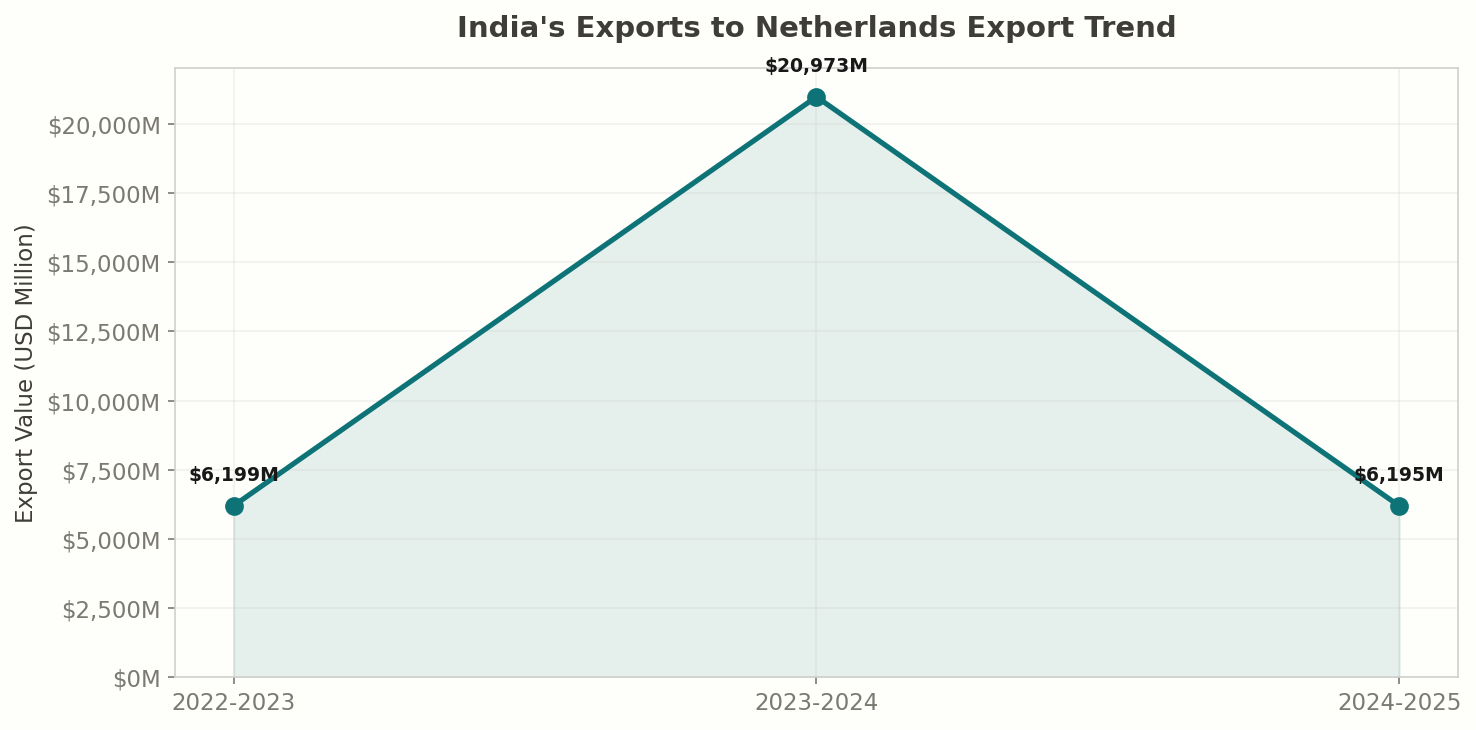
The Netherlands is India's third-largest export destination in the European Union and one of the most strategically important trade partners for any exporter targeting the European market. India exported $6,194.54 million worth of goods to the Netherlands in 2024-25. While this is a sharp decline from the $20,973 million recorded in 2023-24, the previous year's figure was inflated by one-time petroleum re-exports routed through Rotterdam — the underlying non-petroleum trade relationship is steady and growing.
For Indian MSME exporters, the Netherlands offers something no other European country can match: Rotterdam, the largest port in Europe and the continent's primary logistics gateway. Roughly 40% of all goods entering the EU pass through the Netherlands before being distributed to Germany, France, Belgium, and beyond. Exporting to the Netherlands often means exporting to all of Europe.
India–Netherlands Trade Overview
India's exports to the Netherlands reached $6,194.54 million in 2024-25. The dramatic spike to $20,973 million in 2023-24 was almost entirely driven by petroleum product re-exports routed through Rotterdam, which is the world's largest petroleum refining and distribution hub. Excluding petroleum, the bilateral trade in manufactured goods, chemicals, textiles, and agricultural products has grown steadily from around $5.5 billion in 2022-23.
The Netherlands punches far above its weight in global trade. With just 18 million people, it is the world's fifth-largest exporter and the EU's largest re-export economy. For Indian exporters, this means that goods shipped to the Netherlands frequently reach end consumers in Germany, France, Scandinavia, or Eastern Europe. Dutch importers and logistics companies specialise in this distribution function.
India and the Netherlands also share strong economic ties through foreign direct investment. Dutch FDI into India (through holding companies registered in the Netherlands) is among the highest of any country. This creates a network of Dutch companies with India operations who are natural partners for sourcing from Indian suppliers. Major Dutch multinationals like Philips, Unilever, ASML, and Shell all have significant India operations and procurement relationships.
What India Exports to the Netherlands
The top product categories exported from India to the Netherlands in 2024-25:
| Rank | HS Chapter | Product Category | Export Value (USD Million) |
|---|---|---|---|
| 1 | 29 | Organic chemicals | $800.9 |
| 2 | 85 | Electrical equipment | $567.1 |
| 3 | 30 | Pharmaceuticals | $422.0 |
| 4 | 61 | Knitted apparel | $411.1 |
| 5 | 62 | Woven apparel | $390.2 |
| 6 | 84 | Machinery | $360.2 |
| 7 | 72 | Iron and steel | $314.2 |
| 8 | 73 | Iron and steel articles | $207.7 |
| 9 | 08 | Fruits and nuts | $202.4 |
| 10 | 87 | Vehicles and parts | $185.4 |
| 11 | 63 | Textile articles | $155.5 |
| 12 | 42 | Leather goods | $144.2 |
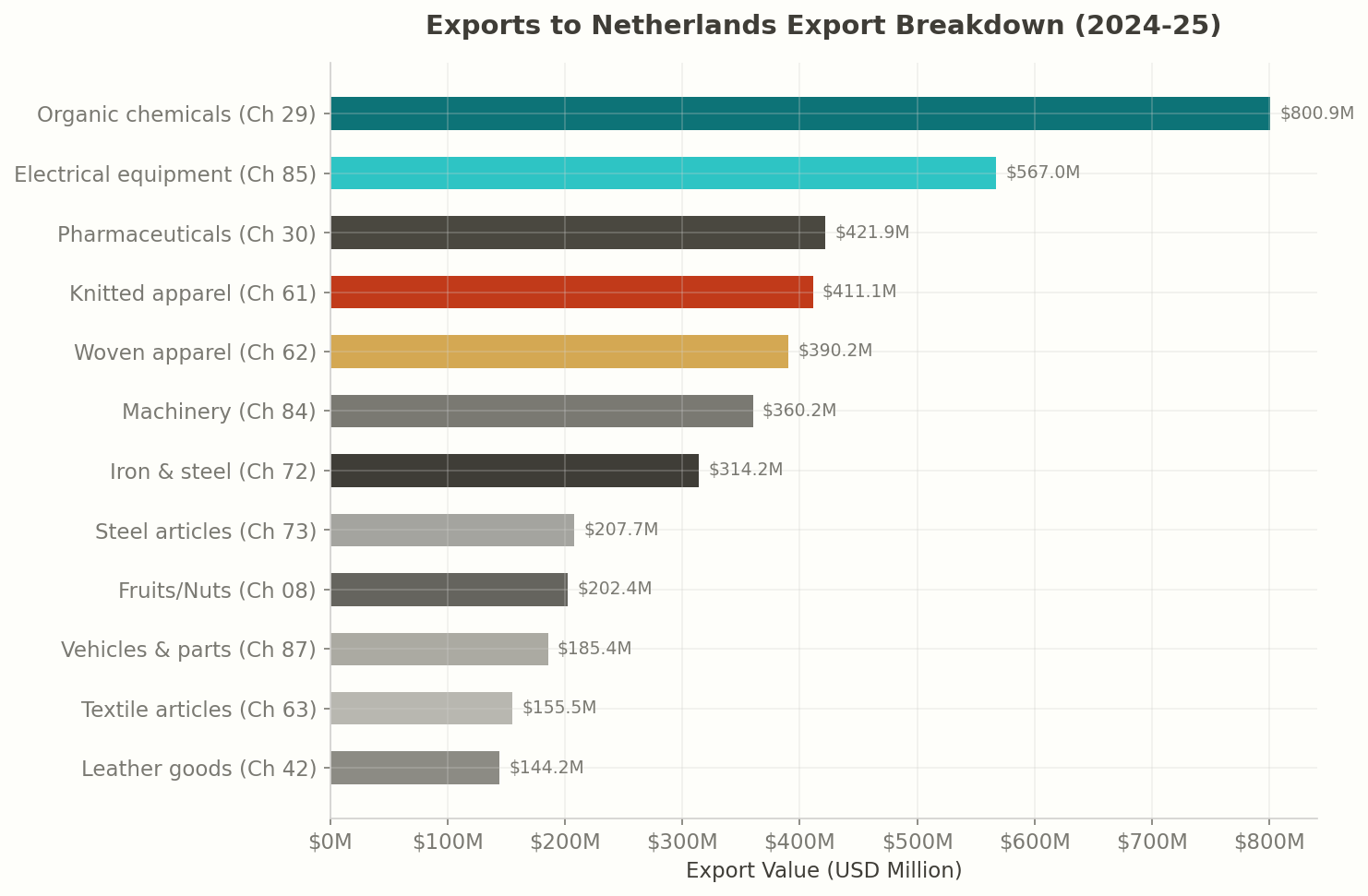
Organic chemicals ($801M) lead India's exports to the Netherlands, reflecting the country's position as a major chemicals processing and distribution hub (Rotterdam's Europoort is one of the world's largest petrochemical complexes). Electrical equipment ($567M) and pharmaceuticals ($422M) represent India's growing strength in high-value manufacturing. Textiles and apparel combined ($957M) are the largest cluster, with the Netherlands serving as a distribution gateway for Indian garments entering the broader EU market. Fruits and nuts ($202M) — primarily mangoes, grapes, and cashews — reflect Dutch expertise in fresh produce logistics. The Netherlands is home to Europe's largest fruit and vegetable auction houses.
Regulatory and Customs Framework
As an EU member state, the Netherlands applies all EU-wide regulations. However, the Netherlands also has efficient national customs procedures that make it one of the easiest EU countries through which to import goods.
EU Regulations (Apply in the Netherlands)
CE Marking: Mandatory for regulated product categories including machinery, electrical equipment, medical devices, toys, PPE, and construction products. Products must meet the essential requirements of applicable EU directives. A Declaration of Conformity and Technical File must be prepared and maintained.
EU REACH: Registration, Evaluation, Authorisation and Restriction of Chemicals applies to all chemical substances manufactured or imported into the EU in quantities above 1 tonne per year. Indian chemical exporters must appoint an Only Representative (OR) based in the EU to handle REACH registration. The Netherlands, with its large chemical sector, has many companies and consultancies that offer OR services.
EU Food Safety Regulations: Managed at the EU level by EFSA (European Food Safety Authority) and enforced in the Netherlands by the Netherlands Food and Consumer Product Safety Authority (NVWA). Requirements include Maximum Residue Limits (MRLs) for pesticides, contaminant limits, traceability requirements, and allergen labelling.
EU General Product Safety Directive: All consumer products must be safe. Importers bear responsibility for ensuring product safety and can be held liable for defective products.
Dutch Customs (Douane)
The Netherlands Customs Authority (Douane) is known for being efficient, technology-driven, and business-friendly. The Dutch government actively promotes the Netherlands as a trade gateway, and customs procedures reflect this.
Key features:
- Electronic customs declarations: All import declarations are filed electronically through the Dutch customs system (AGS - Automated Customs System). Your Dutch importer or customs broker handles this.
- EORI number: Your Dutch buyer needs an EU Economic Operators Registration and Identification (EORI) number. Indian exporters do not need a Dutch EORI unless they establish an EU entity.
- Simplified customs procedures: The Netherlands offers simplified declaration procedures for trusted traders (AEO - Authorised Economic Operator). If your Dutch buyer has AEO status, clearance times are significantly reduced.
- Fiscal representation: For VAT purposes, Dutch importers can use a fiscal representative to defer VAT payment at import, reducing cash flow impact. This is one reason many companies prefer to import through the Netherlands rather than directly into other EU countries.
Dutch Bonded Warehouses
The Netherlands has an extensive bonded warehouse infrastructure, particularly in the Rotterdam-Europoort area. Goods can be stored in bonded warehouses without paying customs duties or VAT until they are released for consumption or re-exported. This is particularly useful for Indian exporters whose goods are being distributed to multiple EU countries — the importer can clear goods selectively for each destination.
Key Standards and Certifications
For food products:
- EU organic certification (if claiming organic status)
- GlobalGAP certification for fresh produce
- BRC/IFS food safety certification (expected by major Dutch food retailers like Albert Heijn, Jumbo)
- Dutch NVWA compliance for pesticide residues, mycotoxins, and microbiological safety
- Allergen labelling per EU Regulation 1169/2011
- Labelling in Dutch (for consumer-facing products)
For textiles and apparel:
- Oeko-Tex Standard 100 certification
- GOTS (Global Organic Textile Standard) if claiming organic
- BSCI or SA8000 social compliance certification
- EU REACH compliance for chemical content in textiles (dyes, finishes)
For chemicals:
- EU REACH registration (through an Only Representative)
- CLP (Classification, Labelling and Packaging) regulation compliance
- Safety Data Sheets (SDS) in Dutch for hazardous chemicals
For machinery and industrial goods:
- CE marking with Declaration of Conformity
- EU Machine Directive compliance
- ISO 9001 quality management certification
Tariff Structure and Trade Agreements
The Netherlands, as an EU member, applies the EU Common Customs Tariff (CCT). India benefits from the EU Generalised Scheme of Preferences (GSP).
EU GSP for India: Standard GSP provides tariff reductions on approximately 66% of tariff lines. Products eligible for GSP preference include textiles, leather, footwear, and certain industrial goods. India does not qualify for GSP+ (the enhanced scheme).
India-EU FTA: Negotiations on a Broad-Based Trade and Investment Agreement (BTIA) between India and the EU were relaunched in 2022. Conclusion of this agreement would reduce tariffs on Indian goods entering the Netherlands and the rest of the EU.
Indicative EU tariff rates for Indian exports:
| Product Category | EU Tariff Rate (MFN) | GSP Rate |
|---|---|---|
| Organic chemicals (2933) | 0-6.5% | 0-5.5% |
| Electrical equipment (8504) | 0-3.7% | 0-3% |
| Pharmaceuticals (3004) | 0% | 0% |
| Knitted T-shirts (6109) | 12% | 9.6% |
| Woven trousers (6204) | 12% | 9.6% |
| Iron and steel (7208) | 0-3.7% | 0-3% |
| Fruits/nuts (0804) | 0-8% | 0-5.5% |
| Leather goods (4202) | 3-9.7% | 1.7-7.7% |
| Machinery (8431) | 0-2.7% | 0-2.2% |
| Vehicles/parts (8708) | 3-4.5% | 2.7-3.5% |
Dutch VAT (BTW): 21% standard rate (9% reduced rate for food and some essential goods). VAT is charged at import on the CIF value plus customs duty. As mentioned, the Netherlands' fiscal representation scheme allows deferral of import VAT, which is a significant advantage.
Use the Duty Calculator to check exact rates for your HS code.
Logistics and Shipping
The Rotterdam Advantage
The Port of Rotterdam is the largest port in Europe and the 10th-largest in the world. It handles over 14 million TEUs annually and is the primary distribution gateway for goods entering the EU. For Indian exporters, shipping to Rotterdam means your goods can be distributed across the entire EU from a single entry point.
Rotterdam's advantages:
- Direct liner services from all major Indian ports
- State-of-the-art container terminals (Euromax, APM Terminals, RWG)
- Extensive hinterland connections by barge, rail, and truck to Germany, Belgium, France, and beyond
- Europe's largest petrochemical cluster (Europoort) for chemicals distribution
- Cold chain logistics for perishable goods
- Bonded warehouse facilities for flexible distribution
Shipping Routes and Transit Times
- JNPT/Nhava Sheva to Rotterdam: 18-22 days via Suez Canal
- Mundra to Rotterdam: 17-21 days
- Chennai to Rotterdam: 20-25 days
- Air freight (Delhi/Mumbai to Amsterdam Schiphol): 8-9 hours direct
Air Cargo — Amsterdam Schiphol
Amsterdam Airport Schiphol is one of Europe's top three air cargo hubs (alongside Frankfurt and Paris CDG). It handles over 1.7 million tonnes of air cargo annually and is the primary entry point for high-value, time-sensitive Indian exports to Europe — pharmaceuticals, perishable food (mangoes, grapes), gems, and electronics. Schiphol's flower auction-linked cold chain infrastructure is also available for perishable food exports.
Freight Costs (Indicative, 2024-25)
- 20-ft container to Rotterdam: $1,600-$3,200
- 40-ft container to Rotterdam: $2,800-$5,000
- Air freight to Amsterdam: $3-$5.50 per kg
Documentation Requirements
- Commercial Invoice
- Packing List
- Bill of Lading (ocean) or Airway Bill
- EUR.1 Movement Certificate or GSP Form A (for preferential tariff under EU GSP)
- Certificate of Origin
- CE Declaration of Conformity (for regulated products)
- Phytosanitary Certificate (for agricultural products — issued by Plant Quarantine authorities in India)
- Health Certificate (for food products of animal origin)
- REACH documentation (for chemicals or products containing regulated substances)
- Shipping Bill (filed via ICEGATE)
- Insurance Certificate (if CIF terms)
- Laboratory test reports as required by the buyer or Dutch authorities
Payment and Banking
Payment Methods
- Open Account (30-60 days): The most common payment method for established relationships. Dutch companies are among the most reliable payers in Europe — payment discipline is strong.
- Letters of Credit (LC): Used for first-time transactions or high-value orders. Dutch banks (ING, ABN AMRO, Rabobank) have extensive India trade operations.
- Wire Transfer (T/T): Common for SME trade. 30% advance, balance against documents is a typical structure.
- Documents against Payment (D/P): Used as an intermediate step between LC and open account.
Currency
Trade is typically denominated in EUR or USD. Dutch buyers generally prefer EUR. Hedge your currency exposure using forward contracts for orders above Rs 25 lakh.
Dutch Business Culture
Dutch business culture is direct, pragmatic, and egalitarian. Dutch buyers will negotiate firmly on price but value transparency — do not pad your quotes with hidden margins. They prefer straightforward communication, on-time delivery, and consistent quality over relationship-based selling. Meetings are efficient, decisions are made quickly, and commitments are expected to be honoured exactly. Being late — whether in a meeting or a delivery — is not tolerated.
Common Mistakes
Treating the Netherlands as a small market. While the Netherlands has only 18 million people, it is Europe's distribution hub. Your Dutch buyer may be distributing your goods across the entire EU. Price and quality for a European market, not just a Dutch one.
Not understanding the re-export model. Many Dutch importers buy Indian goods, store them in bonded warehouses, and redistribute to customers across Europe. This affects how you should think about packaging, labelling (multi-language), and volumes.
Shipping food without meeting Dutch MRL standards. The NVWA (Netherlands Food and Consumer Product Safety Authority) is among the strictest food safety enforcers in the EU. Pesticide residue levels that may be acceptable in other markets can result in rejection in the Netherlands. Test your products against EU MRL standards before shipping.
Not claiming GSP preferences. Ensure your Certificate of Origin is in the correct GSP format (Form A or EUR.1 with GSP declaration) and that your product meets the Rules of Origin criteria. Many Indian exporters pay full MFN duties unnecessarily.
Ignoring sustainability requirements. Dutch buyers — particularly in food, textiles, and consumer goods — increasingly require sustainability certifications. Fair trade, organic, and environmental certifications can be deciding factors in procurement decisions.
Key Takeaways
- India exported $6.19 billion to the Netherlands in 2024-25 — chemicals ($801M), electrical equipment ($567M), and pharmaceuticals ($422M) lead
- The Netherlands is Europe's distribution gateway — Rotterdam handles 40% of EU-bound containerised cargo
- EU regulations apply: CE marking, REACH, and food safety rules are mandatory
- India benefits from EU GSP tariff preferences — claim them with the correct Certificate of Origin
- Bonded warehouses and the Dutch fiscal representation scheme make the Netherlands the most cost-efficient EU entry point
- Dutch buyers value punctuality, transparency, and consistent quality above all
- Amsterdam Schiphol is a top European air cargo hub for pharmaceuticals and perishable exports
Next Steps
- Identify your HS code with the HS Code Finder and check the EU tariff rate using the Duty Calculator
- Verify CE marking and REACH requirements for your product category
- Explore the Dutch market with the Market Finder — remember that your Dutch buyer may be distributing across the EU
- Ensure food products meet EU MRL standards before shipping — test at a NABL-accredited lab in India
- Consider sustainability certifications (Fair Trade, organic, Oeko-Tex) that Dutch buyers value
- Connect with Dutch importers through trade platforms like the Netherlands Enterprise Agency (RVO) or trade missions organised by the Indian Embassy in The Hague
The Netherlands is not just a market — it is a gateway. Indian exporters who ship to the Netherlands effectively gain access to 450 million EU consumers through the world's most efficient logistics infrastructure. The $6.2 billion trade relationship is a strong foundation, and with the India-EU FTA under negotiation, the opportunity is set to expand significantly.
For related information, explore our HS code directory to find the exact tariff classification for your products, or browse country export guides for other major markets.
Ready to start exporting?
Get a detailed market report with country-by-country analysis, pricing insights, and buyer contacts.
Get Market ReportXIMPEX Export Advisory
Need help implementing the strategies discussed in this guide? Our team of export specialists can provide personalized guidance for your business.