How to Export to Singapore from India — Complete Guide
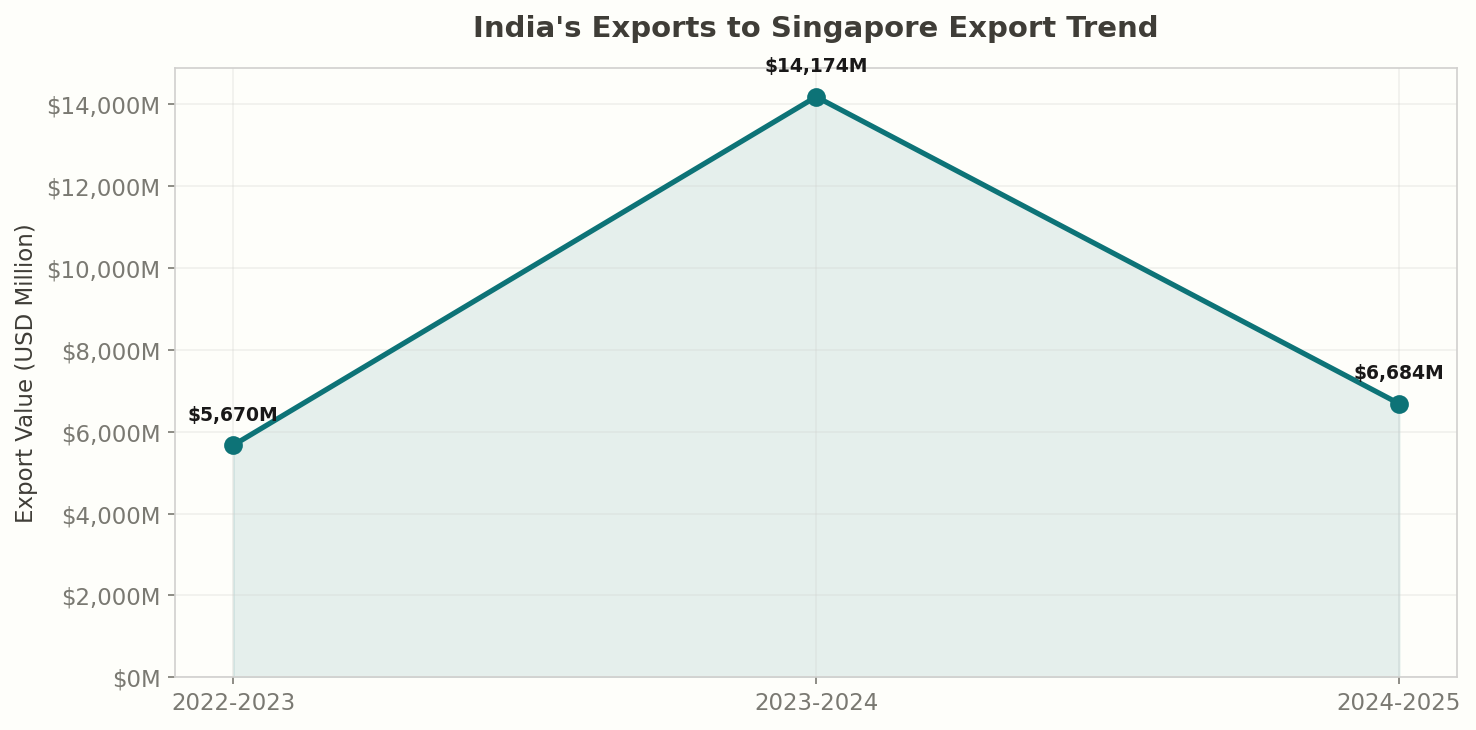
Singapore is one of India's most important trading partners in Southeast Asia and a critical gateway to the broader ASEAN market of 680 million people. India exported $6,684.40 million worth of goods to Singapore in 2024-25, down from a spike of $14,174 million in 2023-24 that was driven by one-time ship deliveries and elevated petroleum trade. The underlying trade relationship is anchored by the India-Singapore Comprehensive Economic Cooperation Agreement (CECA), which provides zero or significantly reduced tariffs on most Indian goods entering Singapore.
For Indian MSME exporters, Singapore offers a unique combination: a wealthy, efficient market of 6 million people with the world's highest per-capita GDP, world-class port and logistics infrastructure, near-zero tariffs under CECA, strong rule of law, and a position as the transshipment and re-export hub for all of Southeast Asia. Goods shipped to Singapore often reach end markets in Malaysia, Indonesia, Thailand, Vietnam, and the Philippines.
India–Singapore Trade Overview
India's exports to Singapore totalled $6,684.40 million in 2024-25. The dramatic spike to $14,174 million in 2023-24 was largely attributable to major ship deliveries (HS Chapter 89) and elevated petroleum product trade. Excluding these one-time items, the baseline trade in manufactured goods, chemicals, gems, and food products has been growing steadily.
India and Singapore share deep economic ties. Singapore is one of the largest sources of foreign direct investment into India, and Indian companies have significant investments in Singapore. The India-Singapore CECA, in force since August 2005, was among the first comprehensive trade agreements India signed, and it has been instrumental in growing bilateral trade.
Singapore's role as a transshipment hub amplifies its importance. The Port of Singapore is the world's second-busiest container port, and a significant portion of goods entering Singapore are re-exported to destinations across ASEAN, East Asia, and Oceania. For Indian exporters, establishing a Singapore presence — even through a trading partner — opens doors to the entire Asia-Pacific region.
What India Exports to Singapore
The top product categories exported from India to Singapore in 2024-25:
| Rank | HS Chapter | Product Category | Export Value (USD Million) |
|---|---|---|---|
| 1 | 84 | Machinery | $1,842.5 |
| 2 | 89 | Ships and boats | $1,799.4 |
| 3 | 29 | Organic chemicals | $811.1 |
| 4 | 71 | Gems and jewellery | $541.5 |
| 5 | 85 | Electrical equipment | $302.2 |
| 6 | 90 | Instruments | $276.5 |
| 7 | 79 | Zinc | $111.8 |
| 8 | 10 | Rice | $110.5 |
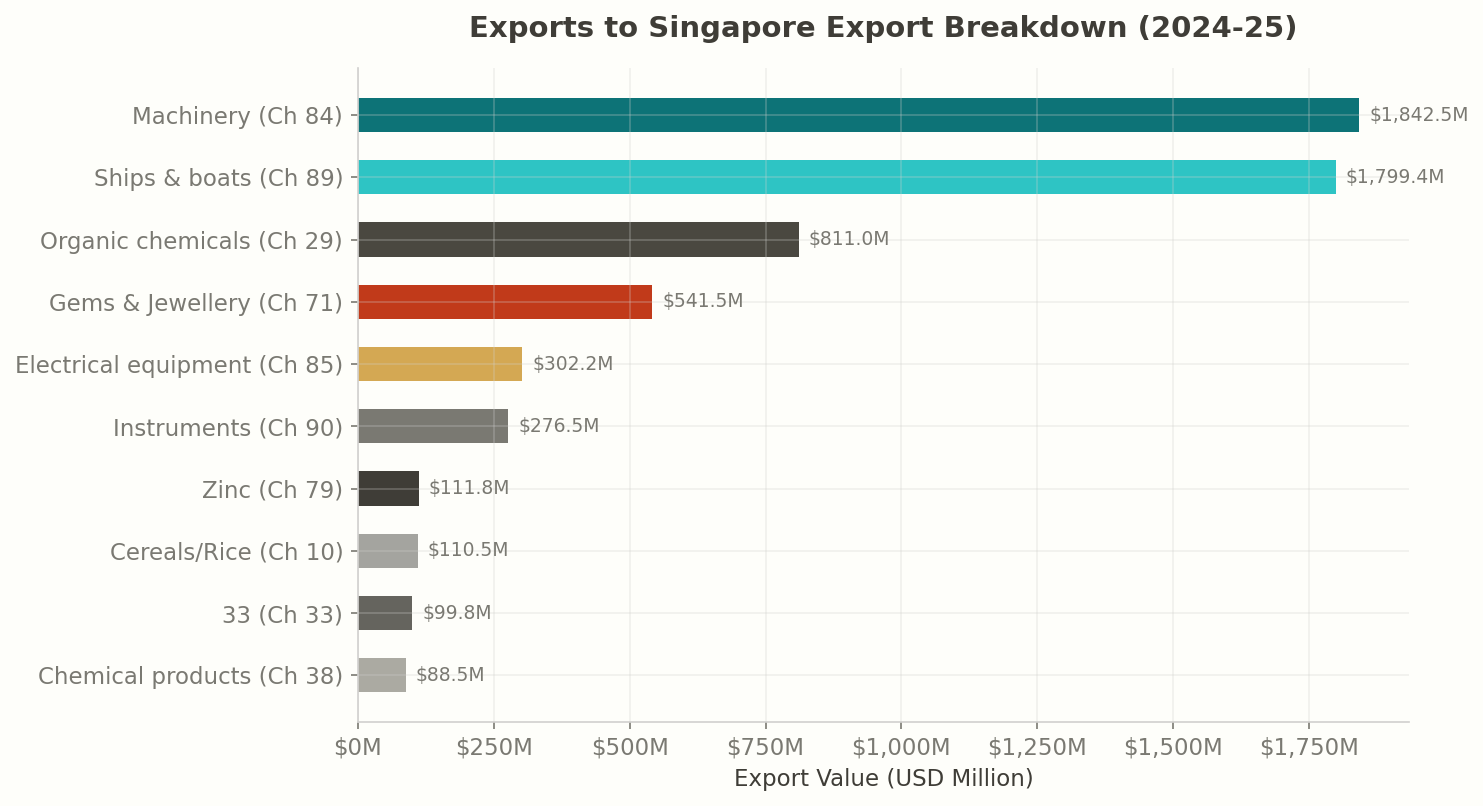
Machinery ($1.84B) leads India's exports to Singapore, driven by industrial equipment, turbines, pumps, and engineering components that serve Singapore's advanced manufacturing sector and are also re-exported regionally. Ships and boats ($1.8B) represent major vessel deliveries from Indian shipyards — this category is inherently lumpy and varies significantly year to year. Organic chemicals ($811M) reflect Singapore's position as Asia's petrochemical hub (Jurong Island hosts major refineries and chemical plants). Gems and jewellery ($542M) are traded through Singapore's diamond and precious metals exchange. Instruments ($277M) and electrical equipment ($302M) serve Singapore's high-technology manufacturing and re-export functions.
Regulatory and Customs Framework
Singapore has one of the world's most open and business-friendly regulatory environments. There are very few import restrictions, and customs clearance is highly efficient — often completed within hours. However, specific product categories do have regulatory requirements.
Singapore Customs
Singapore Customs is the national authority for trade facilitation and customs enforcement. The system is almost entirely electronic.
TradeNet: All import declarations are filed electronically through TradeNet, Singapore's single-window trade documentation system. Your Singapore importer or customs agent handles the filing. TradeNet processes most declarations within 10 minutes — among the fastest in the world.
Customs permits: An import permit is required for all goods entering Singapore. Your importer applies through TradeNet, and the permit is typically issued within minutes for standard goods.
Goods and Services Tax (GST): Singapore charges 9% GST on the CIF value of imported goods plus customs duty (where applicable). GST-registered businesses can claim this back as input tax credit.
Singapore Food Agency (SFA)
The Singapore Food Agency regulates all food imports into Singapore. Key requirements:
- Import licence: All food importers must hold an SFA licence. Your Singapore buyer handles this.
- Product registration: Certain food products must be registered with SFA before import, including processed food, food additives, and health supplements.
- Approved sources: Meat, seafood, and eggs can only be imported from SFA-approved source countries and establishments. India is an approved source for most food categories, but verify your specific product.
- Lab testing: SFA conducts risk-based testing for pesticide residues, heavy metals, microbiological contamination, and food additives. Products that fail testing are rejected or destroyed.
- Labelling: Food labels must include product name, ingredients, allergen declarations, net quantity, country of origin, and importer's name and address — all in English.
Product Safety Standards (PSB Singapore)
Enterprise Singapore (formerly PSB Singapore and SPRING Singapore) administers product safety standards for consumer goods:
- Controlled goods: 33 categories of household electrical, electronic, and gas appliances are designated as "Controlled Goods" and must carry the SAFETY Mark. These include air conditioners, cooking appliances, power adapters, and cables.
- Consumer Protection (Safety Requirements) Registration Scheme: Products must be tested by an accredited lab and registered with Enterprise Singapore before they can be sold.
- General safety requirements: Non-controlled consumer products must still meet reasonable safety standards. Singapore applies the "general safety requirement" principle.
Intellectual Property Protection
Singapore has one of the strongest intellectual property protection regimes in Asia. The Intellectual Property Office of Singapore (IPOS) enforces patents, trademarks, copyrights, and designs. Indian exporters should consider registering their trademarks in Singapore, particularly if using Singapore as a regional distribution base. IP registration also provides protection against counterfeit products bearing your brand in Southeast Asian markets.
Key Standards and Certifications
For food products:
- SFA import licence and product registration
- Halal certification from MUIS (Majlis Ugama Islam Singapura) for products marketed as halal — Singapore has a significant Muslim population (15%)
- Health certificates from Indian competent authorities (FSSAI, EIC)
- Lab analysis reports for pesticides, heavy metals, and microbiological safety
For electrical and electronic products:
- SAFETY Mark for controlled goods (33 categories)
- IEC/EN test reports from accredited laboratories
- Registration with Enterprise Singapore
For pharmaceuticals and medical devices:
- Health Sciences Authority (HSA) product registration
- GMP certification
- Stability data for tropical climate conditions
- Product licence from HSA before import
For chemicals:
- Hazardous substances permit from the National Environment Agency (NEA)
- Safety Data Sheets
- Singapore Standard SS 586 for hazardous substances classification
Tariff Structure and Trade Agreements
Singapore is a free port — it applies zero customs duties on virtually all imports. This makes Singapore one of the most tariff-friendly markets in the world for Indian exporters.
Singapore's tariff policy: Customs duties are levied on only four product categories:
- Intoxicating liquors (beer, wine, spirits)
- Tobacco products
- Motor vehicles
- Petroleum products
All other goods — machinery, chemicals, textiles, food products, electronics, gems, metals — enter Singapore duty-free. This is true regardless of the country of origin.
India-Singapore CECA
The Comprehensive Economic Cooperation Agreement (CECA) between India and Singapore has been in force since August 1, 2005. While Singapore's tariffs are already at zero for most products, CECA provides additional benefits:
- Rules of Origin certification: CECA provides a formal framework for Rules of Origin, which matters when goods are re-exported from Singapore to other ASEAN countries under regional trade agreements.
- Mutual recognition of standards: Some testing and certification done in India is recognised in Singapore, reducing compliance costs.
- Trade facilitation: Streamlined customs procedures for CECA-origin goods.
- Services liberalisation: Easier movement of Indian professionals to Singapore for business purposes.
- Investment protection: Bilateral investment treaty provisions protect Indian investments in Singapore and vice versa.
Certificate of Origin under CECA: To claim CECA benefits (primarily useful for onward re-export under ASEAN agreements), obtain a Certificate of Origin from the designated Indian issuing authority (DGFT or authorised chambers) in the CECA format.
| Product Category | Singapore Tariff Rate |
|---|---|
| Machinery (84xx) | 0% |
| Ships and boats (89xx) | 0% |
| Chemicals (29xx) | 0% |
| Gems and jewellery (71xx) | 0% |
| Electrical equipment (85xx) | 0% |
| Instruments (90xx) | 0% |
| Rice (1006) | 0% |
| Textiles and apparel | 0% |
| Pharmaceuticals (30xx) | 0% |
| Beer, wine, spirits | Specific duty |
Use the Duty Calculator to verify tariff rates for your specific HS code.
Logistics and Shipping
The Singapore Port Advantage
The Port of Singapore is the world's second-busiest container port by throughput and the busiest transshipment hub globally. Over 130,000 vessels call at Singapore annually, and the port is connected to over 600 ports in 120 countries. For Indian exporters, this means:
- Frequent direct liner services from all major Indian ports
- Competitive freight rates due to high cargo volumes
- Fast turnaround times — average vessel turnaround is less than one day
- Excellent connectivity for re-export to ASEAN, East Asia, and Oceania
Shipping Routes and Transit Times
- JNPT/Nhava Sheva to Singapore: 10-14 days
- Mundra to Singapore: 10-13 days
- Chennai/Tuticorin to Singapore: 5-8 days
- Kolkata/Haldia to Singapore: 7-10 days
- Vizag to Singapore: 6-9 days
- Air freight (Delhi/Mumbai to Singapore Changi): 5-6 hours direct
Key Singapore Ports and Terminals
- PSA Singapore Terminals (Tanjong Pagar, Keppel, Brani, Pasir Panjang) — handles the bulk of containerised cargo. PSA is the world's largest container terminal operator.
- Jurong Port — specialises in bulk cargo, cement, steel, and industrial materials. If you're exporting commodities or industrial goods, Jurong is likely your destination.
- Tuas Mega Port — currently under construction, will be the world's largest fully automated container terminal when complete. Expected to consolidate all container operations by 2040.
Freight Costs (Indicative, 2024-25)
- 20-ft container to Singapore: $600-$1,200 (from South India), $800-$1,500 (from Western India)
- 40-ft container to Singapore: $1,000-$2,200
- Air freight: $2-$4 per kg
These are among the lowest freight costs for any significant export market, reflecting the high volume of India-Singapore shipping traffic.
Free Trade Zones
Singapore has several Free Trade Zones (FTZs) where goods can be stored, consolidated, and re-exported without payment of GST or duties:
- Changi Airport Free Trade Zone — for air cargo consolidation and distribution
- Jurong Port Free Trade Zone — for bulk and industrial cargo
- Sembawang Wharves Free Trade Zone — general cargo
Goods in FTZs can be stored indefinitely, providing flexibility for Indian exporters whose Singapore buyers operate distribution businesses.
Documentation Requirements
- Commercial Invoice
- Packing List
- Bill of Lading (ocean) or Airway Bill
- Certificate of Origin (CECA format if claiming CECA benefits for onward re-export)
- Phytosanitary Certificate (for agricultural/plant products)
- Health Certificate (for food products of animal origin)
- SFA import permit number (for food products — your Singapore buyer provides this)
- SAFETY Mark documentation (for controlled electrical/electronic goods)
- Shipping Bill (filed via ICEGATE)
- Insurance Certificate (if CIF terms)
Singapore's documentation requirements are among the lightest of any major market. The focus is on electronic filing through TradeNet rather than paper documentation.
Payment and Banking
Payment Methods
- Wire Transfer (T/T): The most common payment method for India-Singapore trade. Singapore buyers are reliable payers, and the banking infrastructure between both countries is excellent. 30% advance, 70% against documents is a typical structure for new relationships.
- Letters of Credit (LC): Used for larger orders or first-time transactions. Singapore's banks (DBS, OCBC, UOB) are among Asia's strongest and have extensive India operations. Standard Chartered and HSBC, with large presence in both countries, are also commonly used.
- Open Account (30-60 days): Common for established relationships. Singapore companies have excellent payment discipline.
- Documents against Payment (D/P): Less common but used as a transitional mechanism.
Currency
Trade is typically denominated in USD or SGD (Singapore Dollar). The SGD is a strong, stable currency managed by the Monetary Authority of Singapore (MAS). If quoting in SGD, note that the SGD/INR rate is relatively stable but should still be hedged for large orders.
India-Singapore Banking Links
The Reserve Bank of India and the Monetary Authority of Singapore have established mechanisms for cross-border payments. UPI-PayNow linkage allows real-time retail payments between India and Singapore. For trade payments, the extensive network of correspondent banking relationships ensures fast and low-cost wire transfers. Typically, India-Singapore bank transfers settle within 1-2 business days.
Common Mistakes
Assuming Singapore is just a small city-state market. Singapore's domestic market is 6 million people, but its re-export and transshipment functions mean your goods can reach all of ASEAN. Think of Singapore as a distribution platform, not just an end market.
Not leveraging the zero-tariff advantage. Singapore charges zero customs duty on virtually all goods. Combined with CECA benefits and efficient customs clearance, Singapore is one of the lowest-cost markets to enter. Factor this into your pricing — you can be more competitive here than in markets with 10-15% tariffs.
Overlooking SFA requirements for food. Singapore's food safety standards are high. The SFA tests imports rigorously for pesticide residues, heavy metals, and contaminants. Ensure your food products meet Singapore's standards before shipping — rejected shipments are destroyed, not returned.
Not protecting intellectual property. If you're using Singapore as a regional base, register your trademarks and patents with IPOS. Southeast Asia has significant counterfeiting activity, and IP protection in Singapore provides a strong legal foundation for enforcement across the region.
Ignoring the ASEAN opportunity. India has a Free Trade Agreement with ASEAN (AIFTA) that provides preferential tariffs on Indian goods in ASEAN member states. If your Singapore buyer is re-exporting to ASEAN markets, ensure the correct Rules of Origin documentation is in place to claim preferential treatment in the destination country.
Key Takeaways
- India exported $6.68 billion to Singapore in 2024-25 — machinery ($1.84B), ships ($1.8B), and chemicals ($811M) lead
- Singapore charges zero customs duty on virtually all imports — no tariff barrier to entry
- The India-Singapore CECA provides additional trade facilitation and investment protection benefits
- Singapore is the world's busiest transshipment hub — goods shipped here reach all of ASEAN and Asia-Pacific
- Customs clearance through TradeNet is among the fastest in the world (minutes, not days)
- SFA food safety standards are rigorous — test your products against Singapore's MRL standards before shipping
- Freight costs from India are very low ($600-$1,500 per container), especially from South Indian ports
- Singapore's banking and payment infrastructure with India is excellent, with fast settlement times
Next Steps
- Identify your HS code with the HS Code Finder and verify the zero-duty status using the Duty Calculator
- Verify SFA requirements if exporting food products — ensure your facility and products are approved
- Obtain a CECA Certificate of Origin from DGFT if your goods may be re-exported under regional trade agreements
- Use the Market Finder to see which Indian products are in demand in Singapore and the broader ASEAN region
- Register your intellectual property with IPOS if using Singapore as a regional distribution base
- Connect with Singapore buyers through trade events like the Singapore International Trade Expo, or through Enterprise Singapore's partner networks
Singapore is the ideal market for Indian exporters who want to access Southeast Asia. Zero tariffs, world-class infrastructure, fast customs clearance, strong rule of law, and proximity to India make it a natural first step into the ASEAN region. The $6.7 billion trade relationship is well-established, and India's growing manufacturing capabilities align perfectly with Singapore's role as Asia's premier trade and logistics hub.
For related information, explore our HS code directory to find the exact tariff classification for your products, or browse country export guides for other major markets.
Ready to start exporting?
Get a detailed market report with country-by-country analysis, pricing insights, and buyer contacts.
Get Market ReportXIMPEX Export Advisory
Need help implementing the strategies discussed in this guide? Our team of export specialists can provide personalized guidance for your business.