How to Export to South Africa from India — Complete Guide
South Africa is India's largest trading partner on the African continent and a strategic gateway to the broader Southern African and pan-African markets. India exported $4,191.35 million in goods to South Africa in 2024-25, with vehicles and parts alone accounting for $1.59 billion — a testament to the deep manufacturing and distribution links between the two countries. South Africa is the most industrialised economy in Africa, with 62 million consumers, well-developed infrastructure, and membership in both the Southern African Customs Union (SACU) and the African Continental Free Trade Area (AfCFTA).
For Indian exporters, South Africa offers a unique combination: a sophisticated market with modern retail, financial, and logistics infrastructure, combined with the potential to serve as a launchpad into the broader African continent. Indian automotive manufacturers — Tata Motors, Mahindra, Ashok Leyland — have established major footholds here, and Indian pharmaceutical companies supply over 20% of South Africa's generic medicines. But the market also presents distinct challenges, from the Broad-Based Black Economic Empowerment (B-BBEE) procurement requirements to volatile currency conditions and port congestion. This guide covers everything an Indian MSME exporter needs to know to successfully enter the South African market.
India-South Africa Trade Overview
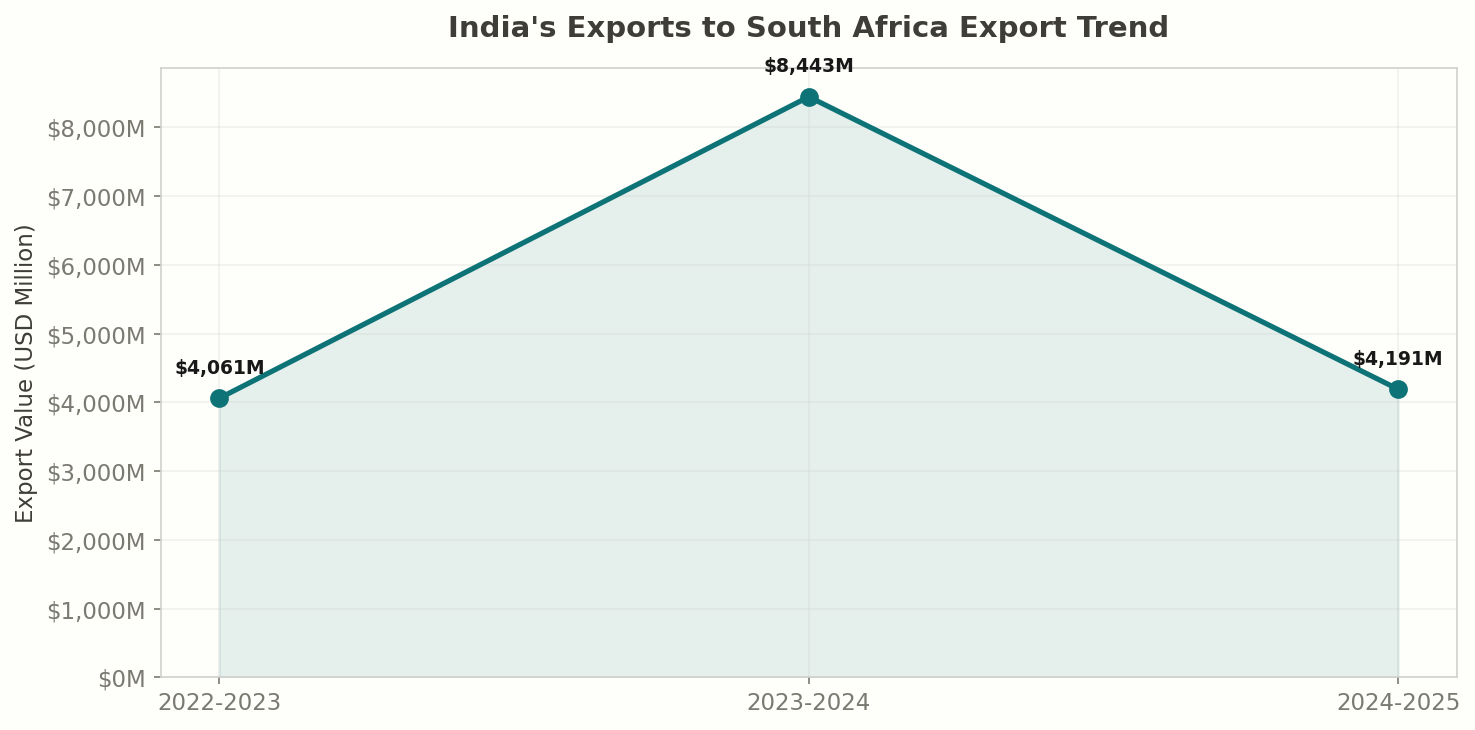
India's goods exports to South Africa totalled $4,191.35 million in 2024-25, following a dramatic spike to $8,443.35 million in 2023-24 (driven by a surge in vehicle and mineral fuel shipments) and a baseline of $4,061.06 million in 2022-23. The 2023-24 figure was exceptional; the 2024-25 number represents a more normalised level of trade, though still higher than the 2022-23 baseline — indicating a genuine upward trajectory beneath the year-on-year volatility.
The bilateral relationship is anchored by the India-Southern African Customs Union Preferential Trade Agreement (India-SACU PTA), which has been under negotiation and partial implementation. While a comprehensive free trade agreement has not yet been concluded, India and South Africa cooperate closely through BRICS, IBSA (India-Brazil-South Africa), and various bilateral mechanisms. South Africa's membership in SACU means that any trade agreement with South Africa effectively covers Botswana, Namibia, Eswatini, and Lesotho — a combined market of approximately 70 million people.
The AfCFTA, which came into force in 2021, adds another strategic dimension. South Africa is the largest economy in the AfCFTA bloc, and Indian exporters who establish distribution operations in South Africa can potentially use it as a hub to access preferential tariff arrangements across the entire African continent as the AfCFTA tariff liberalisation programme progresses.
What India Exports to South Africa
The top product categories exported from India to South Africa in 2024-25:
| Rank | HS Chapter | Product Category | Export Value (USD Million) |
|---|---|---|---|
| 1 | 87 | Vehicles and parts | $1,593.77 |
| 2 | 30 | Pharmaceuticals | $617.50 |
| 3 | 84 | Machinery | $336.85 |
| 4 | 85 | Electrical equipment | $211.89 |
| 5 | 39 | Plastics | $102.73 |
| 6 | 10 | Cereals and rice | $97.80 |
| 7 | 38 | Chemical products | $85.30 |
| 8 | 40 | Rubber | $81.74 |
| 9 | 29 | Organic chemicals | $69.25 |
| 10 | 28 | Inorganic chemicals | $68.27 |
| 11 | 76 | Aluminium | $57.14 |
| 12 | 33 | Essential oils and cosmetics | $52.62 |
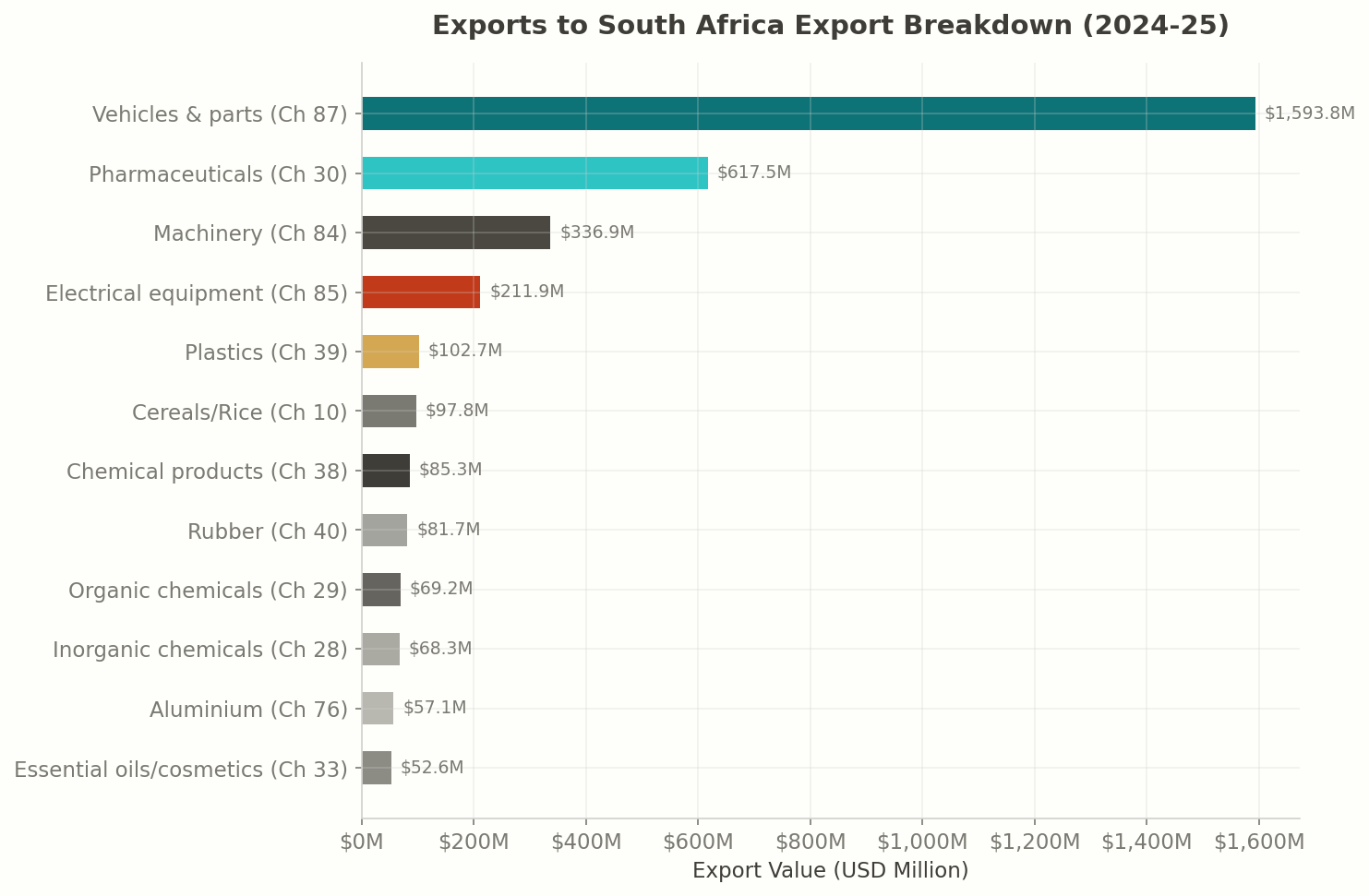
Vehicles and parts dominate at $1,593.77 million — nearly 38% of all Indian exports to South Africa. This reflects the substantial presence of Indian automotive manufacturers in the South African market. Tata Motors sells commercial vehicles and passenger cars, Mahindra has a strong presence in SUVs and pickups, and Ashok Leyland supplies buses and trucks. Beyond finished vehicles, India exports a significant volume of auto components — engines, transmission parts, body panels, and electrical systems — both for aftermarket sales and assembly operations.
Pharmaceuticals at $617.50 million make South Africa one of India's largest pharma export destinations in the developing world. India supplies more than 20% of South Africa's generic medicines, including critical antiretroviral (ARV) drugs for the country's HIV/AIDS treatment programme. This position was built over decades through South Africa's willingness to use compulsory licensing and generic procurement to drive down medicine costs, and India's ability to supply quality generics at competitive prices.
Machinery ($336.85M) and electrical equipment ($211.89M) reflect South Africa's ongoing industrialisation and infrastructure needs. Rice ($97.80M) serves the large Indian-origin community and broader consumer market.
Regulatory and Customs Framework
South Africa's regulatory environment is well-structured but involves multiple agencies, each with specific compliance requirements. Understanding which agency governs your product category is the first step.
South African Revenue Service (SARS) — Customs Division
SARS Customs is the primary border agency responsible for import control, tariff assessment, and revenue collection. Key requirements:
- Import declaration must be filed electronically via the SARS customs system by a registered importer or licensed customs broker
- Customs valuation: Based on CIF value (Cost, Insurance, Freight) — duties are calculated on the landed cost, not FOB
- Tariff classification: South Africa uses the Harmonized System aligned with the SACU tariff schedule. Tariff rates are set at the SACU level and apply uniformly across all five member states
- Import permits: Required for certain controlled goods including pharmaceuticals, foodstuffs, firearms, and certain chemicals. Permits must be obtained before shipment
- Post-clearance audit: SARS conducts risk-based audits. Maintain records for at least five years
National Regulator for Compulsory Specifications (NRCS)
The NRCS administers mandatory product specifications for products that pose a safety, health, or environmental risk. This is one of the most important regulatory bodies for Indian exporters to understand:
- Electrical and electronic products: Must carry a Letter of Authority (LoA) from NRCS before importation. This covers appliances, lighting, cables, switches, and similar products
- Automotive components: Compulsory specifications apply to tyres, safety glass, child restraints, and other safety-related components
- Food products: Canned meat, canned fish, frozen fish, and various processed foods are subject to NRCS compulsory specifications
- Construction materials: Cement and certain building materials require NRCS approval
Failure to obtain an NRCS Letter of Authority before shipment will result in the goods being held at the port and potentially returned or destroyed. This is one of the most common compliance failures for first-time exporters to South Africa.
South African Bureau of Standards (SABS)
SABS develops and publishes South African National Standards (SANS) and provides testing and certification services:
- SABS mark: Voluntary but widely recognised quality mark. Products carrying the SABS mark are preferred by government procurement agencies and major retailers
- Testing and certification: SABS operates laboratories that test products against SANS standards. For many product categories, SABS certification is a practical market requirement even where it is not legally mandatory
South African Health Products Regulatory Authority (SAHPRA)
SAHPRA regulates pharmaceuticals, medical devices, and complementary medicines:
- All pharmaceutical products must be registered with SAHPRA before they can be sold in South Africa
- Registration timelines are long — typically 18-36 months for new registrations, though generic medicines with established bioequivalence data may be faster
- Manufacturing facilities must comply with WHO GMP or PIC/S GMP standards
- Indian pharmaceutical companies typically maintain a dedicated regulatory affairs team for SAHPRA submissions
Key Standards and Certifications
SANS Standards
South African National Standards (SANS) are published by SABS and cover a wide range of products and processes. Key standards for Indian exporters include:
- SANS 164 (electrical plugs and sockets): South Africa uses a unique three-pin plug system. Electrical products must be compatible or adapted
- SANS 10142 (electrical installations): Relevant for electrical equipment and components
- SANS 241 (drinking water): Relevant for water treatment equipment and chemicals
- SANS 1841 (automotive): Safety standards for automotive components
Food Safety Standards
- Department of Agriculture, Land Reform and Rural Development issues import permits for agricultural products and enforces phytosanitary and sanitary requirements
- Maximum Residue Limits (MRLs) for pesticides are generally aligned with Codex Alimentarius, though some South Africa-specific limits exist
- Halal certification is relevant for meat and food products, given South Africa's significant Muslim population (approximately 3%)
B-BBEE (Broad-Based Black Economic Empowerment)
B-BBEE is not a product standard but a socio-economic compliance framework that affects how business is conducted in South Africa, particularly for government procurement:
- Government tenders are scored on B-BBEE compliance. Companies with higher B-BBEE ratings receive preferential scoring
- Indian exporters selling to government entities or large corporates should partner with B-BBEE compliant local distributors or agents
- B-BBEE does not directly apply to foreign exporters, but your South African buyer's B-BBEE procurement spend is affected by who they buy from and how their supply chain is structured
- Understanding B-BBEE is essential for any exporter targeting government procurement in South Africa
Tariff Structure and Trade Agreements
SACU Common External Tariff
South Africa's tariff rates are set at the SACU level and apply uniformly across all five SACU member states. The tariff structure is moderately protective:
- Average MFN applied tariff: Approximately 7-8% overall, but significantly higher for certain product categories
- Vehicles: Import duties of 25% on passenger vehicles and 20% on commercial vehicles — though Indian manufacturers with local assembly operations benefit from lower effective rates
- Pharmaceuticals: Generally 0% duty on active pharmaceutical ingredients, low duties on finished formulations
- Machinery: Duties range from 0-10% depending on whether the machinery is manufactured locally
- Textiles and apparel: Higher tariff protection, typically 15-45%
- Agricultural products: Variable duties, with some products subject to tariff rate quotas
Trade Preferences and Agreements
- India-SACU PTA: Negotiations for a comprehensive preferential trade agreement have been ongoing. Limited preferences currently exist under bilateral arrangements
- AGOA (African Growth and Opportunity Act): South Africa's eligibility under AGOA provides preferential access to the US market for South African-made goods — relevant if you are considering setting up manufacturing or value-addition operations in South Africa for re-export
- EU-SADC EPA: South Africa has a trade agreement with the EU. Indian exporters may benefit indirectly if their products are incorporated into South African goods exported to the EU
Use the Duty Calculator to check the exact tariff rate for your specific HS code.
Logistics and Shipping
Shipping Routes and Transit Times
- JNPT/Nhava Sheva to Durban: 14-18 days
- Mumbai to Cape Town: 16-20 days
- Chennai to Durban: 12-16 days
- Mundra to Durban: 14-18 days
- Air freight (Mumbai/Delhi to Johannesburg): 9-12 hours (typically with one stop via Middle East hub)
Major South African Ports
- Durban — South Africa's busiest port and the largest container port in Sub-Saharan Africa. Handles approximately 60% of South Africa's container traffic. Primary port for vehicles, machinery, and general cargo. Also serves as a transit port for landlocked countries like Zambia, Zimbabwe, and Malawi. However, Durban has experienced chronic port congestion in recent years — factor in potential delays of 3-7 days beyond scheduled arrival.
- Cape Town — Serves the Western Cape region. Strong for fresh produce, wine, and consumer goods. Less congested than Durban.
- Gqeberha (Port Elizabeth) — Serves the Eastern Cape automotive manufacturing hub. If you supply auto components to the Eastern Cape vehicle assembly plants (Volkswagen, Mercedes-Benz, Ford), this is your target port.
- Ngqura (Coega) — Deep-water port near Gqeberha, growing rapidly as an alternative to congested Durban. Handles increasing container volumes.
Freight Costs (Indicative)
- 20-ft container to Durban: $1,200-$2,500
- 40-ft container to South African ports: $2,000-$4,500
- Air freight: $3.50-$6.50 per kg
- Port congestion surcharges at Durban: Variable, check with your freight forwarder before shipping
Inland Transportation
- Gauteng (Johannesburg/Pretoria) is South Africa's economic heartland, located 600 km inland from Durban. Road transport from Durban to Johannesburg takes approximately 8-10 hours
- Rail infrastructure exists but is unreliable due to years of underinvestment. Most cargo moves by road
- Factor inland transport costs into your CIF pricing if your buyer is located in Gauteng or inland provinces
Documentation Requirements
- Commercial Invoice (must include HS code classification, country of origin declaration, and accurate CIF values)
- Packing List (detailed weights and dimensions per package)
- Bill of Lading or Airway Bill
- Certificate of Origin (issued by DGFT or authorised chamber of commerce)
- NRCS Letter of Authority (for products subject to compulsory specifications — obtain before shipment)
- Import Permit (for controlled goods — issued by relevant South African department)
- Phytosanitary Certificate (for agricultural and plant products, issued by India's Plant Quarantine authority)
- Health Certificate (for food products, issued by EIC/FSSAI)
- SAHPRA registration certificate (for pharmaceuticals and medical devices)
- SABS or NRCS test reports (where applicable)
- Shipping Bill (filed via ICEGATE)
- Insurance Certificate
- Fumigation Certificate (for wooden packaging materials — ISPM-15 compliance)
Payment and Banking
Common Payment Methods
- Letters of Credit: Recommended for first-time transactions and large orders. South African banks (Standard Bank, FirstRand, Absa, Nedbank) are well-regarded and LC confirmations are readily available. For new buyers, insist on a confirmed, irrevocable LC.
- T/T Wire Transfer: Used for established relationships. Advance payment of 30-50% with balance against documents is a common arrangement with trusted buyers.
- Documentary Collection (D/P): Used in ongoing relationships. Offers a balance between cost and security.
- ECGC cover: Strongly recommended. ECGC (Export Credit Guarantee Corporation of India) provides credit insurance against buyer default and country risk. South Africa is rated as a moderate-risk market by most credit agencies.
Currency
The South African Rand (ZAR) is one of the most volatile emerging market currencies, subject to sharp swings driven by commodity prices, political developments, and global risk appetite. Always price your exports in USD. Do not accept ZAR-denominated contracts unless you have a specific hedging strategy in place. Even South African buyers in international trade expect USD pricing — Rand volatility is a risk they manage on their end.
Business Culture
South Africa's business culture is formal, diverse, and shaped by the country's complex social history:
- Diversity: South Africa's business community is multiracial and multicultural. Respect for diversity and awareness of the country's transformation agenda is important
- Formality: Business communication tends to be formal, especially in initial interactions. Use professional titles and surnames until invited to use first names
- Punctuality: Expected in business meetings, though a degree of flexibility is common
- Indian diaspora: South Africa has a significant Indian-origin community (approximately 1.5 million, concentrated in KwaZulu-Natal/Durban), which provides cultural bridges and business networks for Indian exporters
- B-BBEE sensitivity: Understanding and respecting B-BBEE is not just a regulatory requirement — it reflects the country's commitment to economic transformation and inclusion
Common Mistakes
Ignoring B-BBEE requirements in government procurement. Indian exporters targeting government tenders or state-owned enterprise contracts in South Africa often overlook the B-BBEE scoring system. Government procurement in South Africa is heavily weighted toward B-BBEE compliance. If your South African distributor or agent does not have a strong B-BBEE scorecard, your bid will be disadvantaged regardless of price or quality. Partner with B-BBEE compliant local entities from the outset.
Not understanding NRCS compulsory specifications. Shipping electrical products, automotive components, or certain food products to South Africa without an NRCS Letter of Authority is a guaranteed way to have your goods detained at the port. The NRCS LoA must be obtained before shipment, and the process can take weeks. Plan ahead and do not assume you can clear customs first and deal with NRCS later.
Underestimating port congestion at Durban. Durban port has experienced significant congestion issues in recent years, with vessels waiting days for berth space and containers sitting in the port for extended periods. Build buffer time into your delivery commitments. If your buyer requires just-in-time delivery, consider routing through Ngqura (Coega) or Cape Town as alternatives where feasible.
Pricing in Rand. The ZAR can swing 10-15% against the USD within a quarter. Exporters who accept Rand-denominated contracts without hedging have seen profits wiped out by currency movements. Price in USD and let the South African buyer manage their own currency risk.
Assuming South Africa is like other African markets. South Africa has the most sophisticated economy on the continent, with world-class financial services, modern retail chains, and demanding consumer standards. Products and packaging that might be acceptable in smaller African markets may not meet South African buyer expectations. Treat South Africa as a developed market in terms of quality and presentation standards.
Not leveraging ECGC cover. While South Africa has a modern banking system, payment collection can be slower than in developed markets, and political and economic risks exist. ECGC cover is affordable and provides critical protection against both commercial and country risks. Use it.
Key Takeaways
- India exported $4,191.35 million to South Africa in 2024-25, led by vehicles and parts ($1,593.77M), pharmaceuticals ($617.50M), and machinery ($336.85M)
- South Africa is a gateway to the SACU bloc (5 nations, 70 million people) and the broader AfCFTA market across the African continent
- Indian automotive manufacturers (Tata, Mahindra, Ashok Leyland) and pharmaceutical companies have established strong positions — opportunities exist across their supply chains
- NRCS compulsory specifications are mandatory for electrical, automotive, and certain food products — obtain the Letter of Authority before shipment
- B-BBEE compliance is critical for government procurement — partner with B-BBEE compliant local distributors
- SAHPRA pharmaceutical registration takes 18-36 months — plan well ahead for pharma exports
- Always price in USD due to ZAR volatility
- Durban port congestion is a real risk — build buffer time or consider alternative ports like Ngqura
- ECGC credit insurance is strongly recommended for South African buyers
Next Steps
- Identify your HS code with the HS Code Finder and check South Africa's tariff rate using the Duty Calculator
- Check NRCS compulsory specifications — determine whether your product requires an NRCS Letter of Authority before export
- Register with SAHPRA if exporting pharmaceuticals or medical devices — begin the process early given the 18-36 month timeline
- Identify a B-BBEE compliant local partner if targeting government procurement or large corporate supply chains
- Explore South African market demand with the Market Finder and assess product-specific opportunities
- Obtain ECGC cover for credit risk protection, especially for new buyer relationships
- Engage a South African customs broker experienced with SARS procedures and NRCS requirements
- Attend India-South Africa trade events — both FIEO and South African trade bodies organise regular business matchmaking sessions
- Explore other export markets across Africa and globally to diversify your export portfolio
South Africa represents a mature, sophisticated market that rewards Indian exporters who invest in compliance, quality, and relationship building. The automotive and pharmaceutical corridors are already well-established, but opportunities exist across machinery, chemicals, plastics, and consumer goods. The strategic value extends beyond South Africa itself — as the gateway to the SACU customs union and the AfCFTA, establishing a presence in South Africa positions you to access the entire African continent as it continues its economic integration journey. Indian MSMEs that combine competitive pricing with compliance rigour and local partnership will find South Africa to be a rewarding and growing market.
Ready to start exporting?
Get a detailed market report with country-by-country analysis, pricing insights, and buyer contacts.
Get Market ReportXIMPEX Export Advisory
Need help implementing the strategies discussed in this guide? Our team of export specialists can provide personalized guidance for your business.