How to Export to Turkey from India — Complete Guide
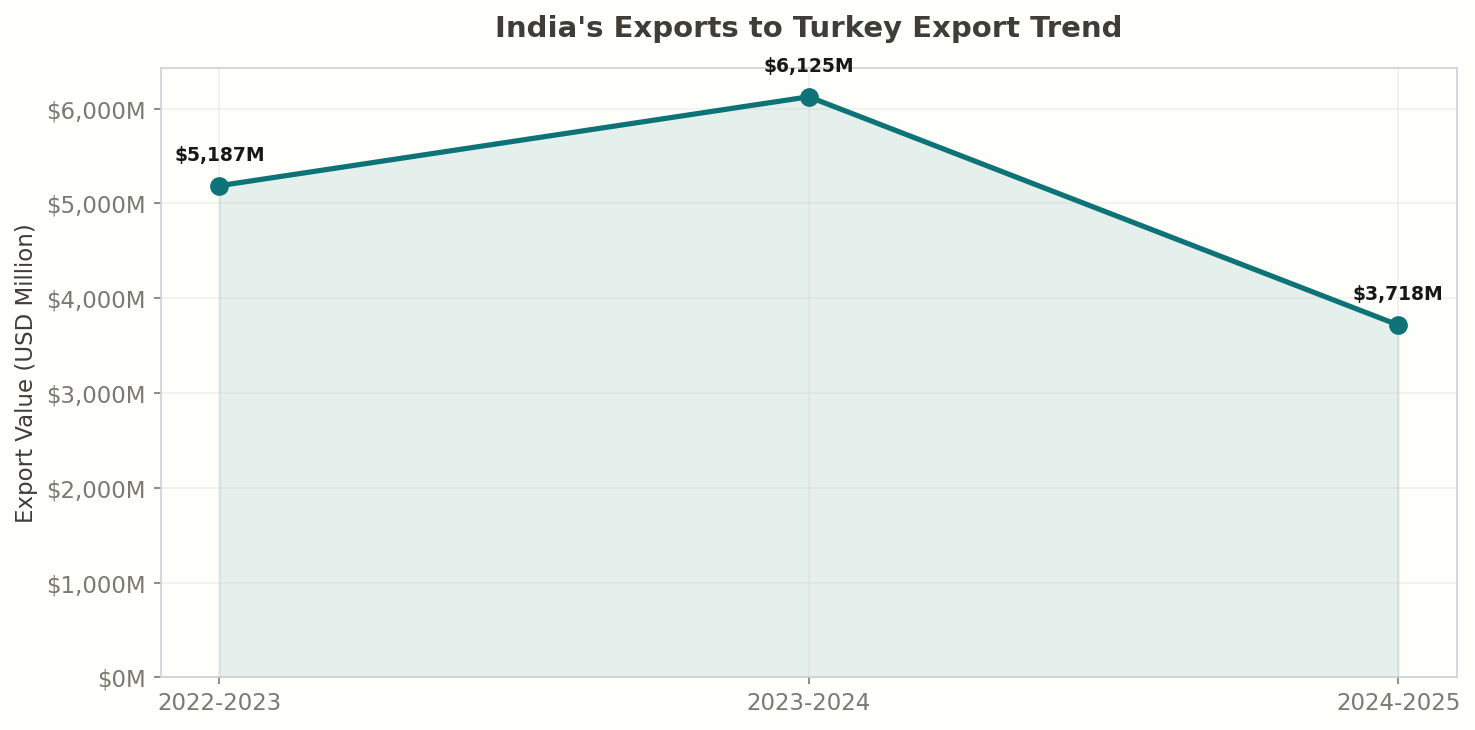
Turkey sits at the crossroads of Europe and Asia, and for Indian exporters it represents a strategically important but complex market. India exported $3,718.03 million in goods to Turkey in 2024-25 — a significant decline from the $6,125.06 million peak in 2023-24 and $5,187.22 million in 2022-23. The drop reflects both Turkey's macroeconomic headwinds — persistent inflation and Turkish Lira depreciation — and the country's aggressive use of trade defence measures, particularly anti-dumping duties that have hit Indian steel, chemicals, and textile exports.
For Indian MSME exporters, Turkey is a market of contradictions. It is the world's 17th-largest economy with deep industrial capacity, and its Customs Union with the EU means Turkish import regulations closely mirror EU standards — a potential springboard for Indian exporters seeking European alignment. However, Turkey is also one of the world's most active users of anti-dumping and safeguard measures, and Indian products — particularly steel, chemicals, and man-made textiles — have been frequent targets. Success in Turkey requires understanding not just the opportunity but the risks.
India–Turkey Trade Overview
India's goods exports to Turkey totalled $3,718.03 million in 2024-25, a sharp correction from $6,125.06 million in 2023-24 and $5,187.22 million in 2022-23. The 2023-24 spike was driven in part by Turkey's post-earthquake reconstruction demand and one-off industrial procurement, while the 2024-25 decline reflects a combination of Turkey's tightening import controls under its new economic stabilisation programme, the impact of anti-dumping duties on key Indian export categories, and the ongoing depreciation of the Turkish Lira that has made imports more expensive for Turkish buyers.
Despite the volatility, structural fundamentals remain solid. Turkey's large manufacturing sector — automobiles, white goods, construction, textiles, and defence — requires imported raw materials and intermediates that India produces competitively. There is no bilateral free trade agreement between India and Turkey. Turkey's Customs Union with the EU is the defining feature of its trade policy — Turkey applies the EU's Common External Tariff (CET) to industrial goods from third countries including India, while maintaining its own tariff schedule (GTiP) for agricultural products.
What India Exports to Turkey
The top product categories exported from India to Turkey in 2024-25:
| Rank | HS Chapter | Product Category | Export Value (USD Million) |
|---|---|---|---|
| 1 | 87 | Vehicles and parts | $627.33 |
| 2 | 84 | Machinery | $496.75 |
| 3 | 29 | Organic chemicals | $320.02 |
| 4 | 85 | Electrical equipment | $297.17 |
| 5 | 72 | Iron and steel | $278.89 |
| 6 | 54 | Man-made filaments | $163.94 |
| 7 | 55 | Man-made staple fibres | $158.62 |
| 8 | 32 | Dyes/Paints | $155.32 |
| 9 | 76 | Aluminium | $103.64 |
| 10 | 38 | Chemical products | $96.36 |
| 11 | 90 | Instruments | $90.08 |
| 12 | 10 | Cereals/Rice | $78.06 |
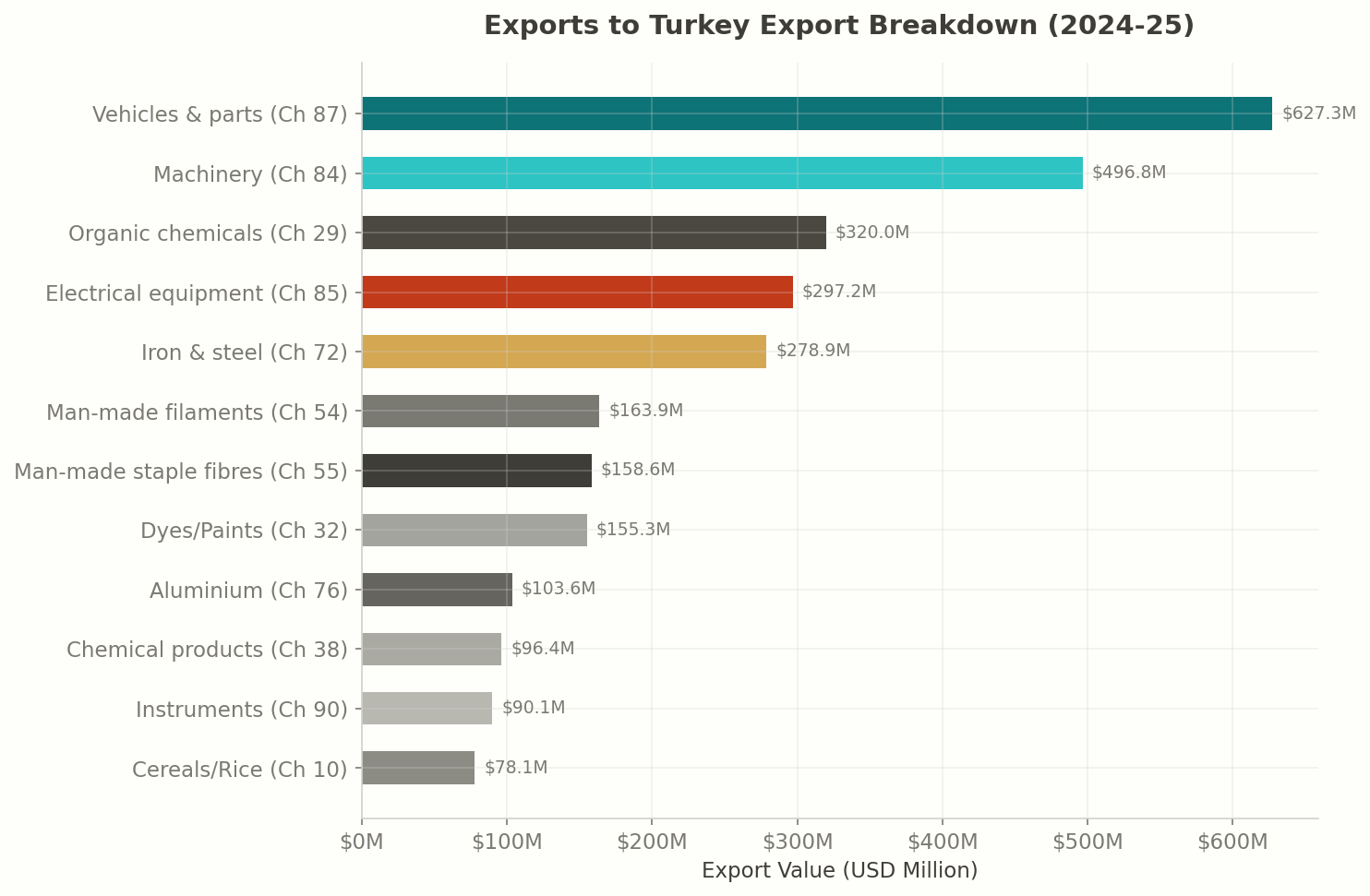
Vehicles and parts lead at $627.33 million, reflecting India's growing automotive export capabilities and Turkish demand for both finished vehicles and components. Turkey itself is a major automotive manufacturer — producing over 1.3 million vehicles annually for companies like Ford, Fiat, Renault, Toyota, and Hyundai — and Indian auto component suppliers are integrated into several of these production networks. Machinery ($496.75M) spans a wide range of industrial and agricultural machinery that feeds Turkey's manufacturing and agricultural sectors.
Organic chemicals ($320.02M) and chemical products ($96.36M) together exceed $416 million, serving Turkey's large pharmaceutical, plastics, and agrochemical industries. Electrical equipment ($297.17M) includes components, cables, and electronic assemblies. Iron and steel ($278.89M) — while still a significant export category — has been particularly affected by Turkish anti-dumping measures, which have constrained volumes and imposed additional duties on certain Indian steel products.
Man-made filaments ($163.94M) and man-made staple fibres ($158.62M) together exceed $322 million, serving Turkey's enormous textile industry — the world's sixth-largest textile exporter. Indian polyester and viscose fibres are key inputs for Turkish fabric manufacturers. Dyes and paints ($155.32M) further support textile dyeing and finishing. Aluminium ($103.64M) feeds construction and industrial sectors, while instruments ($90.08M) and cereals/rice ($78.06M) round out the top categories.
Regulatory and Customs Framework
Turkey's regulatory framework is heavily influenced by its Customs Union with the European Union. For industrial products, Turkey applies EU regulations, standards, and technical requirements almost identically. This alignment has important implications for Indian exporters — compliance with EU standards generally means compliance with Turkish requirements, but there are notable exceptions.
Ministry of Trade (Ticaret Bakanligi)
Turkey's Ministry of Trade is the primary authority for customs, trade policy, and trade defence measures.
- Customs declarations are filed electronically through Turkey's BILGE customs automation system by licensed customs brokers (gumruk musaviri)
- Customs valuation follows WTO Transaction Value methodology. Turkey applies the valuation on CIF basis — duties are calculated on the CIF (Cost, Insurance, Freight) value, not FOB
- Risk-based inspection: Shipments are classified into channels — Blue (post-clearance audit), Green (automatic clearance), Yellow (document review), and Red (physical inspection). New exporters and first-time shipments typically face Yellow or Red channel.
- Conformity assessment: For many product categories, a Certificate of Conformity to Turkish/EU standards must be presented at customs. Without it, goods will not be released.
Turkey's Customs Union with the EU
The EU-Turkey Customs Union, in force since 1996, is the single most important factor shaping Turkey's trade policy for industrial goods. Turkey applies the EU Common External Tariff (CET) to industrial goods (Chapters 25-97) from third countries including India. EU product regulations, CE marking requirements, and technical standards are adopted into Turkish law. Agricultural products (Chapters 01-24) are NOT covered — Turkey maintains its own agricultural tariff schedule. The Customs Union does not grant Indian goods any preferential access.
Turkish Standards Institution (TSE)
TSE (Turk Standardlari Enstitusu) is Turkey's national standards body. The TSE mark is required or strongly expected for many product categories including food, construction materials, electrical equipment, and consumer goods. TSE conformity assessment involves product testing, factory inspection, and ongoing surveillance. For products covered by EU harmonised standards, CE marking compliance generally satisfies TSE requirements as well.
TAREKS (Risk-Based Trade Control System)
Turkey's TAREKS system screens imports at the border for compliance with technical regulations. Products subject to TAREKS control require a Reference Number obtained through the TAREKS electronic portal before customs clearance. TAREKS applies to electrical equipment, machinery, personal protective equipment, toys, construction products, and pressure equipment. Without TAREKS clearance, goods will be held at customs regardless of other documentation.
Key Standards and Certifications
CE Marking
Due to Turkey's Customs Union alignment with the EU, CE marking is effectively mandatory in Turkey for the same product categories as in the EU:
- Machinery Directive (2006/42/EC): All machinery must bear CE marking with a Declaration of Conformity
- Low Voltage Directive (2014/35/EU): Electrical equipment operating within 50-1000V AC or 75-1500V DC
- EMC Directive (2014/30/EU): Electromagnetic compatibility requirements for electrical and electronic equipment
- Construction Products Regulation (EU 305/2011): Construction products must have a CE marking based on a Declaration of Performance
- Medical Devices Regulation: Medical devices must comply with Turkish regulations harmonised with EU MDR
Indian exporters already CE-certified for the EU market can generally use the same certification for Turkey. This is a significant advantage — investing in CE marking opens both the EU and Turkish markets simultaneously.
Product-Specific Certifications
- Food products: Turkish Food Codex (aligned with EU food law) governs food safety, labelling, and additives. Turkish-language labelling is mandatory for retail food products. Halal certification is not legally mandatory but is strongly expected by Turkish consumers for meat, dairy, and processed food.
- Automotive components: Must comply with UNECE regulations as adopted by Turkey. Type approval through TSE or recognised bodies is required.
- Pharmaceutical products: Turkish Medicines and Medical Devices Agency (TITCK) regulates pharmaceuticals. Registration and GMP compliance are mandatory, taking 12-24 months.
- Textiles: Labelling requirements include fibre composition, care instructions, and manufacturer/importer details in Turkish.
Tariff Structure and Trade Agreements
EU Common External Tariff (for Industrial Goods)
For industrial products (HS Chapters 25-97), Turkey applies the EU CET. Indicative rates for key Indian export categories:
| Product Category | Applied Tariff Rate | Notes |
|---|---|---|
| Vehicles/parts (8703/8708) | 0-6.5% | Component rates vary widely |
| Machinery (84xx) | 0-4.7% | Most at 0-2.7% |
| Organic chemicals (29xx) | 0-6.5% | Varies by product |
| Electrical equipment (85xx) | 0-4.7% | Many lines at 0% |
| Iron and steel (72xx) | 0-5% | + Anti-dumping duties on specific Indian products |
| Man-made filaments (54xx) | 4-8% | Higher for finished fabrics |
| Man-made staple fibres (55xx) | 4-8% | Higher for finished fabrics |
| Dyes/paints (32xx) | 0-6.5% | Most at 0-4% |
| Aluminium (76xx) | 3-10% | Higher for fabricated products |
| Instruments (90xx) | 0-4.7% | Most at 0-2.5% |
Agricultural Tariffs
Agricultural products (HS Chapters 01-24) are outside the Customs Union and subject to Turkey's own tariff schedule, which is generally higher and more protective:
| Product Category | Applied Tariff Rate |
|---|---|
| Cereals/Rice (10xx) | 8-45% (rice tariffs are particularly high) |
| Spices (09xx) | 5-20% |
| Processed food (21xx) | 10-40% |
Anti-Dumping and Safeguard Duties — The Critical Risk
Turkey is one of the world's most active users of trade defence measures, and Indian products are frequently targeted.
Active measures affecting Indian exports (indicative — verify current status before shipping):
- Iron and steel: Anti-dumping duties on various flat-rolled steel products from India. Duties can range from 5% to 25% ad valorem, applied in addition to the CET.
- Man-made textiles: Safeguard measures and anti-dumping duties on polyester yarn and fabrics from India have been applied periodically.
- Chemicals: Certain organic and inorganic chemical products from India have faced anti-dumping investigations.
Why this matters: Anti-dumping duties are applied in addition to normal customs duties and can make Indian products commercially unviable in the Turkish market overnight. An Indian steel exporter paying 3% CET plus a 20% anti-dumping duty faces an effective rate of 23% — compared to 3% for suppliers from countries not subject to the measure.
How to manage the risk:
- Check the Turkish Ministry of Trade's trade defence portal for current anti-dumping and safeguard measures affecting your specific HS code
- Monitor ongoing investigations — Turkey publishes investigation notices in its Official Gazette
- If your product is subject to an investigation, cooperate fully and submit questionnaire responses. Non-cooperating exporters receive the highest duty rates.
- Consider whether your product classification can be adjusted (legitimately) to fall outside the scope of the measure
Use the Duty Calculator to check the applicable tariff rate for your HS code, and verify anti-dumping measures separately through the Ministry of Trade.
Logistics and Shipping
Shipping Routes and Transit Times
- JNPT/Nhava Sheva to Mersin: 12-16 days (via Suez Canal)
- Mundra to Mersin: 12-16 days
- JNPT to Istanbul (Ambarli): 14-18 days
- Mundra to Izmir (Alsancak): 14-18 days
- Chennai to Mersin: 14-18 days
- Air freight (Delhi/Mumbai to Istanbul): 6-8 hours direct; air cargo services are well-established on this route
Major Turkish Ports
- Mersin: Turkey's largest container port, located on the Mediterranean coast. Primary gateway for Indian shipments, well-connected to Ankara and central Anatolia.
- Istanbul (Ambarli): Serves the Marmara industrial region — Turkey's economic core with approximately 40% of industrial output. Key entry point for Istanbul, Bursa, and the northwestern industrial zone.
- Izmir (Alsancak): Third-largest port, serving the Aegean region. Important for textiles, automotive, and agricultural goods.
- Iskenderun (Hatay): Important for heavy industrial goods, steel, and commodities near the Iskenderun steel mills.
Freight Costs (Indicative)
- 20-ft container to Mersin: $1,200-$2,500
- 40-ft container to Istanbul (Ambarli): $2,000-$4,000
- Air freight: $3.50-$6.50 per kg
- Inland transport from Mersin to Ankara: $800-$1,200 per 20-ft container
Turkish Customs Clearance
Turkey's customs system is modern and automated (BILGE system), but clearance times vary significantly based on the inspection channel:
- Blue channel: Post-clearance audit — goods released immediately, audited later. Available for established, trusted importers.
- Green channel: Automatic clearance, typically within hours.
- Yellow channel: Document review, 1-3 business days.
- Red channel: Physical inspection, 3-7 business days. Applied to first-time shipments, high-risk cargo, or products flagged by TAREKS.
- TAREKS processing: Products subject to TAREKS must obtain a TAREKS Reference Number before customs clearance. Processing time varies from same-day to several days depending on the product category and whether testing or inspection is required.
Documentation Requirements
- Commercial Invoice (in English or Turkish, with detailed product descriptions, HS codes, unit prices, and CIF value)
- Packing List (detailed weights, carton counts, and product descriptions)
- Bill of Lading or Airway Bill
- Certificate of Origin (standard non-preferential CoO — there is no bilateral FTA, so no preferential CoO applies)
- EUR.1 or A.TR movement certificate — NOT applicable for India (these are for EU/Turkey Customs Union trade only). Indian goods do not qualify.
- CE Declaration of Conformity and technical file (for products subject to CE marking requirements)
- TSE Certificate or TSEK Mark (if applicable to your product category)
- TAREKS Reference Number (for products subject to TAREKS import control)
- Phytosanitary Certificate (for plant and agricultural products)
- Health/Veterinary Certificate (for food and animal products)
- Halal Certificate (recommended for food products)
- Shipping Bill (filed via ICEGATE at the Indian end)
- Insurance Certificate
- Laboratory test reports (product safety, chemical composition — as required by Turkish/EU technical regulations)
Payment and Banking
Common Payment Methods
- T/T Wire Transfer: Widely used in India-Turkey trade. For established relationships, terms of 30-60 days against documents are common. Turkish buyers in the private sector are generally reliable payers, though the Lira depreciation environment has made some buyers seek extended payment terms.
- Letters of Credit: Recommended for new relationships and large transactions. Turkish banks — Isbank, Garanti BBVA, Akbank, Yapi Kredi, Ziraat Bank — are experienced in international LC operations. LC confirmation through an Indian bank is advisable for first-time transactions.
- Documentary Collection (D/P, D/A): Commonly used for medium-sized transactions with established buyers. D/P provides reasonable security for exporters.
- Open Account: Used for trusted, long-standing relationships. Exercise caution with extended open account terms given Turkey's macroeconomic volatility.
Currency — The Lira Challenge
The Turkish Lira (TRY) has experienced severe depreciation — losing approximately 80% of its value against the USD between 2020 and 2025. Always price in USD or EUR. Never price in Turkish Lira — Lira-denominated contracts expose you to currency depreciation risk that can eliminate your profit margin between quotation and payment. Even for USD-denominated contracts, monitor Turkey's macroeconomic indicators because Lira depreciation affects your buyer's ability to pay and may lead to payment delay requests. Competitive pricing is essential in this environment, but do not sacrifice margin — compete on quality and delivery reliability, not just price.
Turkish Business Culture
Turkish business culture is warm, relationship-oriented, and built on personal trust. Business meetings involve extensive hospitality — tea, coffee, and meals are integral to relationship building. Turkish buyers are assertive negotiators; expect extended negotiations on price, payment terms, and delivery conditions, and leave room to negotiate from your initial offer. Business in Turkey is conducted between people, not just between companies — building personal rapport is essential. Turkey hosts numerous international trade fairs in Istanbul, Izmir, and Ankara, and attendance at relevant fairs is one of the most effective ways to meet buyers and build market presence.
Industrial Zones and Free Trade Zones
Turkey operates Organized Industrial Zones (OSBs) and Free Trade Zones (FTZs). FTZs in Mersin, Istanbul, and Izmir offer duty deferral, VAT exemption, and simplified procedures. Indian exporters supplying components for Turkish manufacturers in OSBs may benefit from Turkey's Inward Processing Regime, which suspends customs duties on imported inputs used in products that are subsequently exported from Turkey.
Common Mistakes
Ignoring anti-dumping duties on Indian steel and chemicals. Turkey is among the most active users of anti-dumping measures globally, and Indian iron and steel, chemicals, and textiles are frequent targets. An exporter who quotes a price based on the standard CET rate without checking for anti-dumping duties may find the shipment subject to an additional 10-25% duty at the Turkish border — making the deal commercially unviable and creating a dispute with the buyer. Always verify the current anti-dumping status of your specific HS code through Turkey's Ministry of Trade before quoting.
Not understanding Turkey's safeguard measures. Beyond anti-dumping, Turkey applies safeguard tariffs on certain product categories — particularly steel. These measures apply to all exporting countries and can change on short notice. Monitor Turkey's Official Gazette regularly.
Underestimating CE marking and TAREKS requirements. Turkey's EU alignment means CE marking is effectively mandatory for a wide range of industrial and consumer products. Shipping without CE marking results in customs rejection. Similarly, TAREKS control requirements are frequently overlooked — without the TAREKS Reference Number, goods cannot clear customs even if all other documentation is perfect. Verify both CE and TAREKS requirements before shipping.
Pricing in Turkish Lira. The Lira's severe depreciation makes Lira-denominated contracts extremely risky for exporters. Even if a Turkish buyer insists on Lira pricing, resist firmly — the currency risk is substantial and one-directional. Price in USD or EUR and let the buyer manage their own Lira exposure.
Neglecting documentation for Customs Union compliance. Indian goods entering Turkey must comply with the same technical standards as goods entering the EU. Certificate of Conformity, technical files, test reports, and labelling must all be in order. Non-compliant shipments are rejected or destroyed.
Sending goods without verifying the buyer. Conduct due diligence on your Turkish buyer before shipping — verify their commercial registration (Ticaret Sicil), tax registration (Vergi Levhasi), and credit standing through Turkish chambers of commerce or the Indian embassy commercial sections in Ankara and Istanbul.
Key Takeaways
- India exported $3,718.03 million to Turkey in 2024-25, led by vehicles ($627.33M), machinery ($496.75M), and organic chemicals ($320.02M)
- Turkey's Customs Union with the EU means Turkish import regulations closely mirror EU standards — CE marking, TAREKS compliance, and EU-aligned technical regulations are effectively mandatory
- Anti-dumping and safeguard duties are a critical risk for Indian steel, chemicals, and textile exporters — verify the current trade defence status of your HS code before quoting
- There is no bilateral FTA between India and Turkey — Indian goods face the EU Common External Tariff for industrial products and Turkey's own tariff schedule for agricultural products
- Always price in USD or EUR — never in Turkish Lira, given the severe and ongoing Lira depreciation
- CE marking investment opens both the EU and Turkish markets simultaneously — a dual-market certification advantage
- Turkish business culture is relationship-oriented — invest in personal connections, trade fairs, and face-to-face meetings
- Man-made textiles (filaments + staple fibres) together exceed $322 million, reflecting Turkey's position as a major global textile manufacturer dependent on Indian synthetic fibre inputs
- Shipping via Suez Canal from JNPT/Mundra to Mersin takes 12-16 days
Next Steps
- Identify your HS code with the HS Code Finder and check Turkey's applied tariff rate using the Duty Calculator
- Check anti-dumping and safeguard measures — verify whether your specific HS code is subject to any active Turkish trade defence measures before quoting prices
- Assess CE marking requirements — determine whether your product requires CE marking in Turkey and invest in certification if needed (this opens the EU market as well)
- Verify TAREKS requirements — confirm whether your product category is subject to TAREKS import control and understand the Reference Number process
- Explore Turkish market demand with the Market Finder to identify specific product opportunities
- Attend relevant trade fairs — Istanbul hosts major international fairs including the Istanbul International Fair, WIN Eurasia (machinery), and ITM (textiles)
- Engage a Turkish customs broker — a licensed gumruk musaviri experienced with your product category is essential for smooth customs clearance
- Explore other export markets to diversify your market portfolio and reduce dependence on any single country
Turkey rewards well-prepared exporters and punishes those who underestimate its complexity. The EU Customs Union alignment means Turkish standards are among the highest in the emerging world — but an Indian exporter who invests in Turkish market compliance simultaneously builds capability for the entire European market. The anti-dumping risk is real and must be actively managed, but for product categories not subject to trade defence measures, Turkey offers access to a large, industrialised economy with deep demand for Indian raw materials and components. Approach Turkey with thorough preparation, strong documentation, and patience — and the returns will justify the effort.
Ready to start exporting?
Get a detailed market report with country-by-country analysis, pricing insights, and buyer contacts.
Get Market ReportXIMPEX Export Advisory
Need help implementing the strategies discussed in this guide? Our team of export specialists can provide personalized guidance for your business.