How to Export to Vietnam from India — Complete Guide
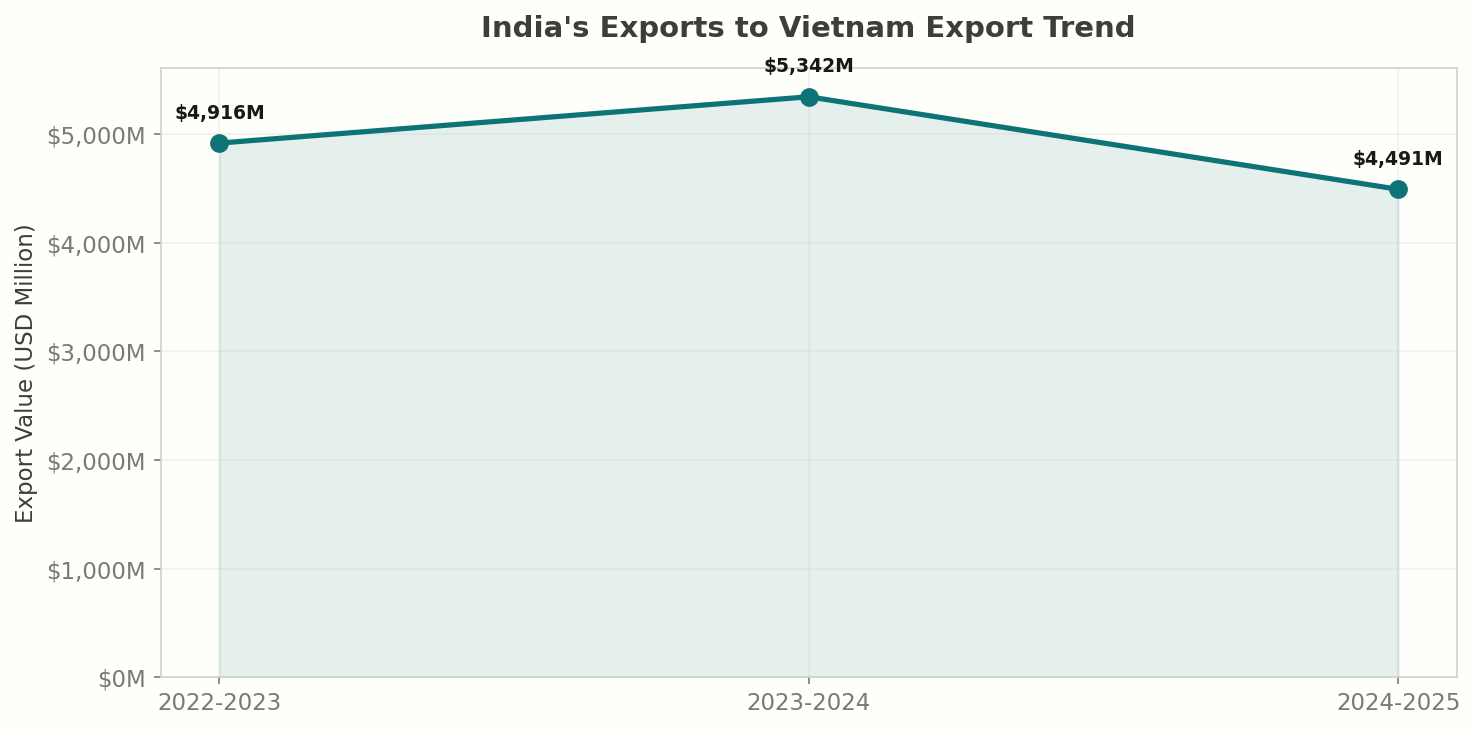
Vietnam is one of Southeast Asia's fastest-growing economies and an increasingly important destination for Indian exports. India exported $4,490.61 million in goods to Vietnam in 2024-25, down slightly from the $5,341.68 million peak in 2023-24, but the long-term trajectory is firmly upward — exports stood at $4,915.92 million in 2022-23. Vietnam's transformation from an agrarian economy to a major manufacturing hub has created surging demand for raw materials, intermediates, and capital goods that Indian producers are well-positioned to supply.
For Indian MSME exporters, Vietnam represents one of the most compelling opportunities in the ASEAN region. The ASEAN-India Free Trade Agreement (AIFTA) provides preferential tariff access. Vietnam's emergence as a China+1 manufacturing alternative has attracted massive foreign investment from Samsung, Apple, Intel, and dozens of other multinationals, all of which need supply chain inputs that India can provide. The market is relationship-oriented, the business culture rewards patience and personal connections, and the regulatory environment — while complex — is navigable for exporters who do their homework.
India–Vietnam Trade Overview
India's goods exports to Vietnam totalled $4,490.61 million in 2024-25, following $5,341.68 million in 2023-24 and $4,915.92 million in 2022-23. The slight decline in 2024-25 reflects broader global trade softness rather than any structural shift in the bilateral relationship. Vietnam's GDP has been growing at 6-7% annually over the past decade, and its integration into global manufacturing supply chains — particularly in electronics, textiles, and footwear — continues to deepen demand for imported raw materials and intermediate goods.
The ASEAN-India Free Trade Agreement (AIFTA), in force since 2010, is the primary trade framework governing tariff preferences. Under AIFTA, India and Vietnam exchange preferential tariffs on thousands of product lines, though the agreement's utilisation rate remains lower than it should be — many Indian exporters are unaware of the preferences available or find the Rules of Origin documentation cumbersome. The India-Vietnam bilateral relationship also benefits from strong diplomatic ties, with Vietnam being a key pillar of India's Act East Policy.
Vietnam's position in the China+1 narrative is particularly significant for Indian exporters. As multinational manufacturers diversify production away from China, Vietnam has become the primary beneficiary — and these new factories need inputs. Indian meat, seafood, cotton, chemicals, and machinery are flowing into Vietnam's expanding industrial base, and this structural shift suggests sustained demand growth over the medium term.
What India Exports to Vietnam
The top product categories exported from India to Vietnam in 2024-25:
| Rank | HS Chapter | Product Category | Export Value (USD Million) |
|---|---|---|---|
| 1 | 02 | Meat | $741.20 |
| 2 | 03 | Seafood | $321.22 |
| 3 | 87 | Vehicles and parts | $298.46 |
| 4 | 84 | Machinery | $268.01 |
| 5 | 52 | Cotton | $255.13 |
| 6 | 10 | Cereals/Rice | $222.01 |
| 7 | 85 | Electrical equipment | $176.21 |
| 8 | 23 | Animal feed/residues | $162.43 |
| 9 | 68 | Stone/cement articles | $160.22 |
| 10 | 30 | Pharmaceuticals | $152.40 |
| 11 | 12 | Oil seeds | $150.97 |
| 12 | 38 | Chemical products | $148.31 |
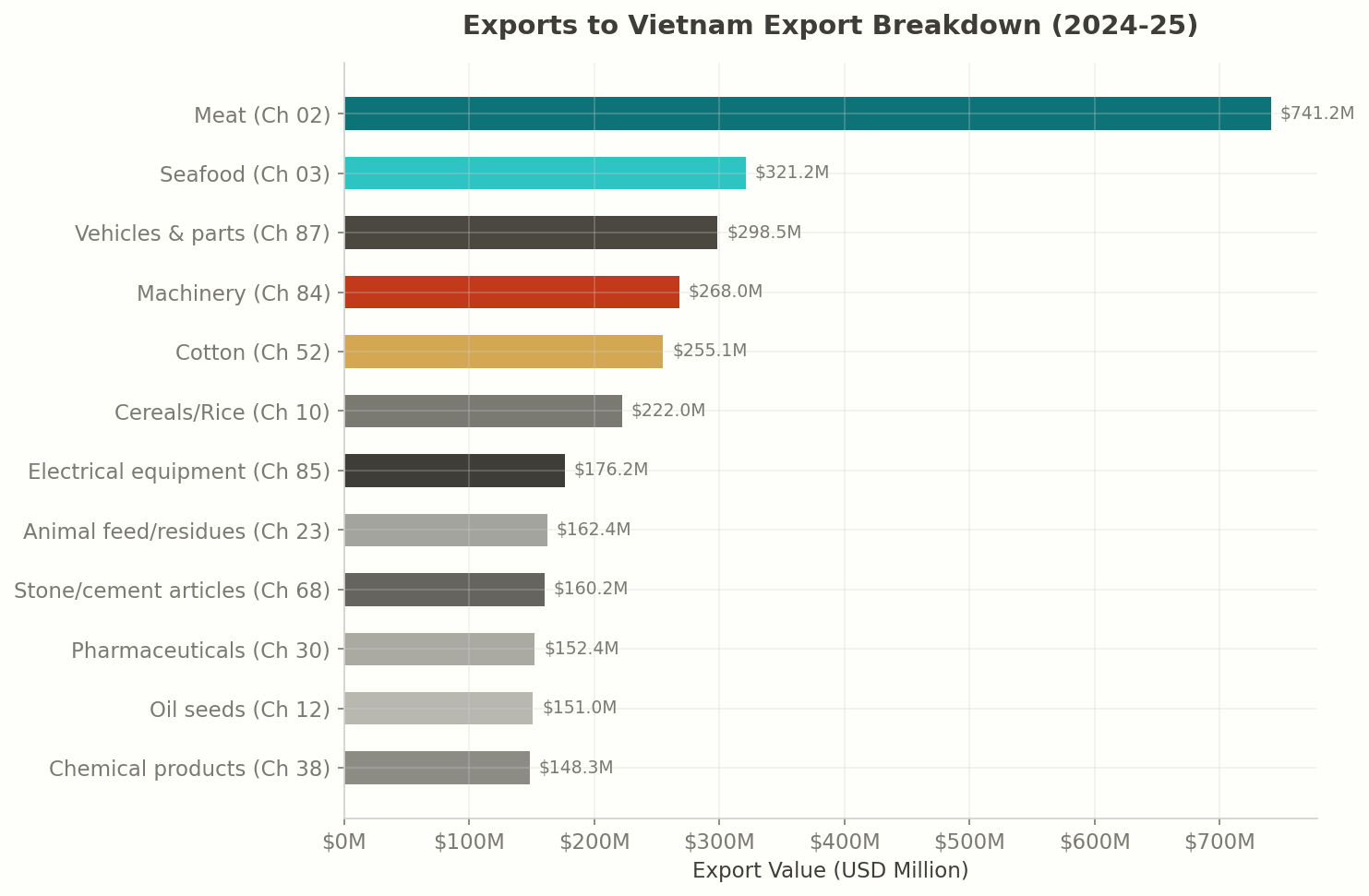
Meat dominates India's exports to Vietnam at $741.20 million, overwhelmingly comprising frozen buffalo meat (carabeef). Vietnam is one of the world's largest importers of Indian buffalo meat, which is processed for both domestic consumption and re-export to other markets in the region. This trade is well-established, with Indian abattoirs holding MARD (Ministry of Agriculture and Rural Development) approval and direct shipping lanes from Indian ports to Ho Chi Minh City and Hai Phong.
Seafood at $321.22 million includes frozen shrimp, fish meal, and other marine products — Vietnam's own seafood processing industry imports Indian raw materials for value-added re-export. Vehicles and parts ($298.46M) reflects growing demand for Indian two-wheelers, commercial vehicles, and auto components as Vietnam's domestic market expands. Machinery ($268.01M) feeds Vietnam's industrialisation, while cotton ($255.13M) supplies Vietnam's rapidly growing textile and garment sector — Vietnam is now the third-largest garment exporter in the world, creating significant demand for cotton yarn and fabric.
Electrical equipment ($176.21M) supports Vietnam's electronics manufacturing ecosystem. Stone and cement articles ($160.22M) reflect India's position as a leading exporter of granite and natural stone to Vietnam's construction sector. Pharmaceuticals ($152.40M) serve Vietnam's healthcare needs, with Indian generic medicines well-regarded for quality and affordability.
Regulatory and Customs Framework
Vietnam's regulatory environment has modernised significantly since the country joined the WTO in 2007, but it retains complexities that reflect its transition economy status. Understanding the key agencies is essential.
Vietnam Customs (General Department of Customs)
Vietnam Customs operates under the Ministry of Finance and has implemented the VNACCS/VCIS automated customs management system.
- Import declaration is filed electronically through VNACCS by the Vietnamese importer or their licensed customs broker
- Customs valuation follows WTO Transaction Value methodology, but Vietnam Customs maintains a reference price database and may challenge invoice values that appear significantly below market norms
- Risk-based inspection: Shipments are classified into Green (automatic clearance), Yellow (document review), and Red (physical inspection) channels. First-time shipments from new suppliers typically face Yellow or Red channel processing
- Processing time: Green channel clearances can be completed within hours. Yellow channel takes 1-2 days, Red channel 3-5 days depending on inspection requirements
Ministry of Agriculture and Rural Development (MARD)
MARD is the critical agency for Indian exporters of meat, seafood, and agricultural products — which collectively represent over $1.5 billion of India's exports to Vietnam.
- Meat imports: Indian abattoirs must be approved and listed by MARD's Department of Animal Health. Only meat from MARD-listed facilities can be imported into Vietnam. The listing process involves facility inspection by Vietnamese veterinary authorities.
- Seafood: Similar facility registration requirements apply. Vietnam's National Agro-Forestry-Fisheries Quality Assurance Department (NAFIQAD) oversees food safety for imported aquatic products.
- Plant products: Phytosanitary certification is required for all plant and agricultural imports. Vietnam applies its own MRL standards for pesticides, which may differ from Indian or Codex standards.
- Quarantine requirements: Animal and plant quarantine inspections are conducted at the port of entry. Certificates from India's competent authorities (APEDA, EIC, Plant Quarantine) must accompany shipments.
Ministry of Industry and Trade (MOIT)
MOIT oversees trade policy, import licensing, and trade remedy investigations.
- Import licensing: Most goods are freely importable, but certain categories (including some chemicals, steel products, and consumer goods) require specific import permits or are subject to automatic licensing requirements
- Trade remedies: Vietnam has become increasingly active in anti-dumping and safeguard investigations. Indian steel, chemicals, and certain agricultural products have faced trade remedy actions
- Special import requirements: Products affecting public health, safety, or the environment may require specific MOIT approval
Ministry of Health (MOH)
MOH regulates pharmaceuticals, medical devices, and food safety through the Drug Administration of Vietnam (DAV) and the Vietnam Food Administration (VFA).
- Pharmaceutical registration: All pharmaceutical products must be registered with DAV before they can be marketed in Vietnam. The registration process typically takes 12-18 months.
- Food safety: Processed food imports must comply with Vietnamese food safety regulations, including labelling requirements in Vietnamese language
Key Standards and Certifications
TCVN (Vietnamese National Standards)
TCVN standards are Vietnam's national standards, developed by the Directorate for Standards, Metrology and Quality (STAMEQ) under the Ministry of Science and Technology.
- Mandatory TCVN standards (called Technical Regulations or QCVN) apply to products affecting safety, health, and the environment — including electrical equipment, construction materials, food products, and children's products
- Voluntary TCVN standards cover quality benchmarks for a wide range of industrial and consumer products
- Products subject to mandatory QCVN technical regulations must undergo conformity assessment (testing and certification) before they can be sold in Vietnam
- Many QCVN standards are harmonised with international standards (ISO, IEC), which can simplify compliance for Indian exporters already certified to international standards
Food Safety Certification
For meat and seafood exports — India's largest product categories to Vietnam — MARD facility approval is mandatory for processing plants and abattoirs. Health certificates issued by India's competent authority (EIC for general food, MPEDA for marine products, APEDA for meat) must accompany each shipment. Laboratory test reports for microbiological, chemical residue, and heavy metal parameters may be requested by Vietnamese authorities.
CE Marking and International Standards
Vietnam increasingly recognises international certifications:
- Products certified to ISO, IEC, or CE standards often have a simplified conformity assessment path in Vietnam
- For electrical equipment and machinery, IEC-based testing may be accepted by Vietnamese testing laboratories
- Indian pharmaceutical companies with WHO-GMP certification have an advantage in the Vietnamese market, as DAV recognises WHO-GMP as a baseline quality indicator
Tariff Structure and Trade Agreements
ASEAN-India Free Trade Agreement (AIFTA)
AIFTA, in force since January 2010, is the primary preferential trade framework between India and Vietnam.
Key provisions:
- Tariff reduction and elimination on approximately 80% of tariff lines, phased over different timelines depending on product sensitivity
- Normal Track: Tariffs reduced to 0% on most industrial goods by 2018 (for ASEAN-6) and by 2024 (for Vietnam, as a newer ASEAN member)
- Sensitive Track: Reduced tariffs (not zero) on products deemed sensitive by either party
- Highly Sensitive List and Exclusion List: Products excluded from tariff concessions entirely
- Rules of Origin: Generally 35% AIFTA Regional Value Content (RVC) or Change in Tariff Classification at the 4-digit level (CTH). Product-Specific Rules apply to certain categories.
Current AIFTA preferential tariff rates (indicative):
| Product Category | AIFTA Rate | MFN Rate |
|---|---|---|
| Frozen buffalo meat (0202) | 5-10% | 15-30% |
| Seafood (0306) | 0-10% | 15-25% |
| Machinery (84xx) | 0-5% | 5-20% |
| Cotton yarn (5205) | 0-5% | 10-20% |
| Electrical equipment (85xx) | 0-5% | 10-25% |
| Vehicles/parts (8703/8708) | 10-30% | 30-70% |
| Pharmaceuticals (3004) | 2.5-5% | 5-10% |
| Chemical products (38xx) | 0-5% | 5-15% |
| Stone articles (68xx) | 0-5% | 10-30% |
| Oil seeds (12xx) | 0-5% | 5-15% |
How to claim AIFTA preferences:
- Verify your product qualifies under the AIFTA tariff schedule for Vietnam
- Ensure compliance with the applicable Rule of Origin (check product-specific rules if any)
- Obtain a Certificate of Origin (Form AI) from DGFT or an authorised chamber of commerce
- Your Vietnamese importer presents the CO Form AI to Vietnam Customs at import
Important note on AIFTA utilisation: Studies indicate that AIFTA preference utilisation rates are below 25% for India-Vietnam trade. This means three out of four eligible shipments are paying unnecessary MFN duties. The primary reasons are exporter unawareness and documentation complexity. On a $500,000 meat shipment, the tariff saving under AIFTA could be $25,000-$50,000 — a significant margin improvement.
Use the Duty Calculator to check the exact AIFTA rate for your HS code.
Logistics and Shipping
Shipping Routes and Transit Times
- Chennai to Ho Chi Minh City (Cat Lai): 8-12 days
- Vizag to Ho Chi Minh City: 8-10 days
- JNPT/Nhava Sheva to Ho Chi Minh City: 12-16 days
- Mundra to Ho Chi Minh City: 14-18 days
- Kolkata to Hai Phong: 10-14 days
- Air freight (Delhi/Mumbai to Ho Chi Minh City/Hanoi): Direct flights 5-6 hours, but most air cargo routes require a stopover in Bangkok or Singapore, extending transit to 12-24 hours
Major Vietnamese Ports
- Ho Chi Minh City (Cat Lai terminal): Vietnam's largest and busiest port complex, handling approximately 50% of the country's container throughput. Located in the southern economic zone, it is the primary gateway for consumer goods, food products, and general cargo. Cat Lai is well-connected to the city's industrial zones and export processing zones.
- Hai Phong: The largest port in northern Vietnam, serving the Hanoi economic corridor. Important for industrial goods, electronics components, and raw materials destined for northern Vietnam's manufacturing zones. The Lach Huyen deep-water port terminal (opened 2018) can handle larger vessels.
- Da Nang: Central Vietnam's primary port. Smaller than Cat Lai and Hai Phong but growing, particularly for goods destined for central Vietnam's manufacturing and tourism sectors.
- Cai Mep-Thi Vai: Deep-water port complex near Ho Chi Minh City, designed to handle the largest container vessels. Increasingly important for direct deep-sea services from India.
Freight Costs (Indicative)
- 20-ft container to Ho Chi Minh City: $1,000-$2,200
- 40-ft container to Ho Chi Minh City: $1,800-$3,500
- Reefer container (for meat/seafood): Premium of 40-60% over standard rates
- Air freight: $3.50-$6.00 per kg
- Inland transport from Cat Lai to Ho Chi Minh City industrial zones: $150-$300
Customs Clearance in Vietnam
Vietnam Customs clearance through the VNACCS system has improved significantly:
- Green channel: Automatic clearance, typically within hours. Available for established importers with clean compliance records.
- Yellow channel: Document review only, 1-2 business days. Most first-time or moderate-risk shipments fall into this category.
- Red channel: Physical inspection required, 3-5 business days. Applied to high-risk cargo, first-time importers, or products flagged for specific regulatory checks (particularly food and agricultural products).
- Specialised inspection: Meat and food products undergo quarantine inspection by MARD/NAFIQAD at the port, which adds 1-3 days to the clearance timeline.
Documentation Requirements
- Commercial Invoice (in English, with detailed product descriptions, HS codes, unit prices, and total values)
- Packing List (with weights, dimensions, and carton-level detail)
- Bill of Lading or Airway Bill
- Certificate of Origin — Form AI for AIFTA preferential tariff claims
- Phytosanitary Certificate (for plant and agricultural products, issued by India's Plant Quarantine authority)
- Health/Veterinary Certificate (for meat products, issued by EIC; for marine products, issued by MPEDA/EIC)
- MARD import permit (for certain agricultural and animal products)
- Certificate of Quality/Conformity (for products subject to mandatory QCVN standards)
- Laboratory test reports (microbiological, chemical residue, pesticide — particularly for food products)
- Shipping Bill (filed via ICEGATE at the Indian end)
- Insurance Certificate
- Product registration certificate (for pharmaceuticals, medical devices, and certain regulated products)
Payment and Banking
Common Payment Methods
- T/T Wire Transfer: The most common method in India-Vietnam trade for established relationships. Typical terms range from advance payment (for new relationships) to 30-60 day payment against documents for trusted suppliers.
- Letters of Credit: Widely used for larger transactions and new trading relationships. Vietnamese commercial banks — Vietcombank, BIDV, VietinBank, Techcombank — are experienced in international LC operations. LC terms of 60-90 days are standard.
- Documentary Collection (D/P, D/A): Used for medium-risk transactions. D/P (Documents against Payment) offers reasonable security for the exporter.
- Open Account: Reserved for established, high-trust relationships. Vietnamese buyers generally expect some credit terms once a relationship is established, but open account terms beyond 30 days should be extended cautiously.
Currency
The Vietnamese Dong (VND) is not freely convertible on international markets. Virtually all India-Vietnam trade is denominated in USD. Do not attempt to price in VND unless you have specific treasury capability to manage VND exposure. While the State Bank of Vietnam manages the VND exchange rate within a band, periodic devaluations can affect your buyer's cost structure — factor this into long-term supply contracts.
Vietnamese Business Culture
Vietnamese business culture is relationship-oriented. Vietnamese businesses strongly prefer working with suppliers they know personally — a visit to Vietnam, even a brief one, can be more effective than months of email correspondence. In Vietnam's mixed economy, government relationships and approvals play a significant role, and your buyer's ability to navigate agencies like MARD and customs directly affects clearance timelines. Decision-making tends to be hierarchical, so building trust through multiple interactions is more effective than pushing for quick commitments. Having a local agent or distributor significantly improves your chances of commercial success — language barriers, time zone differences, and the relationship culture all favour having someone on the ground.
Common Mistakes
Not understanding AIFTA Rules of Origin. The AIFTA Certificate of Origin (Form AI) is essential for claiming preferential tariffs in Vietnam, but many Indian exporters either do not obtain it or fail to comply with the Rules of Origin requirements. The RVC (Regional Value Content) calculation must be accurate and supported by documentation. If Vietnam Customs challenges the CoO and finds non-compliance, the importer pays full MFN duty plus potential penalties. Ensure your CoO application accurately reflects the origin criteria.
Ignoring Vietnam's non-tariff barriers. While AIFTA has reduced tariffs, Vietnam maintains significant non-tariff barriers — including MARD facility registration requirements for meat and food imports, QCVN technical regulations for industrial and consumer products, and automatic import licensing for certain categories. These requirements are not waived by AIFTA. Indian exporters who focus only on tariff rates and ignore non-tariff compliance will face clearance delays and rejections at the border.
Underestimating documentation for food products. Meat and seafood are India's largest exports to Vietnam, and the documentation requirements are extensive — MARD facility approval, health/veterinary certificates, laboratory test reports, quarantine clearance. A single missing or incorrect document can result in shipment detention at the port, with container detention costs of $100-$200 per day accumulating rapidly. Build a comprehensive documentation checklist for food shipments and verify every document before the cargo leaves India.
Shipping without MARD facility approval. Indian meat exporters sometimes receive orders from Vietnamese buyers without verifying that their abattoir or processing plant is on MARD's approved list. If your facility is not MARD-listed, the shipment will be rejected at the Vietnamese border — regardless of how good your product quality is. Confirm your MARD listing status before accepting orders.
Neglecting relationship building. Vietnamese business culture places enormous value on personal relationships. Exporters who rely solely on email quotations and expect orders to flow automatically will be outcompeted by suppliers (often Chinese or Thai) who invest in face-to-face relationship building. Plan at least one visit to Vietnam per year to meet buyers, attend trade fairs, and build the personal trust that drives commercial success in this market.
Pricing only on FOB basis. Vietnamese buyers — particularly smaller and mid-sized companies — often prefer CIF pricing. Quoting FOB when your competitor quotes CIF puts you at a disadvantage because the buyer must arrange and pay for freight separately. Offer CIF Ho Chi Minh City or CIF Hai Phong pricing to make your quotation directly comparable to competitors.
Key Takeaways
- India exported $4,490.61 million to Vietnam in 2024-25, led by meat ($741.20M), seafood ($321.22M), and vehicles ($298.46M)
- Vietnam's China+1 manufacturing boom is driving structural demand growth for Indian raw materials, intermediates, and capital goods
- AIFTA provides preferential tariff access on approximately 80% of tariff lines — but utilisation rates are below 25%, meaning most exporters are paying unnecessary duties
- Always obtain a Certificate of Origin (Form AI) and ensure compliance with AIFTA Rules of Origin
- Meat and food exports require MARD facility approval, health certificates, and quarantine clearance — the documentation chain is extensive and every link must be intact
- TCVN/QCVN standards compliance is mandatory for regulated product categories — verify requirements before shipping
- Vietnamese business culture is relationship-oriented — invest in face-to-face meetings and local representation
- All trade is denominated in USD; the Vietnamese Dong is not freely convertible
- Shipping from east coast Indian ports (Chennai, Vizag) offers transit times of 8-12 days to Ho Chi Minh City
Next Steps
- Identify your HS code with the HS Code Finder and check Vietnam's AIFTA tariff rate using the Duty Calculator
- Verify MARD facility listing — if you export meat or food products, confirm your processing facility is on MARD's approved list before accepting orders
- Check QCVN requirements — determine whether your product category is subject to mandatory Vietnamese technical regulations
- Obtain AIFTA Certificate of Origin — register with DGFT or your authorised chamber for Form AI issuance and understand the applicable Rules of Origin
- Explore Vietnam market demand with the Market Finder to identify specific product opportunities
- Plan a market visit — attend the Vietnam Expo (Hanoi, April) or Vietfood & Beverage (Ho Chi Minh City, August) to meet buyers and understand the market firsthand
- Engage a local agent or distributor — identify a Vietnamese partner who can provide market intelligence, buyer introductions, and on-ground support
- Explore other export markets in ASEAN to build a diversified regional export strategy
Vietnam is a market in rapid transformation. The China+1 shift is structural, not cyclical, and demand for Indian inputs will continue to grow as Vietnam's manufacturing ecosystem expands. AIFTA has created the tariff framework; what Indian exporters need now is awareness, documentation discipline, and the willingness to invest in relationships. For MSMEs that treat Vietnam as a strategic market, the rewards will compound over time — in an economy growing faster than almost any other in Asia.
Ready to start exporting?
Get a detailed market report with country-by-country analysis, pricing insights, and buyer contacts.
Get Market ReportXIMPEX Export Advisory
Need help implementing the strategies discussed in this guide? Our team of export specialists can provide personalized guidance for your business.