How to Export Auto Parts from India — Complete Guide
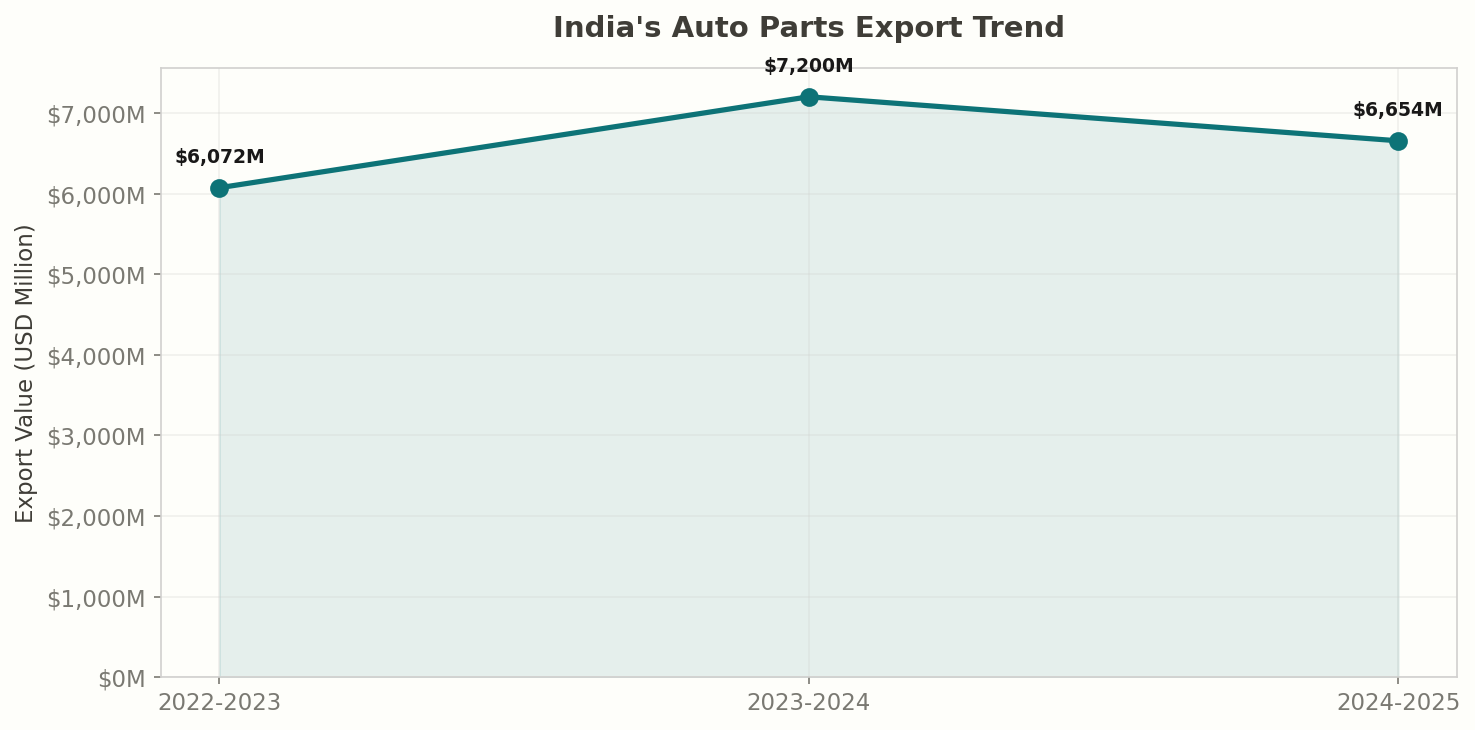
India is one of the world's largest auto component manufacturers, exporting $6.65 billion worth of auto parts in 2024-25 under HS heading 8708 alone. Add related categories like engines (8407/8408), tyres (4011), and electrical equipment (8511/8512), and India's automotive component exports exceed $10 billion. The Indian auto component industry supplies to every major global automaker — from Ford and GM to BMW, Toyota, Volkswagen, and Hyundai.
For MSME exporters, auto parts represent a high-value, repeat-order business. Once you qualify as an OEM (Original Equipment Manufacturer) or Tier-2 supplier to a global automaker, orders are typically multi-year contracts with predictable volumes. India's competitive advantages include a vast skilled workforce, competitive manufacturing costs (30-40% lower than developed markets), proximity to raw materials (steel, aluminium, rubber), and a well-established supplier ecosystem centred around automotive clusters.
India's Auto Parts Export Landscape
India exported $6.65 billion in auto parts (HS 8708) in 2024-25, up from $6.07 billion in 2022-23 — a 9.6% increase. The sector peaked at $7.20 billion in 2023-24 before moderating.
| HS Code | Category | 2024-25 Exports (USD Million) | Share |
|---|---|---|---|
| 870899 | Other parts and accessories | $3,567.8 | 53.6% |
| 870840 | Gear boxes and parts thereof | $668.1 | 10.0% |
| 870850 | Drive axles with differentials | $667.5 | 10.0% |
| 870894 | Steering wheels, columns, boxes | $278.3 | 4.2% |
| 870880 | Suspension and shock absorbers | $276.1 | 4.1% |
| 870892 | Silencers and exhaust pipes | $276.1 | 4.1% |
| 870829 | Other body parts and accessories | $234.9 | 3.5% |
| 870870 | Wheels, parts, and accessories | $167.9 | 2.5% |
| 870810 | Bumpers and parts | $144.0 | 2.2% |
| 870895 | Safety airbags and parts | $127.1 | 1.9% |
The catchall category "other parts and accessories" (870899) at $3.57 billion includes engine parts, brake components, clutch assemblies, and various castings/forgings that don't fall into specific HS subheadings. Gear boxes ($668M) and drive axles ($668M) are the two largest specific categories.
Where Indian Auto Parts Are in Demand
India's auto parts reach virtually every major automotive manufacturing region in the world. North America is the dominant destination, with the USA and Mexico together forming the largest corridor — driven by Indian suppliers integrating into the US-Mexico automotive manufacturing ecosystem. European OEMs, particularly in Germany and Italy, source precision machined parts, castings, and forgings from India. Southeast Asian markets like Vietnam, Thailand, and Indonesia reflect Japanese automakers sourcing from India for their regional assembly plants.
The geographic spread reveals India's deep integration into global automotive supply chains. OEM (original equipment manufacturer) orders tend to be concentrated in mature automotive markets with established assembly operations, while aftermarket demand is more geographically diverse, spanning Africa, the Middle East, and Latin America.
Want the full country-by-country breakdown? See exact export values, growth rates, tariff rates, and market attractiveness scores for every destination in our detailed data pages. View Auto Parts export data by country →
Manufacturing Clusters
Pune-Nashik Corridor (Maharashtra)
- India's largest auto component cluster
- Suppliers to Tata, Bajaj, Force Motors, Mercedes-Benz India
- Strong in forgings, castings, machined components
Chennai-Hosur Belt (Tamil Nadu-Karnataka)
- Suppliers to Hyundai, Ford (legacy), Renault-Nissan, BMW, Daimler
- Specialises in powertrain, electronics, rubber components
- Home to Sundaram Fasteners, Brakes India, India Pistons
NCR-Gurugram-Manesar (Haryana)
- Maruti Suzuki supplier ecosystem (India's largest OEM)
- Hero MotoCorp supplier base
- Sheet metal, rubber parts, electrical components
Rajkot-Ahmedabad (Gujarat)
- Engine components, forgings, castings
- Strong aftermarket parts manufacturing
- Cost-competitive for volume production
HS Code Classification
All auto parts fall under HS heading 8708. Classification at the 6-digit level depends on the vehicle system:
| 6-Digit Code | Vehicle System | Examples |
|---|---|---|
| 870810 | Bumpers and parts | Front bumpers, bumper brackets |
| 870821 | Safety seat belts | Three-point belts, pretensioners |
| 870829 | Other body parts | Door panels, fenders, hoods |
| 870830 | Brakes and servo-brakes | Disc brakes, brake pads, ABS units |
| 870840 | Gear boxes | Manual/auto transmissions, parts |
| 870850 | Drive axles | Differentials, half-shafts, CV joints |
| 870870 | Wheels and parts | Alloy wheels, wheel caps, hub caps |
| 870880 | Suspension | Shock absorbers, struts, springs |
| 870891 | Radiators and parts | Engine radiators, intercoolers |
| 870892 | Silencers/exhaust | Mufflers, catalytic converters, pipes |
| 870893 | Clutches and parts | Clutch plates, pressure plates |
| 870894 | Steering | Steering columns, racks, pumps |
| 870895 | Safety airbags | Driver/passenger airbags, inflators |
| 870899 | Other parts | Engine brackets, mounts, miscellaneous |
Critical classification issue: Many auto parts can be classified under multiple headings. A rubber seal could fall under HS 4016 (rubber articles), 8708 (auto parts), or 8484 (gaskets). The General Interpretive Rules specify that parts identifiable as being for a specific machine are classified with the machine — so an engine gasket for a car should be classified under 870899, not 8484.
Use the HS Code Finder for accurate classification.
Quality Standards and Certifications
Mandatory Standards
- IATF 16949 — The automotive quality management system standard, mandatory for all OEM suppliers globally. This is the entry ticket to the auto parts export business. Based on ISO 9001, with additional automotive-specific requirements for defect prevention, waste reduction, and supply chain management.
- ISO 9001:2015 — Base quality management system, minimum requirement
- ISO 14001 — Environmental management system, increasingly required by European OEMs
Product-Specific Standards
| Standard | Scope | Required By |
|---|---|---|
| FMVSS (Federal Motor Vehicle Safety Standards) | Safety-critical parts for US market | US DOT/NHTSA |
| ECE Regulations (UNECE) | Safety and environmental standards | EU and 50+ countries |
| JIS Standards | Japanese Industrial Standards | Japanese OEMs |
| AIS Standards (India) | Automotive Industry Standards | Indian homologation |
| REACH/RoHS | Chemical/substance restrictions | EU market |
OEM-Specific Requirements
Every major automaker has additional supplier requirements:
- Toyota — Toyota Supplier Quality Assurance Manual (SQM)
- Volkswagen Group — Formel Q (quality capability assessment)
- BMW — Part-specific quality agreements
- GM — BIQS (Built-In Quality System)
- Ford — Q1 Award certification
Testing and Validation
Auto parts require extensive testing before production approval:
- PPAP (Production Part Approval Process) — Standard 18-element submission package
- Material testing — Tensile strength, hardness, chemical composition
- Dimensional validation — CMM (Coordinate Measuring Machine) reports
- Endurance/fatigue testing — Cyclic loading tests per OEM specifications
- Salt spray testing — For corrosion resistance (typically 480-720 hours)
- Environmental testing — Temperature cycling (-40°C to +120°C), humidity, vibration
Testing Laboratories and Costs
NABL-accredited labs that handle auto parts testing in India include ARAI (Automotive Research Association of India, Pune), ICAT (International Centre for Automotive Technology, Manesar), and the NATRiP centres. ARAI is the most widely recognised for homologation and PPAP-level testing — their turnaround time for a full PPAP validation package (material, dimensional, endurance) is typically 4-8 weeks, with costs ranging from Rs 1-5 lakh depending on the component complexity. Private labs like TÜV India, SGS India, and Bureau Veritas also offer automotive testing accredited to IATF and OEM-specific protocols. For EMC (electromagnetic compatibility) testing of electronic auto parts, SAMEER (Society for Applied Microwave Electronics Engineering and Research) in Mumbai and Chennai is the primary facility. Budget 8-12 weeks for a complete first-article test cycle, including material characterisation, dimensional validation, and endurance testing. OEMs increasingly require test reports from labs with A2LA or DAkkS accreditation for international acceptance — verify your lab's accreditation status before commencing testing.
Packaging and Labelling
OEM Packaging
- Returnable containers — Many OEMs specify reusable plastic containers with specific dimensions
- Anti-corrosion packaging — VCI (Vapour Corrosion Inhibitor) wrapping for machined surfaces
- Foam/bubble cushioning for precision components
- RFID/barcode labels with part number, quantity, lot number, production date, supplier code
Aftermarket Packaging
- Individual blister packs or printed cardboard boxes
- Brand labelling with part number cross-reference (OEM equivalent)
- Safety warnings and installation instructions
- EAN/UPC barcodes for retail distribution
Labelling Requirements
- USA: Country of origin ("Made in India"), DOT certification marks for safety parts. Aftermarket parts must comply with FMVSS marking where applicable, and the Magnuson-Moss Warranty Act prohibits misleading "OEM equivalent" claims without substantiation.
- EU: ECE approval marks, "e" mark with country code, REACH substance declarations. From 2024, the EU Deforestation Regulation may affect rubber-based auto parts — verify compliance for components containing natural rubber.
- Middle East (GCC): GSO (Gulf Standardization Organization) marking, conformity certificates from accredited bodies, Arabic-language labelling for aftermarket retail packaging. Saudi Arabia's SASO and UAE's ESMA require additional type-approval for safety-critical parts.
- All markets: Part number, manufacturer code, batch/lot traceability
Pricing Strategy
| Component Type | FOB Price Range | Typical Margin |
|---|---|---|
| Castings (iron/aluminium) | $1-$15/kg | 15-25% |
| Forgings (steel) | $2-$20/kg | 12-20% |
| Machined components | $5-$100/piece | 18-30% |
| Sheet metal stampings | $1-$30/piece | 10-18% |
| Rubber components | $0.50-$20/piece | 20-35% |
| Gear boxes/assemblies | $50-$500/unit | 15-22% |
| Brake components | $5-$50/set | 18-25% |
| Aftermarket parts | OEM price × 0.4-0.6 | 25-40% |
OEM vs. Aftermarket pricing: OEM parts are priced on a cost-plus basis negotiated during RFQ (Request for Quotation). Aftermarket parts are priced at 40-60% of OEM retail price — lower than OEM but significantly higher margins due to no OEM compliance overhead.
Logistics
Shipping
- Ocean freight for regular production orders (containers, RORO for large assemblies)
- Air freight for emergency/line-down situations (automakers will pay air freight to avoid production line stoppages — $5-15/kg)
- Rail + sea from inland clusters (Pune/Nashik to JNPT, NCR to ICD)
Transit Times
- JNPT to USA East Coast: 28-35 days
- Chennai to Germany: 20-26 days via Suez
- JNPT to Mexico (Veracruz): 30-38 days
- Chennai to Thailand/Vietnam: 10-14 days
Freight Costs (Indicative)
- 20-ft container to USA: $2,500-$4,500
- 40-ft container to Europe: $3,000-$5,500
- Air freight (emergency): $5-$12 per kg
Supply Chain Considerations
- OEMs expect Just-In-Time (JIT) delivery capability — maintain buffer stock at destination or in bonded warehouse
- VMI (Vendor Managed Inventory) — Some OEMs require suppliers to manage inventory at their facility
- Kanban systems — Standard for Toyota and Japanese OEM supply chains
Documentation
- Commercial Invoice (per piece pricing, HS code, country of origin)
- Packing List (with lot/batch traceability)
- Bill of Lading
- Certificate of Origin (CEPA for UAE, GSP for EU, standard for USA)
- Material Test Certificates (chemical composition, mechanical properties)
- PPAP Documentation (as required by buyer)
- Dimensional Inspection Reports
- IATF 16949 Certificate
- REACH/RoHS Declarations of Conformity (for EU)
- Shipping Bill (via ICEGATE)
- Insurance Certificate
Government Incentives
- PLI Scheme for Automotive — Production-linked incentives for advanced automotive technology components (ACC batteries, motors, hydrogen fuel cells)
- AMAS (Automobile Mission Plan) — Government vision for $300 billion automotive industry by 2026
- RoDTEP — 0.5-2.5% of FOB value
- Duty Drawback — 1-3% for auto components
- EPCG Scheme — Duty-free import of capital goods against export obligation
- ACMA support — Automotive Component Manufacturers Association provides market access, buyer-seller meets, and technical support
- RoDTEP specifics — Auto component rates under RoDTEP range from 0.5% to 2.5% depending on the specific HS code. Brake pads and linings typically qualify at the higher end (2-2.5%), while castings and forgings receive 0.5-1.5%. File claims through ICEGATE; the RoDTEP scrips are transferable and can be sold on the DGFT portal if you do not need them for your own imports.
- NATRIP (National Automotive Testing and R&D Infrastructure Project) — Government-funded testing infrastructure with centres in Pune, Manesar, Chennai, Indore, and Silchar. MSMEs can access world-class testing facilities at subsidised rates.
- Export Credit Guarantee Corporation (ECGC) — Provides credit insurance against buyer default, essential for new export relationships. Premium rates for auto parts exports are typically 0.3-0.8% of the invoice value depending on the buyer country's risk rating.
Common Mistakes When Exporting Auto Parts
Failing PPAP first time. PPAP submission is your first impression with an OEM. A rejected PPAP delays production start by 3-6 months and damages your credibility. Invest in getting it right the first time — hire a quality engineer experienced in PPAP.
Not maintaining traceability. Every auto part must be traceable to the raw material batch, production shift, operator, and machine. In a recall scenario, you need to identify exactly which parts are affected. Lack of traceability = loss of OEM business.
Underestimating tooling costs. OEM orders typically require dedicated dies, moulds, and fixtures. Tooling costs can be $10,000-$500,000 depending on complexity. Clarify who pays for tooling (usually the OEM, but amortised across the order volume) before quoting.
Ignoring PPM (Parts Per Million) targets. OEMs target zero defects, measured in PPM. A typical expectation is <50 PPM for established suppliers. Shipping a batch with 500 PPM defects will trigger a quality alert, potential line shutdown charges, and possible delisting.
Not having a local presence. Major markets (USA, Germany) expect suppliers to have a local warehouse or representative for urgent deliveries and quality issues. Consider partnering with a local distributor or setting up a small warehouse.
Skipping IMDS (International Material Data System) submissions. All auto parts sold to European OEMs require material declarations via IMDS. This database tracks substances of concern in vehicles. Non-compliance with IMDS means your part cannot be approved for production. Register on the IMDS portal (mdsystem.com) and build material declarations early in the quoting phase.
Quoting without understanding total landed cost. Many Indian exporters lose orders because they quote FOB without considering the buyer's total landed cost — which includes freight, insurance, customs duty, warehousing, and local transport. Always calculate the buyer's landed cost and compare it to local alternatives. A 30% FOB cost advantage can shrink to 10% after logistics, making the deal unattractive.
Key Takeaways
- India exported $6.65 billion in auto parts (HS 8708) in 2024-25
- USA ($1.73B), Mexico ($465M), and Turkey ($438M) are the top three markets
- IATF 16949 certification is the non-negotiable entry requirement
- OEM business requires PPAP, full traceability, and JIT delivery capability
- Aftermarket offers higher margins (25-40%) with lower compliance overhead
- India's cost advantage is 30-40% over developed-country manufacturers
- ACMA membership provides market access and buyer connections
Next Steps
- Identify your HS code with the HS Code Finder — auto parts span 15+ sub-headings under 8708
- Get IATF 16949 certified — this is the absolute prerequisite for OEM business
- Check tariff rates using the Duty Calculator — auto parts face 0-6% duty in most markets
- Join ACMA (Automotive Component Manufacturers Association) for industry connections
- Explore target markets with the Market Finder — identify which specific components are in demand
- Attend trade fairs — Automechanika (Frankfurt/Dubai), AAPEX (Las Vegas), Auto Expo Components (Delhi)
- Build PPAP capability — invest in CMM machines, material testing lab, and trained quality personnel
India's auto component industry is on track to become a $200 billion sector by 2030. With global automakers actively diversifying supply chains beyond China, Indian MSME manufacturers have a once-in-a-generation opportunity to become embedded in global automotive supply chains.
Ready to start exporting?
Get a detailed market report with country-by-country analysis, pricing insights, and buyer contacts.
Get Market ReportXIMPEX Export Advisory
Need help implementing the strategies discussed in this guide? Our team of export specialists can provide personalized guidance for your business.