How to Export Furniture from India — Complete Guide
For MSME manufacturers — whether you operate a wooden furniture workshop in Jodhpur, a cane and rattan unit in Assam, an upholstered furniture factory in Mumbai, or a wrought iron workshop in Saharanpur — the global furniture market offers strong margins and growing demand for handcrafted, sustainable, and artisanal products. India's competitive advantages include access to diverse raw materials (sheesham, mango wood, teak, bamboo, rattan, wrought iron), a deep reservoir of traditional craftsmanship, and significantly lower manufacturing costs compared to European and American producers. This guide covers the complete export process from product classification to shipping your first container.
India's Furniture Export Landscape
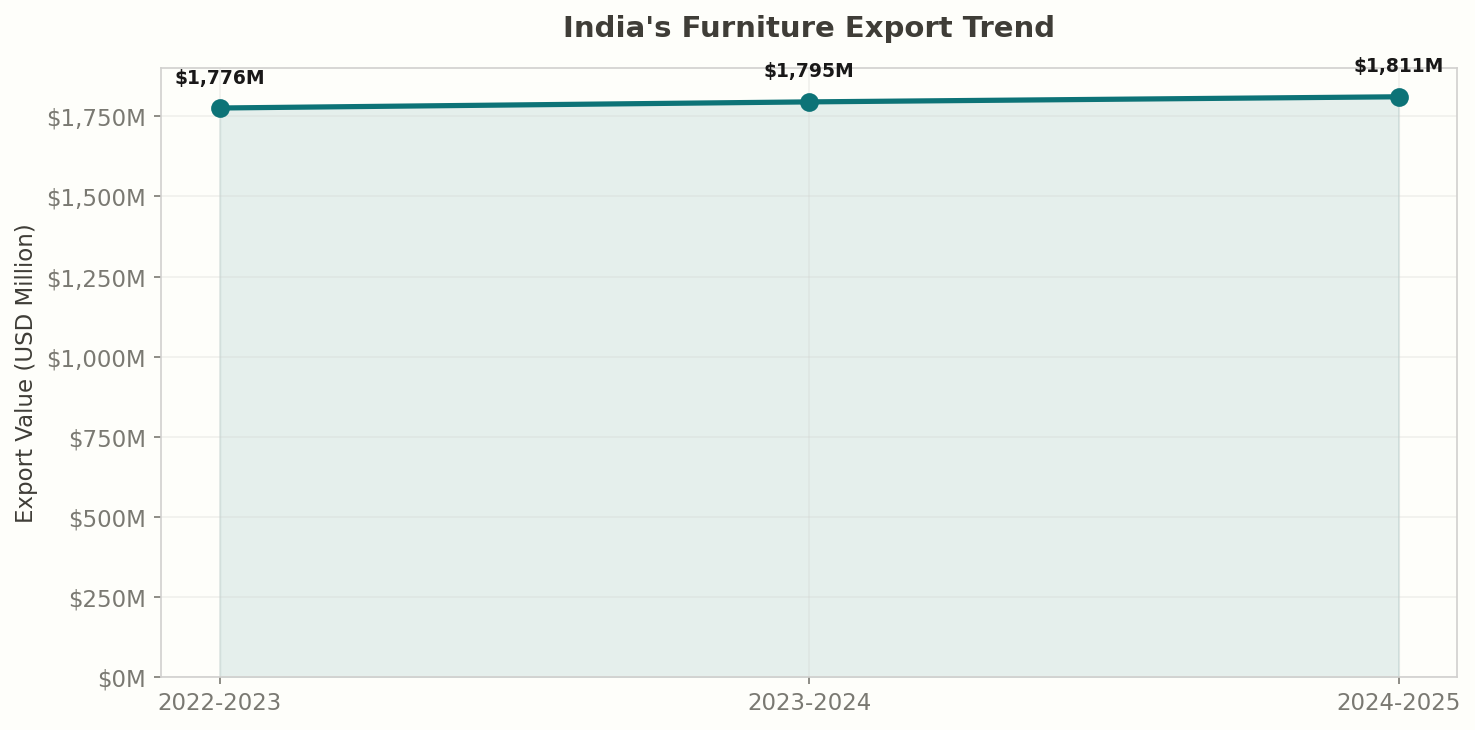
India exported $1,810.60 million in furniture products in 2024-25, spanning four major HS headings under Chapter 94:
| HS Code | Category | 2024-25 Exports (USD Million) | Share |
|---|---|---|---|
| 9403 | Other furniture (wooden, metal, plastic) | $1,149.6 | 63.5% |
| 9404 | Mattress supports, mattresses, bedding | $472.8 | 26.1% |
| 9401 | Seats (other than medical/dental) | $166.1 | 9.2% |
| 9402 | Medical, dental, surgical furniture | $22.0 | 1.2% |
"Other furniture" (HS 9403) dominates at $1.15 billion, covering the full range of tables, cabinets, shelving, bedroom furniture, and decorative wooden furniture that India is renowned for. Mattresses and bedding (HS 9404) represent the second largest category at $472.8 million, reflecting strong demand for Indian-made mattresses, quilts, and cushions. Seats (HS 9401) at $166.1 million cover chairs, sofas, and outdoor seating. Medical furniture (HS 9402) is a smaller but growing niche.
Where Indian Furniture Is in Demand
The USA is India's largest furniture export market by a significant margin, driven by demand for handcrafted, solid-wood, and industrial-chic furniture styles that Indian manufacturers excel at. European markets — Germany, the Netherlands, the UK, France, and Spain — collectively form the second major cluster, valuing Indian furniture for its craftsmanship and competitive pricing. The Middle East (UAE, Saudi Arabia) and Australia are growing markets. India's furniture exports span a wide range, from high-volume commercial furniture to artisanal, handcrafted pieces from clusters like Jodhpur, Saharanpur, and Jaipur.
Want the full country-by-country breakdown? See exact export values, growth rates, tariff rates, and market attractiveness scores for every destination in our detailed data pages. View Furniture export data by country →
Manufacturing Clusters
Jodhpur (Rajasthan)
India's largest furniture export cluster. Specialises in solid wood furniture (sheesham, mango wood, acacia), wrought iron furniture, and industrial/vintage styles. Over 2,000 manufacturers and exporters operate in the Jodhpur cluster. Known for hand-carved, hand-painted, and distressed-finish furniture. Proximity to Mundra Port (Gujarat) for shipping.
Saharanpur (Uttar Pradesh)
Traditional wood carving centre with centuries of craftsmanship heritage. Specialises in intricately carved wooden furniture, lattice screens (jali work), and decorative items. Sheesham and teak are the primary woods. Exports primarily to the UK, Germany, and Middle East.
Jaipur (Rajasthan)
Known for painted furniture, bone inlay work, mother-of-pearl inlay, and brass-fitted furniture. The Jaipur cluster produces distinctive decorative furniture that commands premium prices in Western markets. Also strong in stone-top tables and marble inlay work.
Mumbai-Pune Corridor (Maharashtra)
Focus on modern upholstered furniture, office furniture, and mattress manufacturing. Larger-scale, factory-based production compared to the artisanal clusters. Proximity to JNPT port.
Ernakulam-Thrissur (Kerala)
Teak furniture manufacturing, rosewood furniture (where legally sourced), and traditional South Indian designs. Also produces cane and rattan furniture.
Assam-Northeast
Bamboo and cane furniture manufacturing. A growing cluster with government support for Northeast handicraft and furniture exports.
HS Code Classification
Furniture products fall under HS Chapter 94. Classification at the 6-digit level:
| 6-Digit Code | Description | Examples |
|---|---|---|
| 940110 | Seats for aircraft | Aircraft seating components |
| 940130 | Swivel seats with variable height | Office chairs, adjustable stools |
| 940140 | Seats convertible into beds | Sofa beds, futons |
| 940161 | Upholstered wooden-frame seats | Sofas, armchairs, dining chairs |
| 940169 | Other wooden-frame seats | Wooden chairs, benches |
| 940171 | Upholstered metal-frame seats | Metal-frame sofas and chairs |
| 940179 | Other metal-frame seats | Metal chairs, stools |
| 940310 | Metal office furniture | Filing cabinets, metal desks |
| 940330 | Wooden office furniture | Wooden desks, bookcases |
| 940340 | Wooden kitchen furniture | Kitchen cabinets, trolleys |
| 940350 | Wooden bedroom furniture | Beds, wardrobes, dressers |
| 940360 | Other wooden furniture | Tables, sideboards, shelving |
| 940390 | Furniture of other materials | Rattan, bamboo, plastic, wrought iron |
| 940410 | Mattress supports | Bed bases, slat systems |
| 940421 | Cellular rubber mattresses | Foam mattresses |
| 940429 | Other material mattresses | Spring, coir, latex mattresses |
| 940490 | Sleeping bags, quilts, cushions | Bedding, duvets, pillows |
The majority of Indian furniture exports fall under 940350 (wooden bedroom furniture), 940360 (other wooden furniture), and 940490 (bedding/mattresses). Use the HS Code Finder for precise 8-digit ITC-HS classification.
Quality Standards and Certifications
Wood Treatment — ISPM 15
The International Standards for Phytosanitary Measures No. 15 (ISPM 15) is mandatory for all wood packaging materials (pallets, crates, dunnage) used in international trade. For wooden furniture specifically:
- All solid wood must be kiln-dried to a moisture content below 12% (for most markets)
- Wood packaging material must be heat-treated (HT) to 56 degrees Celsius core temperature for 30 minutes, or methyl bromide fumigated
- ISPM 15 stamp/mark is required on all wood packaging
- Some countries (Australia, New Zealand) have additional biosecurity requirements
Forest Certification — FSC/PEFC
FSC (Forest Stewardship Council): Increasingly demanded by European and US buyers as proof of sustainable wood sourcing. FSC Chain of Custody (CoC) certification tracks wood from the forest to the finished product. Many large retailers (IKEA, Crate & Barrel, West Elm) require FSC certification as a condition of purchase.
PEFC (Programme for the Endorsement of Forest Certification): An alternative to FSC, recognised globally. Indian teak plantations and managed forests can obtain PEFC certification.
Due Diligence: The EU Deforestation Regulation (EUDR), effective from December 2025, requires importers to demonstrate that wood products were not produced on deforested land. This will affect all wooden furniture exports to the EU and requires traceability to the forest/plantation of origin.
Chemical Compliance
REACH (EU): Registration, Evaluation, Authorisation and Restriction of Chemicals regulation applies to all products sold in the EU:
- Formaldehyde emissions from plywood, MDF, and composite wood: EN 717-1 limits (E1 class: 0.124 mg/m3)
- Heavy metals in paints, lacquers, and coatings
- VOC (Volatile Organic Compound) limits in finishes
- Restricted substances in upholstery textiles and foams
California Proposition 65: For USA (California) exports, furniture must comply with warnings for chemicals including formaldehyde, lead in paint, and certain flame retardants.
CARB (California Air Resources Board): Composite wood products (plywood, MDF, particleboard) must comply with CARB Phase 2 formaldehyde emission standards for USA exports. This is now a federal requirement under the Formaldehyde Standards for Composite Wood Products Act.
Furniture Safety Standards
| Standard | Scope | Required By |
|---|---|---|
| BIFMA (Business and Institutional Furniture Manufacturers Association) | Office and commercial furniture performance | USA commercial/contract market |
| EN 12520/12521 | Domestic furniture — strength, durability, safety | EU market |
| EN 1725 | Domestic tables — strength and durability | EU market |
| EN 747 | Bunk beds and high beds — safety | EU market |
| BS 7177 / EN 597 | Flammability of mattresses and upholstered furniture | UK market |
| AS/NZS 4610 | Furniture and fittings — safety | Australia/New Zealand |
| ASTM F2057 | Tip-over resistance for clothing storage units | USA (mandatory after STURDY Act) |
Tip-over safety: The USA STURDY Act requires clothing storage furniture (dressers, chests of drawers) to pass tip-over stability testing. This is particularly relevant for Indian wooden furniture exporters targeting the US market.
Packaging and Labelling
Packaging for Furniture
Furniture packaging is critical — damage during transit is the leading cause of buyer complaints and returns.
Fully assembled furniture:
- Corner protectors (foam, cardboard, or styrofoam)
- Stretch wrap (PE film) around the entire piece
- Corrugated cardboard outer layer
- Custom-sized master carton for smaller pieces
- Blanket wrapping for premium/antique pieces
Flat-pack/knock-down (KD) furniture:
- Components separated with cardboard dividers
- Hardware in labelled poly bags taped inside the carton
- Assembly instructions included (multilingual for export)
- Flat cartons, palletised for container loading
- Flat-pack reduces shipping costs by 40-60% compared to assembled furniture
Mattresses:
- Compressed and rolled (for foam/spring mattresses) — roll-packing significantly reduces shipping volume
- Vacuum-sealed in PE film
- Placed in printed cardboard boxes
Labelling Requirements
- USA: Country of origin ("Made in India"), care/cleaning instructions, material composition, flammability labels (California TB 117), CARB compliance label for composite wood
- EU: CE marking (for children's furniture), material composition, care labels, REACH compliance, fire safety rating (UK)
- All markets: Manufacturer identification, item description, dimensions, weight, assembly instructions (if KD)
Pricing Strategy
| Product Type | FOB Price Range | Key Markets |
|---|---|---|
| Solid wood dining table (6-seater) | $80-$300 | USA, UK, Germany |
| Wooden bed frame (queen) | $100-$400 | USA, UK, Australia |
| Carved wooden cabinet | $60-$250 | USA, France, Germany |
| Upholstered sofa (3-seater) | $150-$500 | USA, UK, UAE |
| Metal-and-wood industrial furniture | $30-$150 | USA, Netherlands, Germany |
| Bone inlay/mother-of-pearl furniture | $100-$800 | USA, UK, UAE |
| Foam mattress (queen) | $40-$120 | USA, UAE, Saudi Arabia |
| Coir mattress (queen) | $25-$80 | EU, Australia |
| Rattan/cane chair | $15-$60 | Australia, UK, France |
| Office chair (ergonomic) | $30-$120 | USA, UK |
India's FOB pricing is typically 30-50% below comparable European-made furniture and 15-25% below Chinese-made furniture for solid wood categories. The price advantage is strongest in handcrafted, solid-wood, and artisanal furniture where Indian craftsmanship creates genuine value.
Margins for furniture exports range from 15-30% for standard items and 25-45% for premium handcrafted and designer pieces.
Logistics
Shipping
Furniture is a volume-intensive product — container utilisation is the key logistics challenge.
Container loading:
- 20-ft container: 28-33 cubic metres — typically 6-10 large furniture pieces (assembled) or 20-40 flat-pack units
- 40-ft container: 58-67 cubic metres — the standard for furniture shipments
- 40-ft High Cube (HC): 76 cubic metres — preferred for bulky items like sofas, beds, wardrobes
- Flat-pack advantage: KD furniture can achieve 90%+ container utilisation vs. 50-60% for assembled furniture
Fumigation: Mandatory for wooden furniture exported to most countries. Methyl bromide or heat treatment at approved fumigation centres. The fumigation certificate must accompany every shipment.
Manufacturing Clusters and Nearest Ports
- Jodhpur cluster → Mundra Port (Gujarat, 5-6 hours) or JNPT (12-14 hours)
- Saharanpur cluster → ICD Tughlakabad (Delhi) → JNPT or Mundra
- Jaipur cluster → ICD Jaipur → Mundra or JNPT
- Mumbai-Pune → JNPT/Nhava Sheva (1-3 hours)
- Kerala → Kochi Port
Transit Times
- Mundra/JNPT to USA East Coast: 28-35 days
- Mundra/JNPT to USA West Coast: 22-28 days
- JNPT to UK: 20-25 days via Suez
- JNPT to Netherlands/Germany: 22-28 days
- JNPT to UAE: 5-8 days
- JNPT to Australia: 18-24 days
Freight Costs (Indicative)
- 40-ft container to USA: $3,500-$6,000
- 40-ft HC container to Europe: $3,000-$5,500
- 40-ft container to UAE: $1,200-$2,500
- 40-ft container to Australia: $2,500-$4,500
Documentation
- Commercial Invoice (with detailed item descriptions, material, dimensions, HS codes)
- Packing List (item-wise with measurements, weight, carton numbers)
- Bill of Lading
- Certificate of Origin (GSP Form A for EU, standard for USA, CEPA for UAE)
- Fumigation Certificate (mandatory for wooden furniture)
- Phytosanitary Certificate (from Plant Quarantine Division)
- ISPM 15 Compliance Declaration (for wood packaging)
- FSC/PEFC Chain of Custody Certificate (if buyer requires)
- Material Test Reports (formaldehyde emissions, REACH compliance, flammability)
- CARB/EPA Compliance Certificate (for composite wood products to USA)
- Shipping Bill (filed via ICEGATE)
- Insurance Certificate
For EU shipments post-2025, additionally prepare EUDR due diligence documentation demonstrating deforestation-free sourcing.
Government Incentives
RoDTEP (Remission of Duties and Taxes on Exported Products): 1-3% of FOB value for furniture products, depending on the specific HS code.
Duty Drawback: 1-4% of FOB value for furniture categories.
EPCG Scheme: Duty-free import of capital goods (woodworking machinery, CNC routers, upholstery equipment) against export obligations.
EPCH Support: The Export Promotion Council for Handicrafts provides support for furniture exporters through trade fair participation (Maison & Objet Paris, High Point Market USA, IFEX), buyer-seller meets, and design development assistance.
One District One Product (ODOP): Several furniture clusters (Jodhpur, Saharanpur) are identified under ODOP for focused development support including infrastructure, skills, and marketing.
SFURTI (Scheme of Fund for Regeneration of Traditional Industries): Cluster development support for traditional furniture artisans, including common facility centres, design studios, and marketing assistance.
Transport and Marketing Assistance (TMA): Freight support for exports to new markets, particularly in Africa and Latin America.
Common Mistakes to Avoid
Ignoring moisture content. Wood that is not properly kiln-dried will warp, crack, or develop mould in transit or after delivery. International buyers expect moisture content below 12% (often 8-10% for heated indoor environments in Europe and North America). Invest in proper kilns and moisture meters — test every batch before packing.
Failing fumigation or phytosanitary requirements. A container of wooden furniture rejected at port for inadequate fumigation results in the entire shipment being returned or destroyed — losses of Rs 10-30 lakh per container. Ensure fumigation is done by an approved agency and the certificate is valid for the destination country's requirements.
Not accounting for EUDR compliance. The EU Deforestation Regulation will require full traceability of wood to its origin. Indian exporters using illegally sourced timber or unable to demonstrate legal, deforestation-free sourcing will lose EU market access. Start building your wood sourcing documentation and consider FSC/PEFC certification now.
Underestimating packaging costs. Furniture damage rates of 5-15% during transit are common if packaging is inadequate. Damaged furniture cannot be sold and generates returns, replacement shipments, and buyer dissatisfaction. Budget 8-12% of FOB value for proper export packaging. Flat-pack where possible to reduce damage and freight costs.
Ignoring formaldehyde emission standards. Composite wood products (plywood, MDF, particleboard) must meet CARB Phase 2 standards for the US market and E1 standards for the EU. Using non-compliant composite materials will result in shipment rejection and potential legal liability. Source only from certified composite wood manufacturers.
Key Takeaways
- India exported $1,810.60 million in furniture in 2024-25, with "other furniture" (HS 9403) at $1.15B dominating
- USA ($862.9M) absorbs nearly half of all Indian furniture exports
- Jodhpur, Saharanpur, and Jaipur are the primary furniture export clusters, specialising in solid wood and handcrafted furniture
- ISPM 15 wood treatment and fumigation are mandatory for all wooden furniture exports
- FSC/PEFC certification is increasingly required by Western buyers for sustainable sourcing
- EU Deforestation Regulation (EUDR) will add traceability requirements from December 2025
- Flat-pack furniture reduces shipping costs by 40-60% and damage rates significantly
- India's price advantage of 30-50% over European furniture makes it highly competitive in solid wood categories
Next Steps
- Identify your HS code with the HS Code Finder — furniture spans Chapter 94 with specific codes for each type
- Ensure kiln-drying and fumigation capability — these are non-negotiable for wood furniture exports
- Check tariff rates using the Duty Calculator — furniture faces 0-5% duty in most Western markets
- Explore target markets with the Market Finder — identify demand for your furniture category
- Consider FSC Chain of Custody certification — the investment opens doors to premium buyers and prepares you for EUDR
- Invest in flat-pack/KD capability — this is the single most effective way to reduce logistics costs and expand your market reach
- Attend trade fairs — High Point Market (USA), Maison & Objet (Paris), IFEX (India), Index Dubai
India's furniture industry combines centuries of woodworking tradition with modern manufacturing capability. With growing global demand for sustainable, handcrafted, and solid-wood furniture — and buyers actively seeking alternatives to Chinese mass production — Indian furniture exporters are positioned for significant growth in the $600 billion global furniture market.
Ready to start exporting?
Get a detailed market report with country-by-country analysis, pricing insights, and buyer contacts.
Get Market ReportXIMPEX Export Advisory
Need help implementing the strategies discussed in this guide? Our team of export specialists can provide personalized guidance for your business.