How to Export Toys from India — Complete Guide
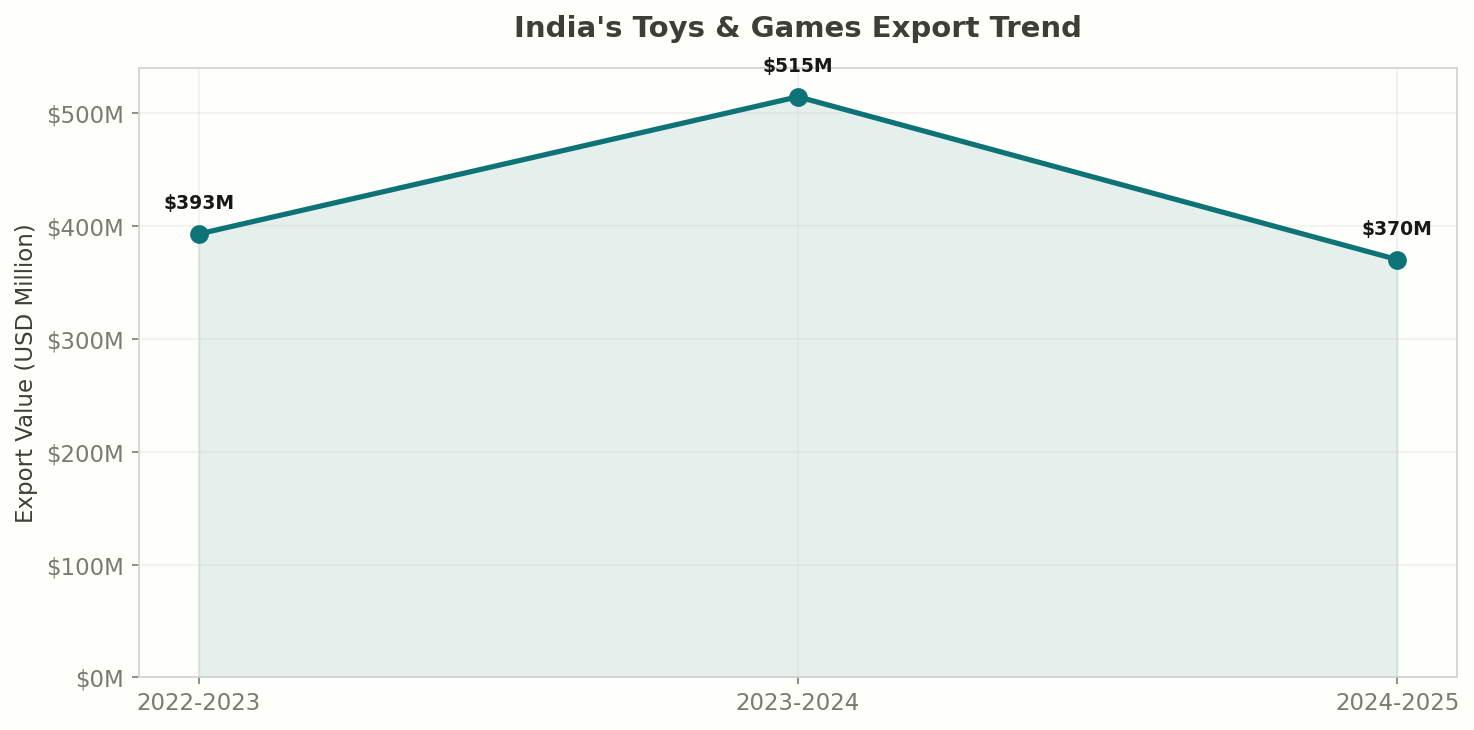
India's toy industry is in the midst of a transformation. In 2024-25, India exported $370 million in toys, games, and sports equipment under HS Chapter 95, with the government's "Aatmanirbhar Bharat" push driving both domestic manufacturing growth and export competitiveness. Toys proper (HS 9503) accounted for $152 million in 2023-24, sports requisites (HS 9506) reached $196 million, and festive/carnival articles (HS 9505) contributed $140 million. India has moved from being a net importer to an emerging exporter, with toy imports dropping 70% since 2018 while exports have doubled.
For MSME manufacturers — whether you produce wooden toys in Channapatna, soft toys in Delhi, educational toys in Jaipur, or plastic toys in Mumbai — the export opportunity is real. Global toy buyers are actively diversifying their supply chains beyond China, and India's competitive labour costs, growing manufacturing ecosystem, and government incentives make it an increasingly attractive sourcing destination. This guide covers everything from BIS certification to international safety standards, market access, and logistics.
India's Toy Export Landscape
India exported $370 million in toys, games, and sports equipment (Chapter 95) in 2024-25. The sector has grown significantly, driven by government policy interventions including mandatory BIS certification (which eliminated cheap, non-compliant imports), increased import duties, and the PLI scheme for toys.
| HS Code | Category | Exports (USD Million) | Period |
|---|---|---|---|
| 9503 | Toys (dolls, puzzles, models, stuffed animals, construction sets) | $152 | 2023-24 |
| 9506 | Sports requisites (equipment, gym, athletics) | $196 | 2024-25 |
| 9505 | Festive, carnival, entertainment articles | $140 | 2024-25 |
| 9504 | Video games, board games, playing cards | $38 | 2024-25 |
| 9501-9502 | Wheeled toys, dolls | Included in 9503 | — |
The toy category (HS 9503) is the core focus for most MSME exporters. India's strengths lie in wooden toys, educational toys, traditional games, soft/stuffed toys, and increasingly, plastic moulded toys. Sports requisites (HS 9506) represent a mature export category covering cricket equipment, yoga mats, gym equipment, and outdoor sports gear.
Where Indian Toys Are in Demand
The USA and UK are India's two largest toy export markets, together accounting for a dominant share. This reflects the global toy market's concentration in English-speaking, high-income countries with strong retail distribution. European markets — Germany, Netherlands, France — are the next cluster, with particular interest in wooden, educational, and sustainable toys where India has a competitive advantage. Australia, South Africa, and Canada are growing markets. India's toy exports have been boosted by the government's "China Plus One" push and PLI scheme, making India an increasingly attractive alternative source for toy brands.
Want the full country-by-country breakdown? See exact export values, growth rates, tariff rates, and market attractiveness scores for every destination in our detailed data pages. View Toys export data by country →
Product Categories
Wooden Toys
India has a rich tradition of wooden toy-making, with clusters in Channapatna (Karnataka), Kondapalli (Andhra Pradesh), Varanasi (UP), and Sawantwadi (Maharashtra). Products include stacking toys, pull-along toys, puzzles, building blocks, and kitchen playsets. Channapatna toys have GI (Geographical Indication) status. The global wooden toy market is growing at 10% annually, driven by eco-conscious parenting.
Soft and Stuffed Toys
Major manufacturing base in Delhi NCR and Mumbai. India produces plush animals, character-licensed stuffed toys, and educational soft toys. This category requires strict compliance with flammability, phthalate, and lead standards.
Educational and STEM Toys
A fast-growing category aligned with the global push for early learning. Indian manufacturers produce science kits, coding toys, maths learning aids, language building sets, and Montessori materials. Strong demand from USA, UK, Australia, and Germany.
Plastic Moulded Toys
Concentrated in Mumbai, Ahmedabad, and Delhi. Includes action figures, vehicles, dolls, construction sets, and outdoor play equipment. Requires significant tooling investment but offers scale advantages.
Traditional and Cultural Toys
Unique to India — board games (Pachisi/Ludo, Snakes and Ladders — which originated in India), traditional dolls (Thanjavur bommai, Chhau masks), and festival-related toys. Niche but premium-priced in Western markets.
HS Code Classification
| 6-Digit Code | Description | Examples |
|---|---|---|
| 950300 | Tricycles, scooters, pedal cars | Ride-on toys, pedal cars |
| 950340 | Billiards, table games | Board games, carrom |
| 950349 | Other toys (catch-all) | Dolls, action figures, playsets |
| 950390 | Parts and accessories | Toy components |
| 950510 | Christmas articles | Christmas decorations, ornaments |
| 950590 | Other festive articles | Festival decorations, carnival items |
| 950610 | Skis | Winter sports equipment |
| 950662 | Inflatable balls | Sports balls, play balls |
| 950691 | Athletic and outdoor equipment | Gym equipment, fitness gear |
Note: HS code 9503 was restructured in 2017 — many sub-headings were merged. Most toys now fall under a fewer number of 6-digit codes, making classification simpler but requiring precise 8-digit ITC-HS codes for Indian customs. Use the HS Code Finder for accurate classification.
Quality Standards and Certifications
BIS Mandatory Certification (India)
The Bureau of Indian Standards implemented a Quality Control Order (QCO) on toys, making BIS certification mandatory for all toys manufactured in or imported into India. This covers:
- IS 9873 (Parts 1-9) — Safety of toys (aligned with EN 71)
- IS 15644 — Safety of electric toys
- Products must bear the ISI mark after testing at BIS-recognised laboratories
For exporters: While BIS certification is a domestic requirement, having BIS-certified products demonstrates a quality baseline that reassures international buyers.
International Safety Standards
The toy industry is one of the most heavily regulated consumer product sectors globally. Key standards by market:
USA — CPSIA and ASTM F963:
- Consumer Product Safety Improvement Act (CPSIA) mandates third-party testing for all children's products
- ASTM F963 — Standard Consumer Safety Specification for Toy Safety. Covers mechanical/physical hazards, flammability, chemical properties
- Lead limit: 100 ppm in surface coatings, 100 ppm total lead in substrate
- Phthalate limits: 8 specific phthalates limited to 1,000 ppm (0.1%)
- Testing by CPSC-accepted laboratory required
- Children's Product Certificate (CPC) required for every shipment
- Age grading labels mandatory (CPSC age determination guidelines)
- Tracking labels on each toy (manufacturer, production date, batch)
EU — EN 71 and CE Marking:
- EN 71-1: Mechanical and physical properties
- EN 71-2: Flammability
- EN 71-3: Migration of certain elements (19 elements tested)
- EN 71-9 to EN 71-11: Organic chemical compounds
- CE marking mandatory — indicates conformity with EU Toy Safety Directive 2009/48/EC
- EC Declaration of Conformity required
- Authorised representative in the EU mandatory for non-EU manufacturers
Australia — AS/NZS 8124:
- Aligned closely with ISO 8124 (which is similar to EN 71)
- Mandatory safety standards under Consumer Protection Notice
- ACCC (Australian Competition and Consumer Commission) enforcement
Testing Laboratories
Products must be tested at internationally recognised labs. Key NABL-accredited and CPSC-accepted labs in India:
- SGS India — multiple locations
- Bureau Veritas — Delhi, Mumbai, Chennai
- Intertek — Bangalore, Delhi
- TUV SUD — Bangalore, Pune
- UL (Underwriters Laboratories) — Bangalore
Test costs typically range from Rs 50,000 to Rs 2,00,000 per SKU depending on the number of tests required. Budget for this upfront — testing is a cost of market access, not an optional expense.
Packaging and Labelling
Packaging Requirements
- Retail packaging: Printed cardboard boxes, blister packs, or window boxes that showcase the product
- Child safety: No small parts in packaging accessible without opening. Suffocation warning on plastic bags thicker than a threshold.
- Sustainability: Growing demand for plastic-free, recyclable packaging, especially in EU and UK markets
- Bulk/master cartons: Corrugated boxes, palletised for container loading. Carton markings: PO number, SKU, quantity, gross/net weight, carton dimensions
Labelling Requirements
USA (CPSC/CPSIA):
- Age grading ("For ages 3+" or specific range)
- Choking hazard warning for small parts ("WARNING: CHOKING HAZARD — Small parts. Not for children under 3 years.")
- Manufacturer or importer name and address
- Tracking label: manufacturer, production location, date of manufacture, batch number
- Country of origin ("Made in India")
EU (Toy Safety Directive):
- CE marking (visible, legible, indelible)
- Age warning pictogram and text
- Manufacturer name and registered address
- EU Authorised Representative name and address
- Batch or serial number for traceability
- Instructions in the language(s) of the destination country
General:
- All warnings and instructions in the destination country's language
- Battery safety warnings (if applicable)
- Material composition (for soft/stuffed toys)
Pricing Strategy
| Product Type | FOB Price Range | Key Markets |
|---|---|---|
| Wooden toys (simple) | $1-$5/piece | USA, UK, Germany, Australia |
| Wooden toys (premium/GI) | $5-$25/piece | Germany, Denmark, UK |
| Soft/stuffed toys (small) | $1-$4/piece | USA, UK, UAE |
| Soft/stuffed toys (large) | $5-$20/piece | USA, UK |
| Plastic moulded toys | $0.50-$8/piece | USA, South Africa, UAE |
| Educational/STEM kits | $3-$30/kit | USA, UK, Australia, Canada |
| Board games | $2-$15/game | USA, UK, Germany |
| Sports equipment (basic) | $5-$50/piece | USA, UK, Australia |
India's price advantage over China has narrowed for plastic toys but remains significant for wooden toys (30-50% cheaper), soft toys (20-40% cheaper), and handcrafted items. The real competitive edge is in small-batch, customised, and eco-friendly products where Chinese mass-production models are less efficient.
Margins for toy exports typically range from 15-35%, with premium handcrafted and educational categories at the higher end.
Logistics
Shipping
- Ocean freight for regular production orders (20-ft or 40-ft containers)
- Air freight for samples, urgent orders, and seasonal rush shipments (Christmas toys must arrive by September for USA/EU retail)
- LCL (Less than Container Load) for small initial orders — available through freight consolidators
Manufacturing Clusters and Ports
- Channapatna (Karnataka) → Chennai Port (5-6 hours) or Bangalore ICD
- Delhi NCR (soft/plastic toys) → ICD Tughlakabad → JNPT or via rail
- Mumbai (plastic toys) → JNPT/Nhava Sheva
- Jaipur (educational/traditional) → ICD Jaipur → Mundra or JNPT
Transit Times
- JNPT to USA East Coast: 28-35 days
- JNPT to UK: 20-25 days via Suez
- Chennai to Australia: 14-18 days
- JNPT to Germany: 22-28 days
Freight Costs (Indicative)
- 20-ft container to USA: $2,500-$4,500
- 40-ft container to Europe: $3,000-$5,500
- 40-ft container to Australia: $2,000-$4,000
- Air freight: $4-$8 per kg
Container Capacity
Toys are typically high-volume, low-weight products:
- 40-ft container: 55-65 cubic metres of volume
- Wooden toys: 8,000-15,000 pieces per 40-ft container (depends on size)
- Stuffed toys: 5,000-20,000 pieces per 40-ft container (low density, high volume)
Seasonal Planning
The toy industry is heavily seasonal. For the Christmas/holiday market (70% of annual Western retail toy sales):
- Production: April-July
- Shipping: August-September (sea freight)
- Retail shelves: October-November
- Miss the August shipping window and you miss the year
Documentation
- Commercial Invoice (with per-piece pricing, HS codes, age grading)
- Packing List (SKU-wise breakdown with quantities and carton details)
- Bill of Lading / Airway Bill
- Certificate of Origin (GSP Form A for EU, standard for USA)
- Children's Product Certificate — CPC (mandatory for USA, issued by manufacturer based on third-party test reports)
- Third-Party Test Reports (ASTM F963 for USA, EN 71 for EU, AS/NZS 8124 for Australia)
- EC Declaration of Conformity (for EU — CE marking)
- BIS Certificate (demonstrates domestic quality compliance)
- Material Safety Data Sheets (for toys with batteries, paints, or chemicals)
- Shipping Bill (filed via ICEGATE)
- Insurance Certificate
Government Incentives
PLI Scheme for Toys: The Production-Linked Incentive scheme provides financial incentives to toy manufacturers who achieve incremental sales thresholds. Incentives range from 2-5% of incremental sales over the base year.
Toy Clusters under MSME: The government has identified 10 toy manufacturing clusters for development, including Channapatna, Varanasi, Jaipur, and Kondapalli. Cluster development includes common facility centres, testing labs, and design studios.
RoDTEP: Remission of Duties and Taxes on Exported Products at 1-3% of FOB value for toy categories.
Duty Drawback: 1-2.5% of FOB value for toys.
EPCG Scheme: Duty-free import of capital goods (moulding machines, testing equipment) against export obligations.
BIS QCO Protection: The mandatory BIS certification on toys has effectively created a non-tariff barrier that protects domestic manufacturers from cheap, non-compliant imports — this has strengthened the domestic manufacturing base that now supports export growth.
National Action Plan for Toys: A comprehensive government initiative to make India a global toy manufacturing hub, including design support, skill development, and market access assistance.
Common Mistakes to Avoid
Skipping third-party testing. Toy safety compliance is non-negotiable. In the USA, CPSC can seize non-compliant shipments at the port and impose civil penalties up to $100,000 per violation. In the EU, RAPEX (Rapid Alert System) notifications for unsafe toys lead to product recalls and border seizures. Every product must be tested by an accredited third-party lab before export.
Ignoring age grading requirements. Age grading is not marketing — it is a safety classification. A toy designed for ages 6+ that lacks a choking hazard warning because small parts were not considered can result in product liability lawsuits in the USA. Follow CPSC age determination guidelines or EN 71-1 Annex A for age classification.
Underestimating lead and phthalate limits. Chinese paint pigments and PVC softeners commonly used in Indian toy manufacturing may contain lead or phthalates above CPSIA limits. Verify every material in your supply chain — paints, coatings, plastics, textile dyes. Test raw materials, not just finished products.
Missing the seasonal window. The global toy industry is driven by the Christmas/holiday season. Retail buyers place orders in Q1, expect delivery by Q3. If your production or testing is delayed and you miss the shipping window, the order is cancelled. Plan your production calendar 9-12 months ahead.
Not having product liability insurance. The USA has aggressive product liability laws. A single injury claim on a toy can result in millions of dollars in damages. Product liability insurance ($1-3 million coverage) costs $5,000-$15,000 annually but is essential for USA exports. Many US retailers will not place orders without proof of insurance.
Key Takeaways
- India exported $370 million in toys, games, and sports equipment (Chapter 95) in 2024-25
- USA ($130M), UK ($52M), and Australia ($28M) are the top three markets
- BIS mandatory certification has strengthened India's domestic manufacturing base
- CPSIA/ASTM F963 (USA) and EN 71/CE marking (EU) compliance is non-negotiable
- Lead (100 ppm) and phthalate (1,000 ppm) limits are the most critical chemical safety parameters
- India's competitive advantage is strongest in wooden toys, educational/STEM products, and handcrafted items
- The Christmas shipping window (August-September) drives the entire annual production cycle
- PLI scheme and toy cluster development are making India increasingly competitive against China
Next Steps
- Identify your HS code using the HS Code Finder — toys span HS 9503-9506 with specific sub-headings for each type
- Get your products tested at a CPSC-accepted lab (for USA) or notified body (for EU) — budget Rs 50,000-2,00,000 per SKU
- Obtain BIS certification for your products if not already certified — this is mandatory domestically and demonstrates quality internationally
- Research target markets with the Market Finder — identify demand for your specific toy category
- Check tariff rates using the Duty Calculator — toys face 0-6.5% duty in most Western markets
- Attend trade fairs — Spielwarenmesse (Nuremberg), Toy Fair New York, Hong Kong Toys and Games Fair, India Toy Fair (Delhi)
- Build a seasonal production plan — work backward from August shipping deadlines for the Christmas market
India's toy industry is at an inflection point. With Chinese toy exports facing increasing scrutiny and costs, global buyers are actively seeking reliable Indian suppliers. The MSME manufacturers who invest in safety compliance, quality testing, and design capability will be the ones who capture this generational opportunity.
Ready to start exporting?
Get a detailed market report with country-by-country analysis, pricing insights, and buyer contacts.
Get Market ReportXIMPEX Export Advisory
Need help implementing the strategies discussed in this guide? Our team of export specialists can provide personalized guidance for your business.