How to Export Carpets and Rugs from India — Complete Guide
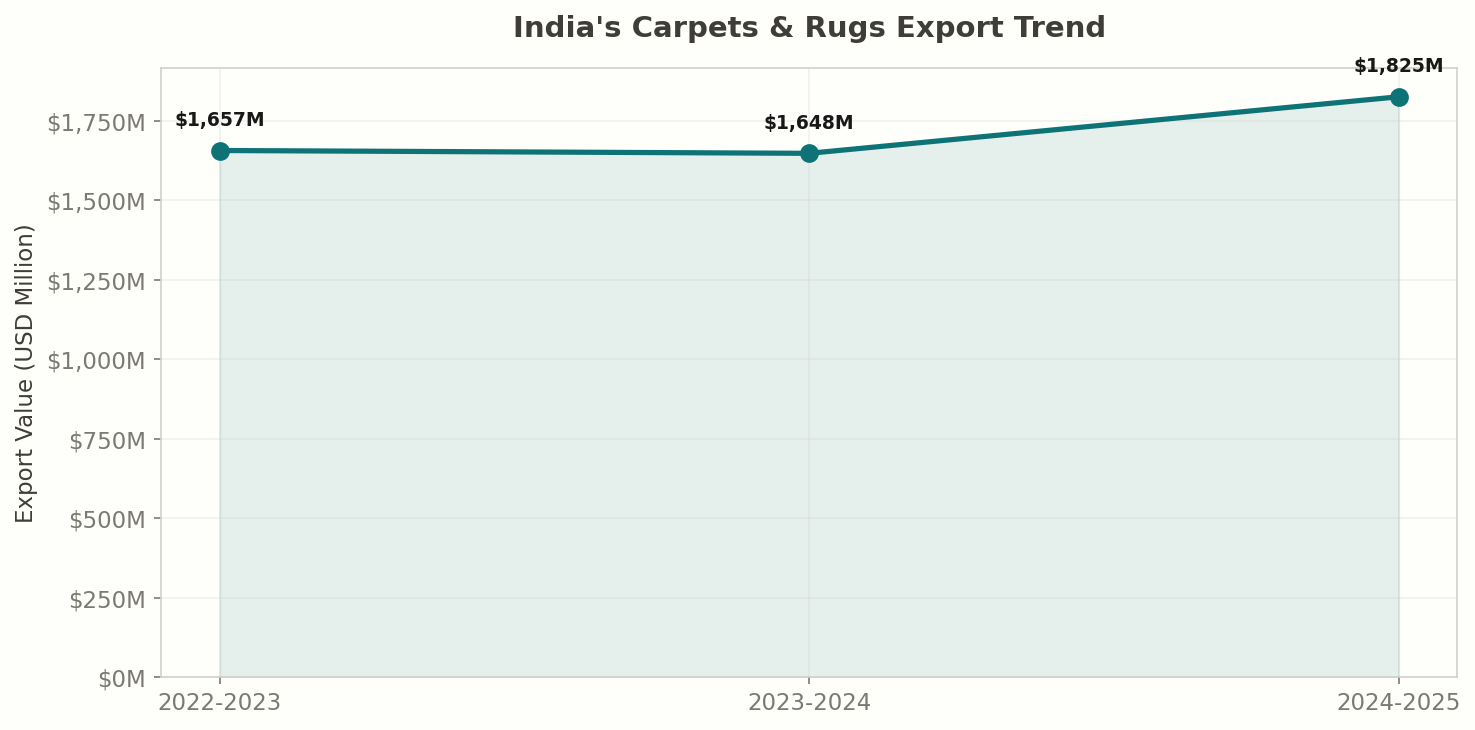
India is the world's largest exporter of handmade carpets and a major producer of machine-made floor coverings, shipping $1.83 billion worth of carpets and rugs in 2024-25 under HS headings 5701-5705. From hand-knotted silk carpets woven in Kashmir to tufted rugs from Bhadohi, from coir mats in Kerala to jute dhurries in West Bengal — India's carpet industry spans centuries of tradition and millions of artisan livelihoods.
India's Carpet Export Landscape
India exported $1.83 billion in carpets and rugs in 2024-25, up from $1.66 billion in 2022-23 — a healthy 10.2% growth over two years.
| HS Code | Category | 2024-25 Exports (USD Million) | Share |
|---|---|---|---|
| 570500 | Tufted carpets | $292.8 | 16.0% |
| 570390 | Other textile floor coverings | $282.8 | 15.5% |
| 570110 | Hand-knotted carpets (wool/fine animal hair) | $231.2 | 12.7% |
| 570310 | Woven carpets, of pile, wool | $214.5 | 11.7% |
| 570231 | Woven carpets, not of pile (kelim, etc.) | $210.4 | 11.5% |
| 570232 | Man-made textile floor coverings | $104.0 | 5.7% |
| 570299 | Other woven, not of pile | $93.1 | 5.1% |
| 570190 | Other knotted carpets | $77.4 | 4.2% |
| 570242 | Pile, of man-made textile | $65.9 | 3.6% |
The product mix is remarkably diverse. Tufted carpets ($293M) have emerged as the largest single category, reflecting growing demand for hand-tufted rugs that offer the look of hand-knotted carpets at lower price points. Hand-knotted carpets ($231M) remain the premium category with the highest per-unit value.
Where Indian Carpets and Rugs Are in Demand
The USA is by far the largest market for Indian handmade carpets and rugs, absorbing a dominant share of exports. European buyers — particularly in Germany, the UK, and the Nordic countries — form the second major cluster, prizing Indian hand-knotted rugs for their craftsmanship and value proposition compared to Persian and Turkish alternatives. Australia, Canada, and the UAE are growing markets. The demand pattern is clear: wealthy, design-conscious markets with strong home furnishing cultures are the natural buyers for Indian carpets, whether hand-knotted, hand-tufted, or machine-made.
Want the full country-by-country breakdown? See exact export values, growth rates, tariff rates, and market attractiveness scores for every destination in our detailed data pages. View Carpets and Rugs export data by country →
Manufacturing Clusters
Bhadohi-Mirzapur (UP) — India's Carpet Belt
- World's largest hand-knotted and hand-tufted carpet production cluster
- Over 2 million weavers, 80% of India's handmade carpet exports
- Specialises in wool, silk, and blended carpets
- Hand-knotted, hand-tufted, flat-weave, and loom-made
Kashmir
- Finest quality hand-knotted silk carpets (GI-tagged "Kashmir Carpet")
- Silk-on-silk and silk-on-cotton constructions
- 400-900 knots per square inch (highest in the world)
- Premium segment — a single Kashmir silk carpet can cost $5,000-$50,000
Jaipur (Rajasthan)
- Hand-block printed rugs, dhurries, cotton flat-weaves
- Contemporary designs for Western markets
- Growing hub for sustainable/organic fibre rugs
Kerala/Tamil Nadu
- Coir (coconut fibre) mats and rugs
- Natural fibre products for eco-conscious markets
- India produces 80% of the world's coir
West Bengal/Odisha
- Jute rugs and dhurries
- Natural fibre braided and woven floor coverings
HS Code Classification
| 6-Digit Code | Description | Indian Product |
|---|---|---|
| 570110 | Knotted, wool/fine animal hair | Kashmir carpets, Bhadohi hand-knotted |
| 570190 | Knotted, other textile materials | Silk carpets, blended fibre knotted |
| 570210 | Kelim, Schumacks, Karamanie | Traditional flat-weave |
| 570231 | Woven, not of pile, wool | Handwoven wool dhurries |
| 570310 | Woven of pile, wool | Wilton, Axminster-style wool |
| 570390 | Other textile floor coverings | Cotton/jute/blended floor coverings |
| 570500 | Tufted carpets | Hand-tufted and machine-tufted rugs |
Key distinction: "Hand-knotted" (5701) is the premium category with zero duty in most markets. "Hand-tufted" (5705) is mid-range. "Machine-made" (5702-5703) faces the highest tariffs. Correct classification matters enormously for duty rates.
Use the HS Code Finder for precise classification.
Quality Standards and Certifications
CEPC Membership
The Carpet Export Promotion Council is the apex body:
- RCMC from CEPC required for export incentives
- CEPC issues "Handmade" certificates authenticating hand-knotted/hand-tufted production
- Organises India Carpet Expo (Varanasi) and participates in Domotex (Hanover)
Social Compliance — The Critical Factor
The carpet industry has historically faced scrutiny over child labour. Certifications addressing this are practically mandatory:
- Goodweave (formerly Rugmark) — The most recognised child-labour-free certification. US buyers (Pottery Barn, Crate & Barrel, West Elm) typically require Goodweave certification.
- SA8000 — Social Accountability standard for factory conditions
- SMETA/SEDEX — Ethical trade audit required by UK and European buyers
- Care & Fair — German-led initiative for social welfare in carpet communities
Quality Certifications
- ISO 9001 — Quality management
- Oeko-Tex Standard 100 — Certifies carpets are free from harmful substances (important for EU/US retail)
- Green Label Plus — Low VOC emissions (required for US commercial/hospitality market)
- Organic Content Standard (OCS) — For carpets using organic wool or cotton
Physical Testing Standards
- Pile height, weight, and density — Specified per buyer tech pack
- Colour fastness — To light (ISO 105-B02), rubbing (ISO 105-X12), water (ISO 105-E01)
- Dimensional stability — Shrinkage testing
- Flammability — CPSC 16 CFR 1630/1631 (USA), EN 13501 (EU)
Testing Laboratories and Costs
The primary testing labs for carpet exports include the Textile Committee laboratories (Mumbai, Chennai, Varanasi), SGS India, Bureau Veritas, and Intertek. The Carpet Export Promotion Council operates its own quality testing lab in Bhadohi. A comprehensive test report covering colour fastness (light, rubbing, water, perspiration), flammability (pill test per 16 CFR 1630), dimensional stability, fibre content analysis, and Oeko-Tex screening costs Rs 15,000-40,000 per sample depending on the number of parameters. Turnaround time is typically 7-15 working days. For Oeko-Tex Standard 100 certification, testing costs Rs 50,000-1,50,000 per product class and the certificate is valid for one year with annual renewal testing. NABL-accredited labs are recommended for internationally accepted test reports — buyers in the USA and EU increasingly require testing from labs with ISO 17025 accreditation.
Packaging and Labelling
Packaging
- Carpets rolled (not folded, to prevent crease marks) around cardboard tubes
- Wrapped in polyethylene film for moisture protection
- Bundled and placed in corrugated cartons or wrapped in hessian/jute fabric
- Moth-repellent sachets included for wool carpets (naphthalene-free, using cedar or lavender)
Labelling
- USA: Textile Fiber Products Identification Act — fibre content (%), country of origin, manufacturer name. FTC requires "Made in India" clearly visible. California Proposition 65 warnings may be required if dyes or treatments contain listed chemicals. The CPSC requires flammability compliance labelling for all floor coverings.
- EU: Textile Regulation (EU) 1007/2011 — fibre composition labelling in the language of the destination country. The EU Ecolabel (optional but beneficial) requires meeting stringent environmental criteria for the entire production chain. REACH compliance declarations must confirm absence of restricted substances, particularly SVHC (Substances of Very High Concern) in dyes and finishing chemicals.
- Middle East (GCC): Arabic-language labelling with fibre content, dimensions, country of origin, and care instructions. UAE's ESMA and Saudi Arabia's SASO conformity marks may be required for retail distribution. For hospitality projects, fire safety test certificates per local building codes must accompany the shipment.
- All markets: Dimensions (length × width), care instructions (vacuum, spot clean, professional cleaning)
- Commercial projects: Green Label Plus number, flammability test certificate reference
Pricing Strategy
| Carpet Type | FOB Price Range (per sq ft) | Key Markets |
|---|---|---|
| Hand-knotted silk (Kashmir) | $30-$200+ | USA, Germany, UAE |
| Hand-knotted wool (Bhadohi) | $8-$40 | USA, Germany, UK |
| Hand-tufted wool | $4-$15 | USA, UK, Australia |
| Flat-weave dhurrie (cotton/wool) | $2-$8 | USA, EU |
| Machine-tufted | $1.50-$5 | USA, EU |
| Coir mat/rug | $1-$4 | EU, Australia |
| Jute rug | $1.50-$5 | USA, EU |
Hand-knotted Kashmir silk carpets at the top end ($100-200/sq ft) can be priced at $5,000-$50,000 per piece. The bulk market, however, is in hand-tufted wool rugs at $4-15/sq ft, which offer good margins (20-35%) and large order volumes.
Logistics
Shipping
- Sea freight — Standard for all carpet exports (carpets are light relative to volume)
- Carpets are "volume freight" — a 40-ft container holds $30,000-$200,000 worth of carpets but only weighs 8-12 tonnes (well below the 26-tonne weight limit)
Container Capacity
- 40-ft container: 3,000-6,000 sq ft of hand-tufted rugs (depends on pile height and size)
- 40-ft HC (High Cube): Preferred for carpets due to extra height (9'6" vs 8'6")
Transit Times
- JNPT to USA East Coast: 28-35 days
- ICD Delhi to EU ports: 25-32 days
- JNPT to UK: 18-22 days
- JNPT to Australia: 22-28 days
Freight Costs
- 40-ft HC container to USA: $3,000-$5,500
- 40-ft HC to EU: $2,500-$4,500
- 40-ft to Australia: $2,000-$4,000
Shipping Routes and Considerations
The primary shipping route for Bhadohi-Mirzapur carpet exports runs from the ICD at Varanasi or Kanpur (rail) to JNPT Mumbai, where carpets are loaded onto vessels. For exports to the USA East Coast, containers transit via Colombo or Singapore hub ports with a total transit of 28-35 days. European shipments via the Suez Canal take 20-28 days to reach major ports like Hamburg, Rotterdam, or Felixstowe. For Middle Eastern markets, direct services from JNPT to Jebel Ali (Dubai) take just 5-7 days, making the Gulf an attractive market for smaller, trial shipments. LCL (Less than Container Load) shipping is common for smaller exporters and sample shipments — consolidation services are available at all major ICDs. Freight forwarders specialising in carpet logistics (like ATC Logistics and DHL Trade Fairs) understand the specific handling requirements and can arrange door-to-door delivery including customs clearance at destination.
Documentation
- Commercial Invoice (with design number, size, fibre content, knot count)
- Packing List
- Bill of Lading
- Certificate of Origin
- CEPC RCMC Certificate
- Handmade Certificate (from CEPC, for handmade carpets)
- Goodweave/Social Compliance Certificate
- Oeko-Tex Certificate (if applicable)
- Flammability Test Report (16 CFR 1630/1631 for USA)
- Fibre Content Test Report
- Shipping Bill (via ICEGATE)
- Insurance Certificate
Government Incentives
- RoDTEP — 2-4% of FOB value (handmade carpets get higher rates)
- Duty Drawback — 1-3%
- Handloom/Handicraft tag — Additional incentives for certified handmade products
- CEPC market development — Trade fair subsidies, buyer-seller meets
- Mega Cluster Scheme — Government investment in carpet cluster infrastructure in Bhadohi-Mirzapur
- Design development — CEPC and NID (National Institute of Design) collaborate on contemporary design workshops for traditional weavers
- RoDTEP specifics — Handmade carpets (HS 5701) attract RoDTEP rates of 3-4% of FOB value, among the highest in any export category. Machine-made carpets receive 1.5-2.5%. The higher rate for handmade products reflects government support for artisan livelihoods.
- MSME Credit Facilitation — Carpet exporters registered as MSMEs can access pre-shipment and post-shipment credit at subsidised rates under RBI's priority sector lending norms. The Interest Equalisation Scheme provides a 3% (5% for MSMEs) interest subvention on rupee export credit for handmade textile products.
- CEPC Trade Fair Support — CEPC provides subsidies of up to 90% of stall rental for MSMEs participating in international trade fairs. Key sponsored events include Domotex Hanover, NY NOW (New York), Maison et Objet (Paris), and the India Carpet Expo in Varanasi (held twice yearly).
- Market Access Initiative (MAI) — DGFT reimburses up to 75% of the cost of market studies, publicity campaigns, and participation in trade delegations through the MAI scheme, particularly useful for entering new markets.
Common Mistakes
Failing social compliance audits. The carpet industry is under intense scrutiny for child labour and working conditions. A single incident can lead to buyer blacklisting and PR damage. Invest in social compliance before approaching Western buyers.
Using azo dyes. EU REACH regulation bans azo dyes that release carcinogenic amines. Many traditional Indian carpet dyes contain restricted azo compounds. Switch to REACH-compliant dyes and test every batch.
Misrepresenting "handmade" status. Claiming a machine-tufted carpet as "hand-tufted" is fraud and leads to US Customs penalties, buyer blacklisting, and potential import bans. Classify honestly.
Ignoring design trends. The US and European rug market is fashion-driven. Designs that sold well 5 years ago may not sell today. Invest in trend research — attend Domotex (January, Hanover) and subscribe to design trend services.
Inconsistent colour matching. Buyers order based on an approved sample. If the production batch doesn't match the sample colour (within Delta E ≤2), the shipment is rejected. Use standardised dye recipes and lab-dip approval processes.
Shipping without fumigation certificates. Many importing countries require proof that textile products have been fumigated or are pest-free. Wool carpets in particular can harbour carpet beetles and moths. Include fumigation certificates using approved methods — phosphine-based fumigation for most markets, heat treatment where methyl bromide is restricted.
Underestimating lead times for custom orders. Hand-knotted carpets take 3-12 months to produce depending on size and knot density. Hand-tufted rugs require 4-8 weeks. Failing to communicate realistic lead times leads to cancelled orders and strained buyer relationships. Always add a 15-20% buffer to production timelines when quoting delivery dates.
Not investing in digital design presentation. Modern buyers expect high-resolution digital renders, Pantone colour references, and 3D room mock-ups showing carpets in situ. Investing in CAD design software (like Galaincha or NedGraphics for carpets) and a professional product photography setup dramatically improves conversion rates with international buyers.
Key Takeaways
- India exported $1.83 billion in carpets and rugs in 2024-25
- USA ($1.06B) absorbs 58% — the most US-dependent export category
- Hand-tufted ($293M), hand-knotted ($231M+), and flat-weave ($210M) are the top categories
- Goodweave/social compliance certification is practically mandatory for Western markets
- Kashmir silk carpets ($30-200/sq ft) are the premium segment; hand-tufted wool ($4-15/sq ft) is the volume market
- CEPC membership and handmade certification are required for incentives and market access
- Carpets are volume freight — a 40-ft container is space-limited, not weight-limited
Next Steps
- Identify your HS code with the HS Code Finder — hand-knotted vs. tufted vs. machine-made changes everything
- Register with CEPC and get your RCMC
- Check tariff rates using the Duty Calculator — handmade carpets often enter duty-free
- Get Goodweave certified — the entry ticket to US premium buyers
- Invest in Oeko-Tex 100 — required by most EU and US retail chains
- Explore market demand with the Market Finder
- Attend Domotex (Hanover, January) and India Carpet Expo (Varanasi) — the industry's premier trade events
India's carpet heritage is legendary. From the Mughal era to modern contemporary design, Indian carpets have adorned homes and palaces worldwide for centuries. Today's $1.83 billion export market is proof that this tradition translates into thriving commercial opportunity.
Ready to start exporting?
Get a detailed market report with country-by-country analysis, pricing insights, and buyer contacts.
Get Market ReportXIMPEX Export Advisory
Need help implementing the strategies discussed in this guide? Our team of export specialists can provide personalized guidance for your business.