How to Export Cashew Nuts from India — Complete Guide
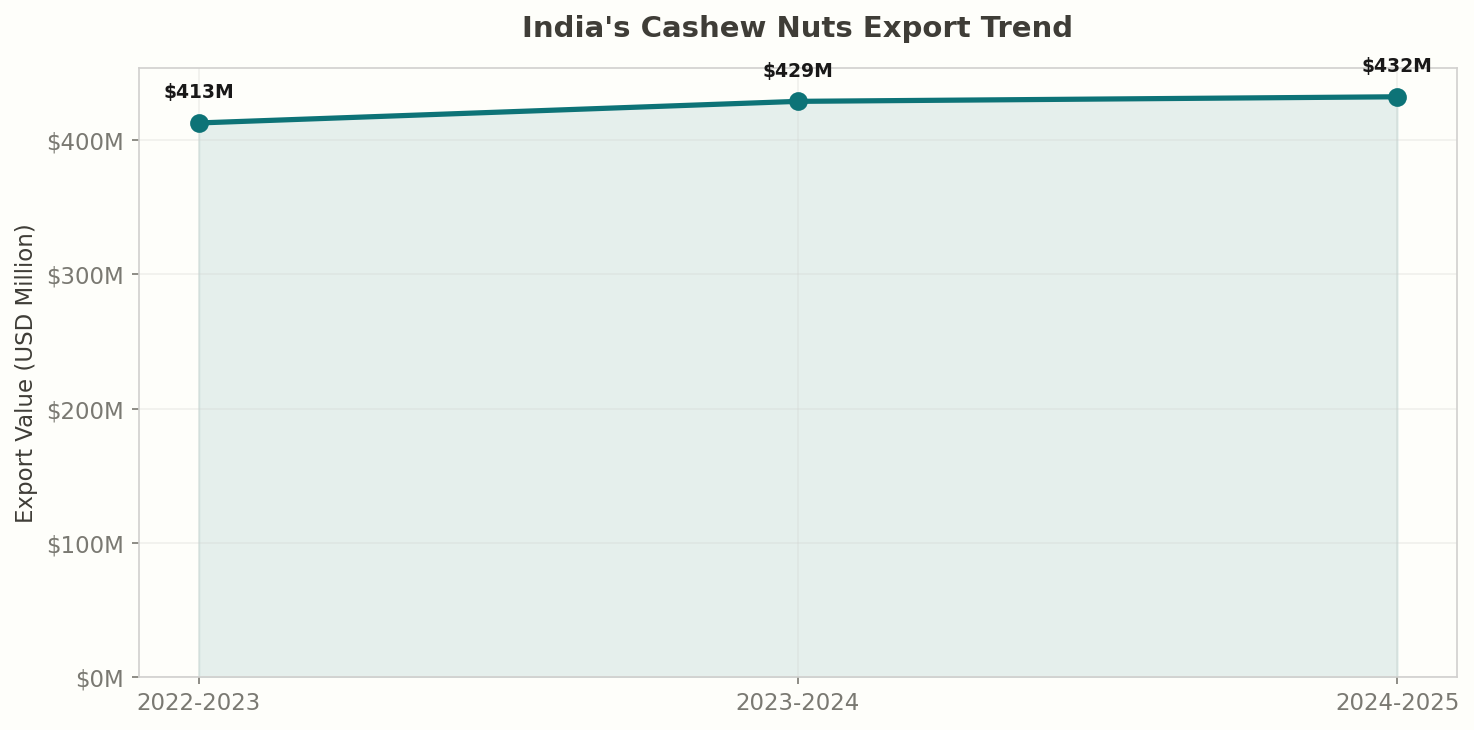
India is the world's largest processor and second-largest exporter of cashew kernels, shipping $432 million worth of cashew and other tree nuts (HS 0801) in 2024-25. India's cashew industry is unique — while India produces a significant volume of raw cashew nuts, it also imports vast quantities of raw cashews from Africa (Ivory Coast, Tanzania, Guinea-Bissau) for processing into kernels for re-export. This import-process-export model has made India the world's dominant cashew processing hub.
For MSME exporters, cashews offer a mature export business with established global demand, year-round processing capability, and strong government support through the Cashew Export Promotion Council of India (CEPCI). The key challenge is managing the volatile raw cashew supply chain while maintaining quality standards for premium markets.
India's Cashew Export Landscape
India exported $432 million in nuts under HS 0801 in 2024-25, steady growth from $413 million in 2022-23:
| HS Code | Category | 2024-25 Exports (USD Million) | Share |
|---|---|---|---|
| 080132 | Cashew nuts, shelled | $293.9 | 68.0% |
| 080131 | Cashew nuts, in shell | $44.3 | 10.3% |
| 080119 | Other nuts, in shell | $39.9 | 9.2% |
| 080112 | Brazil nuts, shelled | $34.9 | 8.1% |
| 080111 | Brazil nuts, in shell | $19.2 | 4.4% |
Shelled cashew kernels ($294M) dominate at 68%, reflecting India's value-addition strength. India processes approximately 1.5 million tonnes of raw cashew nuts annually in over 3,500 processing units, primarily in Kerala, Goa, Karnataka, and Maharashtra.
Where Indian Cashews Are in Demand
Indian processed cashew nuts are exported to over 60 countries. The USA and the UAE are traditionally the two largest buyers, driven by snacking culture and the premium positioning of Indian cashew grades (W180, W210, W240). European markets — particularly the Netherlands (which acts as a re-export hub), Germany, and the UK — represent a significant cluster. Japan and South Korea are growing Asian markets. The Middle East, with its large Indian diaspora and gifting culture, provides year-round demand for premium grades.
Want the full country-by-country breakdown? See exact export values, growth rates, tariff rates, and market attractiveness scores for every destination in our detailed data pages. View Cashew Nuts export data by country →
Cashew Kernel Grading System
India uses an internationally recognised grading system for cashew kernels:
Whole Kernels (W Grades)
| Grade | Size (Kernels per lb) | Description | Price Premium |
|---|---|---|---|
| W180 | 170-180 | "King of Cashews" — largest | Highest (+40-60%) |
| W210 | 200-210 | Jumbo | High (+25-35%) |
| W240 | 220-240 | Premium standard | Benchmark price |
| W320 | 300-320 | Most traded grade globally | Baseline |
| W450 | 400-450 | Small wholes | -10-15% vs W320 |
Splits and Pieces
| Grade | Description | Use |
|---|---|---|
| S | Splits (halves) | Snack mixes, cooking |
| LP | Large pieces | Bakery, confectionery |
| SP | Small pieces | Food processing, butter |
| B | Butts | Food processing |
| SWP | Scorched whole pieces | Lower-grade snacks |
W320 is the international benchmark grade. W240 and W210 command premiums for retail packaging. W180 is the rarest and most expensive grade, priced at $8-12/kg vs $5-7/kg for W320.
HS Code Classification
| 6-Digit Code | Description | Key Products |
|---|---|---|
| 080131 | Cashew nuts, in shell (fresh/dried) | Raw cashew nuts for processing |
| 080132 | Cashew nuts, shelled (fresh/dried) | Cashew kernels — all grades |
Important: Roasted and salted cashews are classified under HS 2008.19, not 0801. Cashew butter is under HS 2008.19 as well. Cashew shell liquid (CNSL), an industrial byproduct, falls under HS 1515. The HS code changes significantly with processing level, and misclassification can result in incorrect duty rates and customs penalties.
Use the HS Code Finder for exact classification.
Quality Standards and Certifications
CEPCI Registration
The Cashew Export Promotion Council of India is the apex body:
- Registration and RCMC required for all cashew exporters
- CEPCI provides market intelligence, quality guidelines, and trade fair access
Quality Parameters
| Parameter | Standard | Testing Method |
|---|---|---|
| Moisture content | ≤5% | Oven-drying method |
| Free fatty acid | ≤1% | Titration |
| Aflatoxin B1 | ≤2 μg/kg (EU), ≤20 ppb (USA) | HPLC/ELISA |
| Salmonella | Absent in 25g | Culture method |
| Total plate count | <10,000 CFU/g | Colony count |
| Pesticide residues | Below MRLs | Multi-residue GC-MS |
Certifications
- FSSAI licence — Mandatory
- HACCP — Required by virtually all international buyers
- BRC/IFS — Required by European supermarket chains
- ISO 22000 — Food safety management system
- Organic (NPOP/NOP/EU) — Organic cashews command 25-40% premium
- Fair Trade — Growing demand from European buyers
- Kosher/Halal — Required for specific markets
Aflatoxin — The Critical Risk
Aflatoxin contamination is the #1 reason for cashew shipment rejections:
- EU limits are extremely strict: Aflatoxin B1 ≤2 μg/kg, total aflatoxins ≤4 μg/kg
- Caused by improper drying and storage (moisture >5% promotes Aspergillus fungus growth)
- Prevention: Sun-dry or machine-dry kernels to ≤5% moisture, store in climate-controlled facilities
- Test every batch at a NABL-accredited lab before shipping
Testing Laboratories and Costs
Key NABL-accredited labs for cashew testing include EAG Laboratories, SGS India, Eurofins Analytical Services (Bangalore), TÜV SÜD, and Arbro Pharmaceuticals (Delhi). State-run food testing labs in Kerala (KFRI), Goa, and Karnataka also offer accredited testing. A standard export analysis panel — covering aflatoxin (HPLC method), moisture, free fatty acid, microbiological count (TPC, yeast, mould, coliform, Salmonella), and pesticide residues (multi-residue GC-MS) — costs Rs 8,000-20,000 per sample with a turnaround of 5-10 working days. For EU-bound shipments, request the full EU MRL (Maximum Residue Limit) pesticide panel, which tests for 400+ pesticides and costs Rs 15,000-25,000. It is strongly recommended to test composite samples drawn from multiple tins/bags in each lot to ensure the result is representative. Some large-volume exporters invest in rapid aflatoxin screening kits (ELISA-based, Rs 500-800 per test) for in-house pre-screening before sending samples to accredited labs for confirmatory testing.
Packaging
Bulk Packaging
- Tinplate containers (flexi-tin) — 25 lb (11.34 kg) tins, vacuum-packed with CO₂/N₂ flush. Industry standard for export.
- Flexi-packs — Nitrogen-flushed multi-layer laminate pouches inside corrugated master cartons
- Vacuum packaging — Extends shelf life to 12-18 months
Retail Packaging
- Stand-up pouches (100g, 200g, 500g) with nitrogen flush
- PET jars for premium retail
- Private label packaging for supermarket brands
Labelling
- USA: Nutrition Facts panel (FDA format), allergen declaration ("Contains: Tree Nuts" in bold per FALCPA), ingredient list, net weight in both metric and US customary units. California Proposition 65 warnings may apply if roasting processes produce acrylamide above threshold levels. FDA Prior Notice is mandatory — file electronically before shipment arrival.
- EU: Nutrition declaration per 100g (energy, fat, saturates, carbohydrate, sugars, protein, salt), allergen bold text per EU FIC Regulation 1169/2011, lot number, best-before date, and name/address of the EU-based food business operator. Origin labelling ("India") is mandatory.
- Middle East (GCC): Arabic-language labelling with product name, ingredients, net weight, production date, expiry date, storage conditions, and country of origin. Halal certification mark required for retail sale. The Gulf Standardization Organization (GSO) technical regulation GSO 9/2007 specifies general labelling requirements for pre-packaged food.
- Japan: JAS (Japanese Agricultural Standards) compliance, Japanese-language labelling, allergen declarations per the Food Labelling Act, and specific import notification to the Ministry of Health, Labour and Welfare.
- All markets: Country of origin ("Product of India"), grade (W240, W320, etc.), storage instructions
Pricing Strategy
| Product | FOB Price Range (per kg) | Key Markets |
|---|---|---|
| W180 (King) | $8-$12 | UAE, Japan, premium retail |
| W240 | $6-$9 | All markets |
| W320 | $5-$7 | All markets (benchmark) |
| W450 | $4-$6 | Middle East, Africa |
| Splits (S) | $3-$5 | Food processing, bakery |
| Large pieces (LP) | $3-$5 | Confectionery, snack mixes |
| Organic W320 | $7-$10 | USA, EU |
Cashew prices are highly volatile, linked to raw cashew nut (RCN) procurement costs. The RCN-to-kernel conversion ratio is approximately 22-25% (4 kg of RCN yields 1 kg of kernels), making raw material cost 60-70% of the finished product price.
Logistics
Shipping
- Cashews are shipped in standard dry containers (not reefer) — properly packed cashews with moisture <5% do not require temperature control
- However, maintain storage at 5-15°C and <65% RH for optimal quality
Key Ports
- Mangalore — Primary for Karnataka processors
- Cochin — For Kerala processors
- Goa (Mormugao) — For Goa processors
- JNPT Mumbai — For Maharashtra processors and consolidated shipments
Transit Times
- Cochin to UAE: 5-7 days
- Cochin to EU ports: 16-22 days
- JNPT to USA: 28-35 days
- Mangalore to Japan: 14-18 days
Freight Costs
- 20-ft container (holds ~18 tonnes): $800-$2,000 to UAE, $2,500-$4,500 to USA
- Container of W320 at $6/kg = ~$108,000 per container — high-value cargo, insure accordingly
Shipping Routes and Considerations
Cochin is the preferred port for Kerala-based processors, with direct feeder services connecting to Colombo, Singapore, and Dubai hub ports. For USA-bound shipments, the Cochin-Colombo-USA route via the Suez Canal takes 28-35 days. Goa's Mormugao port handles significant cashew volumes with competitive rates to European destinations (16-22 days). Mangalore serves Karnataka processors with efficient connections to Middle Eastern markets (5-8 days to UAE/Gulf ports). For smaller volumes or time-sensitive orders, LCL (Less than Container Load) consolidation services are available at all major ports — though LCL rates per tonne are 30-50% higher than FCL. Marine insurance for cashew shipments should be comprehensive (Institute Cargo Clauses A) given the high value per container. Ensure the policy covers warehouse-to-warehouse, including inland transit from the processing facility to the port. For high-value shipments exceeding Rs 50 lakh per container, consider additional survey and inspection clauses. Temperature monitoring devices (data loggers) placed inside containers provide evidence of proper handling during transit — useful for resolving quality disputes at destination.
Documentation
- Commercial Invoice (grade-wise pricing)
- Packing List (tin/carton count, grade, net weight)
- Bill of Lading
- Certificate of Origin (CEPA for UAE)
- CEPCI RCMC Certificate
- Phytosanitary Certificate (from DPPQS)
- FSSAI Licence
- Lab Analysis Report (aflatoxin, moisture, FFA, microbiological)
- Fumigation Certificate (phosphine — NOT methyl bromide)
- Organic Certificate (if applicable)
- Shipping Bill (via ICEGATE)
- Insurance Certificate
Government Incentives
- RoDTEP — 1-2.5% of FOB value
- Duty-free import of RCN — Raw cashew nuts imported for processing and re-export enjoy duty concessions under Advance Authorisation
- CEPCI market development assistance — Trade fair subsidies
- Technology Upgradation Fund — For processing equipment modernisation
- Cashew Board (under DCDI) — R&D support, planting material, and cluster development
- RoDTEP specifics — Shelled cashew kernels (HS 080132) attract RoDTEP at 1.5-2.5% of FOB value. In-shell cashews receive 1-1.5%. The RoDTEP benefit is credited as transferable duty credit scrips in the exporter's ICEGATE account.
- Advance Authorisation specifics — Under the Advance Authorisation scheme, raw cashew nuts (RCN) imported for processing and re-export attract zero customs duty. The standard input-output norm (SION) specifies 4.25 kg of RCN per kg of cashew kernel exported. This is critical for processors who import African RCN.
- ECGC Credit Insurance — The Export Credit Guarantee Corporation provides insurance against buyer payment default. For cashew exports to the Middle East and Africa (where payment risk is higher), ECGC cover is strongly recommended. Premium ranges from 0.3-1.2% of invoice value depending on the buyer country and payment terms.
- CEPCI Buyer-Seller Meets — CEPCI organises buyer-seller meets in major importing markets and facilitates participation in trade fairs including Gulfood (Dubai), ISM Cologne (Germany), ANUGA (Cologne), and Fine Food Australia. CEPCI also maintains a database of international buyers accessible to registered members.
Common Mistakes
Aflatoxin failure. The #1 export risk. Store kernels at ≤5% moisture in climate-controlled warehouses. Test every batch before shipping. A single contaminated container (value $80,000-$120,000) rejected at the EU border is a devastating financial loss.
Not understanding grade specifications. A W320 shipment that contains >5% W450-sized kernels will be regraded and the buyer will claim a discount. Invest in proper grading (electronic colour sorting, manual size grading) to ensure grade purity.
Mixing crop years. Buyers expect consistency within a shipment. Mixing old-crop and new-crop kernels leads to colour inconsistency and quality complaints.
Using methyl bromide for fumigation. Methyl bromide is being phased out globally under the Montreal Protocol. Use phosphine (aluminium phosphide) fumigation instead. Some EU importers specifically reject methyl-bromide-fumigated products.
Not hedging raw material costs. RCN prices are volatile (Rs 100-180/kg depending on season and origin). Lock in raw material prices before confirming export orders to protect margins.
Overlooking testa (skin) removal quality. Cashew kernels with incomplete testa removal or dark spots from over-roasting during shelling are classified as "scorched" grades and command significantly lower prices. Invest in proper borma (steam cooking) process control — temperature of 100-105°C for 20-25 minutes — and trained peelers to ensure clean, white kernels.
Neglecting buyer relationship management. The cashew export business is relationship-driven. Major importers maintain panels of 5-10 approved suppliers and allocate volume based on quality consistency and reliability. New exporters should start with small trial shipments (1-2 containers) at competitive pricing to establish trust, then gradually increase volume as the relationship matures. Respond to buyer enquiries within 24 hours, provide proactive shipment updates, and resolve quality claims promptly.
Key Takeaways
- India exported $432 million in cashews (HS 0801) in 2024-25 — shelled kernels ($294M) dominate
- UAE ($109M), Vietnam ($44M), and Japan ($37M) are the top markets
- India is the world's largest cashew processor, importing raw nuts from Africa for processing
- W320 is the benchmark grade; W180 is the premium "King of Cashews"
- Aflatoxin compliance is the single biggest quality risk — test every batch
- CEPCI registration, HACCP, and FSSAI are mandatory
- Cashew prices are volatile — manage raw material cost exposure carefully
Next Steps
- Identify your HS code with the HS Code Finder — shelled vs. in-shell changes the code
- Register with CEPCI and obtain your RCMC
- Check tariff rates using the Duty Calculator — cashew kernels enter most markets at 0-5% duty
- Invest in quality infrastructure — aflatoxin testing, moisture meters, electronic sorting
- Explore market demand with the Market Finder
- Get HACCP and BRC certified for access to European and US retail chains
- Attend trade fairs — ISM Cologne (snacks), Gulfood (Dubai), CEPCI buyer-seller meets
India processes more cashew kernels than any other country. With the right quality infrastructure and grading discipline, even small processors can access the $432 million export market.
Ready to start exporting?
Get a detailed market report with country-by-country analysis, pricing insights, and buyer contacts.
Get Market ReportXIMPEX Export Advisory
Need help implementing the strategies discussed in this guide? Our team of export specialists can provide personalized guidance for your business.