How to Export Chemicals from India — Complete Guide
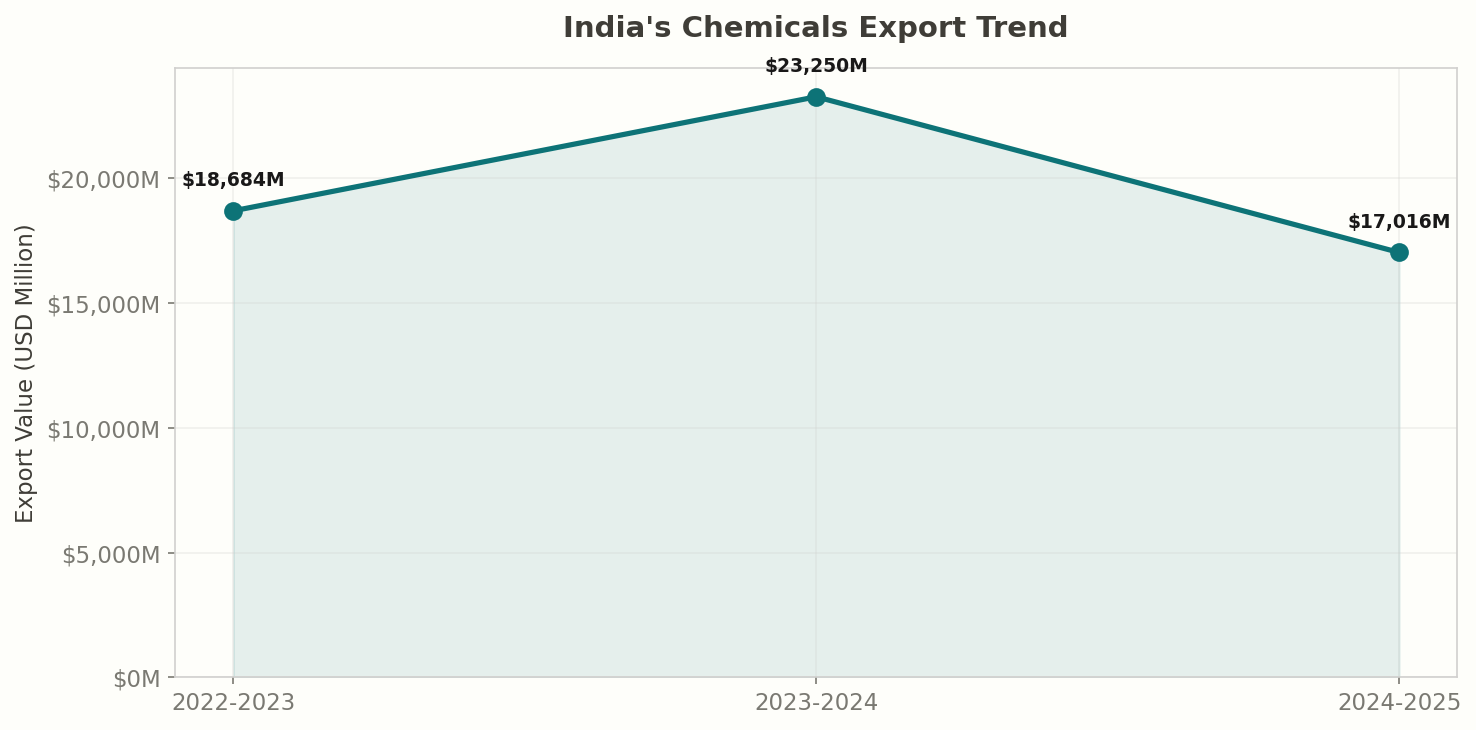
India is the world's sixth-largest chemical producer and third-largest in Asia, with a chemical industry valued at over $220 billion. India's exports of inorganic and organic chemicals under HS Chapters 28-29 reached $17.02 billion in 2024-25, making chemicals one of India's top five export sectors. From pharmaceutical intermediates synthesised in Gujarat's Ankleshwar-Vapi corridor to dyes manufactured in Ahmedabad to agrochemicals produced in Hyderabad, India's chemical industry is a global supplier of both bulk and specialty chemicals.
For MSME exporters, chemicals offer high-value, knowledge-intensive exports with strong intellectual property advantages. India's strength in custom synthesis, contract manufacturing, and cost-effective production of complex organic molecules makes it a preferred supplier for pharmaceutical, agrochemical, and specialty chemical companies worldwide.
India's Chemical Export Landscape
India exported $17.02 billion in chemicals (HS 28-29) in 2024-25, down from $23.25 billion in 2023-24 — a 27% decline driven by global chemical price corrections after the 2022-23 commodity supercycle.
| HS Heading | Category | 2024-25 Exports (USD Million) | Share |
|---|---|---|---|
| 2933 | Heterocyclic compounds (nitrogen) | $4,150.5 | 24.4% |
| 2902 | Cyclic hydrocarbons | $1,717.9 | 10.1% |
| 2941 | Antibiotics | $1,053.4 | 6.2% |
| 2934 | Other heterocyclic compounds | $676.1 | 4.0% |
| 2922 | Amino compounds (oxygen function) | $661.9 | 3.9% |
| 2915 | Saturated acyclic carboxylic acids | $615.6 | 3.6% |
| 2918 | Carboxylic acids (additional oxygen) | $603.8 | 3.5% |
| 2914 | Ketones and quinones | $569.7 | 3.3% |
Heterocyclic compounds (HS 2933) dominate at $4.15 billion — these are primarily pharmaceutical intermediates and API (Active Pharmaceutical Ingredient) building blocks. Cyclic hydrocarbons ($1.72B) include benzene, toluene, and xylene derivatives. Antibiotics ($1.05B) under HS 2941 reflect India's position as the world's largest generic antibiotic manufacturer.
Where Indian Chemicals Are in Demand
Indian chemical exports reach over 170 countries, spanning basic chemicals, speciality chemicals, agrochemicals, and dyes/pigments. The USA is a major destination for pharmaceutical intermediates and speciality chemicals. China, despite being a chemical manufacturing giant itself, imports significant volumes of specific organic chemicals and intermediates from India. European markets — Germany, Netherlands, Belgium — are important for dyestuffs, pigments, and speciality chemicals. Southeast Asian countries and the Middle East are growing markets for agrochemicals and basic chemicals.
Want the full country-by-country breakdown? See exact export values, growth rates, tariff rates, and market attractiveness scores for every destination in our detailed data pages. View Chemicals export data by country →
Manufacturing Clusters
Gujarat — India's Chemical Capital
- Ankleshwar-Vapi-Dahej corridor — India's largest chemical manufacturing belt
- Bulk chemicals, intermediates, dyes, pigments, agrochemicals
- Gujarat accounts for ~40% of India's chemical production
Maharashtra
- Mumbai-Thane-Raigad — Specialty chemicals, pharmaceuticals, dyes
- MIDC industrial areas in Mahad, Patalganga, Ambernath
Andhra Pradesh/Telangana
- Hyderabad — Pharma intermediates, APIs, custom synthesis
- Visakhapatnam — Petrochemicals, bulk chemicals
Other Clusters
- Rajasthan (Jhalawar) — Opium-based alkaloids (government-controlled)
- Tamil Nadu (SIPCOT areas) — Specialty chemicals, petrochemicals
HS Code Classification
Chemicals span two HS chapters with hundreds of headings:
Chapter 28 — Inorganic Chemicals
| Code | Description | Examples |
|---|---|---|
| 2801-2811 | Halides, acids, oxides | Hydrochloric acid, sulphuric acid |
| 2812-2819 | Halides, sulphides, hydroxides | Aluminium chloride, caustic soda |
| 2827-2842 | Salts, peroxides, cyanides | Zinc chloride, potassium dichromate |
Chapter 29 — Organic Chemicals
| Code | Description | Key Indian Exports |
|---|---|---|
| 2902 | Cyclic hydrocarbons | Benzene, styrene, ethylbenzene |
| 2914 | Ketones, quinones | Acetone, methyl ethyl ketone |
| 2915 | Acyclic carboxylic acids | Acetic acid, propionic acid |
| 2922 | Amino compounds | Paracetamol, amino acids |
| 2933 | Heterocyclic nitrogen compounds | Pharma intermediates, APIs |
| 2941 | Antibiotics | Amoxicillin, ciprofloxacin, azithromycin |
Classification complexity: Chemical classification requires precise identification of the molecular structure. A single functional group change can shift the HS code and completely change the duty rate. Work with a trained customs broker for complex organic molecules.
Use the HS Code Finder for exact classification.
Regulatory Framework
REACH (EU) — Registration, Evaluation, Authorisation of Chemicals
The single most important regulation for chemical exports to the EU:
- Registration — All chemicals imported into the EU in quantities >1 tonne/year must be registered with ECHA (European Chemicals Agency)
- Only Representative (OR) — Indian exporters must appoint an EU-based Only Representative to handle REACH registration on their behalf
- Registration cost — €10,000-€100,000+ depending on tonnage band and data requirements
- Pre-registration deadline passed — New substances require full registration before import
- SVHC (Substances of Very High Concern) — Candidate list substances require authorization
TSCA (USA) — Toxic Substances Control Act
- Chemical substances must be listed on the TSCA Inventory before import into the USA
- New chemicals not on the inventory require Pre-Manufacture Notification (PMN)
- EPA can impose restrictions or testing requirements
K-REACH (Korea)
- Korea's REACH equivalent, requires registration for substances >1 tonne/year
- Indian exporters to Korea must comply since January 2019
GHS Classification and SDS
- Globally Harmonized System (GHS) classification is mandatory for all chemical exports
- Safety Data Sheets (SDS) must accompany all chemical shipments (16-section format)
- SDS must be in the language of the importing country
CLP Regulation (EU)
- Classification, Labelling and Packaging regulation for chemical substances
- Hazard pictograms, signal words, hazard/precautionary statements on all labels
Quality and Testing Standards
| Standard | Scope | Markets |
|---|---|---|
| ISO 9001:2015 | Quality management | All markets |
| ISO 14001 | Environmental management | EU, USA |
| ISO 45001 | Occupational health & safety | All markets |
| ICH Q7 | GMP for APIs | Pharma intermediates for regulated markets |
| cGMP | Current Good Manufacturing Practice | USA (FDA), EU (EMA) |
| Responsible Care | Chemical industry sustainability initiative | Global |
Analytical Standards
- Every chemical export batch requires a Certificate of Analysis (CoA) with:
- Assay/purity (HPLC, GC, titration)
- Impurity profile
- Moisture content (Karl Fischer)
- Physical properties (melting point, pH, density, colour)
- Heavy metals (ICP-MS/OES)
- Residual solvents (GC-HS)
Testing Laboratories and Costs
Major NABL-accredited labs for chemical testing include SGS India, Eurofins, TÜV SÜD (Mumbai, Bangalore), Intertek, and Spectro Analytical Labs (Delhi). For pharmaceutical intermediates and APIs, CIPLA Quality Chemical, Vimta Labs (Hyderabad), and Lambda Therapeutic Research provide GLP-compliant analytical services. A standard CoA panel for an organic chemical (assay, impurity profile, moisture, residual solvents, heavy metals, physical properties) costs Rs 10,000-30,000 with 5-7 working day turnaround. REACH-specific testing — including ecotoxicology studies, biodegradation, and bioaccumulation — can cost Rs 5-50 lakh per substance depending on the tonnage band and data requirements. For companies exporting multiple chemicals, investing in in-house HPLC, GC, and Karl Fischer titration equipment (capital cost Rs 25-50 lakh for a basic analytical lab setup) is more economical than outsourcing at high volumes. Accreditation of the in-house lab to ISO 17025 adds credibility and allows CoAs to be accepted without third-party verification by most buyers.
Packaging and Labelling
Packaging
| Container Type | Typical Use | Capacity |
|---|---|---|
| HDPE drums | Liquids, pastes | 50-200 litres |
| Fibre drums | Powders, granules | 25-50 kg |
| IBC (Intermediate Bulk Container) | Bulk liquids | 1,000 litres |
| ISO tank containers | Large-volume liquids | 20,000-26,000 litres |
| HDPE bags with liner | Powders | 25 kg |
| Flexi-bags (in 20-ft container) | Bulk non-hazardous liquids | 16,000-24,000 litres |
Labelling (GHS Compliant)
- Product identifier (chemical name, CAS number)
- Hazard pictograms (flame, skull, exclamation mark, etc.)
- Signal word (Danger or Warning)
- Hazard statements (H-codes)
- Precautionary statements (P-codes)
- Supplier identification (name, address, phone)
- Net weight/volume
Dangerous Goods Classification
- IMDG Code (International Maritime Dangerous Goods) classification for sea freight
- UN number and proper shipping name
- Packing group (I, II, or III based on hazard level)
- DG Declaration required for all hazardous chemical shipments
Pricing Strategy
| Chemical Type | FOB Price Range | Margin |
|---|---|---|
| Bulk inorganic (per tonne) | $200-$800 | 8-15% |
| Bulk organic (per tonne) | $500-$3,000 | 10-20% |
| Specialty chemicals (per kg) | $5-$100 | 25-50% |
| Pharma intermediates (per kg) | $10-$500 | 20-40% |
| APIs (per kg) | $50-$5,000+ | 25-50% |
| Dyes and pigments (per kg) | $3-$50 | 15-30% |
| Custom synthesis (per kg) | $100-$10,000+ | 30-60% |
The highest margins are in custom synthesis and specialty chemicals — where India's chemistry talent, IP capability, and cost advantage combine to create competitive moats.
Logistics
Shipping
- ISO tank containers for bulk liquids (most cost-effective for >15 kL)
- 20-ft containers with drums/IBCs for smaller volumes
- Flexi-bags in 20-ft containers for non-hazardous bulk liquids
- DG-approved containers for hazardous chemicals (special booking required)
Key Ports
- JNPT Mumbai — Primary for Gujarat/Maharashtra chemical exports
- Mundra — Growing alternative for Gujarat exporters
- Hazira (Surat) — For Ankleshwar/Vapi corridor
- Visakhapatnam — For East Coast chemical exports
Transit Times and Costs
- JNPT to USA East Coast: 28-35 days ($3,000-$5,500 per 20-ft)
- Mundra to EU: 18-24 days ($2,000-$4,000)
- JNPT to Middle East: 5-10 days ($800-$1,800)
- ISO tank to Europe: $3,500-$6,000
DG Shipping Surcharges
- Hazardous chemicals attract 15-30% surcharges on base freight rates
- DG booking requires advance notice (3-7 days before vessel)
- Limited DG container slots per vessel — book early
- Not all shipping lines accept all DG classes — Class 1 (explosives), Class 6.1 (toxic), and Class 7 (radioactive) have very limited carrier acceptance. Work with a freight forwarder specialising in chemical logistics, such as Rhenus, Agility, or Brenntag's logistics division, who maintain relationships with DG-approved carriers and can secure space even during peak season.
Documentation
- Commercial Invoice
- Packing List
- Bill of Lading
- Certificate of Origin
- Certificate of Analysis (CoA) — batch-specific
- Safety Data Sheet (SDS) — 16-section format, destination language
- DG Declaration / Dangerous Goods Note (for hazardous)
- IMDG classification certificate
- REACH registration number (for EU)
- Phytosanitary/fumigation certificate (where applicable)
- Drug Controller licence (for APIs/intermediates for pharma)
- Shipping Bill (via ICEGATE)
- Insurance Certificate
Government Incentives
- RoDTEP — 0.5-2% of FOB value
- Advance Authorisation — Duty-free import of raw materials against export commitment
- EPCG Scheme — Duty-free import of capital goods
- Petroleum, Chemicals & Petrochemicals Investment Regions (PCPIRs) — Special economic zones for chemical manufacturing
- CHEMEXCIL membership — Basic Chemicals, Cosmetics & Dyes Export Promotion Council provides market access support
- PLI Scheme for bulk drugs — Production-linked incentives for key starting materials and APIs
- RoDTEP specifics — Chemical export RoDTEP rates range from 0.5% to 2% of FOB value depending on the specific HS code. Dyes and pigments typically receive higher rates (1.5-2%) than bulk inorganic chemicals (0.5-1%). Check the current RoDTEP schedule at the DGFT website for your specific 8-digit ITC-HS code.
- Interest Equalisation Scheme — Chemical exporters classified as MSMEs receive a 5% interest subvention on pre-shipment and post-shipment rupee export credit, reducing working capital costs significantly. Non-MSME exporters receive 3%.
- CHEMEXCIL trade fairs — CHEMEXCIL sponsors Indian pavilions at major chemical trade shows including CHEMSPEC Europe, CPhI Worldwide (pharmaceutical intermediates), in-cosmetics Global, and Gulf Petrochemicals & Chemicals Association (GPCA) events. MSME exhibitors receive up to 90% subsidy on stall costs.
- DSIR Recognition — Companies with in-house R&D facilities can obtain recognition from the Department of Scientific and Industrial Research, unlocking tax benefits under Section 35(2AB) of the Income Tax Act — a weighted deduction of 100% on R&D expenditure. This is particularly valuable for specialty chemical and custom synthesis companies.
Common Mistakes
Not registering under REACH. Exporting to the EU without REACH registration is illegal. Your EU buyer's customs broker will check the REACH registration number at import. Budget 12-18 months and significant investment for registration.
Incomplete SDS. A Safety Data Sheet with missing sections or incorrect GHS classification can halt a shipment at the port. Use trained regulatory affairs professionals to prepare SDS.
DG classification errors. Shipping a Class 3 flammable liquid as non-DG can result in heavy fines, container impoundment, and blacklisting by the shipping line. Always classify correctly per IMDG Code.
Not maintaining batch-to-batch consistency. Chemical buyers expect consistent purity and impurity profiles. A batch that varies by 1-2% in assay from the specification triggers rejection and damages trust. Implement robust process control and in-process testing.
Ignoring environmental compliance at home. Indian chemical plants must comply with CPCB/SPCB norms. European and US buyers increasingly audit supplier environmental compliance. A pollution control non-compliance can cost you your export business.
Not appointing a REACH Only Representative early enough. REACH registration is a 12-18 month process. Many Indian exporters start the process only after receiving an EU order, then lose the order because they cannot ship without a registration number. Appoint an OR and begin pre-registration as soon as you identify the EU as a target market. Consortium registration (sharing data and costs with other registrants of the same substance) can reduce costs from Rs 50-80 lakh to Rs 10-25 lakh per substance.
Underestimating working capital requirements. Chemical exports — especially bulk and intermediates — require significant working capital. Payment terms of 60-90 days are standard, and raw material procurement is often on advance payment. Use ECGC-backed post-shipment credit and factor receivables through banks offering export factoring services to manage cash flow.
Key Takeaways
- India exported $17.02 billion in chemicals (HS 28-29) in 2024-25
- Pharma intermediates (HS 2933, $4.15B) and cyclic hydrocarbons (HS 2902, $1.72B) dominate
- USA ($2.26B), China ($1.09B), and Saudi Arabia ($868M) are the top markets
- REACH registration is mandatory for EU exports — budget 12-18 months
- GHS-compliant labelling and 16-section SDS are required globally
- DG classification and proper documentation are critical for hazardous chemicals
- Specialty chemicals and custom synthesis offer the highest margins (30-60%)
Next Steps
- Identify your HS code with the HS Code Finder — chemical classification requires precision
- Get REACH registered if targeting the EU — appoint an Only Representative
- Check tariff rates using the Duty Calculator — some chemicals face anti-dumping duties
- Join CHEMEXCIL for chemical export promotion support
- Prepare GHS-compliant SDS and labels for your target markets
- Explore market demand with the Market Finder
- Invest in analytical infrastructure — HPLC, GC, ICP for comprehensive CoA capability
India's chemical industry is a $17 billion export engine with competitive advantages in organic synthesis, custom manufacturing, and cost-effective production. For MSMEs with chemistry expertise, chemical exports offer high-value, knowledge-intensive business opportunities.
Ready to start exporting?
Get a detailed market report with country-by-country analysis, pricing insights, and buyer contacts.
Get Market ReportXIMPEX Export Advisory
Need help implementing the strategies discussed in this guide? Our team of export specialists can provide personalized guidance for your business.