How to Export Coffee from India — Complete Guide
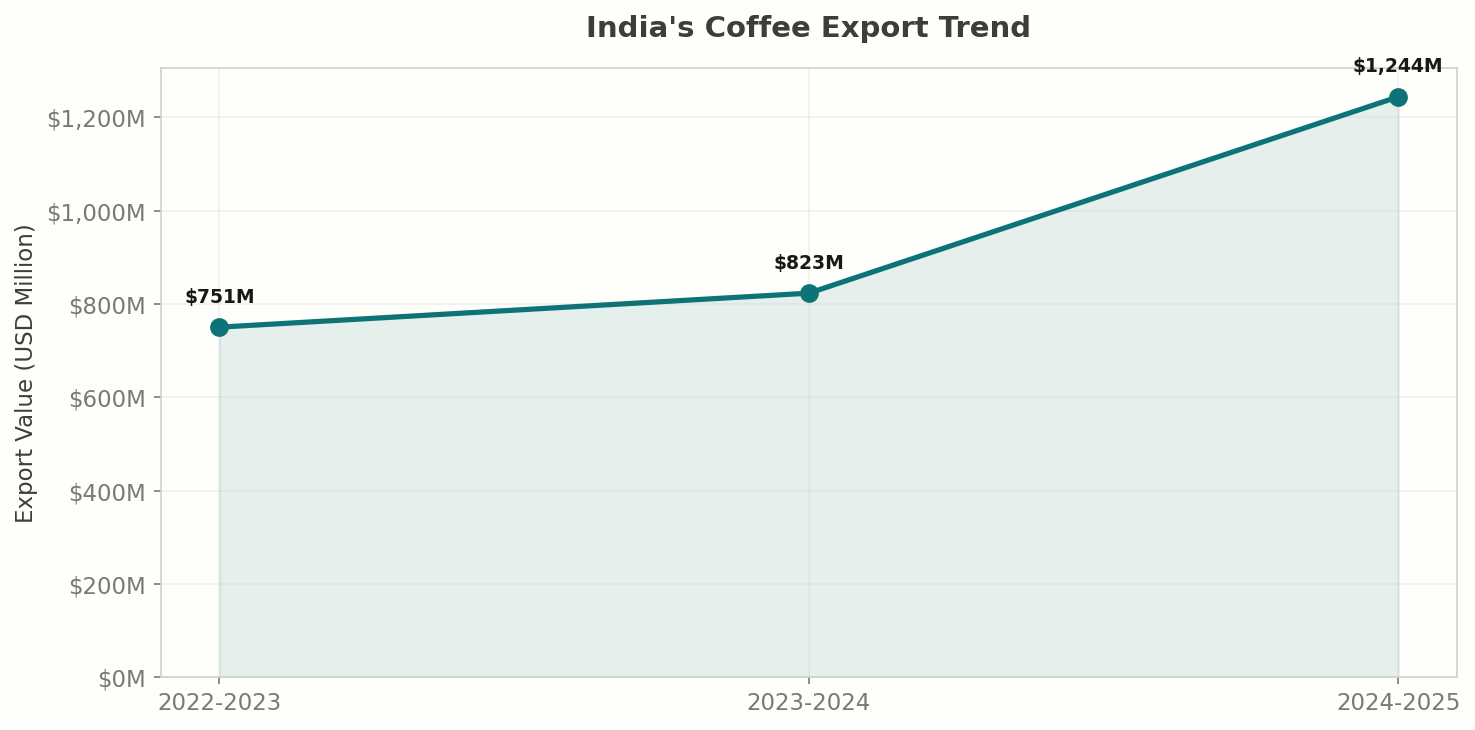
India is the world's sixth-largest coffee producer and the third-largest in Asia, exporting $1.24 billion worth of coffee in 2024-25. India's unique position in the global coffee market stems from its shade-grown Arabica from Karnataka's Western Ghats, robust Robusta from Kerala and Tamil Nadu, and the distinctive Monsooned Malabar — a processing style found nowhere else in the world.
For MSME exporters, coffee presents a high-growth opportunity. India's coffee exports surged from $751 million in 2022-23 to $1.24 billion in 2024-25 — a 66% increase in just two years, driven by record global coffee prices and growing demand for Indian specialty and Robusta beans.
India's Coffee Export Landscape
India exported $1.24 billion in coffee in 2024-25, making it one of the fastest-growing agricultural export categories. The sector is dominated by green (unroasted) bean exports, which account for 99% of volume.
| HS Code | Coffee Category | 2024-25 Exports (USD Million) | Share |
|---|---|---|---|
| 090111 | Not roasted, not decaffeinated | $1,237.6 | 99.5% |
| 090190 | Coffee husks and skins | $3.3 | 0.3% |
| 090121 | Roasted, not decaffeinated | $3.1 | 0.2% |
| 090112 | Not roasted, decaffeinated | $0.2 | 0.0% |
The near-total dominance of green (unroasted) coffee beans (HS 090111) reflects India's role as a raw material supplier to global coffee roasters. This also represents the biggest value-addition opportunity — roasted and instant coffee command 3-5x the price of green beans.
Where Indian Coffee Is in Demand
Italy is India's largest coffee export destination, driven by its massive espresso industry that values Indian Robusta beans for their body and crema. European markets collectively dominate Indian coffee exports — Germany, Belgium, and Spain are all significant buyers. The USA and Japan represent important speciality coffee markets where Indian Arabica (particularly Monsooned Malabar and single-estate coffees) command premium prices. Russia and the Middle East are growing markets for both instant and roasted coffee.
Want the full country-by-country breakdown? See exact export values, growth rates, tariff rates, and market attractiveness scores for every destination in our detailed data pages. View Coffee export data by country →
India's Coffee Varieties — What Makes Them Special
Arabica (30% of production)
Grown at 1,000-1,500m elevation in Karnataka's Chikmagalur, Kodagu (Coorg), and Hassan districts, and in Kerala and Tamil Nadu hill stations. Indian Arabica is mild, low in acidity, with chocolate and nutty notes. Varieties include Kent, S.795, Selection 9, and Cauvery.
Robusta (70% of production)
Grown at 500-1,000m in Karnataka, Kerala (Wayanad), and Tamil Nadu. Indian Robusta is valued globally for espresso blends — it provides the crema and body that Italian coffee culture demands. Robusta accounts for the bulk of India's coffee exports.
Monsooned Malabar
India's most distinctive coffee. Green Arabica or Robusta beans are exposed to monsoon winds and moisture in open warehouses on the Malabar coast (June-September) for 12-16 weeks. The beans swell, lose acidity, and develop a unique musty, earthy, heavy-bodied profile. Monsooned Malabar commands a $1-2/kg premium over regular Indian coffee.
HS Code Classification for Coffee
Coffee falls under HS Chapter 09, heading 0901:
| 6-Digit Code | Description | Typical Indian Product |
|---|---|---|
| 090111 | Coffee, not roasted, not decaffeinated | Green Arabica and Robusta beans |
| 090112 | Coffee, not roasted, decaffeinated | Decaf green beans |
| 090121 | Coffee, roasted, not decaffeinated | Roasted beans, ground coffee |
| 090122 | Coffee, roasted, decaffeinated | Decaf roasted/ground |
| 090190 | Coffee husks and skins; substitutes | Cascara, coffee substitutes |
Note: Instant coffee (soluble) is classified under HS 210111-210112, not under 0901. India is also a major instant coffee exporter through companies like CCL Products and Tata Coffee.
Use the HS Code Finder to confirm the exact code for your coffee product.
Quality Standards and Certifications
Coffee Board of India
The Coffee Board regulates coffee exports from India:
- Registration with the Coffee Board as a curer/dealer/exporter
- Coffee must be graded and classified according to Coffee Board standards before export
- Grades include: Plantation A, Plantation B, Plantation C, Peaberry, Robusta Parchment AB, Cherry AB, etc.
International Standards
- ICO (International Coffee Organization) quality standards — India is an ICO member
- ISO 10470 — Defect reference chart for green coffee
- ISO 4149 — Green coffee — olfactory and visual examination and determination of foreign matter and defects
- ISO 6673 — Green coffee — determination of loss in mass at 105°C (moisture testing)
- Cup quality assessment — Standard cupping protocols (SCA score of 80+ for specialty grade)
Testing Laboratories and Costs
The Coffee Board of India operates quality testing labs in Bangalore, Chikmagalur, and Hassan that provide grading, cupping, and quality assessment services. For export-grade testing, NABL-accredited labs including SGS India, Eurofins, and Bureau Veritas offer comprehensive coffee analysis panels covering moisture (ISO 6673), defect count (ISO 10470), screen size distribution, cup quality scoring, pesticide residues (multi-residue GC-MS for EU MRL compliance), and ochratoxin A (OTA) levels. A standard export analysis panel costs Rs 5,000-15,000 per sample with 5-7 working day turnaround. OTA testing is particularly important for EU-bound shipments — the EU limit is 5 μg/kg for roasted coffee and 10 μg/kg for instant coffee. For specialty coffee, SCA-certified Q Graders conduct cupping evaluations — India has approximately 200 certified Q Graders, primarily based in Bangalore and the coffee-growing districts of Karnataka. A Q Grading assessment costs Rs 3,000-5,000 per sample and provides an internationally recognised quality score.
Certifications for Premium Markets
- Rainforest Alliance — Most common sustainability certification for Indian coffee estates
- UTZ Certified (now merged with Rainforest Alliance)
- Fair Trade — Premium of $0.20/lb above market price for certified cooperatives
- Organic (NPOP/NOP/EU) — India's organic coffee area is expanding rapidly, especially in Kodagu and Wayanad
- India Coffee Trust Mark — Quality seal introduced by the Coffee Board
- GI (Geographical Indication) — Coorg Arabica, Wayanaad Robusta, Chikmagalur Arabica, Araku Valley Arabica, and Monsooned Malabar are all GI-tagged
Packaging and Labelling
Green Beans (Bulk)
- GrainPro bags inside jute or poly-woven sacks (60 kg standard, some markets prefer 69 kg)
- GrainPro or similar hermetic liners protect against moisture absorption during transit
- Mark with: ICO lot number, grade, net weight, crop year, estate/pool name, exporter details
Roasted Coffee
- Valve bags with one-way degassing valve (CO2 release without oxygen ingress)
- Nitrogen-flushed packaging for extended shelf life (12-18 months)
- Foil-laminated pouches for retail
Labelling Requirements
- EU: Origin, roast date, best-before date, net weight, organic certification number (if applicable). EU Regulation 1169/2011 requires allergen information (though coffee is not an allergen, products with added flavourings must declare them). For green beans in bulk, labelling on the bag must include ICO lot number, grade, net weight, and exporter registration number.
- USA: Country of origin, net weight in oz/lb, roaster/packer identification, FDA nutrition panel (for roasted/ground). FDA Prior Notice is mandatory for all food imports. Organic coffee must display the USDA Organic seal and the NOP-accredited certifier's information. For roasted coffee, California Proposition 65 warnings regarding acrylamide may be required.
- Japan: JAS standards, Japanese-language labelling with name, ingredients, net weight, best-before date, storage method, country of origin, and importer details. Japan's Food Sanitation Act requires notification to the Ministry of Health, Labour and Welfare before import.
- Middle East: Arabic-language labelling, Halal certification (relevant for flavoured coffee products), production date and expiry date (not just best-before), and GSO compliance markings. The UAE and Saudi Arabia have specific regulations for caffeine content disclosure on retail packaging.
Pricing Strategy
| Coffee Type | FOB Price Range (per kg) | Key Markets |
|---|---|---|
| Robusta Cherry AB (green) | $2.50-$4.50 | Italy, Belgium, Germany |
| Arabica Plantation A (green) | $4.00-$7.00 | Germany, USA, Japan |
| Arabica Plantation PB (green) | $5.00-$8.50 | Specialty buyers globally |
| Monsooned Malabar AA (green) | $5.50-$9.00 | USA, Europe, Japan |
| Robusta Parchment AB (green) | $2.80-$4.80 | Italy, Spain |
| Roasted whole bean | $8.00-$18.00 | USA, UK, Australia |
| Roasted ground | $7.00-$15.00 | UAE, Middle East |
Global coffee prices reached record highs in 2024-25 (Robusta over $5,000/tonne on ICE Futures), boosting Indian export values significantly. The real margin opportunity is in roasted and specialty coffee — moving up from $3-4/kg green to $10-15/kg roasted.
Logistics
Shipping Routes
- Mangalore/New Mangalore Port — Primary coffee export port (closest to Karnataka production belt)
- Cochin — For Kerala and Tamil Nadu coffee
- JNPT Mumbai — For consolidated shipments
- Mangalore to Italy/Germany: 18-22 days via Suez
- Mangalore to UAE: 5-7 days
- Air freight for specialty micro-lots: Bengaluru to Europe, 8-10 hours
Container Capacity
- 20-ft container: ~18.5 tonnes of green coffee (300-320 bags × 60 kg)
- 40-ft container: ~20-21 tonnes (limited by weight, not volume)
Freight Costs (Indicative)
- 20-ft container Mangalore to European ports: $1,800-$3,500
- 20-ft container to UAE: $800-$1,500
- Air freight (specialty): $3-$5 per kg
Critical Shipping Consideration
Green coffee is hygroscopic — it absorbs moisture from the container environment during ocean transit. Use container desiccants and GrainPro liners. Avoid shipping during monsoon season (June-September) without adequate moisture protection. Target moisture content of green coffee at shipment: 10-12%.
Shipping Routes and Container Details
The primary export route for Karnataka coffee runs from the ICD at Bangalore or the Coffee Board-registered warehouses in Hassan/Chikmagalur to New Mangalore Port or Cochin. From Mangalore, direct feeder services connect to Colombo, from where main-line vessels serve European ports (Hamburg, Antwerp, Trieste) in 20-25 days and US ports (New York, New Orleans) in 30-38 days. For Italian buyers (India's largest coffee market), the Mangalore-Colombo-Trieste/Genoa route is most efficient at 18-22 days. Standard 20-ft containers are the norm for green coffee — they hold 300-320 bags (60 kg each), approximately 18-19 tonnes. For specialty micro-lots (1-5 tonnes), LCL consolidation through Bangalore or Cochin is practical, though per-tonne costs are 40-50% higher. Always request a food-grade container or ensure the container is clean and odour-free — coffee absorbs odours from previous cargo, which can taint the entire lot.
Documentation
- Commercial Invoice
- Packing List
- Bill of Lading
- Certificate of Origin (CEPA format for UAE, GSP for EU)
- Coffee Board Export Permit
- ICO Certificate of Origin (for ICO member importing countries)
- Phytosanitary Certificate (from Plant Quarantine, DPPQS)
- Quality/Grade Certificate from Coffee Board
- Organic Certificate (if applicable)
- Fumigation Certificate (if required by destination)
- Shipping Bill (via ICEGATE)
- Insurance Certificate
Government Incentives
- RoDTEP — Remission of duties at 0.5-1.5% of FOB value
- Coffee Board Quality Improvement Programme — Subsidies for wet processing equipment, grading machinery, and quality labs
- Integrated Coffee Development Programme — Supports replanting, water harvesting, and organic conversion
- APEDA assistance — For organic coffee promotion and market development
- RoDTEP specifics — Green coffee beans (HS 090111) attract RoDTEP at 0.8-1.5% of FOB value. Roasted coffee (HS 090121) receives higher rates at 1.5-2.5%, incentivising value-added exports. Instant coffee under HS 2101 has separate RoDTEP rates.
- Interest Equalisation Scheme — Coffee exporters classified as MSMEs receive a 5% interest subvention on rupee export credit (pre-shipment and post-shipment), significantly reducing financing costs. This is particularly beneficial given the seasonal nature of coffee procurement and the working capital intensity of inventory holding.
- Coffee Board Market Promotion — The Coffee Board conducts annual road shows in importing countries, organises India Coffee Trail visits for international buyers, and sponsors Indian participation in the Specialty Coffee Association (SCA) Expo, World of Coffee (Europe), SCAJ (Japan), and Gulf Food (Dubai). The Board also operates the India Coffee House brand for promoting Indian coffee at international events.
- Warehouse Receipt Finance — Coffee stored in Coffee Board-approved warehouses qualifies for warehouse receipt-based financing from banks. This allows exporters to pledge stored coffee inventory and access working capital at favourable rates, bridging the gap between procurement season and export orders.
Common Mistakes When Exporting Coffee
Not controlling moisture content. Green coffee arriving in Europe at >12.5% moisture will be rejected or heavily discounted. Invest in moisture meters and proper storage.
Ignoring cup quality. European specialty buyers cup-test every lot. A visually perfect green bean can cup poorly if processing (fermentation, drying) was not controlled. Invest in quality at the wet mill and dry mill stages.
Shipping without GrainPro liners. Standard jute bags do not protect against moisture during 18-22 day ocean transit. GrainPro or similar hermetic bags cost only $1-2 per bag — not using them risks the entire container ($30,000-$60,000).
Mixing grades. Coffee Board grades (Plantation A, PB, etc.) have specific screen size and defect count requirements. Mixing grades to fill an order is detectable and destroys buyer trust.
Not leveraging GI tags. Coorg Arabica, Araku Valley, and Monsooned Malabar are GI-tagged products. These tags command premiums but require proper documentation from the Coffee Board.
Selling only through commodity channels. Many Indian coffee exporters sell exclusively through commodity brokers at benchmark prices, missing the growing specialty and direct-trade market. Building a web presence, attending SCA events, and connecting directly with specialty roasters can yield $2-5/kg premiums over commodity pricing. Platforms like Cropster, Algrano, and Beyco connect producers directly with specialty buyers.
Not investing in traceability systems. Modern buyers — particularly in the specialty and sustainability segments — demand farm-to-cup traceability. Implement lot tracking from estate/cooperative level through curing, grading, and export. Digital traceability platforms (like FarmTrace or SourceTrace) allow buyers to scan a QR code and see the origin, processing details, and certifications for each lot, commanding premium pricing.
Key Takeaways
- India exported $1.24 billion in coffee in 2024-25 — a 66% increase from 2022-23
- Green (unroasted) beans account for 99.5% of exports, led by Robusta for Italian espresso blends
- Italy ($306M) and Germany ($187M) are the top markets
- Coffee Board registration, grading, and export permit are mandatory
- Monsooned Malabar and GI-tagged coffees command significant premiums
- Moisture control during storage and shipping is the #1 quality risk
- Roasted and specialty coffee offer 3-5x value addition over green beans
Next Steps
- Identify your HS code with the HS Code Finder — green vs. roasted changes the classification entirely
- Register with the Coffee Board of India and get your export permit
- Check tariff rates for your target market using the Duty Calculator
- Invest in grading infrastructure — screen size graders, colour sorters, and cupping labs
- Explore market demand with the Market Finder to identify growing specialty coffee markets
- Get sustainability certification — Rainforest Alliance or organic, essential for European buyers
India's coffee story is just beginning. With global Robusta prices at record highs and specialty coffee booming, Indian coffee exporters are sitting on a $1.24 billion opportunity that's growing every year.
Ready to start exporting?
Get a detailed market report with country-by-country analysis, pricing insights, and buyer contacts.
Get Market ReportXIMPEX Export Advisory
Need help implementing the strategies discussed in this guide? Our team of export specialists can provide personalized guidance for your business.