How to Export Engineering Goods from India — Complete Guide
Engineering goods are India's single largest export category, and within this vast sector, iron and steel structures, tubes, pipes, fittings, and industrial valves — covered under HS headings 7304-7308 and 8481 — represent a $5.35 billion export business in 2024-25. India is the world's second-largest steel producer and a major supplier of fabricated steel structures, seamless and welded pipes, industrial valves, and pipeline fittings to global infrastructure and energy projects.
For MSME manufacturers in India's engineering clusters — Ahmedabad, Rajkot, Mumbai, Chennai, Ludhiana, Jalandhar — export offers access to large-scale infrastructure projects in the Middle East, USA, and Europe where Indian products are already well-established and price-competitive.
India's Engineering Goods Export Landscape
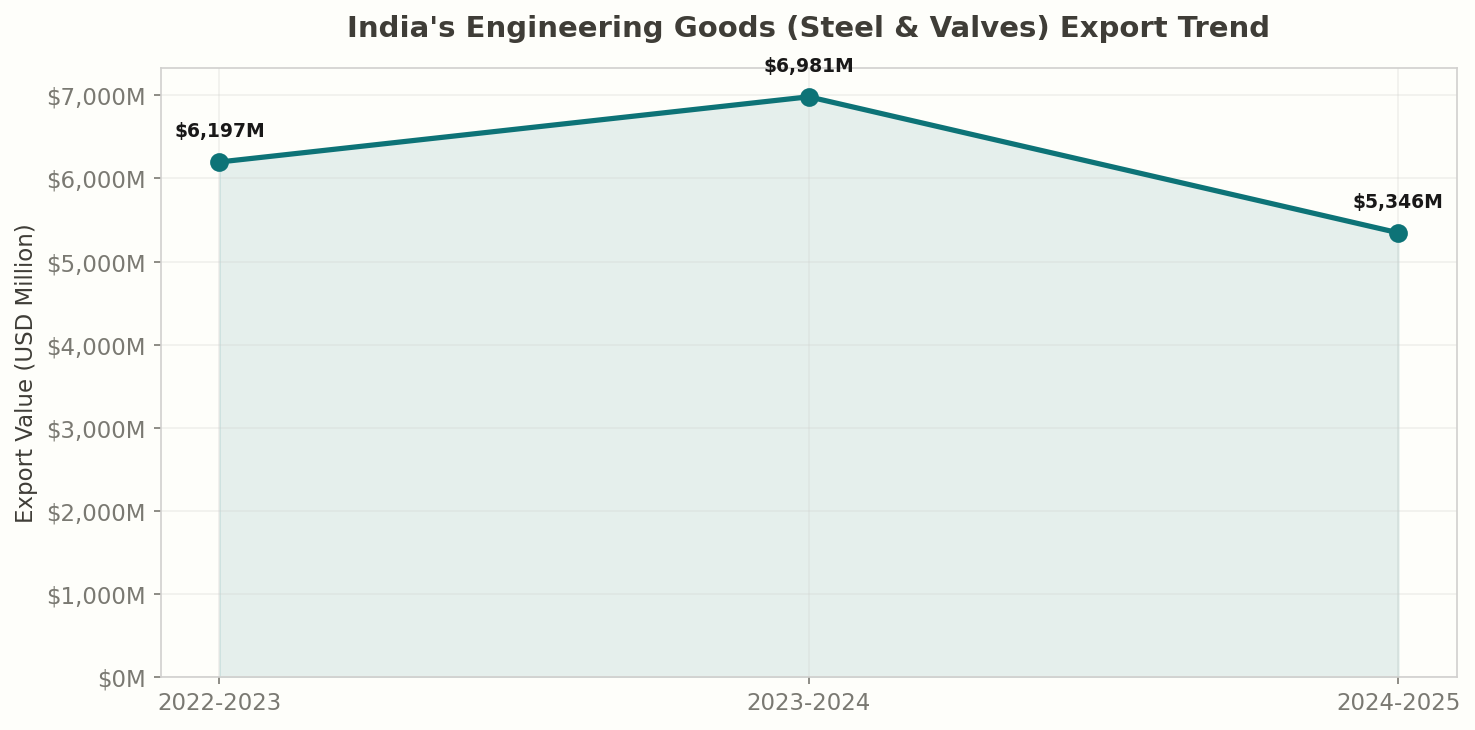
India exported $5.35 billion in steel structures, tubes, pipes, and valves in 2024-25, down from $6.98 billion in 2023-24 due to softer global demand and steel price moderation.
| HS Heading | Category | 2024-25 Exports (USD Million) | Share |
|---|---|---|---|
| 7308 | Iron/steel structures and parts | $1,433.5 | 26.8% |
| 8481 | Taps, valves, and similar | $1,159.7 | 21.7% |
| 7305 | Tubes and pipes (>406mm diameter) | $915.4 | 17.1% |
| 7307 | Tube/pipe fittings | $826.9 | 15.5% |
| 7306 | Welded tubes and pipes | $563.8 | 10.5% |
| 7304 | Seamless tubes and pipes | $446.8 | 8.4% |
Steel structures ($1.43B) lead, reflecting India's strength in fabricated steel for construction, bridges, and industrial plants. Industrial valves ($1.16B) represent India's growing presence in oil & gas, petrochemical, and water infrastructure projects globally.
Where Indian Engineering Goods Are in Demand
The USA is the largest single destination for Indian engineering goods, driven by demand for steel tubes, pipes, castings, and industrial machinery. European markets — Germany, Italy, the UK, and the Netherlands — are important for precision-engineered components and industrial equipment. The Middle East (UAE, Saudi Arabia) is a major market for structural steel products and construction equipment, driven by ongoing infrastructure projects. Southeast Asia and Africa are growing markets for Indian engineering products, particularly agricultural machinery, pumps, and construction equipment.
Want the full country-by-country breakdown? See exact export values, growth rates, tariff rates, and market attractiveness scores for every destination in our detailed data pages. View Engineering Goods export data by country →
Manufacturing Clusters
Ahmedabad-Rajkot (Gujarat)
- India's largest valve manufacturing cluster
- Ball valves, gate valves, globe valves, butterfly valves
- Pipeline fittings (flanges, elbows, tees, reducers)
- Also strong in forgings and castings
Mumbai-Thane-Pune (Maharashtra)
- Steel fabrication, structural steel
- Precision valves for oil & gas
- Large-diameter pipe manufacturing (LSAW, spiral welded)
Ludhiana-Jalandhar (Punjab)
- Steel forgings, hand tools, fasteners
- Stainless steel pipe fittings
- Auto components and agricultural machinery
Chennai-Coimbatore (Tamil Nadu)
- Precision-machined valves and fittings
- Pump and compressor components
- CNC machining centres
HS Code Classification
| 6-Digit Code | Description | Key Products |
|---|---|---|
| 730411 | Seamless pipes, stainless steel | Oil & gas, chemical plant piping |
| 730419 | Seamless pipes, other steel | Boiler tubes, structural tubes |
| 730511 | Line pipe, longitudinally welded (>406mm) | Oil/gas transmission pipelines |
| 730630 | Welded tubes, circular, iron/steel | Construction, fencing, scaffolding |
| 730721 | Flanges, stainless steel | Pipeline connections |
| 730729 | Other tube fittings, stainless steel | Elbows, tees, reducers |
| 730890 | Other structures, iron/steel | Fabricated steel frames, towers |
| 848110 | Pressure reducing valves | Industrial process control |
| 848180 | Other taps, cocks, valves | Ball valves, gate valves, butterfly |
Classification tip: The distinction between seamless (7304) and welded (7305/7306) pipes is fundamental — they have different tariff rates and different technical applications. Seamless pipes are used for high-pressure applications (oil & gas); welded pipes for structural and low-pressure uses.
Use the HS Code Finder for precise classification.
Quality Standards and Certifications
International Standards (Non-Negotiable)
| Standard | Scope | Required For |
|---|---|---|
| ASME (American Society of Mechanical Engineers) | Pressure vessels, piping, valves | USA, Middle East oil & gas |
| API (American Petroleum Institute) | Oil & gas equipment (API 5L, API 6D, API 600) | Global oil & gas projects |
| EN/BS Standards | European/British standards for steel products | EU and UK markets |
| ISO 9001:2015 | Quality management system | All markets |
| ISO 14001 | Environmental management | EU, increasingly required |
| PED 2014/68/EU | Pressure Equipment Directive | EU market (mandatory) |
| NACE MR0175 | Sour service materials | Oil & gas (H₂S environments) |
| ASTM Standards | Material specifications (ASTM A106, A312, A182, etc.) | Global specification standard |
Product-Specific Certifications
- API 5L — Line pipe for oil/gas transmission (PSL1/PSL2 levels)
- API 6D — Pipeline valves
- API 600/602 — Steel gate valves
- ASME B16.5 — Pipe flanges
- ASME B16.9 — Factory-made wrought fittings
- CE Marking — Mandatory for products entering the EU market under PED
Third-Party Inspection (TPI)
Major buyers require third-party inspection by internationally recognised agencies:
- Lloyd's Register, Bureau Veritas, TÜV, SGS, DNV
- Inspection covers: material test certificates, dimensional inspection, hydrostatic testing, NDT (non-destructive testing — radiography, ultrasonic, magnetic particle, dye penetrant)
- Cost: 0.5-2% of order value, but non-negotiable for project orders
Testing and Certification Costs and Timelines
API certification (e.g., API 6D for pipeline valves, API 5L for line pipe) involves an initial application fee of $3,000-5,000, an audit fee of $5,000-10,000, and ongoing annual renewal of $2,000-4,000. The process takes 6-12 months from application to certificate. ASME certification (U, S, PP stamps) requires a formal quality system review by an ASME Authorized Inspection Agency (AIA) — National Board or Hartford Steam Boiler — with costs of $15,000-50,000 for the initial survey and audit depending on the scope. CE marking under the Pressure Equipment Directive (PED) requires assessment by a Notified Body (TÜV, Lloyd's, Bureau Veritas) with costs of Rs 5-15 lakh for the initial assessment and annual surveillance audits. For NDT testing, NABL-accredited labs and Level III certified NDT operators charge Rs 500-2,000 per weld joint for radiographic testing and Rs 200-500 per joint for ultrasonic testing. Hydrostatic testing of pipes and valves is typically done in-house under TPI witness, with test pump and equipment costs being a necessary capital investment for any serious exporter.
Material Testing and Traceability
Mill Test Certificates (MTC/MTR)
Every engineering product for export requires a Mill Test Certificate (EN 10204 Type 3.1 or 3.2):
- Chemical composition — Spectrometer analysis of every heat/batch
- Mechanical properties — Tensile strength, yield strength, elongation, hardness, impact testing (Charpy V-notch)
- Full traceability — Heat number, lot number traceable to raw material source
Non-Destructive Testing (NDT)
- Radiography (RT) — For weld quality assessment in pipes and pressure vessels
- Ultrasonic Testing (UT) — Wall thickness and flaw detection
- Magnetic Particle (MPI) — Surface crack detection on ferromagnetic materials
- Hydrostatic Testing — Pressure testing to 1.5x design pressure
Packaging and Labelling
Pipes and Tubes
- Bundled in hexagonal bundles, strapped with steel bands
- End caps (plastic or metal) on all pipe ends to prevent damage and contamination
- Marking on each pipe: size, wall thickness, grade, heat number, manufacturer's mark, standard (e.g., "ASTM A106 Gr.B, NPS 4, SCH 40, Heat No. XXXX")
Fittings and Flanges
- Packed in wooden cases or palletised in cardboard cartons
- Each piece individually tagged with size, rating, material grade, heat number
- VCI (Vapour Corrosion Inhibitor) wrapping for corrosion protection during transit
Valves
- Wooden crates for large valves, cardboard boxes for smaller ones
- Body and actuator packed separately for large valve assemblies
- Operating instructions, maintenance manuals, and GA (General Arrangement) drawings included
Labelling Requirements
- ASME/API mark stamped on product (if certified)
- CE mark for EU-bound products
- Material grade, size, pressure rating permanently marked (stencil, stamp, or tag)
- USA market: "Buy America" compliance may apply for federally funded infrastructure projects — verify whether the end-use project requires domestic sourcing preferences. Country of origin marking per US Customs (19 CFR 134).
- EU market: CE Declaration of Conformity must accompany each shipment with reference to the applicable directive (PED, CPR for construction products, or Machinery Directive). Technical files must be available for inspection by market surveillance authorities.
- Middle East (GCC): GSO conformity certificates may be required. Saudi Aramco, ADNOC, and other national oil companies maintain Approved Vendor Lists (AVLs) — registration on these lists requires factory audits, qualification testing, and documentation submission that can take 12-18 months.
- Country of origin: "Made in India"
Pricing Strategy
| Product Type | FOB Price Range | Key Factor |
|---|---|---|
| Seamless pipes (per tonne) | $1,200-$3,500 | Material grade, wall thickness |
| Welded pipes (per tonne) | $800-$2,000 | Diameter, length, coating |
| Pipe fittings (per piece) | $5-$500 | Size, material, pressure rating |
| Flanges (per piece) | $3-$200 | Size, class rating (150-2500#) |
| Ball valves (per piece) | $20-$5,000 | Size, material, pressure class |
| Gate valves (per piece) | $30-$10,000 | Size, pressure rating |
| Fabricated structures (per tonne) | $1,500-$3,000 | Complexity, coating, certification |
India's cost advantage in engineering goods is typically 20-35% over European and 15-25% over Chinese manufacturers, driven by lower labour costs and domestic steel availability.
Logistics
Shipping
- Sea freight for all bulk orders (containers or break-bulk for oversized items)
- Project cargo for large structures and equipment (RO-RO, flat rack containers, or charter vessels)
- Air freight only for urgent spare parts ($5-15/kg)
Transit Times
- JNPT to USA East Coast: 28-35 days
- Mundra to UAE: 4-6 days
- Chennai to EU: 18-24 days
- Mundra to Saudi Arabia (Dammam): 8-12 days
Container Capacity
- 20-ft container: 20-22 tonnes of steel products
- 40-ft container: 22-26 tonnes (weight-limited, not volume-limited for steel)
- Flat rack: For oversized structures, large-diameter pipes
Freight Costs
- 20-ft container to UAE: $800-$1,800
- 40-ft container to USA: $3,000-$5,500
- Break-bulk to Middle East: $40-$80/tonne
Documentation
- Commercial Invoice (with full technical description)
- Packing List (piece-by-piece for fittings/valves)
- Bill of Lading
- Certificate of Origin (CEPA for UAE, standard for others)
- Mill Test Certificates (EN 10204 Type 3.1/3.2)
- Third-Party Inspection Certificate (Lloyd's, BV, TÜV)
- Hydrostatic Test Certificate
- NDT Reports (radiography, UT, MPI as applicable)
- CE Declaration of Conformity (for EU)
- Shipping Bill (via ICEGATE)
- Insurance Certificate
Government Incentives
- RoDTEP — 0.5-2% of FOB value
- EPCG Scheme — Duty-free import of capital goods (CNC machines, testing equipment) against export obligation
- Advance Authorisation — Duty-free import of raw steel against confirmed export orders
- EEPC India membership — Engineering Export Promotion Council provides market intelligence, trade fair access
- Duty Drawback — 1-2.5%
- Star Export House benefits for exporters with turnover >Rs 50 crore
- RoDTEP specifics — Engineering goods under HS 7304-7308 attract RoDTEP rates of 0.5-1.5% of FOB value. Valves (HS 8481) receive 1-2%. While these rates appear modest, on high-value shipments they add up significantly — a Rs 5 crore order at 1.5% RoDTEP yields Rs 7.5 lakh in duty credit.
- ECGC Project Export Cover — For large infrastructure project orders, ECGC offers specific project export policies that cover political and commercial risks for contracts spanning multiple years. This is essential for orders from countries in Africa and Central Asia where political risk is elevated.
- EEPC India Trade Fairs — EEPC organises India Engineering exhibitions and sponsors Indian pavilions at ADIPEC (Abu Dhabi), OTC (Houston), Valve World (Düsseldorf), HANNOVER MESSE, Tube & Wire (Düsseldorf), and Big 5 (Dubai). MSME exhibitors receive substantial subsidies through the MAI scheme.
Common Mistakes
Not getting API/ASME certification. Without API or ASME certification, you cannot bid on oil & gas or infrastructure projects — which represent 70% of the export opportunity. Budget 6-12 months and $20,000-$100,000 for certification, but it opens the door to multi-million dollar orders.
Supplying incorrect material grades. Mixing up material grades (e.g., ASTM A106 Grade B vs. Grade C) can have catastrophic consequences in high-pressure applications. Implement positive material identification (PMI) testing on 100% of outgoing products.
Ignoring anti-dumping duties. Several countries (USA, EU, Turkey) have active anti-dumping duties on Indian steel products. Check the current AD/CVD order list before quoting — your buyer may face 5-50% additional duty.
Incomplete documentation. A missing MTR or NDT report can hold up a $500,000 shipment at the port. Engineering exports are documentation-intensive — build a document control system and check every document before shipping.
Underestimating project timelines. Infrastructure project orders have strict delivery schedules with liquidated damages for late delivery (typically 0.5-1% per week). Don't commit to timelines you can't meet.
Not understanding Approved Vendor Lists (AVLs). Major EPC contractors (Bechtel, Technip, Fluor, L&T) and end-users (Saudi Aramco, ADNOC, Shell) maintain AVLs of pre-qualified suppliers. You cannot bid on projects without AVL registration, which requires factory audits, product qualification testing, and reference order histories. Start the AVL registration process 12-18 months before targeting project orders — it is a prerequisite, not an afterthought.
Neglecting surface protection and coating quality. Engineering products shipped to coastal or marine environments require robust surface protection — hot-dip galvanising, fusion-bonded epoxy, or three-layer polyethylene coating for buried pipelines. Coating failures during transit or after installation are a common complaint that leads to expensive rework. Invest in proper surface preparation (Sa 2.5 blast cleaning per ISO 8501) and coating application, and include coating inspection in your TPI scope.
Key Takeaways
- India exported $5.35 billion in steel structures, pipes, fittings, and valves in 2024-25
- USA ($1.66B), UAE ($605M), and Saudi Arabia ($422M) are the top markets
- API, ASME, and PED certifications are mandatory for most export opportunities
- Material test certificates and third-party inspection are non-negotiable
- India offers 20-35% cost advantage over European competitors
- Anti-dumping duties are a risk — check current AD/CVD orders for your HS code
- EEPC India membership provides market access and trade fair support
Next Steps
- Identify your HS code with the HS Code Finder — seamless vs. welded, steel grade matters
- Get API/ASME certified — the gateway to oil & gas and infrastructure projects
- Check tariff rates using the Duty Calculator — verify no AD duties apply
- Join EEPC India for engineering export promotion support
- Invest in testing infrastructure — PMI gun, hardness tester, UTM, hydrostatic test bench
- Explore market opportunities with the Market Finder
- Attend trade fairs — ADIPEC (Abu Dhabi), Valve World (Düsseldorf), OTC (Houston)
India's engineering goods sector is built on world-class steel production, competitive manufacturing costs, and a deep pool of technical talent. For MSMEs that invest in certification and quality infrastructure, engineering exports offer large-ticket, repeat-order business that scales.
Ready to start exporting?
Get a detailed market report with country-by-country analysis, pricing insights, and buyer contacts.
Get Market ReportXIMPEX Export Advisory
Need help implementing the strategies discussed in this guide? Our team of export specialists can provide personalized guidance for your business.