How to Export Essential Oils from India — Complete Guide
India is the world's leading producer and exporter of mint oil and a major source of essential oils used in flavours, fragrances, pharmaceuticals, and aromatherapy worldwide. India's essential oil exports under HS heading 3301 reached $929 million in 2024-25 — making it one of the highest-value agricultural export categories on a per-kilogram basis.
India's dominance in mint (menthol) oils is overwhelming — the country produces over 80% of the world's menthol. Beyond mint, India exports eucalyptus oil, sandalwood oil, lemongrass oil, vetiver oil, and a range of other botanical extracts. For MSME exporters, essential oils offer extraordinary margins compared to most agricultural commodities, with growing global demand driven by the wellness, aromatherapy, and natural products megatrend.
India's Essential Oil Export Landscape
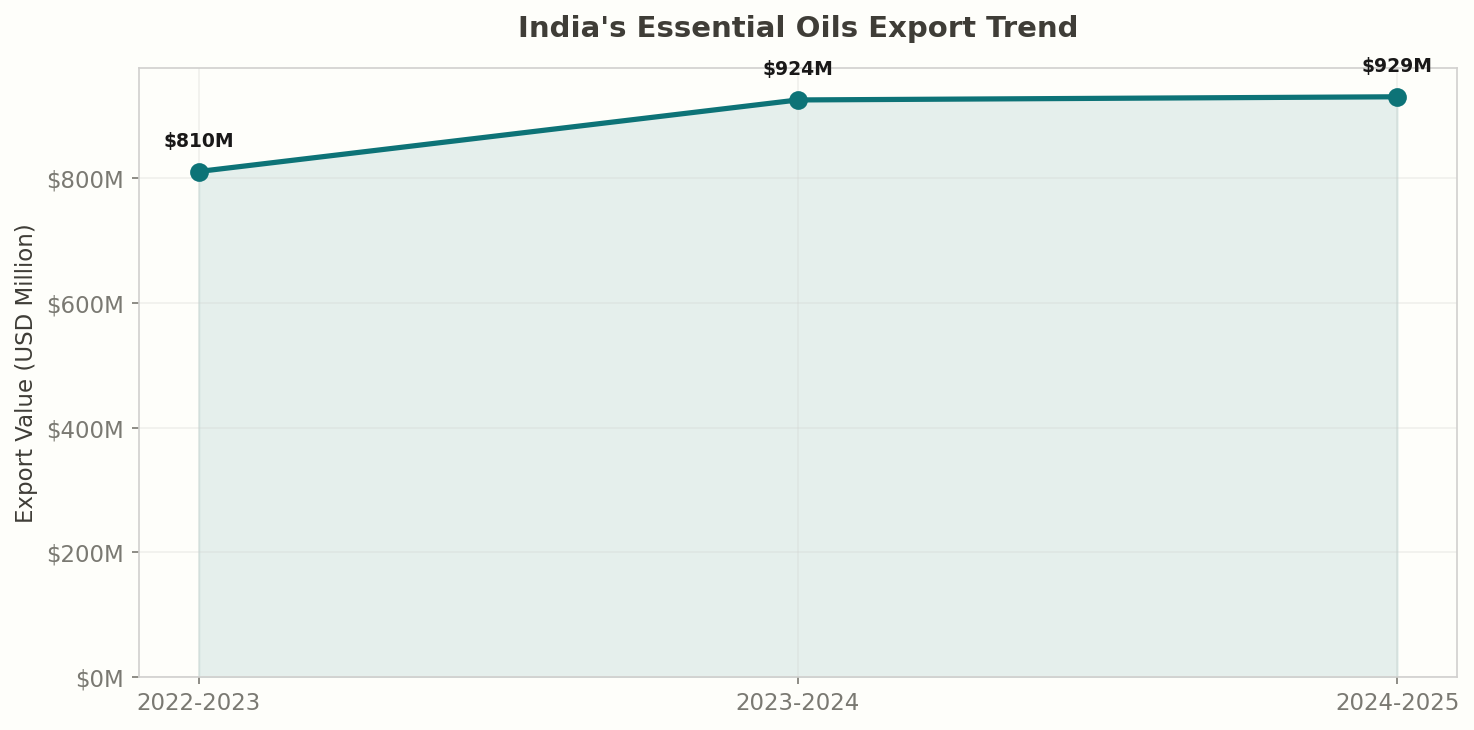
India exported $929 million in essential oils in 2024-25, up from $810 million in 2022-23 — a steady 15% growth.
| HS Code | Category | 2024-25 Exports (USD Million) | Share |
|---|---|---|---|
| 330190 | Other essential oils (incl. concrete/absolute) | $550.6 | 59.2% |
| 330125 | Peppermint oil (Mentha piperita) | $159.4 | 17.1% |
| 330129 | Other mint oils | $137.5 | 14.8% |
| 330124 | Eucalyptus oil | $66.6 | 7.2% |
| 330119 | Other citrus oils | $11.5 | 1.2% |
| 330130 | Resinoids | $2.6 | 0.3% |
The "other essential oils" category ($550.6M) includes menthol crystals, dementholised oil, and a wide range of specialty botanical extracts. Mint oils combined (HS 330125 + 330129) total $297 million, confirming India's dominance in the global mint supply chain. Eucalyptus oil ($66.6M) is a growing segment driven by pharmaceutical and personal care applications.
Where Indian Essential Oils Are in Demand
The USA is the single largest market for Indian essential oils, driven by the fragrance, flavour, and aromatherapy industries. European buyers — particularly in France (the global perfumery capital), Germany, and the UK — are major destinations for high-quality essential oils used in fine fragrances and cosmetics. China is a significant buyer of mint oils. The Middle East and Japan are growing markets for both traditional aromatic oils and therapeutic-grade essential oils.
Want the full country-by-country breakdown? See exact export values, growth rates, tariff rates, and market attractiveness scores for every destination in our detailed data pages. View Essential Oils export data by country →
Key Products and Production Regions
Mint Oils (India's Flagship)
- Menthol — Produced from Japanese mint (Mentha arvensis) grown primarily in UP (Barabanki, Lucknow, Bareilly), Bihar, and MP
- Mentha piperita — Peppermint oil for flavours and fragrances
- Dementholised oil (DMO) — After menthol extraction, used in chewing gum, toothpaste
- India produces 45,000-50,000 tonnes of mint oil annually, 80%+ of global supply
- Chandausi (UP) — India's menthol trading hub
Eucalyptus Oil
- Eucalyptus globulus — Karnataka, Tamil Nadu, Kerala, Nilgiris
- Used in pharmaceuticals (Vicks VapoRub), cleaning products, and aromatherapy
Other Important Oils
- Sandalwood oil — Karnataka (Indian Sandalwood, Santalum album) — extremely high value ($1,500-$3,000/kg), heavily regulated
- Lemongrass oil — Kerala, Karnataka, NE India — growing aromatherapy demand
- Vetiver oil — Rajasthan, UP — used in luxury perfumery (Guerlain, Chanel)
- Palmarosa oil — Maharashtra, MP — used in cosmetics
- Jasmine absolute — Tamil Nadu (Madurai) — luxury perfumery ingredient
HS Code Classification
| 6-Digit Code | Description | Indian Products |
|---|---|---|
| 330112 | Orange oil | Cold-pressed orange peel oil |
| 330113 | Lemon oil | Lemon essential oil |
| 330119 | Other citrus oils | Lime, grapefruit, mandarin oils |
| 330124 | Eucalyptus oil | Eucalyptus globulus, citriodora |
| 330125 | Peppermint oil | Mentha piperita oil |
| 330129 | Other mint oils | Mentha arvensis, spearmint |
| 330130 | Resinoids | Benzoin, opopanax, olibanum |
| 330190 | Other essential oils | All other botanical oils, absolutes, menthol crystals |
Note: Menthol crystals are classified under 330190 (as a derivative of essential oil), not under Chapter 29 (organic chemicals). This classification has been disputed in customs assessments — ensure correct classification to avoid duty issues.
Use the HS Code Finder for accurate classification.
Quality Standards and Certifications
ISO Standards for Essential Oils
- ISO 856 — Oil of peppermint
- ISO 3033 — Oil of rosemary
- ISO 4731 — Oil of eucalyptus (cineole type)
- ISO/TS 210 — Essential oils — General rules for packaging, conditioning, and storage
Quality Parameters
| Parameter | Standard Method | Key for |
|---|---|---|
| Optical rotation | ISO 592 | Authenticity verification |
| Refractive index | ISO 280 | Purity assessment |
| Relative density | ISO 279 | Standard specification |
| GC/GC-MS profile | ISO 11024 | Composition analysis, adulteration detection |
| Heavy metals (Pb, Cd, As, Hg) | ICP-MS | EU/US compliance |
| Pesticide residues | Multi-residue GC-MS/LC-MS | EU MRLs, organic compliance |
Certifications
- FSSAI licence (for food-grade essential oils)
- ISO 22000 / HACCP — For food-grade applications
- Organic (NPOP/NOP/EU) — Organic essential oils command 30-100% premium
- COSMOS/Ecocert — For cosmetic-grade natural/organic certification
- GMP (Good Manufacturing Practice) — For pharmaceutical-grade oils
- IFRA (International Fragrance Association) compliance — For perfumery-grade oils
- Kosher/Halal — For specific market requirements
Testing Laboratories and Costs
Key NABL-accredited labs for essential oil testing include Eurofins (Bangalore), SGS India (Mumbai), Intertek (Chennai), CIMAP (Central Institute of Medicinal and Aromatic Plants, Lucknow), and FFDC (Fragrance and Flavour Development Centre, Kannauj). CIMAP is the premier government institution for mint and aromatic plant research and offers comprehensive GC-MS analysis at subsidised rates. A standard CoA panel — covering GC-MS chromatogram, optical rotation, refractive index, relative density, heavy metals, and pesticide residues — costs Rs 8,000-20,000 per sample with 7-10 working day turnaround. Full GC-MS profiling with 30+ component identification costs Rs 5,000-8,000 alone. Isotope ratio mass spectrometry (IRMS) for authenticity verification costs Rs 15,000-25,000 per sample and is available at select labs including CIMAP and Eurofins. For exporters handling large volumes of mint oil, investing in a basic in-house GC setup (capital cost Rs 15-25 lakh) allows rapid screening of incoming raw material and outgoing shipments, reducing reliance on external labs for routine quality checks.
Adulteration — The Industry's Biggest Challenge
Essential oil adulteration (diluting with cheaper oils, synthetic additives, or solvents) is rampant:
- GC-MS fingerprinting is the gold standard for detecting adulteration
- Isotope ratio analysis (IRMS) detects synthetic vs. natural origin
- Reputable buyers insist on Certificate of Analysis (CoA) with full GC-MS chromatogram
- Building a reputation for unadulterated, consistent-quality oil is the key competitive advantage
Packaging
Bulk
- UN-rated steel drums (180-200 kg) or HDPE drums (25-50 kg) for liquid oils
- HDPE bags inside fibre drums for menthol crystals (25 kg)
- Amber glass bottles for high-value oils (sandalwood, jasmine, vetiver) in 1-5 kg sizes
- Nitrogen blanket on top of liquid oils in drums to prevent oxidation
Retail/Aromatherapy
- Amber glass bottles (10ml, 15ml, 30ml) with orifice reducers and tamper-evident caps
- Private label packaging for aromatherapy brands
Labelling Requirements by Market
- USA: FDA requires labelling based on the intended use — essential oils sold for aromatherapy fall under cosmetics (FDCA), while those making therapeutic claims are regulated as drugs (requiring NDA/OTC monograph compliance). Cosmetic labelling requires ingredient list (using INCI names), net contents, distributor name and address, and any applicable warnings. California Proposition 65 may apply for certain oils containing listed chemicals like pulegone (in pennyroyal) or safrole.
- EU: Regulation (EC) 1223/2009 governs cosmetic-use essential oils. Labels must include INCI ingredient names, batch number, PAO (Period After Opening) symbol, function description, and responsible person's EU address. CLP Regulation applies to bulk essential oils — requiring hazard pictograms (flame symbol for Class 3 flammable), signal words, and H/P statements.
- Middle East: Arabic-language labelling, country of origin, production and expiry dates. For aromatherapy products, some GCC countries require registration with the local health authority (e.g., Dubai Municipality or Saudi FDA). Halal certification may be requested for oils used in personal care products.
Storage
- Store at 15-25°C, away from light and heat
- Essential oils are volatile and photosensitive — exposure to light degrades quality
- Shelf life: 1-3 years (citrus oils shortest, vetiver/sandalwood longest)
Pricing Strategy
| Essential Oil | FOB Price Range (per kg) | Market Application |
|---|---|---|
| Menthol crystals | $12-$25 | Pharma, confectionery, oral care |
| Peppermint oil | $15-$30 | Flavours, fragrances |
| Mentha arvensis oil | $10-$18 | Mentholated products |
| Eucalyptus oil | $8-$15 | Pharma, cleaning, aromatherapy |
| Lemongrass oil | $15-$30 | Aromatherapy, insect repellent |
| Vetiver oil | $80-$200 | Luxury perfumery |
| Sandalwood oil | $1,500-$3,000 | Luxury perfumery, meditation |
| Jasmine absolute | $3,000-$8,000 | Fine perfumery |
India's essential oil pricing is globally competitive for mint and eucalyptus. For premium oils (sandalwood, jasmine, vetiver), India's unique terroir commands significant premiums — Indian sandalwood (Santalum album) is regarded as the world's finest.
Logistics
Shipping
- Sea freight for bulk orders (drums in standard containers)
- Air freight for high-value oils (sandalwood, jasmine) and urgent samples
- Essential oils are classified as DG (Dangerous Goods) for shipping — most are Class 3 flammable liquids
DG Classification
- Mint oils: UN 1272, Class 3, PG III (flammable liquid)
- Eucalyptus oil: UN 1272, Class 3, PG III
- DG documentation (IMDG/IATA declaration) required for all shipments
- DG surcharge: 15-25% above standard freight rates
Key Ports
- JNPT Mumbai — Primary for Western India exporters
- Mundra — Alternative for Gujarat/Rajasthan
- Cochin — For Kerala essential oils (lemongrass, nutmeg)
Freight Costs
- 20-ft container (DG) to USA: $3,500-$6,000
- 20-ft to EU: $2,500-$4,500
- Air freight (high-value oils): $5-$10 per kg
Documentation
- Commercial Invoice (with botanical name, CAS number)
- Packing List
- Bill of Lading
- Certificate of Origin
- Certificate of Analysis (CoA) with GC-MS chromatogram
- Safety Data Sheet (SDS) — GHS compliant
- DG Declaration (IMDG/IATA)
- FSSAI Licence (for food-grade)
- Organic Certificate (if applicable)
- CITES permit (for sandalwood — Santalum album is CITES Appendix II)
- Shipping Bill (via ICEGATE)
- Insurance Certificate
Government Incentives
- RoDTEP — Essential oils (HS 3301) attract RoDTEP at 1-2.5% of FOB value. Mint oils and eucalyptus oil receive rates at the higher end (2-2.5%), reflecting government support for value-added agricultural exports.
- APEDA Support — The Agricultural and Processed Food Products Export Development Authority provides financial assistance for quality improvement, organic certification, infrastructure development, and participation in international trade fairs. Essential oils fall under APEDA's purview for organic and processed agricultural products.
- Organic Certification Subsidy — Under the National Programme for Organic Production (NPOP), APEDA reimburses up to 50% of the cost of organic certification for farmer groups and exporters, subject to a cap of Rs 5 lakh per certification cycle.
- CIMAP and CSIR Support — CIMAP (Central Institute of Medicinal and Aromatic Plants, Lucknow) provides technical assistance for distillation technology, varietal improvement, and quality testing at subsidised rates. CSIR-IITR and CSIR-NBRI also support essential oil research and development.
- Trade Fair Participation — CHEMEXCIL and APEDA sponsor Indian pavilions at key essential oil and fragrance trade shows including IFEAT (International Federation of Essential Oils and Aroma Trades) annual conference, in-cosmetics Global (Barcelona), World Perfumery Congress, and Beautyworld Middle East (Dubai). MSMEs receive up to 90% stall cost subsidy under the MAI scheme.
- Interest Equalisation Scheme — MSME essential oil exporters receive a 5% interest subvention on rupee export credit, significantly reducing working capital costs for this seasonal, inventory-intensive business.
Common Mistakes
Adulteration. Diluting essential oils with cheaper carrier oils, synthetic menthol, or solvents. Buyers test every shipment with GC-MS. One adulterated batch destroys years of reputation and leads to permanent blacklisting.
Not classifying as DG. Most essential oils are flammable liquids (Class 3). Shipping without DG classification is a safety violation that can result in fines, container seizure, and carrier blacklisting.
Ignoring CITES for sandalwood. Indian sandalwood (Santalum album) is a CITES Appendix II species — export requires a CITES permit from the Wildlife Crime Control Bureau. Exporting without a permit is a criminal offence.
Inconsistent quality between batches. Essential oil composition varies by harvest season, rainfall, soil conditions, and distillation parameters. Buyers expect batch-to-batch consistency within specifications. Blend across multiple distillation batches to achieve consistent GC profiles.
Not providing complete CoA. A Certificate of Analysis without a GC-MS chromatogram is considered incomplete by serious buyers. Invest in GC-MS capability or partner with a NABL-accredited lab.
Neglecting proper distillation control. The quality and composition of essential oils depend critically on distillation parameters — steam pressure, temperature, duration, and water-to-plant ratio. Over-distillation produces oils with higher heavy fractions and off-notes, while under-distillation leaves valuable components unextracted. Standardise distillation protocols and train operators on consistent process control. For mint oil, the optimal distillation time is 2-3 hours at atmospheric pressure — extending beyond this introduces undesirable terpene fractions.
Failing to secure supply contracts with farmers. Essential oil prices fluctuate wildly based on harvest quality and agricultural conditions. In 2023-24, mint oil prices swung between Rs 900 and Rs 1,500 per kg within a single season. Exporters who rely on spot purchases from the Chandausi mandi (for mint) face margin erosion during price spikes. Establish forward contracts with farmer cooperatives or invest in backward integration through contract farming to stabilise raw material costs.
Not investing in buyer-facing quality documentation. International fragrance and flavour houses (Firmenich, Givaudan, IFF, Symrise) and major personal care brands require detailed technical dossiers — including GC-MS chromatograms, allergen declarations (per EU Cosmetics Regulation Annex III), safety assessments, and sustainability documentation. Prepare these dossiers proactively rather than scrambling when a buyer requests them.
Key Takeaways
- India exported $929 million in essential oils in 2024-25 — mint oils and menthol dominate
- USA ($314M), China ($87M), and France ($55M) are the top markets
- India produces 80%+ of the world's menthol from mint grown in UP and Bihar
- GC-MS authentication and consistent quality are the key competitive differentiators
- Essential oils are classified as DG (flammable liquids) for shipping
- Organic essential oils command 30-100% premiums
- Sandalwood export requires CITES permit — legally regulated
Next Steps
- Identify your HS code with the HS Code Finder — mint, eucalyptus, citrus each have specific codes
- Invest in GC-MS analysis — either in-house or through a NABL-accredited lab
- Check tariff rates using the Duty Calculator — essential oils enter most markets at 0-5%
- Get organic certification if sourcing from organic farms
- Explore market demand with the Market Finder
- Attend trade fairs — World Perfumery Congress, in-cosmetics (Barcelona), IFEAT (International Federation of Essential Oils and Aroma Trades)
- Build reputation for quality — in the essential oil trade, your reputation IS your business
India's essential oil industry is a $929 million export success story built on centuries of botanical knowledge and modern distillation technology. For MSMEs with access to quality raw material and analytical capability, this is one of the highest-margin agricultural export sectors available.
Ready to start exporting?
Get a detailed market report with country-by-country analysis, pricing insights, and buyer contacts.
Get Market ReportXIMPEX Export Advisory
Need help implementing the strategies discussed in this guide? Our team of export specialists can provide personalized guidance for your business.