How to Export Fruits and Vegetables from India — Complete Guide
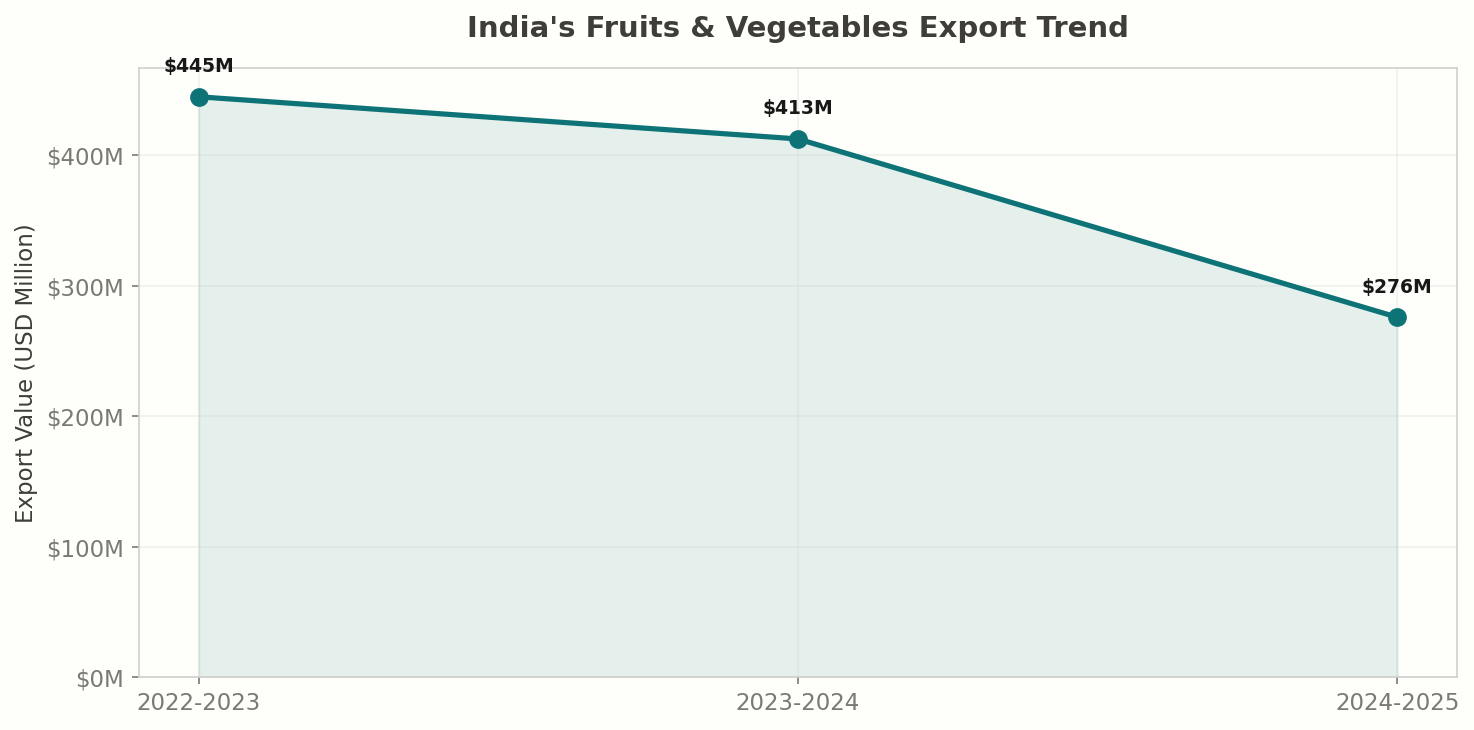
India is the world's second-largest producer of fruits and vegetables, growing over 300 million tonnes annually across a vast range of climatic zones — from tropical mangoes in Maharashtra to temperate apples in Kashmir, from onions in Nashik to potatoes in Uttar Pradesh. India's fresh and frozen fruit and vegetable exports under HS headings 0804, 0709, and 0710 reached $276 million in 2024-25.
While this figure represents a fraction of India's production capacity, the sector holds enormous untapped potential. The decline from $445 million in 2022-23 reflects not a lack of demand but India's ongoing challenge with cold chain infrastructure, phytosanitary compliance, and packaging standards. For MSME exporters who invest in these capabilities, fruits and vegetables offer high margins, year-round demand, and a diversified market spread across the Middle East, UK, USA, and South Asia.
India's Fruits & Vegetables Export Landscape
India exported $276 million in selected fruits, vegetables, and frozen vegetables in 2024-25:
| HS Code | Product Category | 2024-25 Exports (USD Million) | Share |
|---|---|---|---|
| 070999 | Other fresh vegetables | $90.4 | 32.8% |
| 070960 | Fresh capsicum/peppers | $67.0 | 24.3% |
| 071040 | Frozen sweet corn | $32.4 | 11.7% |
| 071080 | Other frozen vegetables | $28.2 | 10.2% |
| 071021 | Frozen peas | $16.0 | 5.8% |
| 070993 | Fresh pumpkins/squash | $13.3 | 4.8% |
| 080430 | Pineapples | $5.7 | 2.1% |
| 080410 | Dates | $1.8 | 0.7% |
Fresh vegetables dominate, led by "other vegetables" ($90.4M) which includes drumstick (moringa pods), bitter gourd, snake gourd, and other Indian vegetables exported primarily to diaspora markets. Frozen vegetables ($76.6M combined) are a growing segment driven by IQF (individually quick frozen) technology.
Where Indian Fruits and Vegetables Are in Demand
The Middle East (UAE, Saudi Arabia, Qatar, Kuwait) is the dominant destination for Indian fresh produce, benefiting from geographic proximity, short transit times, and large South Asian diaspora demand. Bangladesh is a major cross-border market. European markets — the UK, Netherlands, and Germany — import both fresh and processed Indian produce, though strict phytosanitary and MRL (maximum residue limit) requirements make EU market access challenging. The USA imports specific Indian products like mangoes (irradiation-treated), okra, and bitter gourd for the diaspora market.
Want the full country-by-country breakdown? See exact export values, growth rates, tariff rates, and market attractiveness scores for every destination in our detailed data pages. View Fruits and Vegetables export data by country →
Key Export Products and Opportunities
Fresh Vegetables for Diaspora Markets
- Drumstick (moringa pods) — High demand in UAE, UK, Singapore, Malaysia
- Bitter gourd, ridge gourd, snake gourd — Ethnic vegetables with no local production in importing countries
- Green chillies — Year-round demand in Middle East and UK
- Okra (bhindi) — Premium product in UK and European diaspora markets
Frozen Vegetables (IQF)
- Frozen peas, sweet corn, mixed vegetables — Growing segment for supermarket retail
- IQF okra, IQF drumstick, IQF green beans — Premium ethnic frozen range
- Higher margins than fresh, longer shelf life, easier logistics
Fruits
- Mangoes — India's flagship fruit export (Alphonso, Kesar, Banganapalli varieties)
- Grapes — Maharashtra's Nashik district is a major table grape exporter (largely under HS 0806)
- Pomegranates — Growing export from Maharashtra and Karnataka
- Bananas — Cavendish variety for Middle East
HS Code Classification
| 6-Digit Code | Description | Indian Products |
|---|---|---|
| 070960 | Capsicum/peppers, fresh | Green chillies, bell peppers |
| 070999 | Other fresh vegetables | Drumstick, bitter gourd, okra |
| 071021 | Peas, frozen | IQF green peas |
| 071040 | Sweet corn, frozen | IQF sweet corn kernels |
| 071080 | Other vegetables, frozen | IQF okra, beans, mixed veg |
| 080430 | Pineapples, fresh/dried | Fresh pineapples |
| 080450 | Guavas, mangoes, fresh | Alphonso, Kesar mangoes |
Use the HS Code Finder to identify the exact code for your product.
Quality Standards and Certifications
APEDA Registration
APEDA (Agricultural and Processed Food Products Export Development Authority) oversees all agricultural exports:
- Registration with APEDA is mandatory for all fruit and vegetable exporters
- APEDA operates PackHouses approved for mango and grape exports — your product must be processed through an APEDA-approved pack house
- Traceability system — GrapeNet (for grapes) and MangoNet (for mangoes) ensure farm-to-fork traceability
Phytosanitary Requirements
- Phytosanitary Certificate from Plant Quarantine Division (DPPQS) is mandatory for all fresh produce exports
- Pest Risk Analysis — Each destination country has specific pest lists. Products must be free from quarantine pests.
- Vapour Heat Treatment (VHT) — Required for mango exports to USA, Japan, South Korea (kills fruit fly larvae)
- Irradiation — Accepted by some countries as an alternative to VHT
- Cold treatment — Required for grapes exported to EU (kills fruit fly at 0-2°C for 16 days)
Food Safety Certifications
- FSSAI licence — Mandatory for all food exporters
- GlobalG.A.P. — Required by European supermarkets (Tesco, Marks & Spencer, ALDI)
- HACCP — Mandatory for processed/frozen vegetables
- BRC/IFS — Required for UK and German retail supply
- Organic (NPOP/NOP/EU) — Growing demand for organic produce at 30-50% premium
Testing Labs and Costs
Get pre-shipment testing done at NABL-accredited laboratories. Key labs include SGS India (Mumbai, Chennai), Bureau Veritas (multiple locations), Intertek (Delhi, Mumbai), and EIC (Export Inspection Council) laboratories across India. APEDA-empanelled labs in Navi Mumbai and Gurgaon are also authorised for pesticide residue testing. Typical costs: multi-residue pesticide analysis (250+ pesticides) runs Rs 8,000-15,000 per sample with a 5-7 working day turnaround. Heavy metals panel costs Rs 3,000-5,000. Microbiological testing (E. coli, Salmonella, Listeria) costs Rs 4,000-8,000. For EU-bound shipments, get the full 400+ pesticide panel tested — partial testing invites RASFF alerts. Budget Rs 25,000-40,000 per consignment for comprehensive testing across all parameters.
Pesticide Residue Limits (MRLs)
The single biggest compliance risk for fresh produce:
- EU MRLs — Extremely strict, regularly updated under Regulation 396/2005
- Japan Positive List — Default 0.01 ppm for unlisted pesticides
- USA EPA tolerances — Relatively more lenient than EU
- Rapid Alert System (RASFF) — EU's system for notifying non-compliant food imports. India regularly appears for MRL violations in chillies, okra, and curry leaves.
Packaging and Cold Chain
Fresh Produce Packaging
- Corrugated fibreboard cartons with ventilation holes (4-5 kg for mangoes, 5-10 kg for vegetables)
- Modified Atmosphere Packaging (MAP) — Extends shelf life by 50-100% for leafy greens and soft fruits
- Pre-cooling — Mandatory before packing (hydro-cooling or forced-air cooling to remove field heat)
- Waxing — Food-grade wax coating for citrus fruits and apples to reduce moisture loss
Frozen Produce Packaging
- IQF products in LDPE/LLDPE bags, packed in master cartons (10 kg)
- Block frozen in polyethylene bags, master cartons
- Storage at -18°C or below throughout the chain
Region-Specific Packaging and Labelling Rules
Different destination markets have distinct packaging and labelling requirements that must be followed precisely:
EU and UK: All fresh produce packaging must display the lot number, country of origin ("Origin: India"), class/grade (Extra, Class I, or Class II per UNECE standards), net weight, and the name and address of the packer. Wooden crates and pallets must carry the ISPM 15 mark (heat-treated). EU regulations require that all packaging materials be free from harmful substances under Regulation (EC) 1935/2004 on food contact materials. From 2025, the EU also requires sustainability declarations for packaging under the Packaging and Packaging Waste Regulation (PPWR).
USA: FDA requires country of origin labelling. If products are organic, USDA Organic certification and logo must appear on the label. All produce entering the US must comply with USDA APHIS import permits specific to the commodity. Wooden packaging requires ISPM 15 compliance. Bio-security declarations may be required for certain produce categories.
Middle East (GCC countries): GSO (Gulf Standards Organization) labelling standards apply. Arabic language labelling is mandatory — product name, origin, and expiry information must be in Arabic. Halal certification is not typically required for fresh produce but is expected for any processed or value-added vegetable products. The UAE's ESMA and Saudi Arabia's SFDA have specific shelf-life requirements that must be printed on the package.
Cold Chain — The Critical Factor
India's cold chain infrastructure is the single biggest barrier to fruit and vegetable exports:
- Pre-cooling facility at farm gate → reefer truck → cold storage at port → reefer container → destination cold storage
- Any break in the cold chain causes spoilage, quality loss, and rejection
- Target temperatures: Mangoes 10-13°C, grapes 0-2°C, frozen vegetables -18°C
Pricing Strategy
| Product | FOB Price Range | Season | Key Markets |
|---|---|---|---|
| Alphonso mango (per kg) | $3-$8 | April-June | UAE, UK, USA |
| Table grapes (per kg) | $1.50-$3.00 | January-April | EU, UK, Russia |
| Fresh okra (per kg) | $2-$5 | Year-round | UAE, UK |
| Green chillies (per kg) | $1.50-$3.50 | Year-round | UAE, Middle East |
| IQF green peas (per kg) | $0.80-$1.50 | Year-round | UK, EU |
| IQF sweet corn (per kg) | $0.70-$1.20 | Year-round | UK, EU, Japan |
| Drumstick/moringa pods (per kg) | $3-$7 | Year-round | UAE, UK, Singapore |
Fresh ethnic vegetables command 3-5x premiums in diaspora markets compared to Indian wholesale prices. A drumstick selling at Rs 40/kg in India can export at $5-7/kg FOB.
Logistics
Shipping
- Air freight is essential for fresh produce with short shelf life (mangoes, leafy vegetables): 1-3 days to any destination
- Sea freight (reefer containers) for frozen vegetables and longer-shelf-life fresh produce (grapes, onions)
Transit Times (Reefer)
- JNPT to UAE: 5-7 days
- JNPT to UK: 18-22 days
- Chennai to Singapore: 8-10 days
- Air freight to any destination: 1-3 days
Freight Costs
- Air freight (fresh produce): $2-$5 per kg (significant cost component)
- 40-ft reefer container to UAE: $2,500-$4,500
- 40-ft reefer to UK: $4,000-$6,500
Shelf Life Considerations
- Mangoes (air freight): 7-10 days at 10-13°C
- Grapes (sea freight): 45-60 days at 0-2°C with SO₂ pads
- Frozen vegetables: 12-24 months at -18°C
Documentation
- Commercial Invoice
- Packing List (with lot/farm traceability)
- Bill of Lading / Airway Bill
- Certificate of Origin (CEPA for UAE)
- Phytosanitary Certificate (from DPPQS)
- APEDA Registration Certificate
- VHT/Irradiation Certificate (for mangoes to USA/Japan)
- Lab Test Report (pesticide residues)
- FSSAI Licence
- GlobalG.A.P. Certificate (for EU/UK retail)
- Shipping Bill (via ICEGATE)
- Insurance Certificate
Government Incentives
- APEDA Market Development Assistance — Trade fair subsidies, buyer-seller meets, up to 100% stall rental subsidy at international fairs. APEDA also provides airfare assistance (economy class) for exporters attending approved trade shows.
- RoDTEP — 1-3% of FOB value depending on the HS code. Fresh vegetables typically attract 1.5-2.5%, while frozen vegetables get 1-2%. Check the latest RoDTEP schedule on the DGFT website for your specific product code.
- Transport and Marketing Assistance (TMA) for agricultural products — freight subsidy of Rs 3-7 per kg for air freight and Rs 2,500-7,500 per tonne for sea freight, depending on destination. Applies to eligible horticultural products listed by APEDA.
- Integrated Cold Chain projects — Government subsidies of up to 35% of project cost (50% for NE states) for cold chain infrastructure under the Pradhan Mantri Kisan SAMPADA Yojana
- MIDH (Mission for Integrated Development of Horticulture) — Support for pack houses (subsidy up to Rs 35 lakh), pre-cooling units (up to Rs 25 lakh), and reefer vans (up to Rs 26 lakh)
- APEDA Financial Assistance for Infrastructure — Up to Rs 50 lakh for setting up quality testing laboratories and up to Rs 20 lakh for packaging development
- Pre and Post Shipment Credit — Available from scheduled commercial banks at concessional interest rates under the RBI's export credit scheme. Pre-shipment credit (packing credit) available at base rate and post-shipment credit at competitive rates for up to 90 days.
Common Mistakes
Not pre-cooling before packing. Fresh produce must be cooled to the target temperature before packing. Loading warm produce into a reefer container relies on the container to cool it — which is too slow and causes condensation, leading to fungal growth.
Ignoring RASFF alerts. Check the EU's RASFF database for recent rejections of Indian produce. If your product category has active alerts (e.g., okra with pesticide residues), expect enhanced inspections at the destination.
Shipping mangoes without VHT. The USA, Japan, and South Korea require Vapour Heat Treatment for Indian mangoes. There are only a limited number of APHIS-approved VHT facilities in India — book well in advance during mango season (April-May).
Underestimating air freight costs. For fresh produce, air freight is $2-5/kg — often 30-50% of the FOB price. Factor this into your pricing from the start. Many first-time exporters discover they can't compete after accounting for logistics.
Not investing in farm-level quality. Export-quality produce starts at the farm — proper GAP (Good Agricultural Practice), IPM (Integrated Pest Management), and harvest timing are non-negotiable. You cannot convert domestic-market-quality produce into export quality at the pack house.
Using non-approved pesticides close to harvest. Many export rejections stem from applying pesticides that are approved in India but banned in the destination market, or applying permitted pesticides within the pre-harvest interval. Maintain a spray schedule aligned with MRL requirements of your target market, not just Indian regulations.
Skipping trial shipments. Always send a trial consignment (1-2 pallets) to a new buyer or destination before committing to a full container. Trial shipments reveal cold chain weaknesses, transit damage patterns, and shelf-life performance in actual conditions — problems that no amount of planning can predict.
Key Takeaways
- India exported $276 million in fruits, vegetables, and frozen vegetables in 2024-25
- UAE ($67.5M), UK ($32.1M), and USA ($21.2M) are the top markets
- Diaspora markets (Middle East, UK, Singapore) drive demand for ethnic Indian vegetables
- Cold chain integrity and pesticide residue compliance are the two critical success factors
- Frozen/IQF vegetables offer higher margins, longer shelf life, and easier logistics than fresh
- APEDA registration, phytosanitary certificate, and GlobalG.A.P. are essential
- Air freight for fresh produce costs $2-5/kg — factor this into pricing from day one
Next Steps
- Identify your HS code with the HS Code Finder — fresh vs. frozen classification matters
- Register with APEDA and get your pack house approved
- Check tariff rates using the Duty Calculator
- Invest in cold chain — pre-cooling, reefer transport, temperature monitoring
- Get GlobalG.A.P. certified for EU/UK market access
- Explore market demand with the Market Finder
- Start with frozen vegetables if cold chain for fresh produce is not yet available — lower risk, consistent demand
India grows enough fruits and vegetables to feed the world. The export challenge is not production — it is post-harvest handling, cold chain, and compliance. Solve those, and you're tapping into a market with enormous diaspora-driven demand.
Ready to start exporting?
Get a detailed market report with country-by-country analysis, pricing insights, and buyer contacts.
Get Market ReportXIMPEX Export Advisory
Need help implementing the strategies discussed in this guide? Our team of export specialists can provide personalized guidance for your business.