How to Export Handicrafts from India — Complete Guide
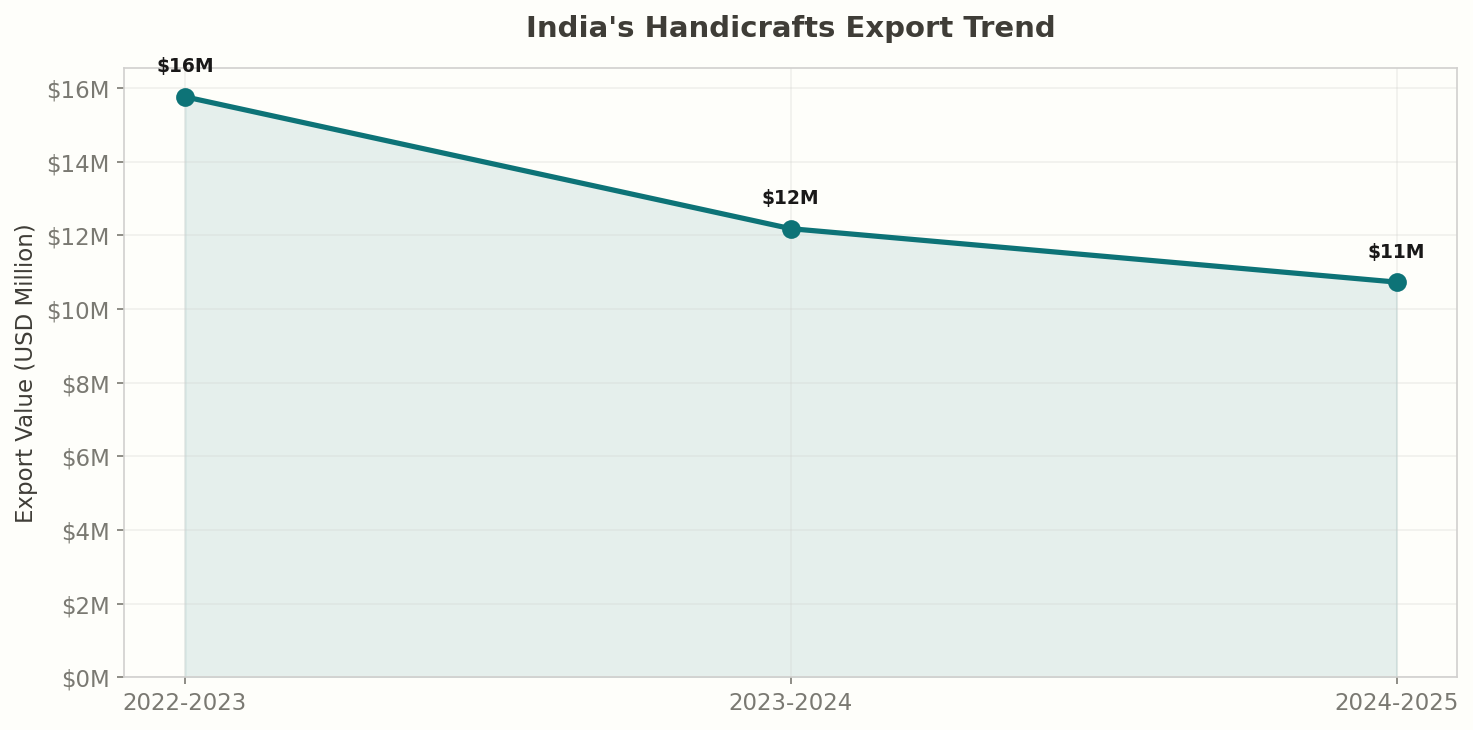
India's handicraft sector is one of the country's oldest and most culturally rich export industries, employing over 7 million artisans across thousands of clusters. While the specific HS codes for handicrafts (woodware HS 4420, decorative ceramics HS 6913, and artworks HS 9703) show exports of $10.7 million in 2024-25, the broader handicraft ecosystem — encompassing carved stone articles ($1.16 billion under HS 6802), handmade carpets ($1.83 billion under HS 57), copper/brass artware ($70 million under HS 7418-7419), and metal statuettes ($32 million under HS 8306) — makes India one of the world's largest handicraft exporters at over $3 billion annually.
For MSME artisan-entrepreneurs, handicraft exports offer the rare combination of cultural heritage value, high per-unit margins, and growing global demand for handmade, sustainable, and artisanal products. The challenge lies in scaling artisan production to meet international buyer volumes while maintaining the handcrafted quality that commands premium pricing.
India's Handicraft Export Landscape
India's handicraft exports under the core HS codes tracked here reached $10.7 million in 2024-25:
| HS Code | Category | 2024-25 Exports (USD Million) | Key Products |
|---|---|---|---|
| 4420 | Woodware and wooden articles | $9.5 | Carved wood, inlaid items, decorative woodwork |
| 6913 | Ceramic statuettes and ornaments | $1.2 | Pottery figurines, decorative ceramics |
However, the broader handicraft sector is significantly larger when including adjacent categories:
| HS Code | Extended Category | 2024-25 Exports (USD Million) |
|---|---|---|
| 6802 | Worked stone articles (marble, granite) | $1,161 |
| 57 | Handmade carpets and rugs | $1,825 |
| 7418-7419 | Copper and brass articles | $70 |
| 8306 | Bells, frames, metal statuettes | $32 |
India's handicraft exports benefit from strong government support through the Export Promotion Council for Handicrafts (EPCH) and the Development Commissioner for Handicrafts.
Where Indian Handicrafts Are in Demand
The USA is the largest single market for Indian handicrafts, driven by demand for home decor, wooden furniture, metal artware, and handmade textiles. European buyers — particularly in the UK, Germany, France, and the Netherlands — value Indian handicrafts for their artisanal quality and cultural distinctiveness. The Middle East (UAE, Saudi Arabia) provides demand for brass/copperware, marble inlay, and decorative items. Australia, Japan, and Canada are growing markets. Indian handicrafts benefit from a "handmade" premium in markets where consumers increasingly value artisanal over mass-produced goods.
Want the full country-by-country breakdown? See exact export values, growth rates, tariff rates, and market attractiveness scores for every destination in our detailed data pages. View Handicrafts export data by country →
Major Handicraft Clusters
Woodware
- Saharanpur (UP) — Carved wood furniture, decorative items, sheesham wood products
- Jodhpur (Rajasthan) — Reclaimed wood furniture, mango wood items, painted furniture
- Mysuru (Karnataka) — Sandalwood carvings, rosewood inlay
- Kashmir — Walnut wood carvings, papier-mâché
Ceramics and Pottery
- Khurja (UP) — India's ceramic city, decorative and tableware pottery
- Jaipur (Rajasthan) — Blue pottery (Persian-influenced, unique to Jaipur)
- Kolkata (West Bengal) — Terracotta craft
Metal Artware
- Moradabad (UP) — India's "Brass City," brass and copper artware, GI-tagged
- Jaipur — Meenakari (enamel work) on copper/brass
- Thanjavur (Tamil Nadu) — Bronze icons, traditional art plates
- Bidriware (Karnataka) — Silver inlay on darkened zinc/copper alloy
Stone Carving
- Agra (UP) — Marble inlay (pietra dura), Taj Mahal heritage craft
- Jaipur — Marble and sandstone sculptures
- Mahabalipuram (Tamil Nadu) — Granite and soapstone sculptures
Textiles (Handcraft)
- Kashmir — Pashmina shawls, crewel embroidery
- Lucknow — Chikankari embroidery
- Gujarat — Bandhani (tie-dye), Kutch embroidery
HS Code Classification
Handicrafts are notoriously difficult to classify because the HS system categorises by material, not by "handmade" status:
| Code | Classification Basis | Typical Handicraft |
|---|---|---|
| 4420 | Wood: ornamental articles | Carved figurines, inlaid boxes, wooden frames |
| 6802 | Stone: worked articles | Marble sculptures, soapstone carvings |
| 6913 | Ceramic: statuettes, ornaments | Pottery figurines, blue pottery |
| 7418 | Copper: household articles | Brass vessels, decorative copper ware |
| 8306 | Base metal: statuettes, frames | Metal figurines, photo frames, bells |
| 5701-5705 | Textile floor coverings | Hand-knotted carpets, dhurries |
| 9703 | Artworks: sculptures | Original sculptures and statuary |
Key classification principle: A wooden elephant is HS 4420 (wood articles), not 9703 (artworks), unless it qualifies as an original work of art. A brass Ganesha statue is HS 8306 (metal statuettes), not 7418 (household copper articles). Classification errors are common and can trigger duty discrepancies at the destination.
Use the HS Code Finder for accurate classification.
Quality Standards and Documentation
EPCH Membership
The Export Promotion Council for Handicrafts is the apex body:
- RCMC from EPCH required for export incentives
- EPCH organises IHGF (Indian Handicrafts & Gifts Fair) — the world's largest handicrafts trade fair, held biannually in Greater Noida
- Market development assistance for participating in international trade fairs
Certifications and Standards
- Geographical Indication (GI) Tags — Many Indian crafts are GI-tagged: Banarasi silk, Kanchipuram silk, Pashmina, Blue Pottery of Jaipur, Bidriware of Bidar, Moradabad metalware. GI tags add authenticity and prevent counterfeiting.
- Fair Trade Certification — Strong demand from US and European buyers for ethically produced handcrafts
- World Fair Trade Organization (WFTO) membership for fair-trade organizations
- FSC Certification — For wooden products, Forest Stewardship Council certification ensures sustainably sourced timber
- CITES Compliance — Required if using certain plant/animal materials (e.g., rosewood, ivory alternatives)
Testing Labs and Compliance Costs
For US-bound handicrafts, get lead and cadmium testing done at NABL-accredited labs such as SGS India, Bureau Veritas, Intertek, or TUV Rheinland. Lead-in-paint testing (CPSC/ASTM F963) costs Rs 2,000-5,000 per sample. California Prop 65 compliance testing for lead, cadmium, and phthalates costs Rs 5,000-10,000. For EU-bound products, REACH compliance testing (restricted substances list including heavy metals, phthalates, and formaldehyde in coatings) costs Rs 8,000-15,000 per product type. Budget for initial testing across your product range and then periodic testing every 6-12 months or whenever you change suppliers, raw materials, or finishes. Many EPCH-organised buyer-seller meets provide guidance on destination-specific compliance requirements — attend these before committing to a new market.
Quality Control
- Surface finish — No rough edges, uniform polish/paint
- Dimensional consistency — Critical for commercial orders (±2-3% tolerance)
- Material authenticity — Genuine wood species, real marble (not composite), authentic metal alloys
- Colour fastness — For painted/dyed items, test for fading and rubbing fastness
- Safety standards — No sharp edges (especially for items marketed as home décor), CPSC compliance for items marketed toward children
Packaging and Labelling
Packaging (Critical for Fragile Items)
- Ceramic/stone items: Individual bubble wrap, foam inserts, double-wall corrugated cartons, "FRAGILE" marking on all sides
- Wooden items: Tissue wrap, corrugated cardboard separators, shrink wrap for large items
- Metal artware: Tissue/bubble wrap, VCI (Vapour Corrosion Inhibitor) paper for brass/copper to prevent tarnishing
- Breakage allowance: Industry standard is 2-3% breakage allowance in pricing for ceramic and stone items
Labelling Requirements
- USA: Country of origin ("Made in India"), CPSC compliance for any children's items, California Prop 65 warnings if applicable (lead in glazes, cadmium in paints)
- EU: CE marking only for items with electrical components, REACH compliance for chemicals in paints/finishes
- All markets: Material description, care instructions, "handmade" certification where claimed
Sustainable Packaging
Increasingly, US and European buyers require:
- No single-use plastic packaging (use paper, jute, or recyclable alternatives)
- FSC-certified packaging materials
- Minimal packaging footprint
Pricing Strategy
| Product Type | FOB Price Range | Key Markets |
|---|---|---|
| Carved wooden figurines (6-12 inch) | $3-$25/piece | USA, UK, Germany |
| Wooden home décor (boxes, frames) | $2-$15/piece | USA, Europe |
| Blue pottery (Jaipur) | $5-$40/piece | USA, UK, Germany |
| Brass/copper artware | $5-$50/piece | USA, UAE, UK |
| Marble inlay items | $10-$200/piece | USA, UAE, UK |
| Handmade carpets (per sq ft) | $15-$150/sq ft | USA, Germany |
| Metal figurines/statuettes | $3-$80/piece | USA, Europe |
| Terracotta items | $1-$10/piece | USA, UK |
Handicraft margins are typically 30-60% at the manufacturer level — significantly higher than most manufacturing sectors. The challenge is volume. Most artisan workshops produce 50-200 pieces per day, limiting scalability.
Pricing approach: Cost the item based on material + artisan labour (daily wage ÷ pieces per day) + overheads (15-20%) + margin (30-40%). Then benchmark against similar items on Amazon, Wayfair, or Anthropologie to ensure market competitiveness.
Logistics
Shipping Considerations
- Ocean freight for regular commercial orders (FCL or LCL)
- Air freight for samples, urgent orders, or high-value items ($4-$8/kg)
- Breakage risk is the primary concern — pack conservatively, use "FRAGILE" stickers, and insure at full value
Transit Times
- JNPT/Mundra to USA East Coast: 28-35 days
- JNPT to UK/EU ports: 18-25 days
- JNPT to UAE: 5-7 days
Freight Costs (Indicative)
- 20-ft container (mixed handicrafts) to USA: $2,500-$4,500
- LCL shipment to Europe: $80-$150 per CBM
- Air freight to USA/Europe: $4-$8 per kg
Weight vs. Volume
Handicrafts are often "volumetric" — they take up more space than their weight suggests. A container of pottery or wooden items may be only 40-60% of the weight limit. Calculate both actual weight and volumetric weight when costing freight.
Documentation
- Commercial Invoice
- Packing List (detailed item descriptions, quantities, dimensions)
- Bill of Lading / Airway Bill
- Certificate of Origin
- EPCH RCMC Certificate
- Phytosanitary Certificate (for wooden products — ISPM 15 treatment)
- Fumigation Certificate (for wooden items, some markets require methyl bromide or heat treatment)
- GI Tag Certificate (if applicable)
- CITES permit (for restricted materials)
- Lab Test Reports (lead in paint/glaze for USA, REACH for EU)
- Shipping Bill (via ICEGATE)
- Insurance Certificate (essential for fragile items)
Buyer Finding Strategies
Trade Shows — The Primary Channel
- IHGF Delhi Fair (Indian Handicrafts & Gifts Fair) — Held biannually (spring and autumn) in Greater Noida. The world's largest handicraft trade fair with over 3,200 exhibitors and 7,000+ buyers from 100+ countries. EPCH organises buyer delegations and provides subsidised stall rentals for first-time exporters.
- Ambiente (Frankfurt) — The world's largest consumer goods fair, held every February. Strong for home decor, tableware, and gift items. EPCH sponsors India Pavilion participation.
- Maison & Objet (Paris) — Premier European trade fair for interior design and lifestyle products, held in January and September.
- NY NOW (New York) — Key trade show for the US gift and home market, held twice a year.
- Heimtextil (Frankfurt) — For handmade textile crafts, rugs, and home furnishings.
Online and B2B Channels
- Amazon Handmade, Etsy Wholesale — Platforms specifically designed for artisan and handmade products. Require "handmade" verification but offer direct access to retail consumers.
- Wayfair, Anthropologie, West Elm — US retailers actively sourcing handmade home decor from India. Approach through their vendor onboarding portals or at trade shows.
- Indian Embassy commercial wings — Contact commercial counsellors at Indian missions for introductions to importers, distributors, and retail chains in target markets.
- EPCH Buyer-Seller Meets — EPCH organises targeted meets in cities like New York, London, Tokyo, and Dubai, providing pre-vetted buyer introductions at subsidised costs.
Government Incentives
- RoDTEP — 1-4% of FOB value for handicraft products. Wooden articles (4420) typically attract 2-3%, ceramics (6913) get 2-4%. Check the latest DGFT RoDTEP schedule for your specific HS code.
- EPCH Market Development Assistance — Subsidies for international trade fair participation (up to 90% of stall rental and 75% of airfare). First-time exhibitors get priority. Apply through EPCH at least 3 months before the fair.
- Ambedkar Hastshilp Vikas Yojana — Skill development for artisans, design workshops, common facility centres
- One District One Product (ODOP) — Promotes district-specific handicrafts for export
- GI Registration — Government-funded for traditional crafts
- Design Registration — IP protection for unique handicraft designs
- Pre-shipment credit (Packing Credit) — Available from scheduled commercial banks at concessional interest rates for handicraft export orders. Artisan cooperatives and MSME exporters can access working capital finance linked to confirmed export orders.
- Duty Drawback — Available for handicraft products that use imported raw materials or components. Rates vary by product category — check the latest Duty Drawback schedule.
Common Mistakes When Exporting Handicrafts
Not treating ISPM 15 for wooden products. All wooden packaging and products exported to the USA, EU, and Australia must be treated (heat-treated or fumigated) and marked with the ISPM 15 stamp. Non-compliant shipments are quarantined or destroyed.
Inconsistent quality in handmade products. By definition, handmade items vary. But commercial buyers expect reasonable consistency. Establish QC checkpoints — material selection, in-process inspection, final inspection — and agree on acceptable variation ranges with buyers.
Ignoring lead content in paints and glazes. The USA (CPSC) and California (Prop 65) have strict lead limits for decorative items and tableware. Many traditional Indian glazes and paints contain lead. Switch to lead-free alternatives or test and declare.
Not investing in product photography. Handicrafts sell on visual appeal. Professional product photography (white background, multiple angles, lifestyle shots) is essential for trade fair catalogues, e-commerce, and buyer presentations.
Underpricing handmade goods. Many artisans price based on material cost alone, ignoring the labour and skill premium. Handmade goods from India compete in the "artisanal premium" segment — price them as craft, not as commodity.
Not adapting designs to market preferences. Indian handicraft designs that sell well domestically may not resonate with Western consumers. Study the colour palettes, size preferences, and functional requirements of your target market. European buyers prefer muted, neutral tones; US buyers lean towards contemporary designs that blend with modern interiors. Hire a product designer or work with EPCH's design development centres to create export-specific collections.
Key Takeaways
- India's broader handicraft exports exceed $3 billion including carpets, stone articles, metal artware, and craft textiles
- Core HS codes (4420, 6913, 9703) showed $10.7 million in 2024-25, with the broader ecosystem significantly larger
- USA is the dominant market across all handicraft categories
- Classification by material (not "handmade" status) is the HS code principle — classify carefully
- GI tags (Jaipur Blue Pottery, Moradabad Brassware, etc.) add authenticity and premium value
- EPCH membership and IHGF trade fair participation are the primary market access channels
- Breakage risk in shipping is the #1 logistics concern — invest in quality packaging
Next Steps
- Identify your HS code with the HS Code Finder — classification depends on material (wood, ceramic, metal, stone, textile)
- Register with EPCH and get your RCMC for export incentives
- Check tariff rates using the Duty Calculator — most handicrafts enter USA/EU at 0-5% duty
- Get GI certification if your product has a geographical indication
- Attend IHGF (Indian Handicrafts & Gifts Fair, Greater Noida) — the world's largest handicraft trade fair
- Explore market demand with the Market Finder for your specific handicraft category
- Invest in professional product photography and a product catalogue — handicrafts sell on visual appeal
India's handicraft tradition spans 5,000 years. In a world increasingly valuing handmade, sustainable, and culturally authentic products, Indian handicraft exporters are perfectly positioned. The key is combining artisanal skill with modern export compliance, packaging, and market access.
Ready to start exporting?
Get a detailed market report with country-by-country analysis, pricing insights, and buyer contacts.
Get Market ReportXIMPEX Export Advisory
Need help implementing the strategies discussed in this guide? Our team of export specialists can provide personalized guidance for your business.