How to Export Honey from India — Complete Guide
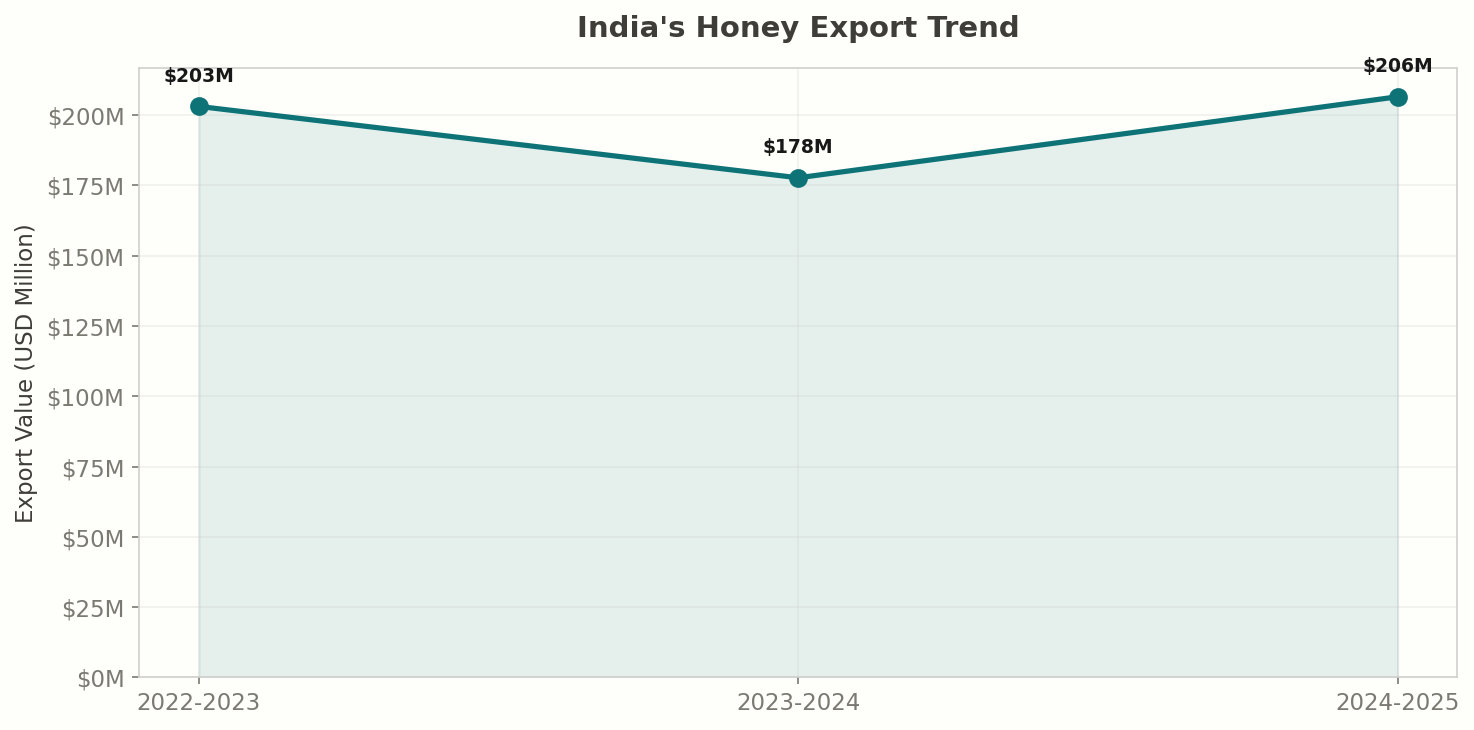
India is one of the world's top 10 honey producers and a fast-growing honey exporter, shipping $206 million worth of natural honey in 2024-25 under HS heading 0409. India's honey exports have grown dramatically over the past decade, driven by global demand for natural sweeteners, Ayurvedic/wellness products, and the unique flavour profiles of Indian multifloral and forest honeys.
India's Honey Export Landscape
India exported $206 million in natural honey in 2024-25, recovering from $178 million in 2023-24 and close to the 2022-23 level of $203 million:
| HS Code | Category | 2024-25 Exports (USD Million) |
|---|---|---|
| 040900 | Natural honey | $206.5 |
India produces approximately 130,000-150,000 tonnes of honey annually. Major honey types include multifloral, mustard, eucalyptus, lychee, acacia, and forest honey. The states of Uttar Pradesh, West Bengal, Rajasthan, Bihar, Punjab, and the Northeast are the primary production regions.
Where Indian Honey Is in Demand
The USA is the largest destination for Indian honey exports, followed by Middle Eastern markets (UAE, Saudi Arabia) and European buyers. The global honey market has been significantly affected by quality and adulteration concerns — the USA and EU have increased testing for antibiotics, pesticides, and sugar syrup adulteration, which has both created challenges and opportunities for compliant Indian exporters. Southeast Asian markets and neighbouring countries also import Indian honey.
Want the full country-by-country breakdown? See exact export values, growth rates, tariff rates, and market attractiveness scores for every destination in our detailed data pages. View Honey export data by country →
Honey Varieties and Production Regions
Multifloral Honey
- Produced across UP, Rajasthan, Bihar, MP, and Punjab
- Most common export variety — blended from multiple floral sources
- Mild flavour, amber colour, suits bulk/industrial markets
Mustard Honey
- UP, Rajasthan, Bihar (major mustard cultivation states)
- Tends to crystallise naturally (high glucose content)
- Light colour, mild flavour
Eucalyptus Honey
- Tamil Nadu, Karnataka, Nilgiris
- Medium amber, slightly mentholated flavour
- Popular in pharmaceutical applications
Lychee Honey
- Bihar, Jharkhand, West Bengal (lychee belt)
- Light golden, fruity flavour
- Premium segment for specialty/retail
Forest Honey (Wild/Tribal)
- Northeast India, Jharkhand, Chhattisgarh, Odisha
- Collected from wild colonies by tribal communities
- Dark, strong flavour — "single origin" positioning
- Organic by default (no chemical inputs)
Acacia Honey
- Kashmir, Punjab
- Light, slow to crystallise
- Premium market positioning
Quality Standards and Compliance
The Compliance Challenge
Honey is one of the most tested food products at international borders. Key parameters:
| Parameter | Codex Standard | EU Limits | US FDA |
|---|---|---|---|
| Moisture | ≤20% | ≤20% | ≤18.6% typical |
| HMF (Hydroxymethylfurfural) | ≤40 mg/kg | ≤40 mg/kg (≤80 tropical) | No specific limit |
| C4 sugars (SIRA test) | ≤7% | ≤7% | Investigation trigger |
| Diastase number | ≥8 (Schade) | ≥8 | No specific limit |
| Antibiotic residues | Not permitted | Zero tolerance | Action level varies |
| Pesticide residues | Below MRLs | Below MRLs | Below EPA tolerance |
| Sucrose content | ≤5% | ≤5% | No specific limit |
Antibiotic Residues — The Critical Risk
Antibiotics (chloramphenicol, streptomycin, tetracycline, sulfonamides) are used in beekeeping to treat bee diseases. All importing countries have zero or near-zero tolerance:
- EU: Zero tolerance for chloramphenicol (detection level 0.3 ppb)
- USA: FDA may detain shipments without refusal if antibiotics are detected
- India has faced multiple US FDA import alerts for honey adulteration and antibiotic residues
Adulteration Testing — C4 Sugar Analysis
The most sophisticated compliance test for honey:
- SIRA (Stable Isotope Ratio Analysis) — Detects addition of corn syrup, rice syrup, and other C4 sugars
- C4 sugar content must be ≤7% — levels above this indicate adulteration
- NMR (Nuclear Magnetic Resonance) profiling — The gold standard for comprehensive adulteration detection, used by EU and US labs
- India has faced significant scrutiny for honey adulteration (rice syrup blending). Maintain clean supply chains.
Testing Labs and Costs
Every export consignment must be tested at a NABL-accredited laboratory before shipment. Key labs include SGS India (Mumbai, Gurgaon), Bureau Veritas (Mumbai, Delhi), Intertek (Delhi, Chennai), Eurofins (Bengaluru), and the EIC (Export Inspection Council) laboratories. Testing costs per batch: SIRA/C4 sugar analysis costs Rs 5,000-8,000, antibiotic residue panel (chloramphenicol, streptomycin, tetracyclines, sulfonamides — typically 6-8 antibiotics) costs Rs 8,000-12,000, pesticide residue analysis (multi-residue panel) costs Rs 8,000-15,000, basic parameters (moisture, HMF, diastase, sucrose) cost Rs 3,000-5,000. A comprehensive export testing package covering all parameters runs Rs 25,000-40,000 per batch with a turnaround of 7-12 working days. For NMR profiling (gold standard for adulteration detection, increasingly demanded by EU and US buyers), samples must be sent to specialised labs — NMR testing costs Rs 15,000-25,000 per sample. Budget testing costs into your per-kilogram pricing from the outset.
Certifications Required
- FSSAI licence — Mandatory
- HACCP — Required by most importers
- BRC/IFS — For EU retail channels
- Organic (NPOP/NOP/EU) — Organic honey commands 40-80% premium. Certification requires documented organic beekeeping practices, no chemical treatments, and organic floral sources within the foraging radius. Certification costs Rs 50,000-1,50,000 initially, with annual renewal.
- Fair Trade — For tribal/community-sourced honey
- NABL-accredited lab testing for every export batch
- Kosher certification — Required for some US retail and food-service buyers. Available through Star-K, OU, or OK certifying agencies with India-based inspectors. Certification costs Rs 1-3 lakh annually.
Packaging
Bulk
- Steel drums (290 kg net) — Industry standard for bulk honey export
- IBC (Intermediate Bulk Containers) — 1,000-1,200 kg for large buyers
- Flexi-tanks in 20-ft containers — 20-22 tonnes per container (most cost-effective for bulk)
Retail
- Glass jars (250g, 500g, 1kg) — Premium positioning
- PET jars/bottles — Cost-effective retail
- Squeeze bottles — For US consumer market
- Sachets/sticks (10-15g) — Growing segment for food service and hospitality
Labelling
- USA: Nutrition Facts panel, ingredient (just "honey"), net weight in oz, country of origin, packer/distributor name. The FDA requires that honey sold as "honey" must be pure honey — no added sugars, syrups, or other substances. If blended, it must be labelled accordingly. State-level regulations (e.g., Florida, California) may impose additional purity standards.
- EU: "Country of origin: India" (mandatory), net weight, best-before date, lot number, storage instructions. EU Honey Directive 2001/110/EC sets composition standards. If selling as "monofloral" honey (e.g., "Eucalyptus Honey"), pollen analysis must confirm the claimed floral source. EU labelling must be in the language of the destination country.
- Middle East (GCC): Arabic language labelling is mandatory. GSO standards require net weight in metric units, production date, expiry date (typically 2 years from packaging), and halal declaration. The UAE's ESMA and Saudi Arabia's SFDA have specific registration requirements for food products — register your brand before shipping.
- All markets: "Natural honey" (no artificial additives), allergen warnings (not recommended for infants under 12 months)
Pricing Strategy
| Honey Type | FOB Price Range (per kg) | Key Market |
|---|---|---|
| Multifloral (bulk, drum) | $1.50-$2.50 | USA (bulk packing) |
| Mustard honey (bulk) | $1.50-$2.30 | USA, Middle East |
| Eucalyptus honey (bulk) | $1.80-$2.80 | USA, EU |
| Lychee honey (retail) | $3.00-$5.00 | Specialty, EU |
| Forest/tribal honey (retail) | $4.00-$8.00 | EU, USA (specialty) |
| Organic honey (bulk) | $2.50-$4.50 | USA, EU |
| Organic honey (retail jar) | $5.00-$10.00 | USA, EU, Middle East |
Indian honey is price-competitive in the bulk segment (vs. Argentina, Brazil, Vietnam), but the real margin opportunity is in retail-packed, single-origin, and organic honey for the specialty market.
Logistics
Shipping
- Sea freight — Standard for bulk (drums, flexi-tanks, IBCs)
- Honey is not temperature-sensitive in transit (can ship in standard dry containers)
- However, avoid extreme heat exposure — HMF increases with temperature, potentially exceeding limits
Container Capacity
- 20-ft container (drums): ~80 drums × 290 kg = ~23 tonnes
- 20-ft container (flexi-tank): 20-22 tonnes
- Container value at $2/kg: ~$40,000-$46,000
Shipping Routes and Container Details
For bulk honey, the most cost-effective option is flexi-tanks in 20-ft containers, which eliminate the need for individual drums and reduce handling costs. However, flexi-tanks require careful inspection for leaks before loading, and the container floor must be inspected for protruding nails or sharp objects that could puncture the tank. For drum shipments, use epoxy-lined new steel drums (UN-approved) with proper gasket seals. Stack drums upright, maximum 2 tiers with plywood separators. Secure with rope lashings and corner bracing to prevent shifting during transit.
Key Ports
- JNPT Mumbai — Primary for Western India processors
- Mundra — For Gujarat/Rajasthan origin, often lower congestion and faster turnaround than JNPT
- Kolkata — For Bihar/Bengal/NE origin honey
Transit and Costs
- JNPT to USA: 28-35 days ($2,500-$4,500/20-ft)
- JNPT to UAE: 5-7 days ($800-$1,500/20-ft)
- JNPT to EU: 18-24 days ($2,000-$3,500/20-ft)
Documentation
- Commercial Invoice
- Packing List
- Bill of Lading
- Certificate of Origin
- FSSAI Licence
- Health Certificate (from EIC/FSSAI)
- Lab Analysis Report (HMF, moisture, C4 sugars/SIRA, antibiotics, pesticides, diastase)
- Organic Certificate (if applicable)
- Phytosanitary Certificate (some markets require)
- Shipping Bill (via ICEGATE)
- Insurance Certificate
Buyer Finding Strategies
Trade Shows and Exhibitions
- Apimondia — The World Beekeeping Congress, held biennially in different countries. The premier global event for honey industry networking, connecting producers with international buyers, packers, and distributors.
- Anuga (Cologne) — The world's largest food and beverage trade fair, held biennially in October. APEDA sponsors India Pavilion with subsidised stalls for honey exporters.
- Gulfood (Dubai) — The Middle East's largest food show, held annually in February. Strong for connecting with GCC region buyers, distributors, and supermarket chains.
- SIAL Paris — Major European food trade show, alternating years with Anuga. Important for EU market access.
- India International Food & Agri Week — Organised by APEDA in New Delhi, bringing international buyers to India for sourcing.
B2B Channels and Buyer Access
- APEDA Buyer-Seller Meets — APEDA organises targeted meets with pre-vetted international buyers. These are often subsidised and provide direct introductions to bulk importers and retail-packers.
- Alibaba, TradeIndia, IndiaMART — Useful for initial inquiries from bulk buyers. Create detailed product listings with lab test reports, certifications, and packaging options.
- Indian Embassy commercial sections — Contact commercial counsellors at Indian missions in target markets for buyer databases, import regulations intelligence, and introductions to food importers.
- Direct outreach to honey packers — Identify major honey packing companies in your target market (companies that pack honey under their own or private-label brands) and approach them directly with samples and test certificates. Many packers source from multiple origins and are open to new suppliers with proven quality.
Government Incentives
- RoDTEP — 1-2.5% of FOB value. Natural honey (040900) currently attracts approximately 1.6-2%. Check the latest DGFT RoDTEP schedule for the current rate.
- National Beekeeping & Honey Mission (NBHM) — Government scheme for beekeeping infrastructure, training, and honey testing. Provides subsidies for honey processing equipment, quality testing labs, and bee colony development.
- APEDA support — Market development assistance for honey exports, including trade fair participation subsidies (stall rental up to 100%, airfare assistance), market study grants, and buyer-seller meet funding
- KVIC (Khadi & Village Industries Commission) — Support for honey processing units in rural areas. Provides margin money subsidies and concessional loans for setting up processing and packaging facilities.
- Tribal Sub-Plan — Specific support for tribal honey collection and processing
- Transport and Marketing Assistance (TMA) — Freight subsidy for agricultural products including honey. Available for both air and sea shipments to specified destinations.
- Pre-shipment and post-shipment export credit — Available from scheduled commercial banks at concessional interest rates under RBI's export credit guidelines. Honey exporters can access packing credit for procurement and processing linked to confirmed export orders.
Common Mistakes
Adulteration (intentional or in supply chain). The global honey industry has a serious adulteration problem. Rice syrup, corn syrup, and invert sugar are used to bulk up honey. Indian honey has faced international scrutiny for this. Source directly from verified beekeepers and test every procurement lot with SIRA/NMR.
Antibiotic contamination. Beekeepers using antibiotics to treat bee diseases contaminate the entire honey batch. Implement a strict sourcing protocol — only buy from beekeepers who follow antibiotic-free practices. Test every lot before processing.
High HMF due to heat exposure. HMF (hydroxymethylfurfural) increases when honey is heated above 45°C or stored in hot conditions. Processing must use gentle heating (<45°C) for filtration. Storage and transport in Indian summers (40°C+) can push HMF above limits. Use climate-controlled storage.
Not diversifying beyond the USA. With 78% dependence on a single market, any US regulatory action (import alert, anti-dumping investigation) can devastate Indian honey exports. Actively develop EU, Middle East, and Japanese markets as alternatives.
Ignoring crystallisation. Mustard and multi-floral honey naturally crystallises. US buyers generally prefer liquid honey. Use controlled crystallisation or gentle heating to maintain liquid form — but never overheat (HMF risk).
Not investing in traceability systems. International buyers increasingly require farm-to-fork traceability — knowing exactly which apiaries produced the honey in each batch. Implement a lot-tracking system that links each drum or retail jar to specific procurement lots, beekeeper names, and geographic origin. This documentation is essential for responding to quality complaints and regulatory inquiries.
Shipping in used or contaminated drums. Always use new, food-grade steel drums or IBCs for honey export. Used drums may contain residual chemicals or off-flavours that contaminate the honey. Drum interiors should be epoxy-coated or food-grade lacquered. Inspect every drum before filling and ensure proper sealing with tamper-evident closures.
Key Takeaways
- India exported $206 million in natural honey in 2024-25
- USA ($162M) absorbs 78% — extreme market concentration
- Multifloral, mustard, eucalyptus, and forest honey are the key varieties
- C4 sugar analysis (SIRA) and antibiotic testing are the critical compliance parameters
- India faces ongoing international scrutiny for honey adulteration — clean supply chains are essential
- Organic and single-origin honey offer 40-100% premiums over bulk multifloral
- Bulk drum honey is the volume game; retail-packed specialty honey is the margin game
Next Steps
- Identify your HS code with the HS Code Finder — honey is straightforward (040900)
- Get FSSAI licence and HACCP certification
- Check tariff rates using the Duty Calculator — honey enters USA at 0% duty
- Invest in lab testing — SIRA, antibiotic panel, HMF at NABL-accredited labs
- Explore market demand with the Market Finder
- Develop organic/specialty product lines for higher margins
- Source directly from beekeepers with verified antibiotic-free practices
India's honey industry is growing fast, driven by domestic beekeeping expansion and global demand for natural sweeteners. For exporters who can guarantee purity, authenticity, and compliance, the $206 million market offers sweet returns — but only if quality is uncompromised.
Ready to start exporting?
Get a detailed market report with country-by-country analysis, pricing insights, and buyer contacts.
Get Market ReportXIMPEX Export Advisory
Need help implementing the strategies discussed in this guide? Our team of export specialists can provide personalized guidance for your business.