How to Export Jute Products from India — Complete Guide
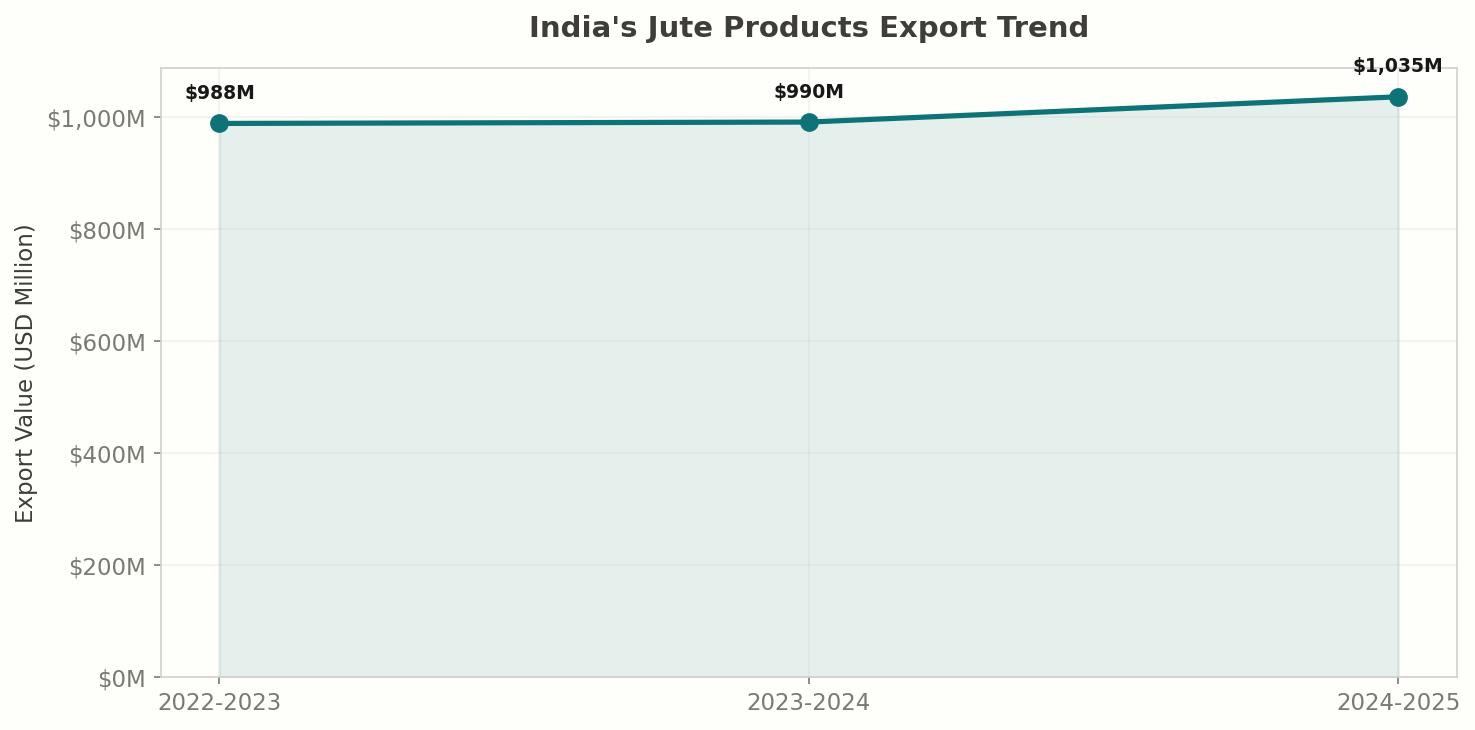
India is the world's largest producer of jute and a major exporter of jute and textile sacking products, shipping $1.04 billion worth of jute fibre and sacks under HS headings 5303 and 6305 in 2024-25. While traditionally associated with packaging sacks and hessian cloth, the modern Indian jute industry has diversified into lifestyle products, home furnishings, geotextiles, and composites — reflecting a global shift towards sustainable, biodegradable packaging and materials.
India's jute belt — concentrated in West Bengal, Bihar, Assam, and Odisha — produces approximately 8-10 million bales annually. For MSME exporters, jute products offer strong demand from sustainability-conscious Western markets, government procurement support through the Jute Packaging Materials Act, and growing international interest in eco-friendly packaging alternatives to plastic.
India's Jute Export Landscape
India exported $1.04 billion in jute fibre and sacking products in 2024-25, steady growth from $988 million in 2022-23:
| HS Code | Category | 2024-25 Exports (USD Million) | Share |
|---|---|---|---|
| 630532 | Flexible IBC (polypropylene/PE sacks) | $928.1 | 89.7% |
| 630520 | Sacks and bags, of cotton | $54.3 | 5.2% |
| 630533 | Sacks, of man-made textile | $22.3 | 2.2% |
| 530310 | Raw jute fibre | $15.8 | 1.5% |
| 630539 | Other sacks and bags | $14.6 | 1.4% |
Important note on data: The HS codes 6305 (sacks and bags) include both jute and non-jute sacking. The polypropylene/PE sack category (630532) at $928M dominates this classification — these are the bulk packaging sacks used globally for grains, cement, fertiliser, and chemicals. Raw jute fibre (530310) at $15.8M represents traditional unprocessed jute exports. The broader jute ecosystem also includes jute bags, jute fabrics (5310), jute floor coverings (5702), and diversified jute products.
Where Indian Jute Products Are in Demand
India's jute product exports are concentrated in markets where jute is used either for industrial packaging or as a sustainable alternative to synthetic materials. African countries, the Middle East, and European markets are significant buyers. The USA and EU markets are increasingly driven by the eco-friendly positioning of jute as a biodegradable, renewable material. The trend toward sustainable packaging in developed markets is creating new demand for jute bags, jute-based composites, and jute geotextiles.
Want the full country-by-country breakdown? See exact export values, growth rates, tariff rates, and market attractiveness scores for every destination in our detailed data pages. View Jute Products export data by country →
Product Categories
Traditional Jute Products
- Hessian/burlap cloth — Wrapping, packaging, upholstery backing
- Jute sacking — Food grain, sugar, fertiliser bags
- Jute carpet backing cloth (CBC) — Used as secondary backing for tufted carpets
Diversified Jute Products (DJP) — The Growth Segment
- Jute shopping bags — Alternative to plastic bags (EU single-use plastics ban driving demand)
- Jute home furnishings — Rugs, table mats, cushion covers, wall hangings
- Jute geotextiles — Soil erosion control, slope stabilisation, river bank protection
- Jute composites — Door panels, ceiling boards (automotive and construction applications)
- Jute fashion accessories — Handbags, totes, pouches (lifestyle/fashion segment)
PP/PE Woven Sacks (Dominant Export)
- Polypropylene and polyethylene woven sacks for industrial packaging
- Cement, fertiliser, chemicals, food grain packaging
- FIBC (Flexible Intermediate Bulk Containers) — "Big bags" for 500-2000 kg loads
HS Code Classification
| 6-Digit Code | Description | Key Products |
|---|---|---|
| 530310 | Jute raw/retted (not spun) | Raw jute fibre bales |
| 530390 | Other jute fibres (processed) | Carded, combed jute |
| 531010 | Unbleached jute fabric | Hessian, sacking cloth |
| 570242 | Pile floor coverings, of coir/jute | Jute rugs and mats |
| 630520 | Sacks and bags, of cotton | Cotton/jute blend bags |
| 630532 | FIBC (PP/PE woven, flexible) | Big bags, bulk containers |
| 630533 | Other sacks, man-made textile | Synthetic woven sacks |
| 630539 | Other sacks and bags | Jute bags, mixed material |
Use the HS Code Finder for accurate classification.
Quality Standards and Certifications
Bureau of Indian Standards (BIS)
- IS 1039 — Hessian cloth specification
- IS 15868 — Jute geotextiles specification
- IS 12154 — Jute shopping bags specification
International Standards
- ISO 9001 — Quality management system
- ISO 14001 — Environmental management (highly valued for jute's eco-positioning)
- FIBC testing per ISO 21898 — For FIBCs (UN-rated for DG, food-grade, etc.)
- REACH compliance — For jute products treated with chemicals (JBO — jute batching oil)
Eco-Certifications — The Key Differentiator
- GOTS (Global Organic Textile Standard) — For organic jute products
- Oeko-Tex Standard 100 — Harmful substance testing
- FSC certification — For wood/fibre sustainability chain
- EU Ecolabel — Strong for EU retail positioning
- Biodegradability certification — Jute is 100% biodegradable in 1-2 years
Testing Labs and Compliance Costs
Testing for jute product exports should be conducted at accredited laboratories. Key labs include SGS India, Bureau Veritas, TUV Rheinland, and the Indian Jute Industries' Research Association (IJIRA) in Kolkata — the latter specialises specifically in jute testing. FIBC testing per ISO 21898 (including top lift, righting, drop, and tear tests) costs Rs 15,000-30,000 per design. Oeko-Tex Standard 100 certification testing costs Rs 20,000-40,000 for a product range. JBO migration testing for food-contact applications costs Rs 8,000-15,000 per sample. REACH compliance testing (restricted substance screening) costs Rs 10,000-20,000. GOTS organic certification requires an annual audit and testing, with initial costs of Rs 50,000-1,50,000 depending on the scope. Budget these testing and certification costs into your pricing — they are essential investments for accessing premium markets.
JBO (Jute Batching Oil) Compliance
Traditional jute processing uses mineral oil (JBO) for softening fibres. The EU has raised concerns about JBO content in jute products, particularly food-contact sacks:
- Migration testing — Mineral oil migration from jute sacks into food must be below EU limits
- Solution: Use food-grade JBO or JBO-free processing using plant-based oils
Packaging and Labelling
Raw Jute
- Baled in press-packed bales (180 kg standard, "kutcha" or "pucca" bale)
- Strapped with steel bands
- Marked with grade, weight, and selection number
Jute Bags/Sacks
- Baled in bundles of 100-500 pieces
- Wrapped in hessian or polyethylene
- Labelling: Size, weight capacity, material composition, "Made in India"
PP/PE Sacks and FIBCs
- Baled or palleted
- FIBC labelling must include: Safe Working Load (SWL), material, manufacturer, test certificate number
- UN-rated FIBCs require specific marking (UN symbol, type, year of manufacture)
Region-Specific Labelling Requirements
EU: All textile products must comply with EU Regulation 1007/2011 on textile fibre names and labelling. Jute must be labelled as "jute" (not "hessian" or "burlap" which are trade names, not fibre names). For food-contact jute sacks, EU Regulation 1935/2004 on food contact materials applies — include a declaration of conformity. Language requirements vary by country — labels must be in the official language(s) of the destination market.
USA: FTC requires fibre content labelling for textile products. Country of origin ("Made in India") is mandatory under US Customs rules. For FIBCs, OSHA workplace safety standards apply — labelling must include Safe Working Load, material, and handling instructions.
Middle East (GCC): Arabic language labelling required. GSO marking standards apply for industrial sacking products. For food-grade jute bags, halal certification may be requested by some buyers.
Eco-Product Labelling
- Highlight biodegradability, recyclability, and carbon footprint
- "Plastic-free alternative" positioning for retail bags
- EU single-use plastics directive compliance marking
Pricing Strategy
| Product | FOB Price Range | Key Markets |
|---|---|---|
| Raw jute fibre (per tonne) | $400-$700 | Bangladesh, China |
| Hessian cloth (per metre) | $0.30-$0.80 | EU, USA, Middle East |
| Jute sacking (per bag) | $0.50-$1.50 | Africa, Middle East |
| Jute shopping bags | $0.50-$3.00/piece | EU, UK, USA |
| Jute home furnishings | $2-$20/piece | USA, EU |
| PP woven sacks (per piece) | $0.30-$2.00 | Global |
| FIBC "Big Bags" (per piece) | $3-$15 | Global |
| Jute geotextiles (per m²) | $1-$4 | EU, USA, India |
The highest margins are in diversified jute products (shopping bags, home furnishings, fashion accessories) — where the "eco-friendly" premium adds 50-200% over commodity jute pricing. FIBCs are a large-volume, stable-margin business.
Logistics
Shipping
- Sea freight — Standard for all jute and sacking products
- Jute products are volume freight (light relative to space) — containers fill up before reaching weight limit
Container Capacity
- 40-ft container: 20,000-40,000 jute shopping bags (depends on size)
- 40-ft container: 6,000-10,000 FIBCs (compressed/baled)
- 20-ft container: ~3,000 hessian bales (~10 tonnes)
Key Ports
- Kolkata/Haldia — Primary for West Bengal jute belt
- JNPT Mumbai — For Western India manufacturers
- Chennai — For South Indian producers
Transit and Costs
- Kolkata to EU ports: 22-30 days ($2,000-$4,000/40-ft)
- Kolkata to USA: 30-38 days ($3,500-$6,000/40-ft)
- JNPT to UAE: 5-7 days ($1,000-$2,000/40-ft)
Documentation
- Commercial Invoice
- Packing List
- Bill of Lading
- Certificate of Origin
- IJMA/IJSG certificate (if applicable)
- Quality Test Report
- FIBC test certificate (SWL, UV stabilisation, top lift, cyclic tests per ISO 21898)
- REACH Declaration (for EU — mineral oil migration)
- Eco-certification (GOTS, Oeko-Tex as applicable)
- Shipping Bill (via ICEGATE)
- Insurance Certificate
Buyer Finding Strategies
Trade Shows
- Heimtextil (Frankfurt) — The world's largest textile trade fair, held every January. Excellent for jute home furnishings, rugs, and decorative textiles. National Jute Board often sponsors India Pavilion participation with subsidised stalls.
- Ambiente (Frankfurt) — For jute lifestyle products, bags, and home accessories, held every February.
- Texworld Paris — For jute fabrics and blended textiles, held twice a year.
- National Jute Board Buyer-Seller Meets — Organised periodically in target markets (EU, UK, USA, Middle East) providing direct introductions to pre-vetted buyers.
- India International Jute Fair — Organised by the National Jute Board and IJMA, showcasing the full range of traditional and diversified jute products.
B2B Channels
- National Jute Board portal — Maintains a directory of Indian jute manufacturers and facilitates buyer inquiries.
- IJMA (Indian Jute Mills Association) — Provides industry connections and buyer introductions for member mills.
- Alibaba, IndiaMART, TradeIndia — Useful for FIBC and jute bag inquiries. Create detailed listings with specifications, test certificates, and capacity information.
- Sustainability-focused procurement platforms — EcoVadis-rated companies, B-Corp certified buyers, and sustainability-conscious retailers actively seek jute as a plastic alternative. Position your products on these platforms.
- Indian Embassy commercial sections — Contact commercial counsellors at Indian missions for market intelligence and buyer introductions, particularly in EU and UK markets where the plastic-free movement is strongest.
Government Incentives
- RoDTEP — 1-3% of FOB value. Raw jute (530310) typically gets 1-1.5%, jute bags and sacks get 2-3%, and diversified jute products can attract up to 3%. Verify the current rates on the DGFT RoDTEP schedule.
- Jute Packaging Materials (Compulsory Use in Packing Commodities) Act — Mandates jute packaging for food grains and sugar, creating domestic base demand
- JMDC (Jute Manufacturers' Development Council) — Research, development, and export support
- National Jute Board — Market development, design development, and technology upgradation. Provides subsidies for international trade fair participation, product design development, and quality improvement initiatives.
- Technology Upgradation Fund Scheme (TUFS) — Capital investment subsidy for jute manufacturing modernisation. Covers 5-10% of the cost of new machinery for spinning, weaving, and processing.
- Jute-ICARE (Improved Cultivation and Advanced Retting Exercise) — Government programme for quality improvement at the farm level
- Pre-shipment export credit — Available from scheduled commercial banks at concessional interest rates under RBI guidelines. Jute exporters can access packing credit linked to confirmed orders.
- MSME Credit Support — SIDBI and MUDRA loan schemes available for jute product MSMEs for working capital and machinery purchase at subsidised rates.
Common Mistakes
Not addressing JBO concerns for food-contact sacks. EU buyers are increasingly concerned about mineral oil migration from jute sacks into food. If supplying jute food sacks, use food-grade JBO or switch to plant-based alternatives, and provide migration test reports.
Positioning jute as cheap, not sustainable. The global market for jute has shifted from "cheap packaging" to "sustainable alternative to plastic." Price and market your products based on eco-value, not cost alone. Invest in eco-certifications and sustainability storytelling.
Ignoring FIBC standards. FIBCs for export must meet rigorous testing standards (ISO 21898). An untested FIBC that fails in transit can cause workplace injuries, product loss, and massive liability. Test every design and provide valid test certificates.
Not diversifying from commodity sacking. Raw jute and basic hessian are commodity products with thin margins. The growth and margin opportunity is in diversified jute products — bags, home furnishings, geotextiles. Invest in product development and design.
Moisture damage during shipping. Jute absorbs moisture. Container condensation ("container rain") during sea transit can damage jute products. Use desiccants and moisture barriers in containers. Place calcium chloride desiccant bags (minimum 1 kg per 10 CBM of cargo) at the top of containers and use polythene liner sheets on the container floor and walls.
Not obtaining eco-certifications before approaching premium buyers. Western retailers and brand owners increasingly require documented proof of sustainability claims. Simply saying "jute is eco-friendly" is not enough — buyers want Oeko-Tex, GOTS, or EU Ecolabel certifications. Invest in these certifications before approaching premium EU and US retail buyers. The certification cost is recovered quickly through higher per-unit pricing in the eco-premium segment.
Ignoring FIBC design validation. Each FIBC design must be tested and validated per ISO 21898 before commercial production. Producing untested designs and shipping them risks catastrophic failure (bag rupture during lifting), which creates liability exposure, buyer claims, and potential workplace injuries at the destination. Always maintain current test certificates for every FIBC design in your product range.
Key Takeaways
- India exported $1.04 billion in jute and sacking products in 2024-25
- PP/PE woven sacks ($928M) dominate the category; traditional jute fibre is $16M
- USA ($279M) and EU ($446M combined) are the primary markets
- The global sustainability trend is transforming jute from commodity packaging to premium eco-material
- FIBCs are a large, stable export business requiring ISO 21898 compliance
- Diversified jute products (bags, furnishings, geotextiles) offer the highest margins
- JBO compliance is critical for EU food-contact applications
Next Steps
- Identify your HS code with the HS Code Finder — raw fibre (5303) vs. finished bags (6305) matters
- Join IJMA or IJSG for industry connections and export support
- Check tariff rates using the Duty Calculator
- Get eco-certifications — GOTS, Oeko-Tex, EU Ecolabel for market differentiation
- Invest in diversified product development — jute bags, home furnishings, geotextiles
- Explore market demand with the Market Finder
- Attend trade fairs — Heimtextil (Frankfurt), Ambiente (Frankfurt), National Jute Board buyer-seller meets
India's jute industry stands at an inflection point. As the world moves away from single-use plastics, jute — the original biodegradable packaging material — is experiencing a renaissance. Indian exporters who position jute products as premium sustainable alternatives (not cheap commodity packaging) will capture the highest growth and margins.
Ready to start exporting?
Get a detailed market report with country-by-country analysis, pricing insights, and buyer contacts.
Get Market ReportXIMPEX Export Advisory
Need help implementing the strategies discussed in this guide? Our team of export specialists can provide personalized guidance for your business.