How to Export Leather and Leather Goods from India — Complete Guide
India is one of the world's largest leather producers, with a fully integrated supply chain from raw hides to finished luxury goods. India's leather and leather products exports totalled $2.67 billion in 2024-25, supplying handbags, shoes, garments, and finished leather to fashion houses and retailers across Europe, North America, and the Middle East.
The Indian leather industry employs over 4 million people, with manufacturing clusters in Tamil Nadu (Chennai, Ambur, Vaniyambadi, Ranipet), Uttar Pradesh (Kanpur, Agra, Noida), West Bengal (Kolkata), and Rajasthan (Jodhpur). For MSME exporters, leather offers strong margins, established buyer relationships, and significant government support through the Council for Leather Exports (CLE) and DPIIT schemes.
India's Leather Export Landscape
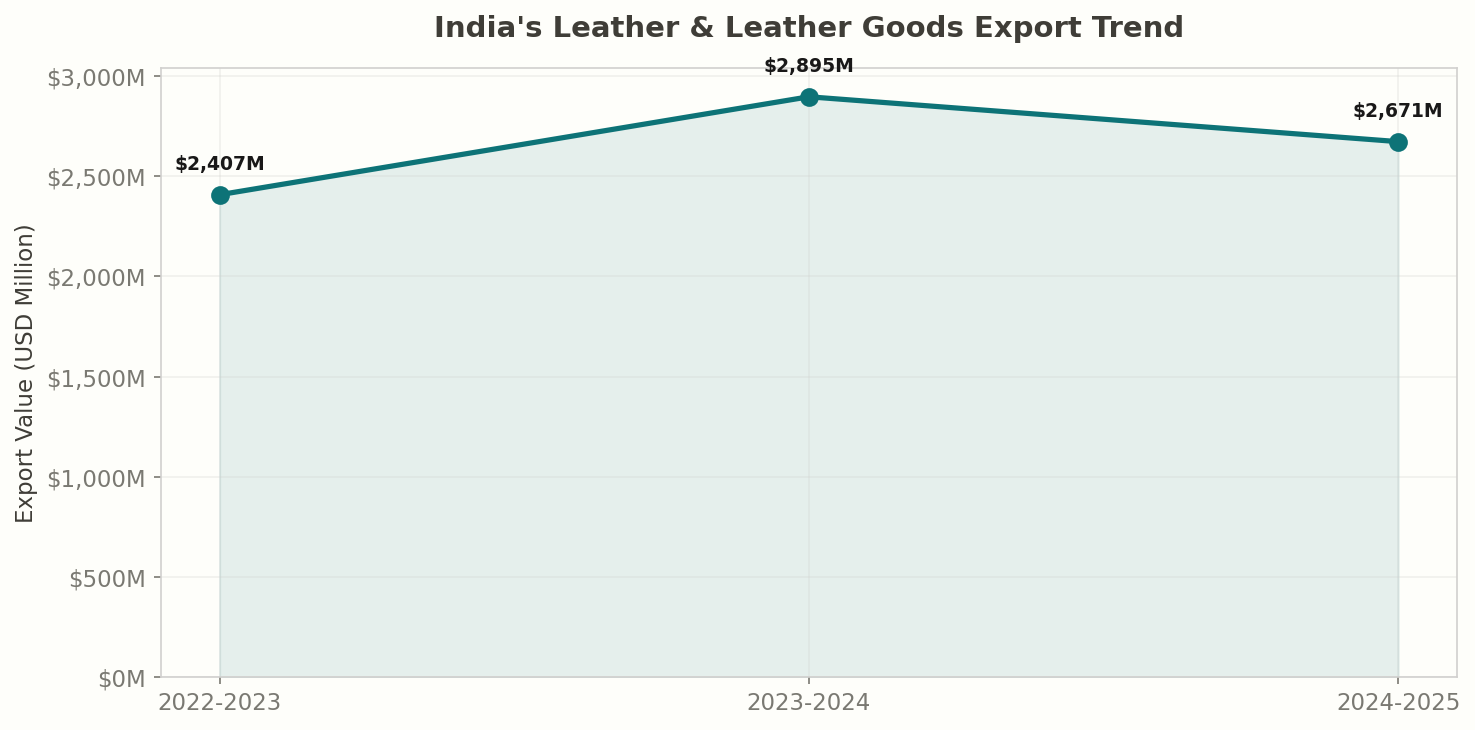
India exported $2.67 billion in leather and leather products in 2024-25, down slightly from $2.90 billion in 2023-24 but up from $2.41 billion in 2022-23. The sector encompasses raw/finished leather, leather goods, footwear components, garments, and saddlery.
| HS Chapter/Heading | Category | 2024-25 Exports (USD Million) | Share |
|---|---|---|---|
| 4202 | Bags, cases, wallets, travel goods | $1,223.0 | 45.8% |
| 4203 | Leather garments and accessories | $751.3 | 28.1% |
| 4107 | Bovine/equine leather, finished | $293.2 | 11.0% |
| 4201 | Saddlery, harness, equestrian | $205.4 | 7.7% |
| 4112-4113 | Sheep, goat, other leather | $140.6 | 5.3% |
| 4205 | Other leather articles | $45.2 | 1.7% |
Leather goods (bags, wallets, accessories under HS 4202) dominate at 45.8%, reflecting India's strength in finished product manufacturing. Leather garments (jackets, coats, gloves under HS 4203) contribute 28.1%. Together, finished goods account for over 80% of leather exports — India has successfully moved up from raw material supplier to finished goods exporter.
Where Indian Leather Goods Are in Demand
The USA is India's largest leather export market, absorbing a significant share of finished leather goods, footwear, and leather garments. European markets — Germany, Italy, the UK, France, and Spain — collectively form the second major cluster, with strong demand for leather accessories, footwear, and garments. Italy, interestingly, imports semi-finished Indian leather for its own luxury manufacturing industry. The Middle East, Hong Kong, and Japan are other important markets. India's leather exports span the full value chain from raw hides to finished luxury goods.
Want the full country-by-country breakdown? See exact export values, growth rates, tariff rates, and market attractiveness scores for every destination in our detailed data pages. View Leather and Leather Goods export data by country →
HS Code Classification for Leather
Leather products span two HS chapters:
Chapter 41 — Raw Hides, Skins, and Leather
| Code | Description | Export Focus |
|---|---|---|
| 4107 | Bovine/equine leather, further prepared | Finished leather for goods manufacturing |
| 4112 | Sheep/lamb leather, further prepared | Garment leather |
| 4113 | Leather of other animals | Goat, reptile leather |
Chapter 42 — Leather Articles
| Code | Description | Export Focus |
|---|---|---|
| 4201 | Saddlery, harness, equestrian goods | Premium equestrian market |
| 4202 | Trunks, bags, wallets, cases | Handbags, travel goods, accessories |
| 4203 | Garments, gloves, belts | Jackets, coats, fashion accessories |
| 4205 | Other articles of leather | Industrial, specialty items |
Important: India prohibits the export of raw hides and skins (HS 4101-4103) to protect domestic value addition. Only semi-processed and finished leather can be exported.
Use the HS Code Finder for precise 6-digit and 8-digit classification.
Quality Standards and Certifications
Regulatory Requirements
- CLE Membership — The Council for Leather Exports is the designated export promotion council. RCMC (Registration-cum-Membership Certificate) is required for claiming export incentives.
- BIS Standards — IS 1011 (vegetable-tanned leather), IS 2643 (chrome-tanned leather), IS 5914 (leather for footwear)
- Pollution Control Compliance — Tanneries must have Consent to Operate from the State Pollution Control Board. The leather industry is classified as "Red Category" for pollution.
International Certifications
- REACH Compliance (EU) — Chromium VI limit: 3 mg/kg in leather articles. Azo dyes releasing carcinogenic amines are banned. Formaldehyde limits: 75 mg/kg for direct skin contact articles.
- California Prop 65 — Lead, chromium VI, and certain chemicals must be below California limits for US exports.
- Leather Working Group (LWG) — Environmental audit protocol for tanneries. Gold, Silver, or Bronze rating. Most European and US brands now require LWG certification from their leather suppliers.
- SEDEX/SMETA / BSCI — Social compliance audits required by virtually all Western brand buyers.
- SA8000 — Social Accountability standard for factory conditions.
- Oeko-Tex Leather Standard — Certifies leather products are free from harmful substances.
Chemical Compliance — The Critical Factor
Chemical compliance is the single most important quality parameter for leather exports:
| Parameter | EU Limit | USA/Prop 65 |
|---|---|---|
| Chromium VI | ≤3 mg/kg | ≤3 mg/kg |
| Formaldehyde | ≤75 mg/kg (skin contact) | Warning label required |
| Azo dyes (restricted amines) | Not detectable | Varies by state |
| PCP (pentachlorophenol) | ≤5 mg/kg | - |
| Nickel release (metal parts) | ≤0.5 μg/cm²/week | - |
Test every batch at a NABL-accredited lab (SGS, Bureau Veritas, Intertek have India labs) before shipment.
Testing Labs and Costs
Key testing laboratories for leather exports in India include CLRI (Central Leather Research Institute, Chennai) — India's premier leather research institution that provides comprehensive chemical and physical testing, SGS India (Chennai, Mumbai, Delhi), Bureau Veritas (multiple locations), Intertek (Delhi, Mumbai), and TUV Rheinland (Bengaluru, Chennai). Typical testing costs: Chromium VI testing costs Rs 2,000-4,000 per sample. Azo dye testing (list of 22 restricted amines) costs Rs 4,000-8,000. Formaldehyde content testing costs Rs 1,500-3,000. A comprehensive REACH compliance package (Chromium VI, azo dyes, formaldehyde, PCP, heavy metals, phthalates) costs Rs 12,000-20,000 per product type. Nickel release testing for metal fittings (buckles, zippers, clasps) costs Rs 3,000-5,000 per component. Physical testing (tensile strength, tear strength, colour fastness to rubbing, flexing endurance) costs Rs 8,000-15,000 per leather type. Budget Rs 25,000-40,000 per order for comprehensive testing. LWG audit preparation and audit costs range from Rs 3-8 lakh depending on tannery size.
Packaging and Labelling
Leather Goods
- Individual items wrapped in tissue paper, placed in branded dustbags
- Packed in corrugated master cartons with cardboard dividers
- Silica gel desiccant sachets in each carton (humidity protection)
- Stuffing paper inside bags to maintain shape during transit
Finished Leather
- Rolled or folded (depending on buyer specification)
- Wrapped in polyethylene film or kraft paper
- Stacked on pallets, shrink-wrapped
- Mark with: skin type, colour, thickness, square footage, lot number
Labelling Requirements
- EU: Pictorial shoe/leather labelling under Directive 94/11/EC — symbols indicating upper, lining, insole, outer sole materials. REACH compliance must be documented (not necessarily on the label, but available on request). The EU Deforestation Regulation (EUDR) will require due diligence documentation proving leather is not linked to deforestation — prepare traceability systems now.
- USA: FTC Guide for Select Leather Products — "genuine leather," "bonded leather," or "man-made materials" must be clearly stated. California Prop 65 warnings required if chromium VI or lead exceeds specified limits. For footwear, country of origin must be clearly marked on the outer sole.
- Middle East (GCC): Arabic labelling mandatory for retail products. Material composition, country of origin, and care instructions in Arabic. Some GCC countries require conformity certificates from accredited labs before customs clearance.
- All markets: Country of origin ("Made in India"), care instructions, material composition
Pricing Strategy
| Product Type | FOB Price Range | Key Markets |
|---|---|---|
| Finished bovine leather (per sq ft) | $1.50-$4.00 | Italy, Vietnam, China |
| Sheep/goat garment leather (per sq ft) | $1.80-$3.50 | Spain, France |
| Leather handbag (per piece) | $8-$80 | USA, UK, Germany |
| Leather wallet (per piece) | $3-$25 | USA, Europe |
| Leather jacket (per piece) | $25-$150 | Germany, Spain, France |
| Leather gloves (per pair) | $4-$20 | UK, Germany, USA |
| Leather belt (per piece) | $3-$15 | USA, Europe |
| Saddlery/equestrian (per piece) | $50-$500+ | USA, Australia, UK |
Margins in leather goods manufacturing are typically 15-30%, significantly better than textiles. The key is buyer relationship depth — once a brand approves your factory, repeat orders follow.
Logistics
Manufacturing Clusters and Nearest Ports
- Chennai cluster (Ambur, Vaniyambadi, Ranipet) → Chennai Port (1-3 hours)
- Kolkata cluster → Kolkata/Haldia Port
- Kanpur/Agra cluster → ICD Tughlakabad (Delhi) or JNPT Mumbai
- Jodhpur cluster → Mundra Port
Transit Times
- Chennai to USA East Coast: 25-30 days
- Chennai to EU ports: 18-24 days via Suez
- Chennai to UK: 20-24 days
- JNPT to USA West Coast: 22-28 days
Freight Costs (Indicative)
- 20-ft container to Europe: $1,800-$3,500
- 40-ft container to USA: $3,000-$5,500
- Air freight (urgent/sample shipments): $4-$7 per kg
Container Capacity
- Leather goods: 8,000-15,000 handbags per 40-ft container (varies by size)
- Finished leather: 12,000-15,000 sq ft per 20-ft container
Documentation
- Commercial Invoice (with detailed item description, material, HS code)
- Packing List
- Bill of Lading / Airway Bill
- Certificate of Origin (GSP Form A for EU, CEPA for UAE)
- CLE/RCMC Certificate
- CITES permit (for exotic leather — crocodile, python, etc.)
- Chemical Test Reports (Chromium VI, azo dyes, formaldehyde)
- LWG Audit Certificate (for tannery)
- Social Audit Report (SEDEX/BSCI)
- Phytosanitary Certificate (for raw/semi-processed leather)
- Shipping Bill (via ICEGATE)
- Insurance Certificate
Buyer Finding Strategies
Trade Shows
- IILF (India International Leather Fair, Chennai) — India's largest leather trade show, held annually in February. Organised by CLE and ITPO, attracting over 500 exhibitors and buyers from 50+ countries. CLE provides subsidised stalls for MSME members.
- Lineapelle (Milan) — The world's most prestigious leather and accessories trade show, held twice a year (September and February). Essential for connecting with Italian and European luxury brands.
- APLF (Asia Pacific Leather Fair, Hong Kong) — Asia's largest leather trade show, held in March. Key for Asian market access.
- ACLE (All China Leather Exhibition, Shanghai) — Important for connecting with Chinese leather goods manufacturers who source Indian finished leather.
- ILM (Offenbach, Germany) — Specialised leather trade fair for the European market.
B2B Channels and Buyer Access
- CLE (Council for Leather Exports) buyer-seller meets — CLE organises targeted meets in key markets including the USA, UK, Germany, Italy, and Spain. These provide pre-vetted introductions and are subsidised for MSME exporters.
- Brand vendor portals — Major fashion brands (H&M, Zara/Inditex, GAP, Next, Marks & Spencer) have vendor registration portals on their corporate websites. Register and submit your factory profile, compliance certificates, and product capabilities.
- Indian Embassy commercial sections — Commercial counsellors at Indian missions maintain leather importer databases. Contact embassies in target markets for introductions and market intelligence.
- LinkedIn and direct outreach — Identify sourcing managers and merchandisers at target brands on LinkedIn. Send a concise introduction with your factory profile, LWG certification, social audit status, and product catalogue.
Government Incentives
- RoDTEP — 1-4% of FOB value for leather products. Finished leather goods (4202) typically attract 2-4%, finished leather (4107) gets 1-2%. Check the latest DGFT RoDTEP schedule for your specific HS code.
- IFLADP (Indian Footwear, Leather and Accessories Development Programme) — Addresses environmental compliance, technology upgrading, and design capabilities for leather MSMEs. Provides subsidies for effluent treatment, CAD/CAM systems, and quality testing equipment.
- Duty Drawback — 2-3% of FOB value
- Common Effluent Treatment Plants (CETPs) — Government-subsidised effluent treatment in leather clusters (Ambur, Vaniyambadi, Kanpur)
- DPIIT Technology Upgradation Fund — For modernisation of tannery and leather goods manufacturing
- CLE Market Access Initiative — Subsidies for international trade fair participation, including stall rental (up to 90%), airfare assistance, and market study funding
- Pre-shipment and post-shipment credit — Available from scheduled commercial banks at concessional interest rates. Leather exporters can access packing credit linked to confirmed buyer orders, with extended credit periods for seasonal production.
Common Mistakes When Exporting Leather
Failing Chromium VI tests. Chrome-tanned leather can develop Chromium VI (a carcinogen) during processing or storage if pH, fat-liquoring, or drying are not controlled. EU limit is 3 mg/kg. Test every batch before shipping.
Ignoring LWG requirements. Most European and US brands now mandate LWG-certified tanneries. If your tannery isn't LWG-audited, you lose access to 70%+ of the premium market. Budget 6-12 months for LWG preparation and audit.
Not accounting for seasonal buying cycles. Fashion leather (garments, bags) has distinct buying cycles — samples in January-March, production orders in April-August, shipping in August-October for the autumn/winter season. Miss the window and you miss the year.
Underestimating compliance documentation. A single missing test report can hold up a $50,000 shipment. Maintain a compliance file for every order with chemical tests, social audit certificate, and material traceability documentation.
Using restricted chemicals. Some Indian tanners still use chemicals banned under EU REACH. Maintain a restricted substances list (RSL) aligned with the AFIRM Group RSL or your buyer's RSL, and enforce it across your supply chain.
Not investing in sample development capability. International brands evaluate suppliers based on sample quality, speed, and accuracy. A factory that takes 4-6 weeks to develop samples loses to one that delivers in 10-14 days. Invest in a dedicated sampling department with skilled pattern makers, a sample cutting table, and a finishing station separate from production. Sample development is your sales tool — treat it as a priority, not an afterthought.
Ignoring the EU Deforestation Regulation (EUDR). The EU's Deforestation Regulation requires importers to demonstrate that products (including leather) are not linked to deforestation. While full enforcement is still being phased in, proactive exporters should start building traceability documentation from slaughterhouse to tannery to finished goods factory. Buyers will increasingly require geolocation data for leather sourcing — prepare now to avoid being excluded from EU supply chains.
Key Takeaways
- India exported $2.67 billion in leather and leather products in 2024-25
- Leather goods (bags, wallets — HS 4202) at $1.22B and garments (HS 4203) at $751M dominate
- USA ($656M) and EU ($1.11B combined) are the primary markets
- Chromium VI, REACH, and LWG compliance are non-negotiable for Western markets
- Raw hide export is prohibited — India focuses on value-added finished goods
- Margins (15-30%) are significantly better than most textile categories
- CLE membership and RCMC are required for export incentives
Next Steps
- Identify your HS code with the HS Code Finder — Chapter 41 for leather, Chapter 42 for goods
- Register with the Council for Leather Exports (CLE) for your RCMC
- Check tariff rates using the Duty Calculator — leather goods face 0-8% duty in most markets
- Get LWG certification for your tannery — this is the gateway to premium buyers
- Invest in chemical testing infrastructure — partner with SGS, Bureau Veritas, or Intertek
- Explore market opportunities with the Market Finder to identify growing demand for Indian leather
- Attend trade fairs — IILF (India International Leather Fair, Chennai), Lineapelle (Milan), APLF (Hong Kong)
India's leather industry has the raw material, the skilled workforce, and the manufacturing depth to compete globally. The competitive edge lies in quality compliance, sustainability certification, and moving up the value chain from commodity leather to branded finished goods.
Ready to start exporting?
Get a detailed market report with country-by-country analysis, pricing insights, and buyer contacts.
Get Market ReportXIMPEX Export Advisory
Need help implementing the strategies discussed in this guide? Our team of export specialists can provide personalized guidance for your business.