How to Export Tea from India — Complete Guide
India is the world's second-largest tea producer and fourth-largest exporter, shipping $832 million worth of tea to over 100 countries in 2024-25. From Darjeeling's muscatel first flush to Assam's malty CTC, from Nilgiri's brisk orthodox to specialty green and white teas — Indian tea is a global brand with premium positioning in markets from the Middle East to Europe.
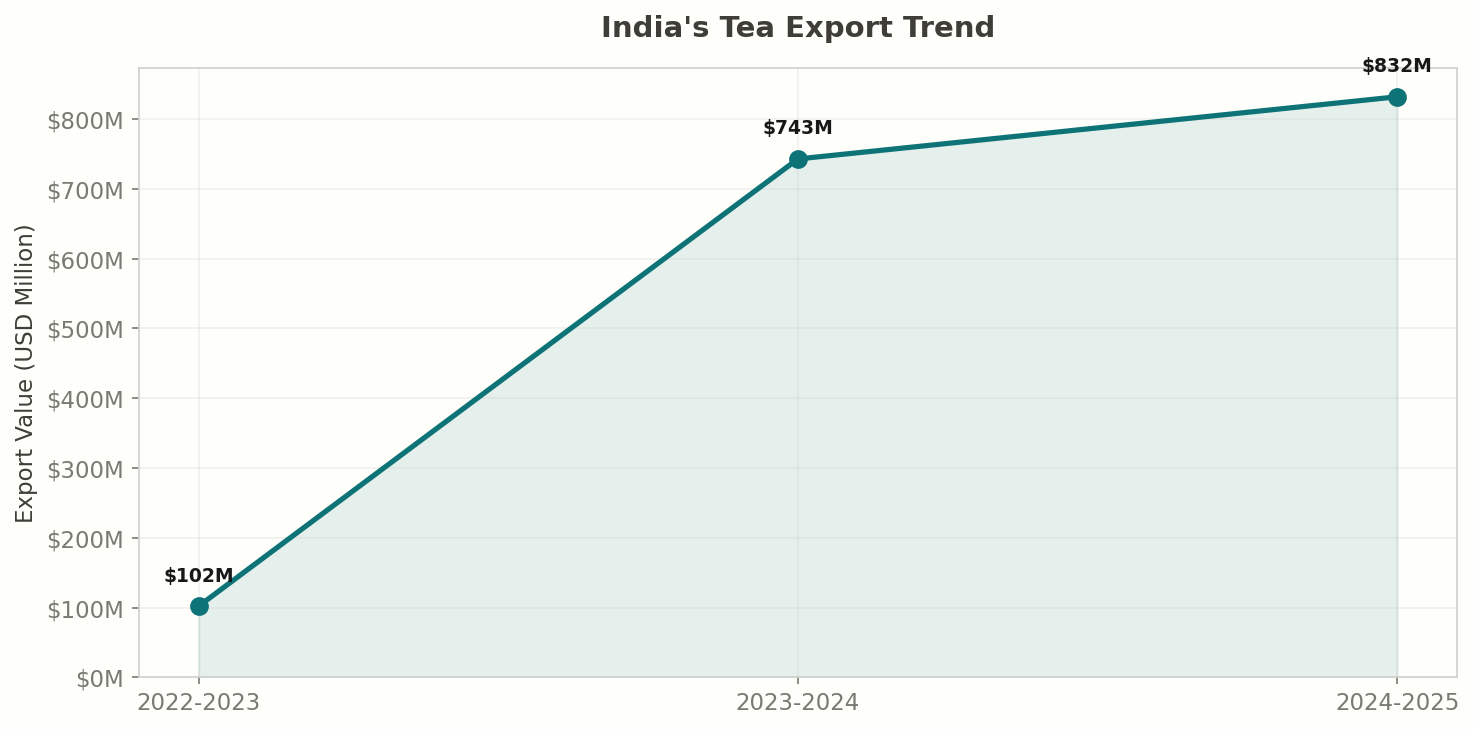
For Indian MSME exporters, tea offers a unique combination of high brand recognition, year-round demand, and strong government support through the Tea Board of India. The sector has grown dramatically from $102 million in 2022-23 to $832 million in 2024-25, reflecting India's rising share in global premium tea markets.
India's Tea Export Landscape
India exported $832 million in tea in 2024-25, an eight-fold increase from $102 million in 2022-23. The growth has been driven by premium tea demand, value-added products, and expanding market access.
| HS Code | Tea Category | 2024-25 Exports (USD Million) | Share |
|---|---|---|---|
| 090240 | Black tea (fermented, >3kg) | $692.0 | 83.2% |
| 090230 | Green tea (not fermented, ≤3kg) | $115.7 | 13.9% |
| 090220 | Green tea (fermented, ≤3kg) | $14.5 | 1.7% |
| 090210 | Green tea (not fermented, ≤3kg) | $9.8 | 1.2% |
Black tea dominates at 83% of exports, reflecting global demand patterns. However, green tea exports ($115.7M) are growing faster as health-conscious consumers worldwide shift to green and specialty variants.
Where Indian Tea Is in Demand
India's tea exports have a distinctive geographic pattern. Russia and CIS countries are traditionally the largest buyers of Indian CTC (crush-tear-curl) tea. The Middle East — particularly the UAE, Iran, and Egypt — imports significant volumes. The USA and UK are important markets for speciality teas (Darjeeling, Assam Orthodox, Nilgiri). Germany, Japan, and Australia are growing markets for premium and organic Indian teas. The pattern is clear: mass-market CTC tea goes to Russia/CIS and Middle East, while high-value speciality teas target Western and Japanese markets.
Want the full country-by-country breakdown? See exact export values, growth rates, tariff rates, and market attractiveness scores for every destination in our detailed data pages. View Tea export data by country →
HS Code Classification for Tea
Tea falls under HS Chapter 09 (Coffee, Tea, Mate, and Spices), heading 0902. The classification depends on fermentation level and packaging:
| 6-Digit Code | Description | Indian 8-Digit Extensions |
|---|---|---|
| 090210 | Green tea (not fermented), ≤3 kg | 09021010 (leaf), 09021020 (dust) |
| 090220 | Green tea (not fermented), >3 kg | 09022010 (leaf), 09022020 (dust) |
| 090230 | Black tea (fermented), ≤3 kg | 09023010 (leaf), 09023020 (dust) |
| 090240 | Black tea (fermented), >3 kg | 09024010 (leaf), 09024020 (dust) |
Critical distinction: Retail-packed tea (≤3 kg) and bulk tea (>3 kg) have different HS codes. This affects duty rates in many countries. Retail-packed tea often attracts higher tariffs but commands 2-3x the FOB price.
Use the HS Code Finder to identify the exact code for your tea product.
Quality Standards and Certifications
Tea Board of India Registration
The Tea Board of India regulates all tea exports. You must:
- Register as a tea exporter with the Tea Board under the Tea (Marketing) Control Order
- Obtain a Tea Export License — required before any tea shipment
- Comply with FSSAI regulations for food safety (licence required for processors with turnover above Rs 12 lakh)
Key Certifications
- ISO 3720 — International standard for black tea, specifying minimum quality requirements for water extract, total ash, crude fibre, and alkalinity
- FSSAI Certification — Mandatory for all food exports from India. Covers MRL (Maximum Residue Limits) for pesticides
- Organic Certification (NPOP/NOP/EU Organic) — India's National Programme for Organic Production (NPOP) is recognised by the EU and Switzerland. For the US market, USDA NOP certification is required. Organic teas command 30-60% premium
- Rainforest Alliance / UTZ — Sustainability certifications increasingly demanded by European buyers
- Fair Trade Certification — Strong demand from UK and German markets
- Hazard Analysis (HACCP) — Required by most institutional buyers and supermarket chains
Pesticide Residue Limits
This is the single biggest compliance risk for tea exporters. The EU and Japan have some of the strictest MRLs globally:
- EU MRLs for tea are set under Regulation (EC) 396/2005 — limits as low as 0.01 mg/kg for many pesticides
- Japan's Positive List — stringent limits, with a uniform 0.01 ppm default for unlisted substances
- USA (EPA tolerances) — Generally more lenient than EU but still stringent for specific pesticides like glyphosate and ethion
- Pre-shipment testing at a NABL-accredited laboratory is essential
Testing Infrastructure and Costs
Key laboratories for tea export testing include the Tea Board's Tea Testing Laboratories in Kolkata and Guwahati, the Central Food Laboratory (Kolkata), and NABL-accredited private labs such as SGS India, Eurofins, TUV SUD, and Intertek. A comprehensive pesticide residue analysis (multi-residue panel covering 250+ pesticides) costs Rs 5,000-12,000 per sample with a turnaround of 5-7 working days. Heavy metal testing (lead, cadmium, arsenic, mercury) costs Rs 2,000-4,000 per sample. Microbiological testing (total plate count, yeast and mould, coliforms, E. coli) costs Rs 1,500-3,000. For regular exporters, establish a standing testing arrangement with a NABL lab — annual contracts can reduce per-sample costs by 25-35%. Budget Rs 10,000-20,000 per lot for comprehensive pre-shipment testing. Some premium Darjeeling buyers require garden-level certification from international labs like SGS Switzerland or TUV Rhineland — factor in 2-3 weeks lead time for international testing.
Packaging and Labelling
Bulk Tea (>3 kg)
- Multi-wall paper sacks with aluminium foil lining (standard: 40-50 kg)
- Plywood tea chests (traditional, still used for auction-grade teas)
- Mark with lot number, invoice number, grade, net weight, gross weight, garden name
Retail-Packed Tea (≤3 kg)
- Nitrogen-flushed foil pouches (extend shelf life to 18-24 months)
- Cardboard cartons with inner foil lining
- Tea bags in individual foil sachets (highest value-addition)
Labelling Requirements
- EU/UK: Product name, ingredients, net weight, best-before date, country of origin, lot number, nutritional information (per 100g and per serving in EU format), allergen declarations (14 allergens), organic certification logo (green EU leaf logo for organic tea), certifying body code number, and language requirements for the destination country. UK requires separate UKCA compliance post-Brexit.
- USA: FDA-compliant Nutrition Facts panel in the standard US format, ingredient list, net weight in both metric and US customary units, manufacturer name and address, facility registration number. Prior notice to FDA required at least 15 days before shipment arrival.
- UAE/Middle East: Arabic and English dual-language labelling mandatory in all GCC countries. Halal certification if flavoured tea contains animal-derived ingredients. Shelf life must be stated as a specific date, not a duration. ESMA (Emirates Authority for Standardization) and SFDA (Saudi Food and Drug Authority) have specific label layout templates.
- Japan: Japanese-language labelling is mandatory. Nutritional information must follow Japan's MHLW format. Allergen declarations for 7 specified and 21 recommended allergens. Organic JAS mark required for organic tea sold in Japan.
Pricing Strategy
| Tea Type | FOB Price Range (per kg) | Key Markets |
|---|---|---|
| CTC black tea (bulk) | $1.80-$3.50 | Middle East, CIS, Africa |
| Orthodox black tea (bulk) | $3.00-$8.00 | UK, Russia, Germany |
| Darjeeling (bulk) | $8.00-$50.00+ | Germany, Japan, USA |
| Green tea (bulk) | $3.50-$7.00 | Russia, USA, Germany |
| Retail-packed CTC | $3.50-$6.00 | UAE, Saudi Arabia |
| Retail-packed specialty | $8.00-$25.00 | USA, UK, EU |
| Organic tea (bulk) | $5.00-$15.00 | Germany, USA, UK |
Darjeeling first flush teas can command $50-$200/kg at auction. The real margin is in retail-packed and branded tea — a CTC tea worth $2/kg bulk can sell at $6-8/kg in retail packaging.
Logistics
Shipping Routes
- Kolkata to Dubai: 12-15 days (primary for CTC exports to Middle East)
- Kolkata to UK/EU ports: 25-30 days via Suez
- JNPT to USA East Coast: 28-35 days
- Air freight (Kolkata/Delhi to London/Dubai): Same day for specialty grades
Key Ports
- Kolkata/Haldia — Primary port for Assam and Darjeeling tea. Most CTC exports to the Middle East and CIS ship from here.
- Cochin — For South Indian (Nilgiri) teas and organic tea exports from Kerala
- JNPT Mumbai — For blended/retail-packed exports and consolidated shipments to multiple destinations
- Mundra — Alternative for North Indian tea routed through Gujarat
Container Capacity
- 20-ft container: ~18-20 tonnes of bulk tea (paper sacks)
- 40-ft container: ~22-25 tonnes of bulk tea
Freight Costs (Indicative)
- 20-ft container to Dubai: $1,000-$2,000
- 40-ft container to UK: $2,500-$4,500
- Air freight: $2.50-$4.50 per kg (for premium Darjeeling/specialty)
Documentation
- Commercial Invoice
- Packing List
- Bill of Lading / Airway Bill
- Certificate of Origin (CEPA format for UAE, GSP for EU)
- Tea Board Export Licence
- Phytosanitary Certificate (from Plant Quarantine, DPPQS)
- FSSAI Certificate
- Health/Lab Analysis Certificate (pesticide residue, heavy metals)
- Organic Certificate (if applicable — NPOP/NOP/EU Organic)
- Shipping Bill (via ICEGATE)
- Insurance Certificate
Government Incentives
- RoDTEP — Remission of duties at 1-2.5% of FOB value for tea products. Specific rates: black tea in bulk (090240) attracts 1.7%, green tea (090210/090220) attracts 2.0-2.5%, retail-packed tea attracts 2.0-2.5%. Check the current DGFT RoDTEP schedule for your specific 8-digit tariff code.
- Tea Board Subsidies — Quality upgrading subsidies cover up to 25% of cost for setting up orthodox tea manufacturing lines (maximum Rs 50 lakh per unit). Replanting subsidies of Rs 2.0-2.5 lakh per hectare for uprooting old tea bushes and replanting with improved clonal varieties. Marketing assistance for new exporters includes subsidised participation in the Tea Board's buyer-seller meets.
- Tea Board's Market Promotion Scheme — The Tea Board sponsors Indian tea pavilions at major international trade fairs including World Tea Expo (USA), Gulfood (Dubai), SIAL (Paris), ANUGA (Cologne), and Foodex Japan (Tokyo). Registered exporters can receive up to 75% reimbursement on stall rental costs.
- Duty Drawback — 1.5-2% of FOB value, refunding customs duties on imported packaging materials (foil, cartons, pouches) used in tea exports.
- Export Credit — Priority sector lending from banks at concessional interest rates (7-9%) for pre-shipment packing credit and post-shipment finance. ECGC provides export credit insurance at 0.6-1.2% of invoice value. Tea Board provides financial assistance for quality testing costs for small exporters.
- NABARD Refinance — NABARD provides refinance support to banks lending to tea growers for productivity improvement, organic conversion, and processing infrastructure upgrades.
Common Mistakes When Exporting Tea
Failing pesticide residue tests. The #1 reason for shipment rejections, especially in the EU and Japan. Test every lot before shipment. The cost of a lab test ($50-100) is negligible compared to losing a $20,000 container.
Not understanding bulk vs. retail classification. Shipping tea in 5 kg packets is classified differently (HS 090230) from 50 kg sacks (HS 090240). The duty implications can be significant.
Ignoring moisture content. Tea absorbs moisture easily. If moisture exceeds 8% (the ISO 3720 limit), the shipment will be rejected or downgraded. Use moisture-barrier packaging and avoid shipping during monsoon season without adequate protection.
Underestimating Darjeeling trademark requirements. "Darjeeling" is a registered geographical indication. Only tea grown in the 87 tea estates of the Darjeeling district can be sold as Darjeeling tea. Misuse leads to legal action by the Tea Board.
Not claiming preferential tariffs. Indian tea enters the UAE at 0% under CEPA and many EU countries at reduced rates under GSP. Ensure you have the correct Certificate of Origin.
Shipping during monsoon without adequate protection. Tea is hygroscopic — it absorbs moisture from the environment rapidly. Shipping from Kolkata during June-September monsoon requires extra precautions: moisture-barrier inner packaging, desiccant sachets in containers, and verification that the container is watertight and dry before stuffing. A container with 2-3% excess moisture arriving in the Middle East or Europe will result in quality downgrade or rejection.
Not diversifying beyond traditional CTC markets. Many Indian tea exporters focus exclusively on bulk CTC tea for the Middle East and CIS markets, where margins are razor-thin. Explore value-added segments: retail-packed orthodox tea, organic and specialty teas, tea bags, instant tea, and flavoured blends. These segments command 2-5x the margin of bulk CTC and are growing faster globally.
Finding Buyers and Building Market Access
The tea export business is built on relationships and reputation for consistent quality. Key channels for finding international buyers include:
- Tea Board buyer-seller meets — The Tea Board organises dedicated buyer-seller meets in India and abroad, connecting Indian tea producers with international importers. These are highly effective for first-time exporters.
- International trade fairs — World Tea Expo (USA), Gulfood (Dubai), SIAL (Paris), ANUGA (Cologne), and the India International Tea Convention are the premier platforms. Attend consistently and follow up within 48 hours of meeting a buyer.
- Indian tea auctions — Kolkata, Guwahati, Coonoor, and Kochi auction centres attract international buyers. Even if you do not sell through auctions, attending them helps you understand pricing and meet buyers.
- B2B platforms — Register on the Tea Board's online directory, IndiaMART Global, Alibaba, and specialty platforms like TeaSource and World Tea Directory.
- Indian embassy commercial sections — Contact the commercial attache at Indian embassies in your target markets for introductions to local tea importers, distributors, and supermarket buyers.
- Direct outreach — Identify tea importers in your target market through trade directories, attend their domestic food fairs, and send samples with a professional company profile.
Key Takeaways
- India exported $832 million in tea in 2024-25, led by black tea ($692M) and green tea ($116M)
- UAE ($155M), Iraq ($94M), and Russia ($71M) are the top markets by volume
- Tea Board registration and export licence are mandatory
- Pesticide residue compliance is the single biggest risk — test every lot before shipping
- Retail-packed and organic tea offer 2-5x margins over bulk CTC
- Darjeeling is a protected geographical indication — use it only for authentic Darjeeling teas
Next Steps
- Identify your HS code with the HS Code Finder — classification depends on tea type and packaging size
- Register with the Tea Board of India and obtain your export licence
- Check tariff rates for your target market using the Duty Calculator
- Get FSSAI and organic certifications if targeting EU or US markets
- Explore market opportunities with the Market Finder to see which countries are importing Indian tea
- Invest in pesticide residue testing — partner with a NABL-accredited laboratory for pre-shipment analysis
India's tea heritage spans 180 years. With Darjeeling, Assam, and Nilgiri as globally recognised brands, Indian tea exporters have a built-in advantage. The key is matching quality compliance to market requirements — get that right, and you're selling into a $832 million market that's growing every year.
Ready to start exporting?
Get a detailed market report with country-by-country analysis, pricing insights, and buyer contacts.
Get Market ReportXIMPEX Export Advisory
Need help implementing the strategies discussed in this guide? Our team of export specialists can provide personalized guidance for your business.