How to Export Dairy Products from India — Complete Guide
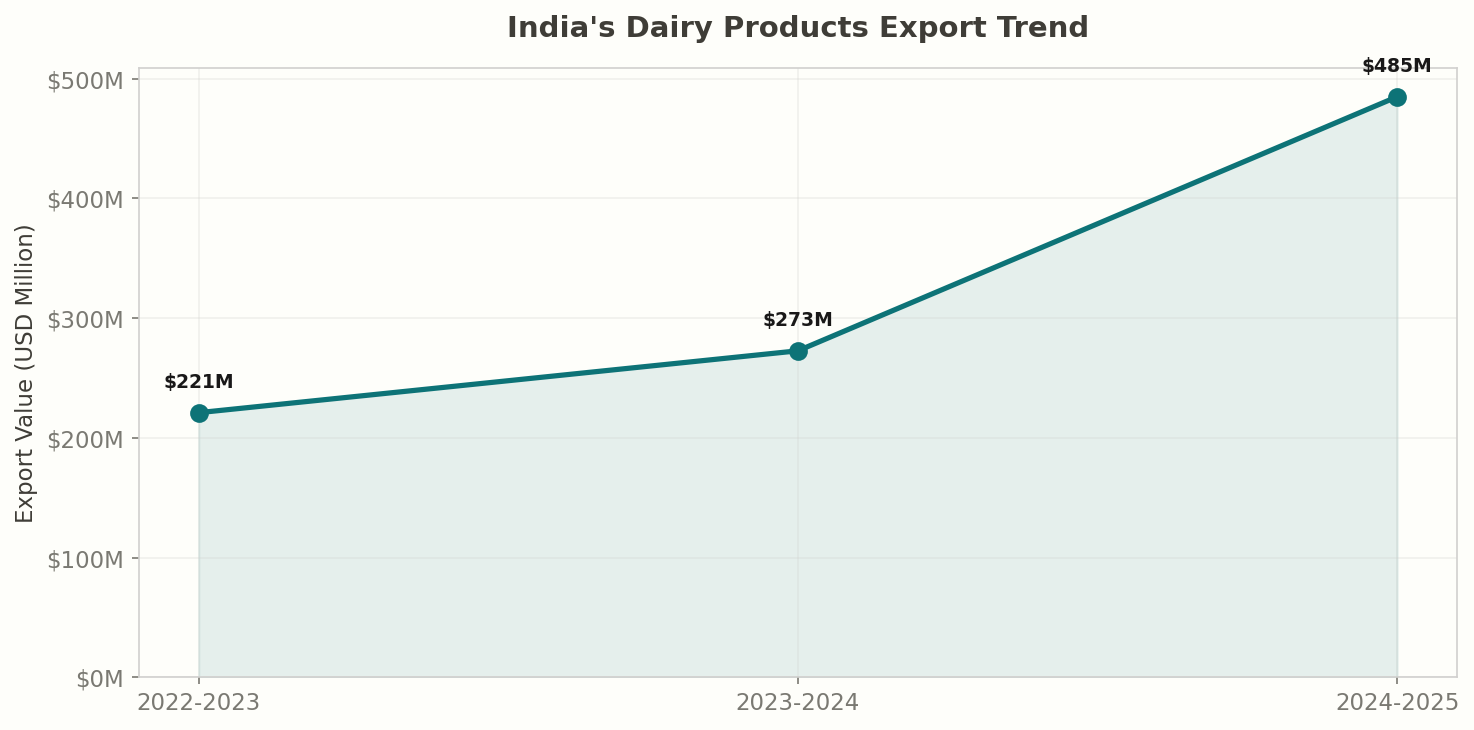
India is the world's largest milk producer, generating over 230 million tonnes annually — yet it has historically been a minor dairy exporter, consuming virtually all its production domestically. That is changing rapidly. India's dairy exports under HS codes 0401-0406 surged to $484.84 million in 2024-25, more than doubling from $221 million in 2022-23 — a 119% increase in just two years.
The story of Indian dairy exports is overwhelmingly a story of butter and ghee. Clarified butter (ghee) alone accounts for 78% of all dairy exports, driven by massive demand from the Middle East, South Asian diaspora communities, and increasingly from health-conscious Western consumers who have embraced ghee as a "superfood." For MSME exporters, dairy products offer strong unit values, growing global demand, and India's unmatched raw material base — but also require strict food safety compliance, cold chain infrastructure, and navigating complex import regulations across markets.
India's Dairy Export Landscape
India exported $484.84 million in dairy products (HS 0401-0406) in 2024-25, a dramatic acceleration from $272.73 million in 2023-24 and $221.07 million in 2022-23:
| HS Code | Product Category | 2024-25 Exports (USD Million) | Share |
|---|---|---|---|
| 0405 | Butter, ghee, and dairy fats | $379.6 | 78.3% |
| 0406 | Cheese and curd | $50.5 | 10.4% |
| 0402 | Milk & cream, concentrated/sweetened | $31.0 | 6.4% |
| 0401 | Milk and cream, not concentrated | $17.2 | 3.6% |
| 0403 | Buttermilk, yogurt, kephir | $4.5 | 0.9% |
| 0404 | Whey and natural milk constituents | $2.1 | 0.4% |
Butter and ghee (HS 0405) at $379.6 million dominates Indian dairy exports. India is the world's largest producer of ghee, and the Middle East — with its large South Asian diaspora and traditional culinary use of ghee — is the primary destination. Cheese and curd (HS 0406) at $50.5 million is the second category, with growing exports of paneer, processed cheese, and curd to diaspora markets.
Where Indian Dairy Products Are in Demand
The Middle East dominates India's dairy export market, with Saudi Arabia, the UAE, Bahrain, and Oman collectively accounting for nearly half of all exports. This demand is driven by the large South Asian diaspora's preference for ghee and paneer, along with traditional Middle Eastern culinary use of clarified butter. The USA is the largest Western market, primarily for ghee — which has gained "superfood" status among health-conscious American consumers — and paneer for the Indian diaspora. Neighbouring countries like Bhutan and Bangladesh provide consistent cross-border dairy trade. North African markets including Egypt and Morocco are emerging buyers for Indian butter and ghee.
Want the full country-by-country breakdown? See exact export values, growth rates, tariff rates, and market attractiveness scores for every destination in our detailed data pages. View Dairy Products export data by country →
Product Categories
Ghee and Butter (78% of exports)
- Clarified butter (ghee) — India's flagship dairy export. Shelf-stable, high-value, culturally significant across Middle East and South Asia
- Anhydrous milk fat (AMF) — Industrial-grade butter oil for food manufacturing
- Table butter — Salted and unsalted, for retail and food service
Cheese and Curd
- Paneer — India's traditional fresh cheese, exported frozen to diaspora markets
- Processed cheese — Slices, spreads, blocks for food service
- Cheddar/Gouda — Growing production capability in India
- Curd/dahi — Shipped frozen or as powdered culture
Milk and Cream
- Skimmed milk powder (SMP) — India's traditional commodity dairy export
- Whole milk powder (WMP) — For reconstitution in destination markets
- UHT milk — Long-shelf-life milk in Tetra Pak packaging
- Condensed milk — Sweetened, for confectionery and consumer use
Specialty and Value-Added
- Flavoured ghee — Garlic, herb-infused (premium retail segment)
- A2 ghee — From indigenous cow breeds (Gir, Sahiwal) — premium positioning
- Organic ghee — Certified organic, commanding 40-80% premium
- Whey protein powder — Growing sports nutrition export segment
HS Code Classification
| 6-Digit Code | Description | Primary Indian Product |
|---|---|---|
| 040510 | Butter, fat content ≤85% | Table butter |
| 040520 | Dairy spreads | Butter-based spreads |
| 040590 | Other fats from milk (ghee, AMF) | Ghee, anhydrous milk fat |
| 040610 | Fresh cheese (unripened) | Paneer, cottage cheese |
| 040630 | Processed cheese | Processed cheese slices, blocks |
| 040690 | Other cheese | Cheddar, Gouda, specialty |
| 040210 | Milk powder, fat ≤1.5% | Skimmed milk powder |
| 040221 | Milk powder, fat >1.5%, unsweetened | Whole milk powder |
| 040110 | Milk, fat ≤1% | Skimmed liquid milk |
| 040120 | Milk, fat 1-6% | Full cream milk |
Classification note: Ghee (clarified butter) is classified under 040590 — "other fats and oils derived from milk." This is distinct from butter (040510). The classification matters because tariff rates differ significantly across markets.
Use the HS Code Finder for accurate classification.
Regulatory Framework
FSSAI (Food Safety and Standards Authority of India)
- FSSAI licence mandatory for all dairy processors and exporters
- FSSAI sets standards for milk quality, fat content, additives, and contaminants
- AGMARK grading optional but preferred for ghee (Special, General, Standard grades)
EIC (Export Inspection Council)
- EIC certification for dairy exports to the EU, USA, and other regulated markets
- EIC-approved dairy processing plants maintain List 1 status for EU market access
- Pre-shipment inspection and sampling
Import Country Requirements
| Market | Key Regulatory Body | Critical Requirements |
|---|---|---|
| Saudi Arabia | SFDA | SFDA registration, halal certification, shelf life >50% remaining |
| UAE | ESMA/municipality | Halal certification, municipality import permit, Arabic labelling |
| USA | FDA | FDA facility registration, FSMA compliance, Prior Notice of import |
| EU | DG SANTE | EU-approved establishment, health certificate, aflatoxin M1 limits |
| Bahrain | NHRA | GCC standards (GSO), halal certification |
Halal Certification — Critical for Middle East
Given that 46% of Indian dairy exports go to the Middle East, halal certification is effectively mandatory:
- Ghee and butter must be certified halal by a recognised certification body (Jamiat Ulama-i-Hind, Halal India, or internationally accredited bodies)
- The halal certificate must confirm: no animal rennet from non-halal slaughter, no pork-derived additives, no alcohol-based flavourings
- Saudi Arabia requires halal certification from an SFDA-approved certifying body
Quality Standards and Certifications
BIS Standards
- IS 3508 — Specification for ghee (grading, fat content, moisture limits)
- IS 13690 — Butter specification
- IS 2785 — Processed cheese specification
- AGMARK — Ghee grading standard (mandatory for domestic, preferred for export)
International Standards
- ISO 22000 — Food Safety Management System
- ISO 9001 — Quality Management System
- HACCP — Hazard Analysis Critical Control Points (required by most importing countries)
- FSSC 22000 — Preferred by EU and US retail buyers
- BRC Global Standard for Food Safety — Required by UK supermarket chains
Quality Parameters for Ghee
| Parameter | Specification | Significance |
|---|---|---|
| Milk fat | ≥99.5% | Core quality measure |
| Moisture | ≤0.5% | Shelf stability |
| Free fatty acid (as oleic) | ≤3.0% | Freshness indicator |
| Peroxide value | ≤3.0 meq/kg | Oxidation indicator |
| Baudouin test | Negative | Absence of vanaspati adulteration |
| BR reading at 40°C | 40.0-43.0 | Purity verification |
| Aflatoxin M1 | ≤0.5 μg/kg (EU: 0.05 μg/kg) | Mycotoxin safety |
Adulteration Testing
Indian ghee exports face scrutiny for:
- Vanaspati (hydrogenated vegetable oil) adulteration — Baudouin test is standard
- Palm oil adulteration — Fatty acid profiling and Reichert-Meissl value
- Aflatoxin M1 — Transfer from contaminated feed to milk to ghee. EU limits (0.05 μg/kg) are extremely strict.
Packaging and Labelling
Ghee Packaging
- Tin containers (500g, 1 kg, 2 kg, 5 kg, 15 kg) — Traditional, still dominant for Middle East exports
- Glass jars (250g, 500g, 1 kg) — Premium retail positioning for US/EU markets
- PET jars — Lighter, lower cost, growing acceptance
- Tetra Pak / aseptic pouches — For liquid butter/ghee
- Bulk packing — 15-20 kg tins or 200 kg drums for food service/industrial
Cheese/Paneer Packaging
- Vacuum-sealed blocks (200g, 500g, 1 kg) — Essential for shelf life
- Modified Atmosphere Packaging (MAP) — For extended shelf life paneer
- IQF (Individually Quick Frozen) paneer cubes — For food service
Labelling Requirements
For all markets:
- Product name, net weight, ingredients list
- Nutritional information panel (format varies by market)
- Manufacturing and expiry dates
- Lot/batch number for traceability
- Storage instructions (temperature for refrigerated items)
- Manufacturer's name and address
- Country of origin ("Product of India")
Market-specific:
- UAE/Saudi Arabia/GCC: Arabic labelling mandatory, halal logo, SFDA/municipality registration number
- USA: FDA Nutrition Facts panel, allergen declaration (milk), FDA establishment registration number
- EU: EU organic logo (if applicable), health mark with EU-approved establishment number, allergen (milk) in bold
Pricing Strategy
| Product | FOB Price Range | Key Markets |
|---|---|---|
| Ghee — standard (per kg) | $5.00-$8.00 | Middle East, South Asia |
| Ghee — A2/organic (per kg) | $10.00-$18.00 | USA, EU, premium retail |
| Table butter (per kg) | $3.50-$6.00 | Middle East, Africa |
| Paneer — frozen (per kg) | $4.00-$7.00 | USA, UK, UAE (diaspora) |
| Processed cheese (per kg) | $3.00-$5.50 | Middle East, Africa |
| Skimmed milk powder (per tonne) | $2,200-$3,200 | Asia, Africa |
| Whole milk powder (per tonne) | $2,800-$3,800 | Asia, Middle East |
| UHT milk (per litre) | $0.60-$1.20 | Neighbouring countries |
The highest margins are in premium A2 ghee and organic ghee for Western markets, where a single 500g jar can retail for $15-$25 in the USA. Commodity products like SMP compete on price with New Zealand, EU, and US dairy surpluses.
Logistics
Shipping
- Refrigerated (reefer) containers for butter, cheese, paneer, liquid milk — maintained at 2-5°C
- Ambient containers for ghee (shelf-stable), milk powder, processed items
- Air freight for fresh paneer and short-shelf-life products
Key Ports
- JNPT Mumbai — Primary for Western India dairy belt (Maharashtra, Gujarat)
- Mundra — For Gujarat dairy cooperative exports (Amul, GCMMF)
- Chennai — For South Indian dairy products
- Kolkata — For eastern India, neighbouring country exports
Transit Times
- JNPT to UAE: 5-7 days
- JNPT to Saudi Arabia: 8-12 days
- JNPT to USA East Coast: 28-35 days
- Mundra to Bahrain: 4-6 days
- Air freight to any destination: 1-3 days
Freight Costs (Indicative)
- 20-ft reefer container to UAE: $1,500-$3,000
- 20-ft reefer container to USA: $3,500-$6,000
- 40-ft ambient container (ghee/SMP) to Middle East: $1,000-$2,500
- Air freight: $3-$8 per kg
Shelf Life
- Ghee (tin/glass, sealed): 9-12 months at ambient temperature
- Butter: 6-9 months at -18°C, 3 months at 2-5°C
- Paneer (frozen): 6 months at -18°C
- SMP: 12-18 months (cool, dry storage)
- UHT milk: 6-9 months (ambient, unopened)
Documentation
- Commercial Invoice
- Packing List
- Bill of Lading / Airway Bill
- Certificate of Origin (CEPA for UAE, GSP for EU)
- Health/Veterinary Certificate (from EIC — mandatory for all dairy exports)
- FSSAI Licence Copy
- Halal Certificate (for Middle East markets)
- Lab Analysis Report (fat content, moisture, adulteration tests, aflatoxin M1, microbiological)
- AGMARK Certificate (for ghee, if applicable)
- SFDA Registration (for Saudi Arabia-bound shipments)
- Phytosanitary Certificate (not required for dairy, but may be needed for blended products)
- Shipping Bill (via ICEGATE)
- Insurance Certificate
Government Incentives
- RoDTEP — 1-3% of FOB value for dairy products
- Duty Drawback — 1-2% on dairy exports
- APEDA support — APEDA provides market development assistance for dairy product exports
- National Dairy Plan — Government investment in dairy infrastructure, cold chain, processing capacity
- Interest Equalisation Scheme — Reduced interest rates on export credit for MSME dairy exporters
- PMMSY integration — Dairy cold chain infrastructure co-funded with fisheries/meat under food processing ministry schemes
Common Mistakes When Exporting Dairy Products
Aflatoxin M1 non-compliance. Aflatoxin M1 transfers from contaminated animal feed to milk. The EU limit (0.05 μg/kg) is 10x stricter than India's domestic standard. Ensure your dairy cooperative or supplier tests milk at procurement. Sourcing from organised dairy cooperatives with feed quality control significantly reduces this risk.
Ignoring halal certification for Middle East. Nearly half of Indian dairy exports go to the GCC. Without halal certification from a recognised body, your shipment will be rejected at customs. Get halal certification before you export — not after your first enquiry.
Ghee adulteration detection at destination. Indian ghee sometimes fails destination-country testing for vanaspati or palm oil adulteration. This damages not just your shipment but India's reputation. Source only from reputable dairy cooperatives (Amul, Nandini, Mother Dairy) or FSSAI-compliant manufacturers with transparent supply chains.
Not meeting SFDA packaging/labelling requirements. Saudi Arabia's SFDA has specific requirements for dairy labelling including Arabic language, halal mark, and remaining shelf life (must be >50% at port of arrival). Products arriving with less than 50% shelf life remaining are rejected.
Cold chain failures for perishable products. Butter, paneer, and liquid milk require unbroken cold chain from factory to destination. A temperature excursion during port handling or transit can spoil the entire container. Use temperature data loggers and reefer containers with GPS monitoring.
Key Takeaways
- India exported $484.84 million in dairy products in 2024-25 — up 119% from $221M in 2022-23
- Ghee/butter (HS 0405) dominates at $379.6M (78% of all dairy exports)
- Saudi Arabia ($75M), UAE ($74M), and Bahrain ($59M) are the top markets — the Middle East accounts for 46%
- The USA ($42.8M) is the fastest-growing market, driven by premium A2/organic ghee demand
- Halal certification is effectively mandatory for the primary export markets
- Aflatoxin M1 compliance is the critical food safety parameter, especially for the EU
- Premium A2 and organic ghee offer the highest margins (FOB $10-$18/kg vs. standard $5-$8/kg)
Next Steps
- Identify your HS code with the HS Code Finder — ghee (040590) vs. butter (040510) vs. cheese (0406) have different tariff implications
- Get FSSAI and EIC approval for your dairy processing facility
- Obtain halal certification from an SFDA-approved certifying body if targeting the Middle East
- Check tariff rates using the Duty Calculator — GCC countries offer preferential rates for Indian dairy
- Invest in aflatoxin M1 testing at NABL-accredited labs for every export lot
- Explore market demand with the Market Finder to identify growing diaspora markets
- Attend Gulfood (Dubai, annually in February) — the world's largest food & beverage trade show, with strong dairy buyer presence
India's dairy export surge from $221M to $485M in two years signals a structural shift. With the world's largest milk production base, growing processing capacity, and insatiable Middle Eastern demand for ghee, Indian dairy exporters are positioned for sustained growth — provided they maintain rigorous food safety standards and invest in halal compliance for their primary markets.
Ready to start exporting?
Get a detailed market report with country-by-country analysis, pricing insights, and buyer contacts.
Get Market ReportXIMPEX Export Advisory
Need help implementing the strategies discussed in this guide? Our team of export specialists can provide personalized guidance for your business.