How to Export Marine Products from India — Complete Guide
India is the world's fourth-largest seafood exporter, shipping $5.30 billion worth of marine products in 2024-25 under HS headings 0306 (crustaceans) and 0307 (molluscs). Frozen shrimp alone accounts for $4.51 billion — 85% of all marine exports — making India the single largest shrimp supplier to the United States. From vannamei shrimp farms in Andhra Pradesh to black tiger prawn trawlers in Gujarat, from Kochi's seafood processing plants to Visakhapatnam's cold chain infrastructure, the marine products sector is a powerhouse of Indian agricultural exports.
For MSME exporters, marine products offer high unit value, strong and growing global demand (driven by health-conscious protein consumption), and robust government support through MPEDA (Marine Products Export Development Authority). The sector provides direct employment to over 14 million people across fishing, aquaculture, processing, and export operations.
India's Marine Export Landscape
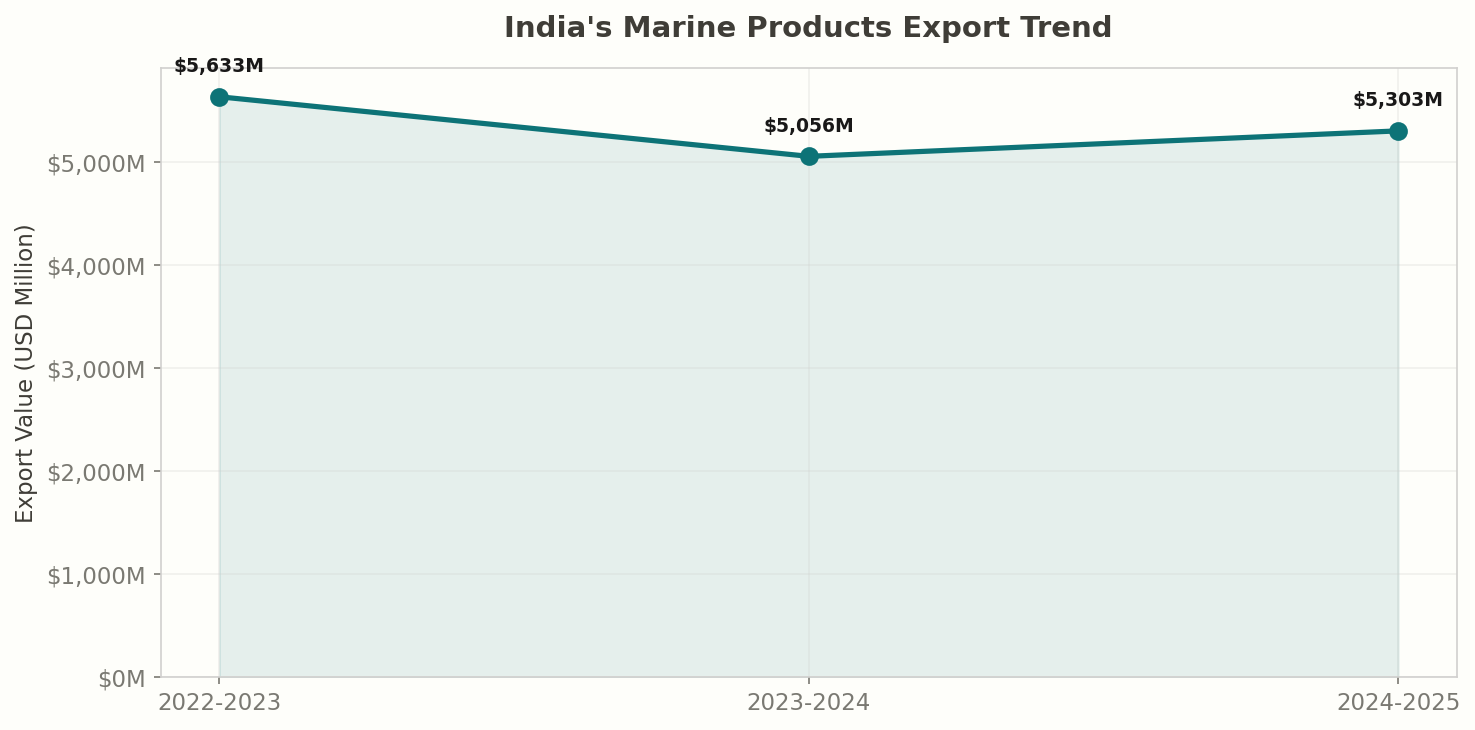
India exported $5.30 billion in crustaceans (HS 0306) and molluscs (HS 0307) in 2024-25, recovering from a dip to $5.06 billion in 2023-24. The sector peaked at $5.63 billion in 2022-23.
| HS Code | Product Category | 2024-25 Exports (USD Million) | Share |
|---|---|---|---|
| 030617 | Frozen shrimp (vannamei, others) | $4,506.7 | 85.0% |
| 030743 | Frozen cuttle fish and squid | $635.3 | 12.0% |
| 030633 | Frozen crab | $49.1 | 0.9% |
| 030636 | Other frozen shrimp | $33.7 | 0.6% |
| 030611 | Frozen rock lobster | $28.5 | 0.5% |
| 030749 | Other frozen molluscs | $10.9 | 0.2% |
Frozen shrimp overwhelmingly dominates at $4.51 billion. India is the world's largest exporter of vannamei shrimp (Litopenaeus vannamei), with Andhra Pradesh alone producing over 70% of India's cultured shrimp. Cuttlefish and squid ($635M) is the second largest category, sourced primarily from capture fisheries.
Where Indian Marine Products Are in Demand
The USA is India's largest seafood export market, driven primarily by shrimp (vannamei and black tiger). Southeast Asian markets — Vietnam, Thailand, Japan, and China — are the second major cluster, with significant volumes of frozen shrimp, cuttlefish, and fish. European markets (particularly Spain, Italy, and the UK) import Indian shrimp, squid, and cuttlefish. The Middle East is a growing market for Indian fish and shrimp. India's marine product export profile is dominated by shrimp, which accounts for over 70% of total seafood export value.
Want the full country-by-country breakdown? See exact export values, growth rates, tariff rates, and market attractiveness scores for every destination in our detailed data pages. View Marine Products export data by country →
Aquaculture vs. Capture Fisheries
Aquaculture (Farmed Seafood)
- Vannamei shrimp — 90%+ of farmed production. Andhra Pradesh (Nellore, West Godavari, East Godavari) is the epicentre. Gujarat and Tamil Nadu are secondary states.
- India produced over 1 million tonnes of vannamei shrimp in 2024-25
- Aquaculture is the growth engine — cultured shrimp production has grown 15-20% annually
Capture Fisheries (Wild-Caught)
- Squid and cuttlefish — Primarily from Gujarat, Tamil Nadu, and Kerala coasts
- Crab — Gujarat, West Bengal, Tamil Nadu
- Lobster — Kerala, Tamil Nadu (seasonal)
- Wild shrimp — Limited compared to farmed, mostly karikkadi and poovalan from Kerala
HS Code Classification
Marine products under HS 03 are classified by species and processing method:
| 6-Digit Code | Description | Primary Indian Product |
|---|---|---|
| 030617 | Other frozen shrimp and prawns | Vannamei, black tiger |
| 030611 | Frozen rock lobster/crawfish | Lobster tails |
| 030614 | Frozen crab | Mud crab, blue swimmer |
| 030633 | Crab, in shell, frozen | Whole crab |
| 030636 | Other shrimp and prawns, frozen | Karikkadi, poovalan |
| 030743 | Squid and cuttlefish, frozen | Squid tubes, cuttlefish whole |
| 030749 | Other molluscs, frozen | Octopus, clams |
Classification considerations: The distinction between "in shell" and "peeled" shrimp, and between "head-on" and "headless," affects the 8-digit Indian tariff line. Value-added forms (breaded shrimp, ready-to-cook preparations) are classified under HS 1605, not 0306.
Use the HS Code Finder for exact classification.
Regulatory Framework
MPEDA Registration
The Marine Products Export Development Authority is the apex body:
- Registration as a seafood exporter/processor with MPEDA is mandatory
- MPEDA issues the RCMC (Registration-cum-Membership Certificate)
- Maintains a list of approved pre-processing and processing plants
- Conducts quality inspections of export consignments
EIC (Export Inspection Council)
- EIC-approved processing plants — Every seafood processing plant must be EIC-approved and carry an EU-equivalent approval number
- Pre-shipment inspection — EIC conducts mandatory inspection of marine product export consignments
- EU List — Plants wanting to export to the EU must be on the EIC-approved EU list (List 1 establishments)
Food Safety Standards
| Requirement | USA (FDA) | EU | Japan |
|---|---|---|---|
| Antibiotic residues | Zero tolerance for unapproved | MRL-based (Regulation 37/2010) | Positive List system |
| Heavy metals | FDA action levels | Regulation 1881/2006 | Japan Food Sanitation Act |
| Sulphite (as SO₂) | ≤100 ppm in raw shrimp | ≤150 ppm (EU) | ≤100 ppm |
| Histamine | 50 ppm (for scombroid fish) | 100-200 mg/kg | Not applicable to shrimp |
| Salmonella | Zero in 25g | Absent in 25g | Absent |
| Listeria | Zero tolerance (RTE) | <100 CFU/g (RTE) | Not specified |
Antibiotic Residue — The #1 Export Risk
Antibiotic residues in farmed shrimp are the most common cause of US FDA import alerts and EU RASFF notifications against Indian seafood. Banned antibiotics include:
- Chloramphenicol — Zero tolerance globally (detection level: 0.3 ppb)
- Nitrofurans (AOZ, AMOZ, AHD, SEM) — Zero tolerance (1 ppb detection)
- Oxytetracycline — Must be below MRL (100 ppb in EU)
- Enrofloxacin — MRL of 100 ppb in EU, zero tolerance for ciprofloxacin
Every lot must be tested at an MPEDA/EIC-approved lab before shipment. A single positive result can lead to import alerts that affect all Indian seafood exporters.
CAA (Coastal Aquaculture Authority)
- CAA registration mandatory for all shrimp farms within the Coastal Regulation Zone
- Regulates farm size, effluent discharge, and stocking density
- Compliance with Aquaculture Practices regulations
Processing and Value Addition
Processing Forms (by value)
| Product Form | FOB Price Range (per kg) | Value Addition |
|---|---|---|
| HOSO (Head-On, Shell-On) frozen | $4-$8 | Lowest |
| HLSO (Headless, Shell-On) frozen | $5-$10 | Low |
| PD (Peeled, Deveined) frozen | $7-$14 | Medium |
| PUD (Peeled, Undeveined) frozen | $6-$12 | Medium |
| Cooked PD | $8-$16 | High |
| Breaded/battered | $6-$12 | Highest (under HS 1605) |
| IQF (Individually Quick Frozen) | Premium of $1-3/kg over block frozen | High |
The value-addition opportunity: Raw HOSO shrimp at $5/kg can become cooked PD shrimp at $12/kg — a 140% price increase. India is increasingly moving towards value-added processing (cooked, breaded, ready-to-eat) to capture more of the retail value chain.
Quality Standards and Certifications
Mandatory
- HACCP (Hazard Analysis Critical Control Points) — Required by virtually all importing countries
- EU Approval Number — Mandatory for exporting to the EU (issued by EIC)
- FDA Registration — Facility must be registered with US FDA for exports to America
- FSSAI Licence — For all food processing and export
Buyer-Required Certifications
- BAP (Best Aquaculture Practices) — Global certification for responsible aquaculture. 2-star, 3-star, and 4-star ratings. Most US retail buyers (Walmart, Costco) now require BAP certification.
- ASC (Aquaculture Stewardship Council) — EU-focused sustainability certification
- MSC (Marine Stewardship Council) — For wild-caught fisheries
- BRC (British Retail Consortium) — Required by UK supermarket chains
- IFS (International Featured Standards) — Required by German/French supermarket chains
- GlobalG.A.P. — Good Agricultural Practice certification for aquaculture farms
Testing Infrastructure and Costs
Pre-shipment lab testing is mandatory for every export lot. Key MPEDA/EIC-approved laboratories include the MPEDA Quality Control Labs in Kochi, Visakhapatnam, Bhubaneswar, and Bhimavaram, the EIC labs in Mumbai, Chennai, and Kolkata, and NABL-accredited private labs such as Eurofins, SGS India, and Intertek. A standard antibiotic residue panel (chloramphenicol, nitrofurans, oxytetracycline, enrofloxacin) costs Rs 3,000-8,000 per sample with a turnaround time of 3-5 working days. Heavy metal analysis (lead, cadmium, mercury, arsenic) costs Rs 2,000-5,000 per sample. Microbiological testing (Salmonella, Listeria, E. coli, total plate count) costs Rs 2,500-6,000. For new exporters, budget Rs 15,000-25,000 per container for comprehensive testing across all parameters. Processing plants exporting to the EU should also invest in in-house rapid screening kits for antibiotics (lateral flow assay kits costing Rs 200-500 per test) to screen incoming raw material at the factory gate before it enters the production line.
Packaging and Cold Chain
Packaging Standards
- Block frozen: Product frozen in blocks (2 kg or 5 lb), packed in poly bags, placed in printed master cartons (10 kg or 20 lb)
- IQF: Individually frozen pieces in poly bags, master cartons
- Net weight accuracy — Zero tolerance for short weight in the USA (USDC inspection) and EU
- Glazing: Ice glazing (5-10%) protects product from dehydration. Must be declared on packaging. Net weight excludes glaze.
Cold Chain Requirements
- Processing plant: -18°C or below for frozen storage
- Transport to port: Reefer trucks maintaining -18°C
- Container: Reefer containers set at -18°C to -25°C
- Temperature monitoring: Data loggers in every container (mandatory for EU imports)
- Any break in cold chain = rejected shipment. Temperature abuse causes drip loss, texture changes, and bacterial growth.
Labelling
- USA: Country of origin, net weight, nutrition facts, allergen declaration (shellfish), processor establishment number, species name (common and scientific)
- EU: Trade name, scientific name, production method (farmed/caught), catch area or country of farming, net weight, best-before date, allergen declaration
- All markets: Lot/batch traceability, storage instructions (-18°C), best-before date
Logistics
Major Seafood Export Ports
- Kochi (Kerala) — India's seafood processing hub
- Visakhapatnam (AP) — Major for Andhra Pradesh shrimp
- Pipavav/Mundra (Gujarat) — For Gujarat-origin products
- Chennai — For Tamil Nadu seafood
- Kolkata — For West Bengal crab and shrimp
Transit Times (Reefer Container)
- Kochi to USA East Coast: 28-35 days
- Visakhapatnam to China: 12-15 days
- Kochi to EU ports: 16-22 days
- Kochi to Japan: 14-18 days
- Any port to UAE: 5-8 days
Freight Costs (Indicative)
- 40-ft reefer container to USA: $4,500-$7,500
- 40-ft reefer to EU: $3,500-$6,000
- 40-ft reefer to Japan: $3,000-$5,000
- Air freight (live lobster/premium products): $5-$10 per kg
Container Capacity
- 40-ft reefer container: 22-25 tonnes of frozen seafood
- 20-ft reefer: 10-12 tonnes
Buyer Finding Strategies
Successful marine product exporters use a combination of channels to find and retain buyers. Attend Seafood Expo Global (Barcelona, April) and Seafood Expo North America (Boston, March) — these are the two largest seafood trade shows globally, attracting thousands of importers, retail buyers, and food service companies. MPEDA organises India Pavilions at both events and subsidises stall costs for registered exporters. The China Fisheries and Seafood Expo (Qingdao, October) is essential for the Asian market. Domestically, India International Seafood Show (IISS, organised by MPEDA biennially) brings international buyers to India. Register on B2B platforms including SeafoodSource, Alibaba, and TradeIndia. Contact Indian embassy commercial sections in your target markets for introductions to local importers and supermarket seafood buyers.
Documentation
- Commercial Invoice
- Packing List
- Bill of Lading (reefer container details, temperature setting)
- Certificate of Origin (CEPA for UAE, GSP for EU)
- Health/Veterinary Certificate (from EIC — mandatory for all seafood exports)
- EU Health Certificate (specific format for EU-bound shipments)
- MPEDA RCMC Certificate
- FSSAI Licence
- Lab Analysis Report (antibiotic residues, heavy metals, microbiological)
- Catch Certificate (for wild-caught — IUU Regulation compliance for EU)
- BAP/ASC Certificate (if applicable)
- Pre-shipment Inspection Certificate (from EIC)
- Shipping Bill (via ICEGATE)
- Insurance Certificate
Government Incentives
- MPEDA Market Development Assistance — Subsidies for trade fair participation, buyer-seller meets, market access initiatives
- RoDTEP — 0.5-2% of FOB value
- Duty Drawback — 1.5-3%
- MPEDA Quality Improvement Programme — Subsidies for processing plant upgrades, lab equipment
- Pradhan Mantri Matsya Sampada Yojana (PMMSY) — Rs 20,050 crore scheme for fisheries infrastructure, cold chain, and aquaculture development
- CAA registration subsidy — Support for small farmers to obtain coastal aquaculture registration
Common Mistakes When Exporting Marine Products
Antibiotic residue in shrimp. The #1 reason for Indian seafood import alerts worldwide. Many aquaculture farmers use antibiotics (chloramphenicol, nitrofurans) during the growing cycle. Implement a strict antibiotic-free protocol — use probiotics and biofloc technology instead. Test every pond harvest before procurement.
Cold chain breaks. A 2-hour break in the cold chain during transport from the processing plant to the port can render the entire container unsaleable. Use reefer trucks with GPS temperature monitoring. Place temperature data loggers inside containers.
Not getting EU List approval. Only EIC-approved "List 1" establishments can export to the EU. Many new processors skip this step and find they cannot access Europe's $700M market. Apply for EU approval early — the audit process takes 3-6 months.
Ignoring IUU (Illegal, Unreported, Unregulated) fishing compliance. The EU requires catch certificates for all wild-caught fish and seafood imports. Without proper catch documentation tracing the product to a legal fishing vessel, EU customs will reject the shipment.
Short-weighting. Deliberate or accidental short weight (undercount or excessive glazing not declared) is taken very seriously, especially in the USA. USDC (US Department of Commerce) inspectors check net weight. Penalties include import bans.
Neglecting traceability documentation. Every shrimp lot should be traceable back to the pond or fishing vessel. Maintain records of farm/vessel ID, harvest date, raw material receipt at the factory, processing batch number, and final product lot code. The EU's traceability requirements under Regulation (EC) 178/2002 require one-step-back, one-step-forward documentation. Without this paper trail, your shipment will be held at EU borders.
Key Takeaways
- India exported $5.30 billion in marine products (HS 0306+0307) in 2024-25
- Frozen shrimp ($4.51B) dominates at 85% — India is the world's #1 shrimp exporter
- USA ($1.99B) is the largest market, followed by China ($817M) and Japan ($296M)
- Antibiotic residue compliance is the single biggest risk — test every lot before shipment
- MPEDA registration, EIC approval, and HACCP certification are mandatory
- BAP and ASC certifications are increasingly required by retail buyers (Walmart, Costco, EU supermarkets)
- Cold chain integrity from farm to destination is non-negotiable
- Value-added products (cooked, PD, IQF) command 50-100% premium over raw forms
Next Steps
- Identify your HS code with the HS Code Finder — classification depends on species and processing form
- Register with MPEDA and get your RCMC
- Get EIC approval for your processing plant — apply for EU List 1 status early
- Check tariff rates using the Duty Calculator — shrimp enters the USA at 0% duty
- Invest in BAP/ASC certification — required by most major retail buyers
- Explore market opportunities with the Market Finder for your specific species and product form
- Attend Seafood Expo Global (Barcelona, annually in April) — the world's largest seafood trade show
India's marine products sector is a $5.3 billion success story built on the back of vannamei shrimp aquaculture. With growing global demand for sustainable protein, Indian seafood exporters are well-positioned — but only if they maintain zero-tolerance standards on antibiotic residues and cold chain integrity.
Ready to start exporting?
Get a detailed market report with country-by-country analysis, pricing insights, and buyer contacts.
Get Market ReportXIMPEX Export Advisory
Need help implementing the strategies discussed in this guide? Our team of export specialists can provide personalized guidance for your business.